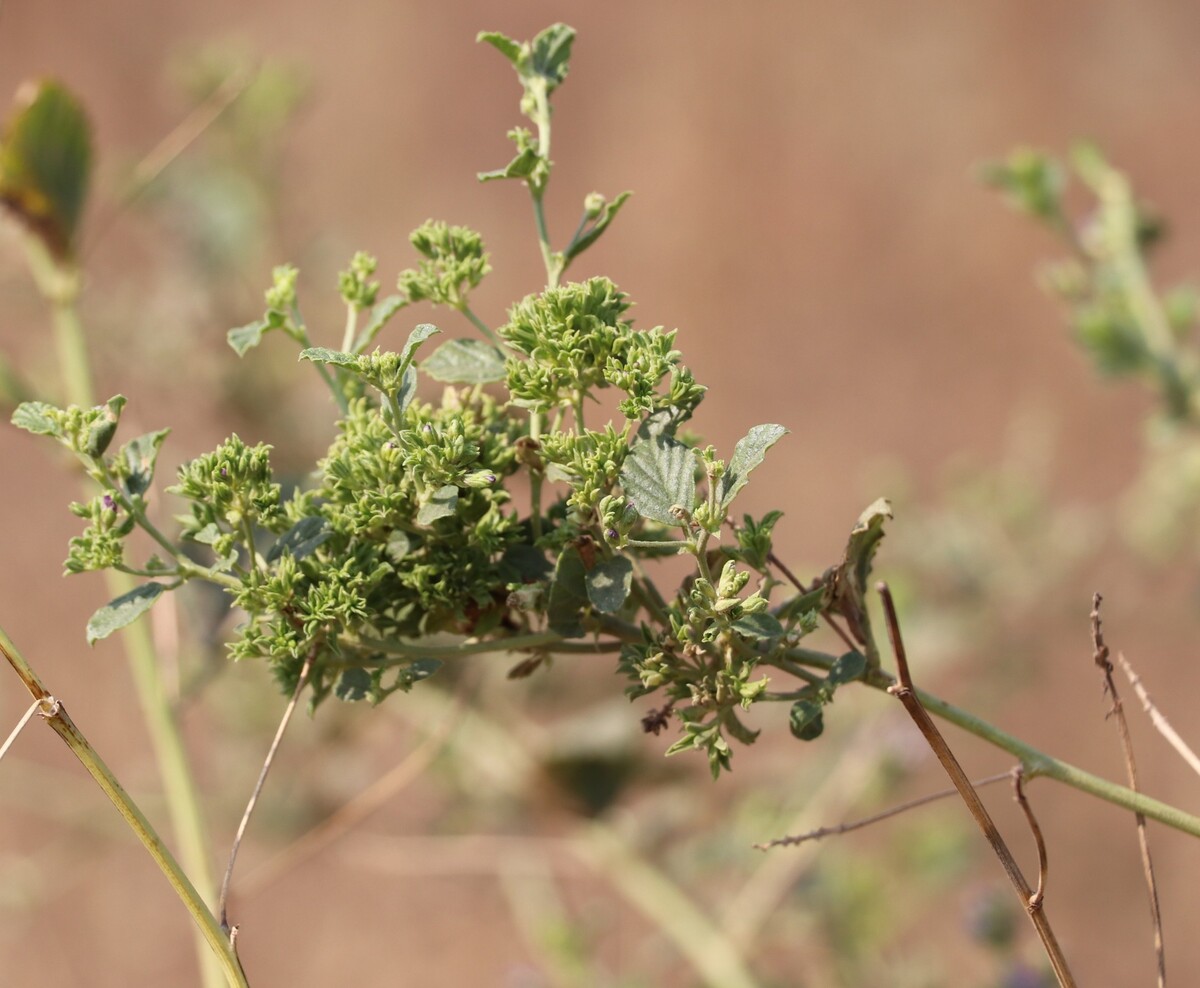
Molecular identification of a ‘Candidatus Phytoplasma trifolii’ (16SrVI-D) strain associated with Scurfy pea (Cullen corylifolium) phyllody and witches’ broom in India
DOI:
https://doi.org/10.24425/jppr.2026.2972Abstract
Scurfy pea (Cullen corylifolium (L.) Medik.) plants exhibiting symptoms of phyllody and witches’ broom indicative of phytoplasma infection were observed in the research field of ICAR – Indian Agricultural Research Institute, Regional Station, Pune (Maharashtra, India). Phytoplasma presence in all symptomatic samples was confirmed through PCR and nested PCR assay using phytoplasma-specific primer pairs P1/P7 and R16F2n/R2. BLASTn analysis revealed that the amplicon sequence shares more than 99% identity with known strains of ‘Candidatus Phytoplasma trifolii’ sequences. Phylogenetic analysis further clustered the sequence of the phytoplasma strain within the ‘Ca. Phytoplasma’ species while virtual RFLP analysis assigned it to the 16SrVI-D subgroup. To the best of our knowledge, this is the first worldwide report of 16SrVI-D phytoplasma associated with phyllody and witches’ broom in C. corylifolium.
References
Backhouse C.N., Delporte C.L., Negrete R.E., Erazo S., Zuniga A., Pinto A., Cassels B.K. 2001. Active constituents isolated from Psoralea glandulosa L. with anti-inflammatory and antipyretic activities. Journal of Ethnopharmacology 78(1): 27–31. DOI: https://doi.org/10.1016/S0378-8741(01)00309-9 DOI: https://doi.org/10.1016/S0378-8741(01)00309-9
Choi S-Y., Lee S., Choi W., Lee Y., Jo Y.O., Ha T-Y. 2010. Isolation and anti-inflammatory activity of bakuchiol from Ulmus davidiana var. japonica. Journal of Medicinal Food 13(4): 1019–1023. DOI: https://doi.org/10.1089/jmf.2009.1207 DOI: https://doi.org/10.1089/jmf.2009.1207
Deng S., Hiruki C. 1991. Amplification of 16S rRNA genes from culturable and nonculturable mollicutes. Journal of Microbiological Methods 14: 53-61. DOI: https://doi.org/10.1016/0167-7012(91)90007-D DOI: https://doi.org/10.1016/0167-7012(91)90007-D
Dutta D.S., Phookan J., Kalita M.K., Nath P.D. 2022. First report of ‘Candidatus Phytoplasma trifolii’ associated with little leaf and floral virescence disease in Solanum violaceum from the North east region of India. Plant Disease 106: 129. DOI: https://doi.org/10.1094/PDIS-07-21-1556-PDN DOI: https://doi.org/10.1094/PDIS-07-21-1556-PDN
Dutta D.S., Kalita M.K., Nath P.D. 2024. First report of Candidatus Phytoplasma trifolii (16SrVI-D) associated with little leaf disease of Nyctanthes arbor-tristis in the world. Journal of Plant Pathology 106: 1403-1404. DOI: https://doi.org/10.1007/s42161-024-01635-x DOI: https://doi.org/10.1007/s42161-024-01635-x
Favali M.A., Musetti R., Benvenuti S., Bianchi A., Pressacco L. 2004. Catharanthus roseus L. plants and explants infected with phytoplasmas: alkaloid production and structural observations. Protoplasma 223:45–51. DOI: https://doi.org/10.1007/s00709-003-0024-4 DOI: https://doi.org/10.1007/s00709-003-0024-4
Gopala, K. E., Rao A., Madhupriya, Rao G.P. 2018. Molecular chracterization of ‘Clover proliferation’ phytoplasma subgroup-D (16SrVI-D) associated with vegetable crops in India. Physiology and Molecular Biology of Plants 24: 203-210. DOI: https://doi.org/10.1007/s12298-017-0499-7 DOI: https://doi.org/10.1007/s12298-017-0499-7
Gundersen D.E., Lee I-M. 1996. Ultrasensitive detection of phytoplasmas by nested-PCR assays using two universal primer sets. Phytopathologia Mediterranea 35:144-151.
Gupta S., Ranebennur H., Singh S.K., Kumar G., Singh V., Yadav J.K., Rao G.P. 2024. First report of ‘Candidatus Phytoplasma trifolii’ related strain causing witches’ broom disease of black cumin (Nigella sativa L.) in India. Physiological and Molecular Plant Pathology 102446. DOI: https://doi.org/10.1016/j.pmpp.2024.102446 DOI: https://doi.org/10.1016/j.pmpp.2024.102446
Jafernik K., Halina E., Ercisli S., Szopa A. 2020. Characteristics of bakuchiol – the compound with high biological activity and the main source of its acquisition – Cullen corylifolium (L.) Medik. Natural Product Research 35 (24): 5828-5842. DOI: https://doi.org/10.1080/14786419.2020.1837813 DOI: https://doi.org/10.1080/14786419.2020.1837813
Kalita M.K., Rao G.P., Madhupriya and Gogoi A.K. 2019. First report of ‘Candidatus Phytoplasma trifolii’ associated with witches’ broom disease of Rauwolfia serpentina from Northeast region of India. Plant Disease 103 (7): 1765. DOI: https://doi.org/10.1094/PDIS-01-19-0150-PDN DOI: https://doi.org/10.1094/PDIS-01-19-0150-PDN
Khushboo P., Jadhav V., Kadam V., Sathe N.S. 2010. Psoralea corylifolia Linn.-"Kushtanashini". Pharmacognosy Reviews 4(7): 69-76. DOI: https://doi.org/10.4103/0973-7847.65331 DOI: https://doi.org/10.4103/0973-7847.65331
Kumar S., Stecher G., Li M., Knyaz C.,Tamura K. 2018. MEGA X: Molecular evolutionary genetics analysis across computing platforms. Molecular Biology and Evolution (35): 1547-1549. DOI: https://doi.org/10.1093/molbev/msy096 DOI: https://doi.org/10.1093/molbev/msy096
Liu R., Li A., Sun A., Kong L. 2004. Preparative isolation and purification of psoralen and isopsoralen from Psoralea corylifolia by high-speed counter-current chromatography. Journal of Chromatography A 1057(1–2):225–228. DOI: https://doi.org/10.1016/j.chroma.2004.09.049 DOI: https://doi.org/10.1016/j.chroma.2004.09.049
Marcone C., Bellardi M.G., Bertaccini A. 2016. Phytoplasma diseases of medicinal and aromatic plants. Journal of Plant Pathology 98 (3): 379-404.
Ohno O., Watabe T., Nakamura K., Kawagoshi M., Uotsu N., Chiba T., Yamada M., Yamaguchi K., Yamada K., Miyamoto K., et al. 2010. Inhibitory effects of bakuchiol, bavachin, and isobavachalcone isolated from Piper longum on melanin production in B16 mouse melanoma cells. Bioscience, Biotechnology and Biochemistry 74(7):1504–1506. DOI: https://doi.org/10.1271/bbb.100221 DOI: https://doi.org/10.1271/bbb.100221
Pandey A.K.,Tripathi N.N. 2011. Aromatic plants of gorakhpur division: Their antimycotic properties and medicinal value. International Journal of Pharmaceutical Sciences Review and Research 7:142–147.
Raghav C.S., Kidwai M.A., Singh B.M., Suneja P., Mohan J., Kumar A., Pareek S.K., Singh M., Somayajulu K.K. 2003. Agronomical and chemical evaluation of babchi (Cullen corylifolia) germplasm. Indian Journal of Agricultural Sciences 73 (10): 567-569.
Rao G.P., Bertaccini A., Fiore N., Liefting L.W. 2018. Phytoplasmas: Plant pathogenic bacteria-I: Characterisation and epidemiology of phytoplasma-associated diseases. Springer. DOI: https://doi.org/10.1007/978-981-13-0119-3 DOI: https://doi.org/10.1007/978-981-13-0119-3
Sah P., Agarwal D., Garg S.P. 2006. Isolation and identification of furocoumarins from the seeds of Psoralea corylifolia L. Indian Journal of Pharmaceutical Sciences 68 (6): 768-771. DOI: https://doi.org/10.4103/0250-474X.31012
Sharma P.C., Yelne M.B., Dennis T.J. 2001. Database on medicinal plants used in ayurveda. Vol. 2. New Delhi: Central Council for Research in Ayurveda and Siddha p. 89-93.
Schneider B., Seemüller E., Smart C.D., Kirkpatrick B.C. 1995. Phylogenetic classification of plant pathogenic mycoplasma-like organisms or phytoplasmas. In: Razin S, Tully JG eds. Molecular and Diagnostic Procedures in Mycoplasmology (New York, USA: Academic Press) 369-380. DOI: http://dx.doi.org/10.1016/B978-012583805-4/50040-6 DOI: https://doi.org/10.1016/B978-012583805-4/50040-6
Thompson J.D., Higgins D.G., Gibson T.J. 1994. CLUSTAL W: improving the sensitivity of progressive multiple sequence alignment through sequence weighting, position-specific gap penalties and weight matrix choice. Nucleic Acids Research (22): 4673-4680. DOI: https://doi.org/10.1093/nar/22.22.4673 DOI: https://doi.org/10.1093/nar/22.22.4673
Tiwari N.N., Jain R.K., Prajapati M.R., Singh J., Srivastava S., Tiwari A.K., Marcone C. 2022. Evidence of mixed infection of phytoplasma and begomovirus associated with Withania somnifera and Capsicum annum plants from Uttar Pradesh, India. Archives of Phytopathology and Plant Protection 55 (18): 2146-2157. DOI: https://doi.org/10.1080/03235408.2022.2156028 DOI: https://doi.org/10.1080/03235408.2022.2156028
Uikey S.K., Yadav A.S., Sharma A.K., Rai A.K., Raghuwanshi D.K., Badkhane Y. 2010. The botany, chemistry, pharmacological and therapeutic application of Psoralea corylifolia L. - a review. International Journal of Phytomedicine 2( 2):100–107. DOI: https://doi.org/10.5138/ijpm.2010.0975.0185.02016
Verma R., Verma A., Tripathi S. 2022a. Molecular identification of a ‘Candidatus Phytoplasma aurantifolia’ strain associated with chickpea phyllody in western India. Phytopathogenic Mollicutes 12(1): 7-13. DOI: https://doi.org/10.5958/2249-4677.2022.00002.0 DOI: https://doi.org/10.5958/2249-4677.2022.00002.0
Verma R., Verma A., Tripathi S. 2022b. Bitter gourd and bottle gourd—new natural hosts of Candidatus Phytoplasma trifolii (16SrVI-D). Australasian Plant Pathology 51: 43-46. https://doi.org/10.1007/s13313-021-00833-w DOI: https://doi.org/10.1007/s13313-021-00833-w
Wang D., Yang G., Engelhardt H., Zhang H. 1999. Micellar electrokinetic capillary chromatography of psoralen and isopsoralen. Electrophoresis 20 (9): 1895-1899. DOI: https://doi.org/10.1002/(SICI)1522-2683(19990701)20:9<1895::AID-ELPS1895>3.0.CO;2-L DOI: https://doi.org/10.1002/(SICI)1522-2683(19990701)20:9<1895::AID-ELPS1895>3.3.CO;2-C
Yao S., Yang B., Xu Z. 1995. Determination of bakuchiol in the fruit of Psoralea corylifolia L. China. Journal of Chinese Materia Medica 20:601–683.
Zamharir M.G., Aldaghi M. 2018. First report of a ‘Candidatus Phytoplasma trifolii’ -related strain associated with soybean bud proliferation and seed pod abortion in Iran. New Disease Reports 37: 15. https://doi.org/10.5197/j.2044-0588.2018.037.015 DOI: https://doi.org/10.5197/j.2044-0588.2018.037.015
Zhao Y., Wei W., Lee I-M., Shao J., Suo X., Davis R.E. 2009. Construction of an interactive online phytoplasma classification tool, iPhyClassifier, and its application in analysis of the peach X-disease phytoplasma group (16SrIII). International Journal of Systematic and Evolutionary Microbiology 59: 2582-2593. DOI: https://doi.org/10.1099/ijs.0.010249-0 DOI: https://doi.org/10.1099/ijs.0.010249-0
Downloads
Published
How to Cite
Issue
Section
License
Copyright (c) 2025 Journal of Plant Protection Research

This work is licensed under a Creative Commons Attribution 4.0 International License.