
Biocontrol Potential of Selected Botanicals and Beauveria bassiana (Bals.) spore suspension Against Bemisia tabaci (Genn.)
DOI:
https://doi.org/10.24425/jppr.2026.158062Abstract
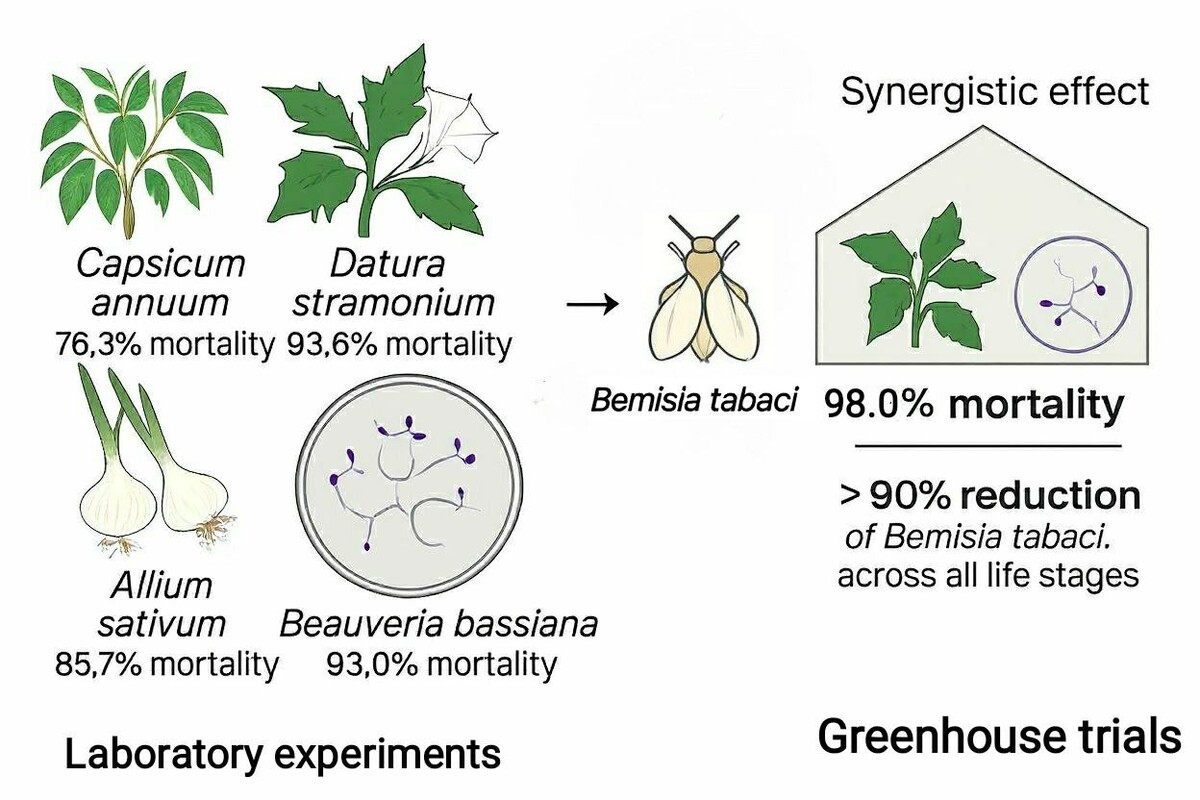
This study aimed to evaluate the effects of plant extracts of Capsicum annuum, Datura stramonium and Allium sativum and the fungus Beauveria bassiana on different developmental stages of Bemisia tabaci.
The D. stramonium extract achieved the most effective adult mortality rate of 92.4% at 4% w/v strength after 96 h of testing, which was higher than A. sativum (85.7%) and C. annuum (76.3%). Isolated extracts of D. stramonium demonstrated maximum lethal activity against the early stages of B. tabaci where the second instar exhibited the highest vulnerability with a mortality rate of up to 97.8%. The pathogenicity of B. bassiana reached its highest level against B. tabaci life stages specifically the second instar nymphs because they demonstrated 93.6% mortality when treated with 1 × 10⁸ conidia/mL. When plant extracts were combined with B. bassiana as treatments they caused elevated mortality rates because all combinations demonstrated synergistic effects with co-toxicity factor (CTF) values > 20. Lethal potency emerged from the combination treatment of D. stramonium (1% w/v) and B. bassiana (1 × 10⁶ conidia/mL) which reached a maximum adult mortality of 98.0% ± 2.1. The results of greenhouse trials showed that the combined treatment generated population reductions above 90% which included adult insects, nymphs, and eggs in a period of 14 days. The research confirms that both botanical extracts and B. bassiana are suitable components for developing sustainable Integrated Pest Management (IPM) programs through their efficient and environmentally friendly insect pest control mechanisms.
References
Bamisile B.S., Akutse K.S., Siddiqui J.A., Xu Y. 2021. Model application of entomopathogenic fungi as alternatives to chemical pesticides: prospects, challenges, and insights for next-generation sustainable agriculture. Frontiers in Plant Science 12: 741804. DOI: https://doi.org/10.3389/FPLS.2021.741804
Campolo O., Giunti G., Laigle M., Michel T., Palmeri V. 2020. Essential oil-based nano-emulsions: Effect of different surfactants, sonication and plant species on physicochemical characteristics. Industrial Crops and Products 157: 112935. DOI: https://doi.org/10.1016/J.INDCROP.2020.112935
Cuthbertson A.G.S., Audsley N. 2016. Further screening of entomopathogenic fungi and nematodes as control agents for Drosophila suzukii. Insects 7 (2): 24. DOI: https://doi.org/10.3390/INSECTS7020024
Dara S.K. 2019. The new integrated pest management paradigm for the modern age. Journal of Integrated Pest Management 10 (1): 12: 1–9. DOI: https://doi.org/10.1093/JIPM/PMZ010
Fiallo-Olivé E., Pan L.-L., Liu S.-S., Navas-Castillo J. 2020. Transmission of Begomoviruses and other whitefly-borne viruses: dependence on the vector species. Phytopathology 110 (1): 10–17. DOI: https://doi.org/10.1094/PHYTO-07-19-0273-FI
Gilbertson R.L., Batuman O., Webster C.G., Adkins S. 2015. Role of the insect supervectors Bemisia tabaci and Frankliniella occidentalis in the emergence and global spread of plant viruses. Annual Review of Virology 2 (1): 67–93. DOI: https://doi.org/10.1146/ANNUREV-VIROLOGY-031413-085410
Guo Z., Sun D., Kang S., Zhou J., Gong L., Qin J., Le G., Zhu L., Yang B., Liang L., Zhang Y. 2019. CRISPR/Cas9-mediated knockout of both the PxABCC2 and PxABCC3 genes confers high-level resistance to Bacillus thuringiensis Cry1Ac toxin in the diamondback moth, Plutella xylostella (L.). Insect Biochemistry and Molecular Biology 107: 31–38. DOI: https://doi.org/10.1016/J.IBMB.2019.01.009
Jafarbeigi F., Samih M.A., Zarabi M., Esmaeily S. 2012. The effect of some herbal extracts and pesticides on the biological parameters of Bemisia Tabaci (genn.) (hem.: Aleyrodidae) pertaining to tomato grown under controlled conditions. Journal of Plant Protection Research. 52 (4): 375–380. DOI: https://doi.org/10.2478/V10045-012-0062-Z
Jaronski S.T., Mascarin G.M. 2017. Mass production of fungal entomopathogens. p. 141–155. In: “Microbial Control of Insect and Mite Pests” (Lawrence A.L., ed.). Academic Press: Cambridge, MA, USA. DOI: https://doi.org/10.1016/B978-0-12-803527-6.00009-3
Jasman A.K., Slomy A.K. 2021. Effect aqueous plant extracts of Mentha longifolia and Anethum graveolens on green peach aphid (Myzus persicae (Sulzer) (Aphididae: Homoptera). Indian Journal of Ecology 48 (Special Issue 13): 272–274.
Kayahan A. 2023. The effects of some essential oils on the life table parameters of green peach aphid Myzus persicae (Sulzer, 1776) (Hemiptera: Aphididae). Turkish Journal of Entomology 47 (4): 373–386. DOI: https://doi.org/10.16970/entoted.1291685
Khalifa M.H., Bedair A.F., 2023. Field Evaluation of some insect growth regulators and plant originated insecticides against sucking-piercing insects on cucumber plant and their side effects on the associated predators. Alexandria Science Exchange Journal 44 (3): 331–338. DOI: https://doi.org/10.21608/asejaiqjsae.2023.310539
Kumari S., Chauhan U., Kumari A., Nadda G. 2017. Comparative toxicities of novel and conventional acaricides against different stages of Tetranychus urticae Koch (Acarina: Tetranychidae). Journal of the Saudi Society of Agricultural Sciences 16 (2): 191–196. DOI: https://doi.org/10.1016/J.JSSAS.2015.06.003
Li Y., Mbata G.N., Punnuri S., Simmons A.M., Shapiro-Ilan D.I. 2021. Bemisia tabaci on vegetables in the southern United States: incidence, impact, and management. Insects 12 (3): 198. DOI: https://doi.org/10.3390/INSECTS12030198
Mansour N.A., Eldefrawi M.E., Toppozada A., Zeid M. 1966. Toxicological studies on the egyptian cotton leaf worm, Prodenia litura. vi. potentiation and antagonism of organophosphorus and carbamate insecticides. Journal of Economic Entomology 59 (2): 307–311. DOI: https://doi.org/10.1093/JEE/59.2.307
Mnayer D., Fabiano-Tixier A.-S., Petitcolas E., Hamieh T., Nehme N., Ferrant C., Fernandez X., Chemat F. 2014. Chemical composition, antibacterial and antioxidant activities of six essentials oils from the Alliaceae family. Molecules 19 (12): 20034–20053. DOI: https://doi.org/10.3390/MOLECULES191220034
Moustafa M.A.M., Ahmed F.S., Alfuhaid N.A., El-Said N.A., Ibrahim E.D., Awad M. 2024. The synergistic effect of lemongrass essential oil and flometoquin, flonicamid, and sulfoxaflor on bemisia tabaci (genn.) (Hemiptera: Aleyrodidae): insights into toxicity, biochemical impact, and molecular docking. Insects 15 (5): 302. DOI: https://doi.org/10.3390/insects15050302
Norris E.J., Bloomquist J.R. 2021. Co-toxicity factor analysis reveals numerous plant essential oils are synergists of natural pyrethrins against Aedes aegypti mosquitoes. Insects 12 (2): 154. DOI: https://doi.org/10.3390/INSECTS12020154
Rehner S.A., Minnis A.M., Sung G., Luangsa-ard J.J., Devotto L., Humber R.A. 2011. Phylogeny and systematics of the anamorphic, entomopathogenic genus Beauveria. Mycologia 103 (5): 1055–1073. DOI: 10.3852/10-302
Ristaino J.B., Anderson P.K., Bebber D.P., Brauman K.A., Cunniffe N.J., Fedoroff N.V., Finegold C., Garrett K.A., Gilligan C.A., Jones C.M., Martin M.D., MacDonald G.K., Neenan P., Records A., Schmale D.G., Tateosian L., Wei Q. 2021. The persistent threat of emerging plant disease pandemics to global food security. Proceedings of the National Academy of Sciences 118 (23) e2022239118. DOI: https://doi.org/10.1073/PNAS.2022239118
Rohimatun M.D., Aisyah R., Molide R., Noveriza R., Mardiningsih T.L. 2024. Evaluation of citronella oil nanoemulsion formulation against the insect-stored pest Callosobruchus maculatus (Fab.) (Coleoptera: Bruchidae). Journal of Plant Protection Research 64 (3): 288–297. DOI: https://doi.org/10.24425/jppr.2024.151256
Sabry A.H., Mohamady A.H., Sleem R.A., Abolmaaty S.M., Helmy R.M. 2023. Role of etofenprox nanoformulation in suppression of the silver whitefly, Bemisia tabaci and its residue in eggplant fruits. Journal of Plant Protection Research 63 (1): 30–38. https://doi.org/10.24425/jppr.2023.144501
Sabzevari S., Hofman J. 2022. A worldwide review of currently used pesticides’ monitoring in agricultural soils. Science of The Total Environment 812: 152344. DOI: https://doi.org/10.1016/j.scitotenv.2021.152344
Sánchez-Quezada V., Velázquez-Guadarrama N., Mendoza-Elizalde S., Hernandez-Iturriaga M., Vázquez Landaverde P., Loarca-Piña G. 2024. Bioaccessibility of bioactive compounds present in Persea americana Mill. seed ingredient during oral-gastric digestion with antibacterial capacity against Helicobacter pylori. Journal of Ethnopharmacology 331: 118259. DOI: https://doi.org/10.1016/j.jep.2024.118259
Sutanto K.D., Nurawan A., Taufik I., Surdianto Y., Sutrisna N., Rizal M., Rahardjo I.B. 2025. Eco-friendly botanical insecticides to control brown leafhoppers and their effects on the predators and aquatic environment. Global Journal of Environmental Science and Management 11 (1): 113–128. DOI: https://doi.org/10.22034/gjesm.2025.01.07
Togbé C.E., Togbé C.E., Haagsma R., Zannou E.T., Gbèhounou G., Déguénon J.M., Vodouhe S.D., Kossou D., van Huis A. 2015. Field evaluation of the efficacy of neem oil (Azadirachta indica A. Juss) and Beauveria bassiana (Bals.) Vuill. in cotton production. Journal of Applied Entomology 139 (3): 217–228. DOI: https://doi.org/10.1111/JEN.12174
Townsend C.C., Guest E. 1985. Flora of Iraq, Monocotyledones, excluding Gramineae. Baghdad: Ministry of Agriculture & Agrarian Reform, Republic of Iraq.
Wakil W., Gulzar S., Wu S., Rasool K.G., Husain M., Aldawood A.S., Toews M.D. 2023. Development of insecticide resistance in field populations of onion thrips, Thrips tabaci (Thysanoptera: Thripidae). Insects 14 (4): 376. DOI: https://doi.org/10.3390/insects14040376
Wang L., Keyhani N.O., Xia Y., Xie J. 2024. The potential and limitations of entomopathogenic fungi as biocontrol agents for insect pest management. Entomologia Generalis 44 (4): 797–811. DOI: https://doi.org/10.1127/entomologia/2024/2498
Downloads
Published
How to Cite
Issue
Section
License
Copyright (c) 2026 Journal of Plant Protection Research

This work is licensed under a Creative Commons Attribution 4.0 International License.