Andrii Kashuba1*
Bohdan Andriyevsky2
Hryhorii Ilchuk1
Ihor Semkiv1
Ludmila Andriyevska3
Iryna Moroz1
Received 03 Oct. 2024
Received in revised form 16 Dec. 2024
Accepted 22 Dec. 2024
Available on-line 04 Feb. 2025
Keywords: thin film; optical transmission; band gap; bowing parameter; spin-orbit splitting.
CdSe1-xSx (x = 0, 0.3, 0.4, 0.6, and 1) thin films were deposited on a quartz and silicon substrate using high-frequency magnetron sputtering. X-ray diffraction analysis estimated that the CdSe1-xSx thin films are crystallized in a hexagonal structure [structure type – ZnO, space group P63 mc (No. 186)]. Spectral dependence of the optical transmittance between 300 and 1500 nm of the obtained thin films at room temperature was measured. Normalized integral optical transmittance, optical band gap, spin-orbit splitting, and the value of the bowing parameter of the CdSe1-xSx thin films are determined. The values of the optical band gaps for CdSe1-xSx thin films were estimated using the two methods (by Tauc plot and dT/dλ). Concentration dependences of the energy gaps connected with the leading optical transitions in CdSe1-xSx (Г8 v–Г6 c,Г7 v–Г6 c) and spin-orbit splitting are studied. It is shown that the concentration dependences of main optical transitions are quadratic. The principal explanation for this seems to be the Burstein–Moss effect, which is caused by the doping atoms' excess carriers (electrons and holes).
One of the perspective materials used for application in solar cells are cadmium chalcogenides (CdTe, CdSe, and CdS) thin films [1–3]. Usually, solar cells are constructed in a ‘sandwich’ form [4]. Such forms have active elements as transparent front contact, light-absorbing layer, window layer, and back contact [4]. Usually, for the light-absorbing layer cadmium telluride is used and for the window layer – cadmium sulfide (CdS/CdTe heterojunctions) [3]. As is well known, CdTe was crystallized in a cubic crystal structure [5] and CdS in a hexagonal one [6]. Lattice incoherence between CdTe and CdS layers can cause a photocurrent occurrence, negatively affecting the work of the solar cell. The formation of CdTe-CdS solid solutions between these layers reduces the lattice incoherence, but a high defect density causes a loss of efficiency [7]. CdSe can be an alternative solution to the problems originating from the CdTe/CdS junction [8, 9]. Using the cadmium selenide in solar cells can enhance the short circuit current density (Jsc ) [10–14], but the open circuit voltage (VOC) and fill factor (FF) decrease [10–12]. Using a CdS/CdSe as a window layer can enhance Jsc and maintain VOC, thus improving device efficiency [10]. As a result, the optical and energy parameters of the CdSe1-xSx thin films still need to be studied.
Previously, the authors reported on the synthesis and crystal structure of the CdSe1-xSx thin film using the highfrequency (HF) magnetron sputtering method [15]. Here, the authors present the results of the experimental estimate of the leading optical properties of CdSe1-xSx thin films deposited by HF magnetron sputtering.
CdSe1-xSx (x = 0, 0.3, 0.4, 0.6, and 1) thin films were deposited on quartz and silicon substrates (16 × 8 × 1.1 mm3 ) by the HF magnetron sputtering (13.6 МHz) using a VUP- 5M vacuum station (Selmi, Ukraine). Details of the thinfilm deposition condition and crystal structure were reported in [15] and some data from these measurements are listed in the Supplementary file. The spectral dependence of the optical transmittance of the obtained samples in the visible and near-infrared regions is studied at room temperature using a Shimadzu UV-3600 spectrometer.
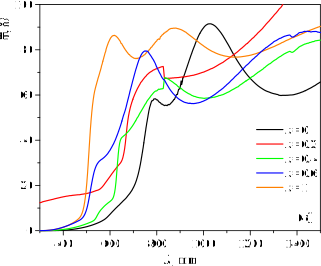
The spectral behaviour of the optical transmission of the CdSe1-xSx thin-film-substrate (quartz) system is shown in Fig. 1(a). A sharp increase in the transmission coefficient in the range of wavelengths from ~ 480 nm (x = 1) to ~ 760 nm (x = 0) can be observed. This growth is characteristic of the edge of fundamental absorption. Additionally, the optical spectra are highly influenced by the film structure, which is, in turn, shaped by the preparation method, film thickness, and deposition conditions. The transmission spectra of the thin films display periodic peaks due to interference effects. This highlights the high structural quality of the thin films.
The normalized integrated transmission was calculated by (1):
\( T_{\mathrm{aver}}=\frac{1}{b-a} \int_a^b T \cdot d \lambda \) (1)
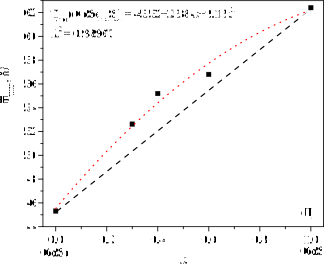
where Taver is the average transmission [see Fig. 1(b)]. The concentration dependence of the integral transmission value is described by a parabolic dependence with an upward deviation from the linear one.
Various methods were employed to determine the optical band gaps of the semiconductor films. One is the Tauc method [see Fig. 2(a)]. This method is based on a dependence of (α · hv)2 = f (hv) [16]. Additionally, the optical band gap energy can be determined from the maximum position in the transmittance first derivative (dT/dλ). The estimated band gap values of the studied CdTe1-xSex thin films obtained by the two above-mentioned methods show a good correlation (see Table 1).
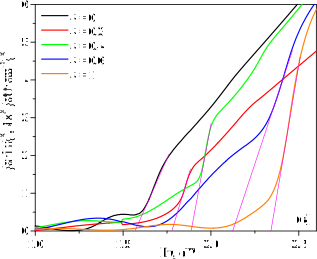
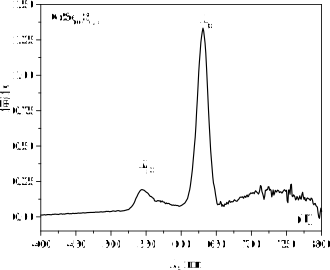
From Fig. 2(a), the value of the direct zone-zone optical transition ( Eg dir) was determined, and it is denoted as: Г8 v–Г6c ( Eg) [17, 18]. It should be noted that the spectra of the absorption coefficient in Tauc coordinates [see Fig. 2(a)] show a break in linear behaviour at energies higher than Eg. This can be attributed to another optical transition, which corresponds to Г7 v–Г6 с ( Eg2) [17, 18]. To confirm this assumption, the method of the first derivative of optical transmission spectra was used [see Fig. 2(b)]. From the example shown in Fig. 2(b), an intense peak that corresponds to the Eg, and a second one, less intense one that corresponds to the optical Eg2 can be observed. From the established optical transitions Eg and Eg2, it is easy to establish the amount of spin-orbit splitting (ESO = Eg2 − Eg). The values of the optical band gaps and spin-orbit splitting are listed in Table 1.
Table 1.
Energy properties of CdSe1-xSx thin films obtained by HF magnetron sputtering.
x |
Eg,eV(Tauc) |
Eg,eV(dT/dλ) |
Eg2eV(dT/dλ) |
ESO,eV |
0 |
1.60 ± 0.07 |
1.66 ± 0.10 |
2.04 ± 0.20 |
0.38 ± 0.02 |
0.3 |
1.77 ± 0.07 |
1.85 ± 0.11 |
2.14 ± 0.21 |
0.29 ± 0.02 |
0.4 |
1.89 ± 0.08 |
1.96 ± 0.12 |
2.28 ± 0.22 |
0.32 ± 0.02 |
0.6 |
2.17 ± 0.09 |
2.3 ± 0.14 |
2.46 ± 0.24 |
0.16 ± 0.01 |
1 |
2.34 ± 0.10 |
2.43 ± 0.15 |
2.48 ± 0.24 |
0.05 ± 0.003 |
Correlation analysis of the value of spin-orbit splitting with known literature data for a single crystal (see Table 2) indicates a decrease in the ESO value when going from a single crystal sample (3D) to a thin film (2D). It can be assumed that this effect is associated with a decrease in the dispersion of energy levels in the thin film [18].
Table 2.
Comparative analysis of the value of spin-orbit splitting ESO for CdSe1-xSx thin films.
x |
ESO for thin films from optical spectra P63mc |
x, |
ESO for thin films from DFT calculation P63mc |
x, |
ESO forthin films from optical spectra F-43m |
x, |
ESO for single crystal from optical spectra P63mc |
0 |
0.38 ± 0.02 |
0 |
0.29 |
0 |
0.30 |
0 |
0.42 |
0.3 |
0.29 ± 0.02 |
0.25 |
0.31 |
0.17 |
0.21 |
0.1 |
0.35 |
0.4 |
0.32 ± 0.02 |
0.50 |
0.29 |
0.35 |
0.21 |
0.4 |
0.31 |
0.6 |
0.16 ± 0.01 |
0.75 |
0.28 |
0.64 |
0.09 |
0.6 |
0.23 |
1 |
0.05 ± 0.003 |
1.00 |
0.28 |
1.00 |
– |
1 |
0.07 |
The concentration dependences of the optical transitions Eg, Eg2, and the value of ESO are presented in Fig. 3. These dependences are not linear, being rather described by quadratic functions [see the legends of Fig. 3 and (2)]. Deviation from linear dependence is a well-known phenomenon commonly observed in ternary alloy thin films. The main reason is the difference in lattice constants between the “parent” and their substitute atoms [17, 18].
\( E(x)=x \cdot E_{\mathrm{CdS}}+(1-x) \cdot E_{\mathrm{CdS}}-\delta \cdot x \cdot(1-x) \) (2)
where δ is the bowing parameter. This bowing parameter can be decomposed into components [17, 18, 21]:
\( \delta=\delta_{\mathrm{VD}}+\delta_{\mathrm{CE}}+\delta_{\mathrm{SR}} \) (3)
The value of the bowing parameter and its comparative analysis are given in Table 3. Attention should be paid to the sign of the bowing parameter, which is negative (δ < 0). Similar behaviour of the bowing parameter was obtained for other solid solutions [22, 23]. The negative value of the bowing parameter means that the electron, excited from the valence band to the conduction band, should obtain a higher energy value than the band gap value. The manifestation of the Burstein can explain this phenomenon – Moss effect [24] which is associated with an excess of carriers (electrons and holes), which may originate from structural defects. These excess carriers lead to an increase in the band gap Eg.
Table 3.
Comparative analysis of the value of bowing parameter for CdSe1-xSx thin films.
Sample |
Crystal structure |
Method or Ref. |
δ forv с Eg (Г8 –Г6 ) |
δ forv с Eg2( Г7 v –Г6 c ) |
Thin film |
P63mc |
Tauc |
−0.14 |
– |
|
|
dT/dλ |
−0.24 |
−0.33 |
|
|
GGA+PBEsol |
0.13 |
0.12 |
Nanoparticle |
P63mc |
[19] |
0.54 |
– |
Thin film |
F-43m |
[17] |
0.079 |
0.101 |
Crystal |
F-43m |
[25] |
0.53, 0.54 |
– |
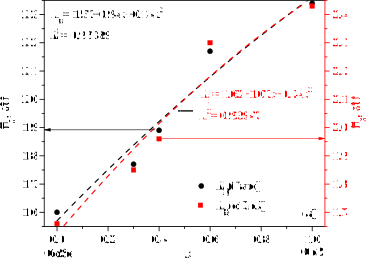
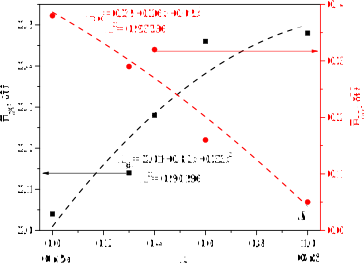
For a more detailed analysis of the nature of deviation of the optical transitions Eg, Eg2 from a linear dependence, the components of the bowing parameter should be determined. According to the method described in [21, 26], the parameters δVD, δCE, and δSR can be determined by (4)– (6), respectively:
\( \delta_{\mathrm{VD}}=\frac{E_{\mathrm{CdS}}^*-E_{\mathrm{CdS}}}{1-x}+\frac{E_{\mathrm{CdSe}}^*-E_{\mathrm{CdSe}}}{x} \) (4)
\( \\delta_{\mathrm{CE}}=\frac{E_{\mathrm{CdS}}}{1-x}+\frac{E_{\mathrm{CdSe}^2}}{x}-\frac{E_{\mathrm{CdSe}_1-x \mathrm{~S}_x}}{x(1-x)} \) (5)
\( \delta_{\mathrm{SR}}=\frac{E_{\mathrm{CdS}_{\mathrm{e}-x} \mathrm{~S}_x}-E_{\mathrm{CdS}_{\mathrm{e}_1-x} \mathrm{~S}_x}}{x(1-x)} \) (6)
In (4)–(6), the top symbol (*) means the equilibrium energy of the alloy with the composition index x (the related data are indicated in the legends of Fig. 3). The determined values of the components of bowing parameter are given in Table 4.
Table 4.
Components of the bowing parameter for CdSe1-xSx thin films.
δ |
Optical transition |
CdSe0.7S0.3 |
CdSe0.6S0.4 |
CdSe0.4S0.6 |
δVD |
Eg, eV (Tauc) |
−0.057 ± 0.002 |
−0.025 ± 0.001 |
0.025 ± 0.001 |
|
Eg, eV (dT/dλ) |
−0.105 ± 0.006 |
−0.067 ± 0.004 |
−0.017 ± 0.001 |
|
Eg2, eV (dT/dλ) |
−0.071 ± 0.007 |
−0.042 ± 0.004 |
−(3.7 ± 0.2) 10−16 |
δCE |
Eg, eV (Tauc) |
0.248 ± 0.010 |
0.025 ± 0.001 |
−0.525 ± 0.022 |
|
Eg, eV (dT/dλ) |
0.195 ± 0.012 |
0.033 ± 0.002 |
−0.742 ± 0.045 |
|
Eg2, eV (dT/dλ) |
0.153 ± 0.015 |
−0.267 ± 0.026 |
−0.650 ± 0.064 |
δSR |
Eg, eV (Tauc) |
−0.331 ± 0.014 |
−0.140 ± 0.006 |
0.360 ± 0.015 |
|
Eg, eV (dT/dλ) |
−0.331 ± 0.020 |
−0.207 ± 0.013 |
0.518 ± 0.031 |
|
Eg2, eV (dT/dλ) |
−0.411 ± 0.040 |
−0.022 ± 0.002 |
0.320 ± 0.031 |
Having obtained the components of the bowing parameter (see Table 4), it can be observed that a minor contribution to the bowing parameter is made by the component associated with the deflection due to the volume deformation effect ( δVD). On the other hand, for CdSe0.7S0.3 and CdSe0.6S0.4 (x < 0.5) thin films, the determined contribution to the bowing parameter is the deflection coefficient which describes the change in the band gap upon relaxation of the ion positions in the solid solution lattice (δSR). However, in the CdSe0.4S0.6 thin film (x > 0.5), the bowing parameter is associated with the charge redistribution between different bonds in the disordered solid solution.
CdSe1-xSx thin films have attracted significant interest in recent years [27–31]. Based on the information in [27–31], the authors can assume that the presented research results may have applications in photovoltaics. Specifically, these solid solutions of CdSe1-xSx can form at the interface between the optical “window” (CdS or CdSe1-xSx [27]) and the absorbing layer (CdTe or CdSe1-xTex [27]). Reference [32] reports the highest efficiencies of the (CdSe, CdTe)-junction solar cells at 26.55 % and 23.69 %, respectively. To achieve higher solar cell efficiency, one can choose compounds ( CdSe1-xSx, CdSe1-xTex)-crystalline alloy junction solar cells instead of (CdSe, CdTe)-junction solar cells [27]. In particular, Reference [27] demonstrates that the maximal efficiencies (34.375 % (33.72 %)) were obtained in CdSe1-xSx, CdSe1-xTex-crystalline alloy junction solar cells at 300 K.
Optical spectra of the CdSe1-xSx thin films deposited by HF magnetron sputtering were studied, as well as quartz and silicon were used as substrates for deposition films. The composition ratios of the thin films were established using the X-ray fluorescence spectroscopy (XRF) method (CdSe0.7Se0.3, CdSe0.6Se0.3, and CdTe0.4S0.36). X-ray diffraction (XRD) analysis estimated that the CdSe1-xSx thin films are crystallized in a hexagonal structure. The spectral dependence of the optical transmittance between 300 and 1500 nm of the CdSe0.7Se0.3, CdSe0.6Se0.3 and CdTe0.4S0.36 thin films at room temperature was measured.
The energy dependence of the optical absorption in the (α · hv)2 = f(hv) coordinate demonstrates the presence of the fundamental absorption edge with the band gap of a direct type for all studies of thin films. The values of the optical band gaps for CdSe1-xSx (x = 0 − 1) thin films were also estimated using the dT/dλ. Both methods of the band gap estimation indicate good correlation and show an increase of the band gap with increasing of sulphur content in the thin films studied. An increasing character of the band gap dependence on the sulphur content Eg(x) was found in the optical studies. The value of spin-orbital splitting for CdSe1-xSx thin films was calculated based on the main optical energy transitions. A small deviation from the Vegard’s law with bowing has been observed for the main optical transitions (Г8 v–Г6 c,Г7 v–Г6 c) and spin-orbital splitting. This deviation is mainly due to the relaxation of the ion positions in the solid solution lattice (δSR) for x < 0.5, and to the charge redistribution between different bonds in the disordered solid solution (δCE) for x > 0.5.
This research was supported by the National research foundation of Ukraine (project no. 2022.01/0163).
Poplawsky, J. D. et al. Structural and compositional dependence of the CdTexSe1-x alloy layer photoactivity in CdTe-based solar cells. Nat. Commun. 7, 12537 (2016). https://doi.org/10.1038/ncomms12537
Bosio, A., Romeo, N., Mazzamuto, S. & Canevari, V. Polycrystalline CdTe thin films for photovoltaic applications. Prog. Cryst. Growth Charact. Mater. 52, 247–279 (2006). https://doi.org/10.1016/j.pcrysgrow.2006.09.001
Petrus, R. Yu. et al. Optical properties of materials for solar energy based on cadmium chalcogenides thin films. Phys. Chem. Solid State 20, 367–371 (2019).https://doi.org/10.15330/pcss.20.4.367-371
Romeo, N., Bosio, A., Mazzamuto, S., Romeo, A. & Vaillant-Roca,L. High Efficiency CdTe/CdS Thin Film Solar Cells with A Novel Back-Contact. in 22nd European Photovoltaic Solar Energy Conference 1919–1921 (EU PVSEC, 2007).
Kamel, N. S., Aadim, K. A. & Kadhim, A. Study of the characterizationn of CdTe thin films prepared by the pulsed laser deposition technique with different laser energies. Adv. Nat. Sci: Nanosci. Nanotechnol. 14, 025015 (2023). https://doi.org/10.1088/2043-6262/acd683
Wang, D., Li, X. & Qin, G. Relaxation effects on the structural and piezoelectric properties of wurtzite ZnS and CdS thin films under in- plane strain. Microelectron. Eng. 286, 112131 (2024). https://doi.org/10.1016/j.mee.2023.112131
Dumre, B. B. et al. Improved optoelectronic properties in CdSexTe1- x through controlled composition and short-range order. Sol. Energy 194, 742–750 (2019). https://doi.org/10.1016/j.solener.2019.10.091
Kashuba, A. I. et al. Growth, crystal structure and theoretical studies of energy and optical properties of CdTe1-xSex thin films. Appl. Nanosci. 12, 335–342 (2022). https://doi.org/10.1007/s13204-020-01635-0
Kashuba, A. I. & Andriyevsky, B. Growth and crystal structure of CdTe1–xSex (x ≥ 0.75) thin films prepared by the method of high- frequency magnetron sputtering. Low Temp. Phys. 50, 29–33 (2024). https://doi.org/10.1063/10.0023888
Li, C. et al. Properties of CdSe1-xSx films by magnetron sputtering and their role in CdTe solar cells. J. Mater. Sci.: Mater. Electron. 31, 21455–21466 (2020). https://doi.org/10.1007/s10854-020-04659-y
Paudel, N. R. & Yan, Y. Enhancing the photo-currents of CdTe thin- film solar cells in both short and long wavelength regions. Appl.Phys. Lett. 105, 183510 (2014). https://doi.org/10.1063/1.4901532
Baines, T. et al. Incorporation of CdSe layers into CdTe thin film solar cells. Sol. Energy Mater. Sol. Cells. 180, 196–204 (2018). https://doi.org/10.1016/j.solmat.2018.03.010
Bao, Z. et al. The study of CdSe thin film prepared by pulsed laser deposition for CdSe/CdTe solar cell. J. Mater. Sci.: Mater. Electron. 27, 7233–7239 (2016). https://doi.org/10.1007/s10854-016-4689-9
Bao, Z. et al. Synthesis and characterization of novel oxygenated CdSe window layer for CdTe thin film solar cells. Mater. Sci. Semicond. Process. 63, 12–17 (2017). https://doi.org/10.1016/j.mssp.2017.01.003
Kashuba, A., Semkiv, I., Andriyevsky, B., Ilchuk, H. & Pokladok,N. Structural and morphological properties of CdSe1-xSx thin films obtained by the method of high-frequency magnetron sputtering. Phys. Chem. Solid State 25, 40–44 (2024). https://doi.org/10.15330/pcss.25.1.40-44
Tauc, J. Optical properties and electronic structure of amorphous Ge and Si. Mater. Res. Bull. 3, 37–46 (1968). https://doi.org/10.1016/0025-5408(68)90023-8
Zuala, L. & Agarwal, P. Effect of Se concentration on mixed phonon modes and spin orbit splitting in thermally evaporated CdSxSe1-x (0 ≤ x ≤ 1) films using CdS–CdSe nano-composites. Mater. Chem. Phys. 162, 813–821 (2015). https://doi.org/10.1016/j.matchemphys.2015.07.008
Kashuba, A. I. et al. Concentration dependences of electronic band structure of CdSe1-xSx thin films. Appl. Nanosci. 13, 4761–4770 (2023). https://doi.org/10.1007/s13204-022-02613-4
Murphy, M. W. et al. Electronic structure and optical properties of CdSxSe1-x solid solution nanostructures from X-ray absorption near edge structure, X-ray excited optical luminescence, and density functional theory investigations. J. Appl. Phys. 166, 193709 (2014). https://doi.org/10.1063/1.4902390
Pedrotti, F. L. & Reynolds, D. C. Spin-orbit splitting in CdS:Se single crystals. Phys. Rev. 127, 1584–1586 (1962). https://doi.org/10.1103/PhysRev.127.1584
Ameri, M. et al. Structural and electronic properties calculations of BexZn1-xSe alloy. Mater. Sci. Semicond. Process. 10, 6–13 (2007). https://doi.org/10.1016/j.mssp.2007.01.003
Kim, K., Hart, G. L. W. & Zunger, A. Negative band gap bowing in epitaxial InAs/GaAs alloys and predicted band offsets of the strained binaries and alloys on various substrates. Appl. Phys. Lett. 80, 3105– 3107 (2002). https://doi.org/10.1063/1.1470693
Singh, S. D. Determination of the optical gap bowing parameter for ternary Ni1-xZnxO cubic rocksalt solid solutions. Dalton Trans. 44, 14793–14798 (2015). https://doi.org/10.1039/C5DT02283E
Grundmann, M. The Physics of Semiconductors. An Introduction Including Devices and Nanophysics. (Springer, 2006). https://doi.org/10.1007/3-540-34661-9
Hernandez-Calderon, I. Optical Properties and Electronic Structure of Wide Band Gap II–VI Semiconductors. in II-VI Semiconductor Materials and their Applications (Ed. Tamargo, M. C) 145 (Taylor and Francis, 2002).
Bernard, J. E. & Zunger, A. Electronic structure of ZnS, ZnSe, ZnTe, and their pseudobinary alloys. Phys. Rev. B 36, 3199–3228 (1987). https://doi.org/10.1103/PhysRevB.36.3199
Van Cong, H. 34.375% (33.72%)-maximal efficiencies, obtained in CdSe1-xSx, CdSe1-xTex-crystalline alloy junction solar cells at 300 K. Eur. J. Appl. Sci. Eng. Technol. 2, 150–174 (2024). https://doi.org/10.59324/ejaset.2024.2(2).11
Zafar, M. et al. Ab initio study of structural, electronic and elastic properties of CdSe1−xSx semiconductor. Sol. Energy 158, 63–70 (2017). https://doi.org/10.1016/j.solener.2017.09.034
Lau, P. C., Zhu, Z., Norwood, R. A., Mansuripur, M. & Peyghambarian, N. Thermally robust and blinking suppressed core/graded-shell Cd e/Cd e1−x x/Cd ‘giant’ multishell semi- conductor nanocrystals. Nanotechnology 24, 475705 (2013). https://doi.org/10.1088/0957-4484/24/47/475705
Junda, M. M. et al. Optical Properties of CdSe1−xSx and CdSe1−yTey Alloys and Their Application for CdTe Photovoltaics. in 2017 IEEE 44th Photovoltaic Specialist Conference (PVSC) 3426–3429 (IEEE, 2017). https://doi.org/10.1109/PVSC.2017.8366483
Almohammedi, A., Ashour, A. & Shaaban, E. R. Structural and optical investigations of chalcogenide CdSe1-xSx thin films for optoelectronic applications. Chalcogenide Lett. 16, 113–122 (2019). https://chalcogen.ro/113_AlmohammediA.pdf
Van Cong, H. (14.82 %, 12.16 %, 26.55 %, or 23.69 %)-limiting highest efficiencies, respectively in n+(p+)−p(n) crystalline (X≡Ge,GaSb,CdTe, or CdSe)-junction solar cells, due to the effects of impurity size, temperature, heavy doping, and photovoltaic conversion. SCIREA J. Phys. 8, 575–595 (2023). https://doi.org/10.54647/physics140591