
Integrated genomic, mechanistic, and transcriptomic analysis of new Bacillus thuringiensis strains for enhanced biocontrol of agricultural pests
DOI:
https://doi.org/10.24425/jppr.2026.2970Abstract
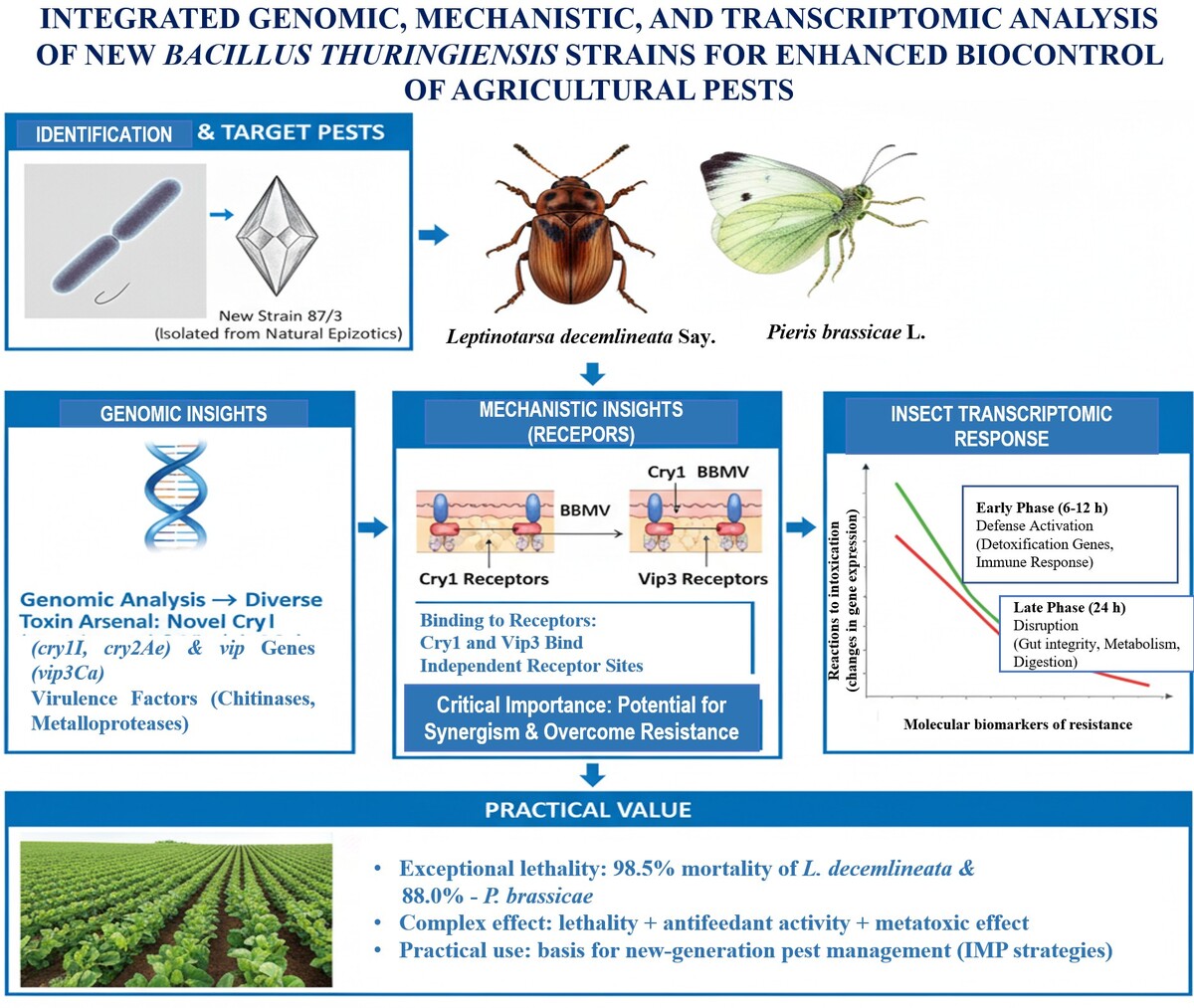
Global agricultural systems face increasing challenges due to climate change and the evolution of pesticide-resistant pest strains. Bacillus thuringiensis (Bt) remains a key bioinsecticide, but new strains with enhanced efficacy are urgently needed. This study aimed to identify and comprehensively characterize a new Bt strain, 87/3, and evaluate its entomocidal and antifeedant properties against the Colorado potato beetle (Leptinotarsa decemlineata) and the large cabbage white butterfly (Pieris brassicae). Strain 87/3 demonstrated exceptional entomocidal action, with up to 98.5% mortality of L. decemlineata, and 87.9% against P. brassicae. Genomic analysis revealed a diverse array of insecticidal genes, including new Cry and Vip types. Receptor binding assays confirmed that purified toxins from strain 87/3 have high-affinity binding to the midgut membranes, with different toxin classes binding to different receptors. Transcriptomic analysis showed significant changes in gene expression in the pests after exposure to strain 87/3. This included early activation of detoxification and immune response genes, followed by later disruptions in genes associated with gut integrity and metabolism. These results confirm the exceptional potential of B. thuringiensis, strain 87/3, as a basis for new-generation bioinsecticides and provide molecular data for developing effective resistance management strategies
References
Abbott W. 1925. A method of computing the effectiveness of an insecticide. Journal of Economic Entomology 18: 265−267.
Adang M.J., Crickmore N., Jurat-Fuentes J. L. 2014. Diversity of Bacillus thuringiensis crystal toxins and mechanism of action. Advances in Insect Physiology 47: 39–87. DOI: https://doi.org/10.1016/B978-0-12-800197-4.00002-6
Badran A., Guzov V., Huai Q., Kemp M.M., Vishwanath P., Kain W., Nance A.M., Evdokimov A., Moshiri F., Turner K.H., Wang P., Malvar T., Liu D.R. 2016. Continuous evolution of Bacillus thuringiensis toxins overcomes insect resistance. Nature 533: 58–63. DOI: https://doi.org/10.1038/nature17938
Baker B.P., Green T.A., Loker A.J. 2020. Biological control and integrated pest management in organic and conventional systems. Biology Control 140: 104095. DOI: https://doi.org/10.1016/j.biocontrol.2019.104095
Banyuls N., Quan Y., González-Martínez R.M., Hernández-Martínez P., Ferré J. 2021. Effect of substitutions of key residues on the stability and the insecticidal activity of Vip3Af from Bacillus thuringiensis. Journal of Invertebrate Pathology 186: 107439. DOI: https://doi.org/10.1016/j.jip.2020.107439
Baranek J., Banaszak M., Lorent D., Kaznowski A., Konecka E. 2020. Insecticidal activity of Bacillus thuringiensis Cry1, Cry2 and Vip3 toxin combinations in Spodoptera exigua control: highlights on synergism and data scoring. Entomologia Generalis. 41. DOI: https://doi.org/10.1127/entomologia/2020/0995
Bayindir A., Erdogan O. 2022. Insecticidal effects of some Bacillus thuringiensis commercial biopreparats on the larvae of the tomato leaf miner, Tuta absoluta (Meyrick, 1917) (Lepidoptera: Gelechiidae). International Journal of Agriculture Environment and Food Sciences. 6: 632-636. DOI: https://doi.org/10.31015/jaefs.2022.4.17
Begum H., Murugesan P., Tangutur A.D. 2022. Western blotting: a powerful staple in scientific and biomedical research. Biotechniques 73 (1): 58–69. DOI: https://doi.org/10.2144/btn-2022-0003
Bel Y., Ferré J., Hernández-Martínez P. 2020. Bacillus thuringiensis toxins: functional characterization and mechanism of action. Toxins 12 (12): 785. DOI: https://doi.org/10.3390/toxins12120785
Bhandari D., Vijay K., Pankaj B. 2019. Bioefficacy of insecticides and botanicals against cabbage butterfly, Pieris brassicae. Journal of entomology and zoology studies 7: 984-989.
Boyko М.V., Patyka N.V., Patyka Т.І. 2017. Estimation of productivity Bacillus thuringiensis on different media. Microbiology & Biotechnology 1: 16–22. DOI: https://doi.org/10.18524/2307-4663.2017.1(37).96320
Bradford M.M. 1976. Rapid and sensitive method for the quantitation of microgram quantities of protein utilizing the principle of protein-dye binding. Analytical Biochemistry 72 (1-2): 248–254. DOI: https://doi.org/10.1016/0003-2697(76)90527-3
Bravo A., Gill S.S., Soberon M. 2006. Mode of action of Bacillus thuringiensis Cry and Cyt toxins and their potential for insect control. Toxicon 49 (4): 423–435. DOI: https://doi.org/10.1016/j.toxicon.2006.11.022
Bravo A., Gomez I., Porta H., García-Gómez B. I., Rodriguez-Almazan C., Pardo L., Soberón M. 2013. Evolution of Bacillus thuringiensis Cry toxins insecticidal activity. Microbial Biotechnology 6: 17–20. DOI: https://doi.org/10.1111/j.1751-7915.2012.00342.x
Bravo A., Likitvivatanavong S., Gill S.S., Soberón M. 2011. Bacillus thuringiensis: A story of a successful bioinsecticide. Insect biochemistry and molecular biology. 41 (7): 423-31. DOI: https://doi.org/10.1016/j.ibmb.2011.02.006
Busvine J.R. 1971. A critical review of the techniques for testing insecticides. 2nd ed. Commonwealth Agricultural Bureaux, Slough, England, 345 pp.
CABI. 2022. Pieris brassicae. In: Invasive Species Compendium. Wallingford, UK, CAB International. www.cabi.org/isc
Cao D., Xiao C., Fu Q., Liu X., Liu R., Li H., Gao J. 2022. The Combination analysis between Bacillus thuringiensis Sip1Ab protein and brush border membrane vesicles in midgut of Colaphellus bowringi Baly. Frontiers in Microbiology 12: 802035. DOI: https://doi.org/10.3389/fmicb.2021.802035
Chen L., Chu C., Lu J., Kong X., Huang T., Cai Y. D. 2015. Gene Ontology and KEGG Pathway Enrichment Analysis of a Drug Target-Based Classification System. PLoS ONE 10 (5): e0126492. DOI: https://doi.org/10.1371/journal.pone.0126492
Chen R., Zhuang Y., Wang M., Yu J., Chi D. 2024. Transcriptomic analysis of the Response of the Dioryctria abietella larva midgut to Bacillus thuringiensis 2913 Infection. International Journal of Molecular Sciences 25: 10921. DOI: https://doi.org/10.3390/ijms252010921
Chen J., Huo Z.J., Sun F.L., Zhang L.Q., Han H.B., Zhu J., Tan Y. 2025. Integrative analysis of transcriptomics and proteomics for screening genes and regulatory networks associated with lambda-cyhalothrin resistance in the plant bug Lygus pratensis Linnaeus (Hemiptera: Miridae). International Journal of Molecular Sciences 26: 1745. DOI: https://doi.org/10.3390/ijms26041745
Clements J., Sanchez-Sedillo B., Bradfield C.A., Groves R.L. 2018. Transcriptomic analysis reveals similarities in genetic activation of detoxification mechanisms resulting from imidacloprid and chlorothalonil exposure. PLoS One 13 (10): e0205881. DOI: https://doi.org/10.1371/journal.pone.0205881
Coyle D.R., McMillin J.D., Krause S.C., Hart E.R. 2000. Laboratory and field evaluations of two Bacillus thuringiensis formulations, Novodor and Raven, for control of cottonwood leaf beetle (Coleoptera: Chrysomelidae). Journal of economic entomology 93 (3): 713-20. DOI: https://doi.org/10.1603/0022-0493-93.3.713
Crickmore N., Berry C., Panneerselvam S., Mishra R., Connor T.R., Bonning B.C. 2021. A structure-based nomenclature for Bacillus thuringiensis and other bacteria-derived pesticidal proteins. Journal of Invertebrate Pathology 186: 107438. DOI: https://doi.org/10.1016/j.jip.2020.107438
Deist B.R., Rausch M.A., Fernandez-Luna M.T., Adang M.J., Bonning B.C. 2014. Bt toxin modification for enhanced efficacy. Toxins 6: 3005–3027. DOI: https://doi.org/10.3390/toxins6103005
Devidas P.C., Pandit B.H., Vitthalrao P.S. 2014. Evaluation of different culture media for improvement in bioinsecticides production by indigenous Bacillus thuringiensis and their application against larvae of Aedes aegypti. ScientificWorldJournal 2014: 273030. DOI: https://doi.org/10.1155/2014/273030
Domínguez-Arrizabalaga M., Villanueva M., Escriche B., Ancín-Azpilicueta C., Caballero P. 2020. Insecticidal activity of Bacillus thuringiensis proteins against coleopteran pests. Toxins 12: 430. DOI: https://doi.org/10.3390/toxins12070430
Eddy S.R. 1998. Profile hidden Markov models. Bioinformatics 14 (9): 755–63. DOI: https://doi.org/10.1093/bioinformatics/14.9.755
Ejaz M.R., Jaoua S., Lorestani N., Shabani F. 2025. Global climate change and its impact on the distribution and efficacy of Bacillus thuringiensis as a biopesticide. Science of the Total Environment 958: 178091. DOI: https://doi.org/10.1016/j.scitotenv.2024.178091
Fabrick J.A., Wu Y. 2023. Chapter Four. Mechanisms and molecular genetics of insect resistance to insecticidal proteins from Bacillus thuringiensis. In: «Insecticidal Proteins and RNAi in the Control of Insects». Juan Luis Jurat-Fuentes (Ed.). Advances in Insect Physiology, Academic Press, 65, 123–183. DOI: https://doi.org/10.1016/bs.aiip.2023.09.005
Fernández-Chapa D., Ramírez-Villalobos J.M., Galán-Wong L.J. 2019. Toxic potential of Bacillus thuringiensis: An Overview. In: Protecting Rice Grains in the Post-Genomic Era. Yulin, J. (Ed.), IntechOpen.
Frankenhuyzen K.V. 2009. Insecticidal activity of Bacillus thuringiensis crystal proteins. Journal of Invertebrate Pathology 101 (1): 1–16. DOI: https://doi.org/10.1016/j.jip.2009.02.009
Gallagher S., Wiley E.A. 2008. Current Protocols Essential Laboratory Techniques. John Wiley and Sons, USA. 806 pp.
Gassmann A.J., Brenizer B.D., Kropf A.L., McCulloch J.B., Radosevich D.L., Shrestha R.B., Smith E.M., St Clair C.R. 2025. Sequential evolution of resistance by western corn rootworm to multiple Bacillus thuringiensis traits in transgenic maize. Proceedings of the National Academy of Sciences of the United States of America 22 (11): e2422337122. DOI: https://doi.org/10.1073/pnas.2422337122
Ge L., Song L., Wang L., Li Y., Sun Y., Wang C., Chen J., Wu G., Pan A., Wu Y., Quan Z., Li P. 2023. Evaluating response mechanisms of soil microbiomes and metabolomes to Bt toxin additions. Journal of Hazardous Materials 448: 130904. DOI: https://doi.org/10.1016/j.jhazmat.2023.130904
Gerhardt P., Murray R.G.E., Wood W.A., Krieg N.R. 1994. Methods for general and molecular bacteriology. ASM Press, Washington, DC. 791 pp.
Gomis-Cebolla J., Scaramal Ricietto A.P., Ferré J.A. 2018. Genomic and proteomic approach to identify and quantify the expressed Bacillus thuringiensis proteins in the supernatant and parasporal crystal. Toxins 10: 193. DOI: https://doi.org/10.3390/toxins10050193
Gupta M., Kumar H., Debbarma A., Kaur S. 2025. Unraveling the abundance of vip3-type genes in Indian Bacillus thuringiensis across the agroclimatic landscape and impact of amino acid substitutions for safer agriculture. Gene 933: 148953. DOI: https://doi.org/10.1016/j.gene.2024.148953
Hasan F., Ansari M.S. 2010. Effect of different cole crops on the biological parameters of Pieris brassicae (L.) (Lepidoptera: Pieridae) under laboratory conditions. Journal of Crop Science and Biotechnology 13: 195–202. DOI: https://doi.org/10.1007/s12892-010-0025-2
Henderson C.F., Tilton E.W. 1955. Tests with acaricides against the brown wheat mite. Journal of Economic Entomology 48: 157–161.
Hernández-Martínez P., Hernández Rodríguez C.S., Rie J.V., Escriche B., Ferré J. 2013. Insecticidal activity of Vip3Aa, Vip3Ad, Vip3Ae, and Vip3Af from Bacillus thuringiensis against lepidopteran corn pests. Journal of invertebrate pathology 113: 78–81. DOI: https://doi.org/10.1016/j.jip.2013.02.001
Honchar A., Tonkha O., Patyka N., Lykholat Y., Patyka T. 2021. Morphological and physiological-biochemical variability of spore-forming bacteria isolated from the agrocoenosis of winter wheat. Regulatory Mechanisms in Biosystems 12: 588–593. DOI: https://doi.org/10.15421/022180.
Hubert J.J. 1984. Bioassay. 2nd ed. Kendall Hunt, Dubuque, Iowa, USA. 413 pp.
Jiang K., Chen Z., Zang Y., Shi Y., Shang C., Jiao X., Cai J., Gao X. 2023. Functional characterization of Vip3Aa from Bacillus thuringiensis reveals the contributions of specific domains to its insecticidal activity. Journal of Biological Chemistry 299 (3): 103000. DOI: https://doi.org/10.1016/j.jbc.2023.103000
Jin M.H., Liao C.Y., Chakrabarty S., Wu K.M., Xiao Y.T. 2019. Comparative proteomics of peritrophic matrix provides an insight into its role in Cry1Ac resistance of cotton bollworm Helicoverpa armigera. Toxins 11: 92. DOI: https://doi.org/10.3390/toxins11020092
Jin M., Shan Y., Peng Y., Wang P., Li Q., Yu S., Zhang L., Xiao Y. 2022. An integrative analysis of transcriptomics and proteomics reveals novel insights into the response in the midgut of Spodoptera frugiperda larvae to Vip3Aa. Toxins (Basel) 14 (1): 55. DOI: https://doi.org/10.3390/toxins14010055
Jurat-Fuentes J.L., Crickmore N. 2017. Specificity determinants for Cry insecticidal proteins: Insights from their mode of action. Journal of Invertebrate Pathology 142: 5–10. DOI: https://doi.org/10.1016/j.jip.2016.07.018
Kadoić Balaško M., Mikac K.M., Bažok R., Lemic D. 2020. Modern techniques in colorado potato beetle (Leptinotarsa decemlineata Say) control and resistance management: history review and future perspectives. Insects 11: 581. DOI: https://doi.org/10.3390/insects11090581
Kandybin N.V., Patyka T.I., Ermolova V.P., Patyka V.F. 2009. Microbiocontrol of the number of insects and its dominant Bacillus thuringiensis. St. Petersburg-Pushkin: Innovation Center for Plant Protection, 244 рр.
Khorramnejad A., Domínguez-Arrizabalaga M., Caballero P., Escriche B., Bel Y. 2020. Study of the Bacillus thuringiensis Cry1Ia protein oligomerization promoted by midgut brush border membrane vesicles of Lepidopteran and Coleopteran insects, or cultured insect cells. Toxins 12: 133. DOI: https://doi.org/10.3390/toxins12020133
Kim D., Paggi J.M., Park C. 2019. Graph-based genome alignment and genotyping with HISAT2 and HISAT-genotype. Nature Biotechnology 37 (8): 907–915. DOI: https://doi.org/10.1038/s41587-019-0201-4
Kumar S. 2012. Textbook of microbiology. JP Medical Ltd., New Delhi, 754 рр.
Kumar P., Kamle M., Borah R., Kumar Mahato D., Sharma B. 2021. Bacillus thuringiensis as microbial biopesticide: uses and application for sustainable agriculture. Egyptian Journal of Biological Pest Control 31: 95. DOI: https://doi.org/10.1186/s41938-021-00440-3
Kumaraswami N.S., Maruyama T., Kurabe S. 2001. Lipids of brush border membrane vesicles (BBMV) from Plutella xylostella resistant and susceptible to Cry1Ac δ-endotoxin of Bacillus thuringiensis. Comparative Biochemistry and Physiology Part B: Biochemistry and Molecular Biology 129 (1): 173–183. DOI: https://doi.org/10.1016/s1096-4959(01)00327-x
Lahens N.F., Ricciotti E., Smirnova O., Toorens E., Kim E. J., Baruzzo G., Hayer K.E., Ganguly T., Schug J., Grant G.R. 2017. A comparison of Illumina and Ion Torrent sequencing platforms in the context of differential gene expression. BMC Genomics 18: 602. DOI: https://doi.org/10.1186/s12864-017-4011-0
Li L., Yang C., Liu Z., Li F., Yu Z. 2000. Screening of acrystalliferous mutants from Bacillus thuringiensis and their transformation properties. Wei Sheng Wu Xue Bao 40: 85–90.
Li C., Wang J., Ling F., You A. 2023. Application and development of Bt insect resistance genes in rice breeding. Sustainability 15 (12): 9779. DOI: https://doi.org/10.3390/su15129779
Liao Y., Smyth G.K., Shi W. 2014. featureCounts: an efficient general purpose program for assigning sequence reads to genomic features. Bioinformatics 30 (7): 923–930. DOI: https://doi.org/10.1093/bioinformatics/btt656
Liu S., Wang Z., Zhu R., Wang F., Cheng Y., Liu Y. 2021. Three differential expression analysis methods for RNA sequencing: limma, EdgeR, DESeq2. Journal of Visualized Experiments: JoVE 175. DOI: https://doi.org/10.3791/62528
Liu J., Liang Y.S., Hu T., Zeng H., Gao R., Wang L., Xiao Y.H. 2021. Environmental fate of Bt proteins in soil: Transport, adsorption/desorption and degradation. Ecotoxicology and Environmental Safety 226: 112805. DOI: https://doi.org/10.1016/j.ecoenv.2021.112805
Lone S.A., Malik A., Padaria J.C. 2017. Characterization of lepidopteran-specific cry1 and cry2 gene harbouring native Bacillus thuringiensis isolates toxic against Helicoverpa armigera. Biotechnology Reports (Amsterdam) 15: 27–32. DOI: https://doi.org/10.1016/j.btre.2017.05.001
Love M.I., Huber W., Anders S. 2014. Moderated estimation of fold change and dispersion for RNA-seq data with DESeq2. Genome Biology 15 (12): 550. DOI: https://doi.org/10.1186/s13059-014-0550-8
Melo A.L.D.A., Soccol V.T., Soccol C.R. 2016. Bacillus thuringiensis: Mechanism of action, resistance, and new applications: A review. Critical Reviews in Biotechnology 36: 317–326. DOI: https://doi.org/10.3109/07388551.2014.960793
Modi A., Vai S., Caramelli D., Lari M. 2021. The Illumina Sequencing Protocol and the NovaSeq 6000 System. Methods in Molecular Biology 2242: 15–42. DOI: https://doi.org/10.1007/978-1-0716-1099-2_2
Nault B.A., Costa S.D., Kennedy G.G. 2000. Colorado potato beetle (Coleoptera: Chrysomelidae) feeding, development, and survival to adulthood after continuous exposure to Bacillus thuringiensis subsp. tenebrionis-treated potato foliage from the field. Journal of economic entomology 93 (1): 149-56. DOI: https://doi.org/10.1603/0022-0493-93.1.149
Nester E.W., Thomashow L.S., Metz M., Gordon M. 2002. 100 Years of Bacillus thuringiensis: A Critical Scientific Assessment: This report is based on a colloquium, «100 Years of Bacillis thuringiensis, a Paradigm for Producing Transgenic Organisms: A Critical Scientific Assessment,» sponsored by the American Academy of Microbiology and held November 16–18, in Ithaca, New York. Washington (DC): American Society for Microbiology. DOI: https://doi.org/10.1128/aamcol.16nov.2002
Pacheco S., Gómez I., Chiñas M., Sánchez J., Soberón M., Bravo A. 2021. Whole genome sequencing analysis of Bacillus thuringiensis GR007 reveals multiple pesticidal protein genes. Frontiers in Microbiology 12: 758314. DOI: https://doi.org/10.3389/fmicb.2021.758314
Pacheco S., Gómez I., Peláez-Aguilar A.E., Verduzco-Rosas L.A., García-Suárez R., do Nascimento N.A., Rivera-Nájera L.Y., Cantón P.E., Soberón M., Bravo A. 2023. Structural changes upon membrane insertion of the insecticidal pore-forming toxins produced by Bacillus thuringiensis. Frontiers in Insect Science 3: 1188891. DOI: https://doi.org/10.3389/finsc.2023.1188891
Palma L., Muñoz D., Berry C., Murillo J., Caballero P. 2014. Bacillus thuringiensis toxins: An overview of their biocidal activity. Toxins (Basel) 6: 3296–325. DOI: https://doi.org/10.3390/toxins6123296
Pardo-López L., Muñoz-Garay C., Porta H., Rodríguez-Almazán C., Soberón M., Bravo A. 2009. Strategies to improve the insecticidal activity of Cry toxins from Bacillus thuringiensis. Peptides 30 (3): 589–95. DOI: https://doi.org/10.1016/j.peptides.2008.07.027
Patyka T.I., Patyka N.V., Patyka V.F. 2009. Phylogenetic interrelations between serological variants of Bacillus thuringiensis. Biopolymers and Cell 25: 240–244. DOI: http://dx.doi.org/10.7124/bc.0007E2
Patyka Т.І., Boyko М.V., Patyka N.V. 2017. Biotechnological multifunctionality of metabolic spore-crystal complex and peculiarities of Bacillus thuringiensis cultivation. Mikrobiolohichnyi Zhurnal 79 (2): 78–85. DOI: https://doi.org/10.15407/microbiolj79.02.078
Patyka N.V., Patyka T.I. 2020. Symbiotic microbial communities of insects: functioning and entomopathogenic action potential initiation on the example of Bacillus thuringiensis. Mikrobiolohichnyi Zhurnal 82 (1): 62–73. DOI: https://doi.org/10.15407/microbiolj82.01.062
Prescott L.M., Willey J.M., Sherwood L.M., Woolverton C.J. 2018. Microbiologie. 5ème edition. Louvain-la-Neuve. De Boeck Supérieur. Print.
Ragasruthi M., Balakrishnan N., Murugan M., Swarnakumari N., Harish S., Sharmila D.J. S. 2024. Bacillus thuringiensis (Bt)-based biopesticide: Navigating success, challenges, and future horizons in sustainable pest control. Science of the Total Environment 954: 176594. DOI: https://doi.org/10.1016/j.scitotenv.2024.176594
Sansinenea E. 2012. Discovery and Description of Bacillus thuringiensis. In: Bacillus thuringiensis Biotechnology. Sansinenea E. (Ed.), Springer Netherlands, 9789400730212: 3–18. DOI: https://doi.org/10.1007/978-94-007-3021-2_1
Sato R. 2024. Utilization of diverse molecules as receptors by Cry toxin and the promiscuous nature of receptor-binding sites which accounts for the diversity. Biomolecules 14: 425. DOI: https://doi.org/10.3390/biom14040425
Singh T., Tiwari Y., Awasthi G. 2019. Understanding the impact of Bacillus thuringiensis proteins on non-target organisms. International Journal of Scientific Research in Biological Sciences 6 (2): 169–176.
Singh S., Sithole B., Lekha P., Permaul K., Govinden R. 2021. Optimization of cultivation medium and cyclic fed-batch fermentation strategy for enhanced polyhydroxyalkanoate production by Bacillus thuringiensis using a glucose-rich hydrolyzate. Bioresources and Bioprocessing 8: 11. DOI: https://doi.org/10.1186/s40643-021-00361-x
Schasfoort R.B.M. 2017. Handbook of Surface Plasmon Resonance (second ed.). Schasfoort R.B.M. (Ed.), Royal Society of Chemistry, London. DOI: https://doi.org/10.1039/9781788010283
Smirnoff W.A. 1962. A straining mеthod for differentiating spores, crystals and cells of Bacillus thuringiensis. Insect Pathology, 384–386.
Tabashnik B.E., Fabrick J.A., Unnithan G.C., Yelich A.J., Masson L., Zhang J., Bravo A., Soberón M. 2013. Efficacy of genetically modified Bt toxins alone and in combinations against pink bollworm resistant to Cry1Ac and Cry2Ab. PLoS One 8 (11): e80496. DOI: https://doi.org/10.1371/journal.pone.0080496
Tamura K., Stecher G., Peterson D., Filipski A., Kumar S. 2013. MEGA6: Molecular Evolutionary Genetics Analysis version 6.0. Molecular Biologt and Evolution 30: 2725–9. DOI: https://doi.org/10.1093/molbev/mst197
Tapp H., Stotzky G. 1998. Persistence of the insecticidal toxin from Bacillus thuringiensis subsp. kurstaki in soil. Soil Biology and Biochemistry 30 (4): 471–476. DOI: https://doi.org/10.1016/S0038-0717(97)00148-X
Thomas D.J., Morgan J.A., Whipps J.M., Saunders J.R. 2000. Plasmid transfer between the Bacillus thuringiensis subspecies kurstaki and tenebrionis in Laboratory culture and soil and in lepidopteran and coleopteran larvae. Applied and Environmental Microbiology 66: 118–124. DOI: https://doi.org/10.1128/aem.66.1.118-124.2000
Wang Z., Fang L., Zhou Z., Pacheco S., Gómez I., Song F., Soberón M., Zhang J., Bravo A. 2018. Specific binding between Bacillus thuringiensis Cry9Aa and Vip3Aa toxins synergizes their toxicity against Asiatic rice borer (Chilo suppressalis). Journal of Biological Chemistry 293 (29): 11447–11458. DOI: https://doi.org/10.1074/jbc.ra118.003490
Wilhelm L., Wang Y., Xu S. 2025. Gene expression atlas of the Colorado potato beetle (Leptinotarsa decemlineata). Scientific Data 12: 299. DOI: https://doi.org/10.1038/s41597-025-04607-7
Wolfersberger M.G., Luethy P., Maurer A., Parenti P., Sacchi F.V., Giordana B., Hanozet G.M. 1987. Preparation and partial characterization of amino acid transporting brush border membrane vesicles from the larval midgut of the cabbage butterfly (Pieris brassicae). Comparative Biochemistry and Physiology 86: 301–308. DOI: https://doi.org/10.1016/0300-9629(87)90334-3
Xiao Y., Wu K. 2019. Recent progress on the interaction between insects and Bacillus thuringiensis crops. Philosophical Transactions of the Royal Society of London. B Biological Sciences 374: 20180316. DOI: https://doi.org/10.1098/rstb.2018.0316
Young M.D., Wakefield M.J., Smyth G.K., Oshlack A. 2010. Gene ontology analysis for RNA-seq: accounting for selection bias. Genome Biology 11 (2): R14. DOI: https://doi.org/10.1186/gb-2010-11-2-r14
Zafar M.M., Razzaq A., Farooq M.A., Rehman A., Firdous H., Shakeel,A., Mo H., Ren M. 2020. Insect resistance management in Bacillus thuringiensis cotton by MGPS (multiple genes pyramiding and silencing). Journal of Cotton Research 3: 33. DOI: https://doi.org/10.1186/s42397-020-00074-0
Zhao F., Mao Y., Yang J., Yang S., Guan X., Wang Z., Huang T. 2025. Enhancing Bacillus thuringiensis performance: fertilizer-driven improvements in biofilm formation, UV protection, and pest control efficacy. Microorganisms 13: 499. DOI: https://doi.org/10.3390/microorganisms13030499
Zheng Z., Lan X., Wang Q., Zhang C., Huang G., Zhang J., Wang H. 2022. Draft genome sequence of Bacillus thuringiensis ZZQ-130 with multiple pesticidal genes, isolated from Caka Salt Lake, China. Microbiology Resource Announcements 11: e00887-21. DOI: https://doi.org/10.1128/mra.00887-21
Zhu J., Zhao Q., Katsevich E., Sabatti C. 2019. Exploratory gene ontology analysis with interactive visualization. Scientific Reporys 9: 7793. DOI: https://doi.org/10.1038/s41598-019-42178-x
Downloads
Published
How to Cite
Issue
Section
License
Copyright (c) 2025 Journal of Plant Protection Research

This work is licensed under a Creative Commons Attribution 4.0 International License.