
Antagonistic interactions between cadherin protein and Bt Cry1c toxin in the black cutworm, Agrotis ipsilon (Hufnagel): implications for resistance development and genomic stability
DOI:
https://doi.org/10.24425/jppr.2026.2999Abstract
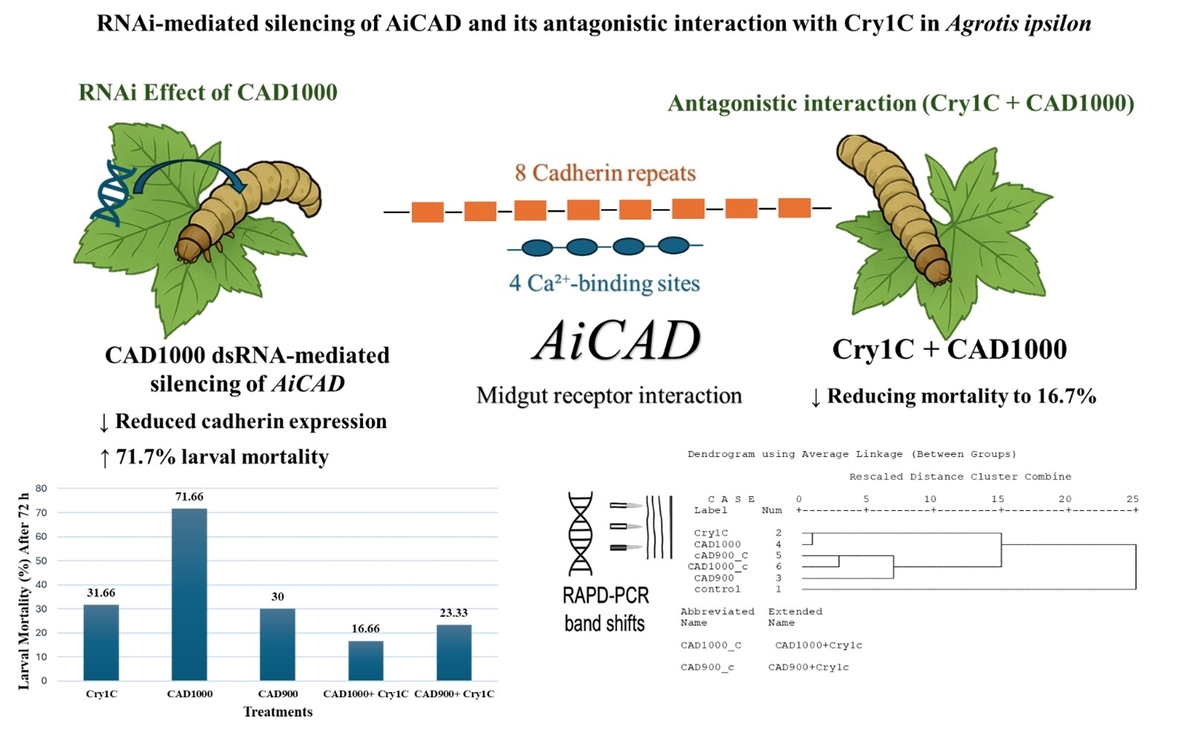
The black cutworm Agrotis ipsilon (Hufnagel) exhibits high tolerance to the Bacillus thuringiensis (Bt) Cry1C toxin, posing significant challenges for effective pest management. In this study, synthetic double-stranded RNA (dsRNA) fragments targeting two regions of the cadherin gene (CAD900 and CAD1000) were assessed for their larvicidal efficacy, interaction with Cry1C, and associated genomic alterations. The A. ipsilon cadherin (AiCAD) gene cloned using the A. ipsilon GenBank sequence (accession no. AEB97396.1) encodes a protein with eight cadherin repeat domains and four calcium-binding sites. Bioassays revealed that CAD1000 induced the highest larval mortality (71.67%), significantly exceeding that of Cry1C (31.67%) and CAD900 (30%). Notably, combining CAD1000 with Cry1C resulted in reduced mortality (16.67%), indicating a potential antagonistic interaction. RAPD-PCR analysis revealed pronounced treatment-associated polymorphisms, with CAD1000 inducing the highest level of variation (88.31%). Unique molecular markers differentiated five genotypes, and cluster analysis separated treatments into two primary groups: a genetically distinct control cluster and a second cluster comprising Cry1C, CAD1000, and their combination. The highest genetic similarity was observed between Cry1C and CAD1000 (0.787). Phylogenetic analysis indicated that AiCAD is most closely related to Sesamia inferens among 28 lepidopteran species. Quantitative real-time PCR (qRT-PCR) revealed significant developmental stage-dependent expression of AiCAD. In addition, tissue-specific profiling showed predominant transcript accumulation in the midgut, with minimal expression in the foregut, hindgut, and fat body, highlighting the midgut as the primary site of cadherin activity and Bt toxin interaction.
Overall, these findings identify CAD1000 as a promising RNAi-based larvicide candidate and suggest caution in its combined use with Cry1C due to the observed antagonistic effects. In addition, this study provides molecular and expression insights that may support the development of targeted management strategies against this resilient pest.
References
Abbott W.S. 1925. A method of computing the effectiveness of an insecticide. Journal of Economic Entomology 18(2): 265-267. https://doi.org/10.1093/jee/18.2.265a DOI: https://doi.org/10.1093/jee/18.2.265a
Ahmed F.S., Helmy W.S., Alfuhaid N.A., Moustafa M.A. 2024. Target enzymes of Origanum majorana and Rosmarinus officinalis essential oils in black cutworm (Agrotis ipsilon): in vitro and in silico studies. Insects 15(7): 483. https://doi.org/10.3390/insects15070483 DOI: https://doi.org/10.3390/insects15070483
Andrés-Garrido A., González-Martínez R.M., Ramos S., Escriche B. 2020. Cadherin fragments of Lepidopteran and Coleopteran species do not enhance toxicity of Cry1Ca and Vip3Aa proteins to Spodoptera exigua (Hübner)(Lepidoptera: Noctuidae). Biocontrol Science and Technology 30(9): 941-950. https://doi.org/10.1080/09583157.2020.1772960 DOI: https://doi.org/10.1080/09583157.2020.1772960
Awad M., Alfuhaid N.A., Amer A., Hassan N.N., Moustafa M.A. 2024a. Towards sustainable pest management: Toxicity, biochemical effects, and molecular docking analysis of Ocimum basilicum (Lamiaceae) essential oil on Agrotis ipsilon and Spodoptera littoralis (Lepidoptera: Noctuidae). Neotropical Entomology 53(3): 669-681. https://doi.org/10.1007/s13744-024-01137-6 DOI: https://doi.org/10.1007/s13744-024-01137-6
Awad M., El Kenawy A.H., Alfuhaid N.A., Ibrahim E.-D.S., Jósvai J.K., Fónagy A., Moustafa, M.A., 2024b. Lethal and sublethal effects of cyantraniliprole on the Biology and Metabolic enzyme activities of two lepidopteran Pests, Spodoptera littoralis and Agrotis ipsilon, and A generalist predator, Chrysoperla carnea (Neuroptera: Chrysopidae). Insects 15(6): 450. https://doi.org/10.3390/insects15060450 DOI: https://doi.org/10.3390/insects15060450
Azizoglu U., Salehi Jouzani G., Sansinenea E., Sanchis-Borja, V. 2023. Biotechnological advances in Bacillus thuringiensis and its toxins: Recent updates. Reviews in Environmental Science and Bio/Technology 22(2): 319-348. https://doi.org/10.1007/s11157-023-09652-5 DOI: https://doi.org/10.1007/s11157-023-09652-5
Bidyananda N., Jamir I., Nowakowska K., Varte V., Vendrame W.A., Devi R.S., Nongdam P., 2024. Plant genetic diversity studies: Insights from DNA marker analyses. International Journal of Plant Biology 15(3): 607-640. https://doi.org/10.3390/ijpb15030046 DOI: https://doi.org/10.3390/ijpb15030046
Binning R.R., Coats J., Kong X., Hellmich R.L. 2015. Susceptibility to Bt proteins is not required for Agrotis ipsilon aversion to Bt maize. Pest Management Science 71(4): 601-606. https://doi.org/10.1002/ps.3901 DOI: https://doi.org/10.1002/ps.3901
Boonyos P., Trakulnalueamsai C., Rungrod A., Chongthammakun S., Promdonkoy B. 2021. Antagonistic effect of truncated fragments of Bacillus thuringiensis Vip3Aa on the larvicidal activity of its full-length protein. Protein and Peptide Letters 28(2): 131-139. https://doi.org/10.2174/0929866527666200625205846 DOI: https://doi.org/10.2174/0929866527666200625205846
Bozzolan F., Durand N., Demondion E., Bourgeois T., Gassias E., Debernard, S. 2017. Evidence for a role of oestrogen receptor‐related receptor in the regulation of male sexual behaviour in the moth Agrotis ipsilon. Insect Molecular Biology 26(4): 403-413. https://doi.org/10.1111/imb.12303 DOI: https://doi.org/10.1111/imb.12303
De Castro E., Sigrist C.J.A., Gattiker A., Bulliard V., Langendijk-Genevaux P.S., Gasteiger E., Bairoch A., Hulo, N. 2006. ScanProsite: detection of PROSITE signature matches and ProRule-associated functional and structural residues in proteins. Nucleic Acids Research 34(suppl_2): W362-W365. https://doi.org/10.1093/nar/gkl124 DOI: https://doi.org/10.1093/nar/gkl124
Deguine J.-P., Aubertot J.-N., Flor R.J., Lescourret F., Wyckhuys K.A., Ratnadass, A. 2021. Integrated pest management: good intentions, hard realities. A review. Agronomy for Sustainable Development 41(3): 38. https://doi.org/10.1007/s13593-021-00689-w DOI: https://doi.org/10.1007/s13593-021-00689-w
Gao M., Dong S., Hu X., Zhang X., Liu Y., Zhong J., Lu L., Wang Y., Chen L., Liu, X. 2019. Roles of midgut cadherin from two moths in different Bacillus thuringiensis action mechanisms: correlation among toxin binding, cellular toxicity, and synergism. Journal of Agricultural and Food Chemistry 67(48): 13237-13246. https://doi.org/10.1021/acs.jafc.9b04563 DOI: https://doi.org/10.1021/acs.jafc.9b04563
Gassias E., Maria A., Couzi P., Demondion E., Durand N., Bozzolan F., Aguilar P., Debernard, S. 2021. Involvement of methoprene-tolerant and Krüppel homolog 1 in juvenile hormone-signaling regulating the maturation of male accessory glands in the moth Agrotis ipsilon. Insect Biochemistry and Molecular Biology 132: 103566. https://doi.org/10.1016/j.ibmb.2021.103566 DOI: https://doi.org/10.1016/j.ibmb.2021.103566
Gassmann A.J., Reisig D.D. 2023. Management of insect pests with Bt crops in the United States. Annual Review of Entomology 68(1): 31-49. https://doi.org/10.1146/annurev-ento-120220-105502 DOI: https://doi.org/10.1146/annurev-ento-120220-105502
He F., Sun S., Tan H., Sun X., Qin C., Ji S., Li X., Zhang J., Jiang X. 2019. Chlorantraniliprole against the black cutworm Agrotis ipsilon (Lepidoptera: Noctuidae): From biochemical/physiological to demographic responses. Scientific Reports 9(1): 10328. https://doi.org/10.1038/s41598-019-46915-0 DOI: https://doi.org/10.1038/s41598-019-46915-0
Hu D., Wang D., Pan H., Liu X. 2025. Molecular mechanisms underlying resistance to Bacillus thuringiensis Cry toxins in Lepidopteran pests: An Updated Research Perspective. Agronomy 15(1): 155. https://doi.org/10.3390/agronomy15010155 DOI: https://doi.org/10.3390/agronomy15010155
Huang F., Andow D.A., Buschman L.L. 2011. Success of the high‐dose/refuge resistance management strategy after 15 years of Bt crop use in North America. Entomologia Experimentalis et Applicata 140(1): 1-16. https://doi.org/10.1111/j.1570-7458.2011.01138.x DOI: https://doi.org/10.1111/j.1570-7458.2011.01138.x
Ismail S.M. 2025. Resistance level and enzymatic detoxification responses in field populations Agrotis ipsilon (Hufnagel) to commercial insecticides. International Journal of Advanced Biological and Biomedical Research 13: 219-227:
https://doi.org/10.48309/IJABBR.2025.2039962.1540
Joshi M., Rana A., Prithiv Raj V., Kaushal S., Inamdar A., Verma K., Chandel, R. 2020. The potency of chemical insecticides in management of cutworm, Agrotis ipsilon Hufnagel (Noctuidae: Lepidoptera): A review. Journal of Entomology and Zoology Studies 8(3): 307-311.
Kandil M.A., Abdel-Kerim R.N. and Moustafa M.A. 2020. Lethal and sub-lethal effects of bio-and chemical insecticides on the tomato leaf miner, Tuta absoluta (Meyrick) (Lepidoptera: Gelechiidae). Egyptian Journal of Biological Pest Control 30(1): 76. https://doi.org/10.1186/s41938-020-00278-1 DOI: https://doi.org/10.1186/s41938-020-00278-1
Kumar P., Kamle M., Borah R., Mahato D.K., Sharma B. 2021. Bacillus thuringiensis as microbial Biopesticide: uses and application for sustainable agriculture. Egyptian Journal of Biological Pest Control 31(1): 95. https://doi.org/10.1186/s41938-021-00440-3 DOI: https://doi.org/10.1186/s41938-021-00440-3
Li Y., Wang C., Ge L., Hu C., Wu G., Sun Y., Song L., Wu X., Pan A., Xu Q. 2022. Environmental behaviors of Bacillus thuringiensis (Bt) insecticidal proteins and their effects on microbial ecology. Plants 11(9): 1212. https://doi.org/10.3390/plants11091212 DOI: https://doi.org/10.3390/plants11091212
Mohammed A.M., Diab M.R., Khalil S.M. 2018. Synergistic activity of Bacillus thuringiensis δ‐endotoxin and TMOF against Culex pipiens and Spodoptera littoralis larvae. Entomological Research 48(3): 156-164. https://doi.org/10.1111/1748-5967.12257 DOI: https://doi.org/10.1111/1748-5967.12257
Mostafa M., Vlasák J., Sehnal F. 2013. Activities of modified Cry3A‐type toxins on the red flour beetle, Tribolium castaneum (Herbst). Journal of Applied Entomology 137(9): 684-692. https://doi.org/10.1111/jen.12054 DOI: https://doi.org/10.1111/jen.12054
Moustafa M., Vlasák J., Sehnal F. 2016. Fragments of Tenebrio molitor cadherin enhance Cry3Aa toxicity for the red flour beetle, Tribolium castaneum (Herbst). Journal of Applied Entomology 140(4): 277-286. https://doi.org/10.1111/jen.12255 DOI: https://doi.org/10.1111/jen.12255
Moustafa M.A., Elmenofy W.H., Osman E.A., El-Said N.A., Awad M. 2022. Biological impact, oxidative stress and adipokinetic hormone activities of Agrotis ipsilon in response to bioinsecticides. Plant Protection Science 58(4): 326–337. https://doi.org/10.17221/46/2022-pps DOI: https://doi.org/10.17221/46/2022-PPS
Naing Z.L., Soe E.T., Zhang C., Niu L., Tang J., Ding Z., Yu S., Lu J., Fang F., Liang G. 2023. Cadherin is a binding protein but not a functional receptor of Bacillus thuringiensis Cry2Ab in Helicoverpa armigera. Applied and Environmental Microbiology 89(7): e00625-00623. https://doi.org/10.1128/aem.00625-23 DOI: https://doi.org/10.1128/aem.00625-23
Shahee C. 2023. Biocontrol against inset pests by Bacillus thuringiensis isolated from organic agricultural farm. PhD Thesis. Department of Microbiology Central Campus of Technology, Dharan, Nepal. pp. 1-92.
Wang Y., Hu Z., Wu W. 2015. Different effects of Bacillus thuringiensis toxin Cry1Ab on midgut cell transmembrane potential of Mythimna separata and Agrotis ipsilon larvae. Toxins 7(12): 5448-5458. https://doi.org/10.3390/toxins7124894 DOI: https://doi.org/10.3390/toxins7124894
Xie J., He W., Qiu M., Lin J., Shu H., Wang J., Liu L. 2026. Field-Evolved resistance to Bt Cry toxins in Lepidopteran Pests: Insights into multilayered regulatory mechanisms and next-generation management strategies. Toxins 18(2): 60. https://doi.org/10.3390/toxins18020060 DOI: https://doi.org/10.3390/toxins18020060
Zhang H., Yu S., Shi Y., Yang Y., Fabrick J.A., Wu Y. 2017. Intra-and extracellular domains of the Helicoverpa armigera cadherin mediate Cry1Ac cytotoxicity. Insect Biochemistry and Molecular Biology 86: 41-49. https://doi.org/10.1016/j.ibmb.2017.05.004 DOI: https://doi.org/10.1016/j.ibmb.2017.05.004
Downloads
Published
How to Cite
Issue
Section
License
Copyright (c) 2026 Journal of Plant Protection Research

This work is licensed under a Creative Commons Attribution 4.0 International License.