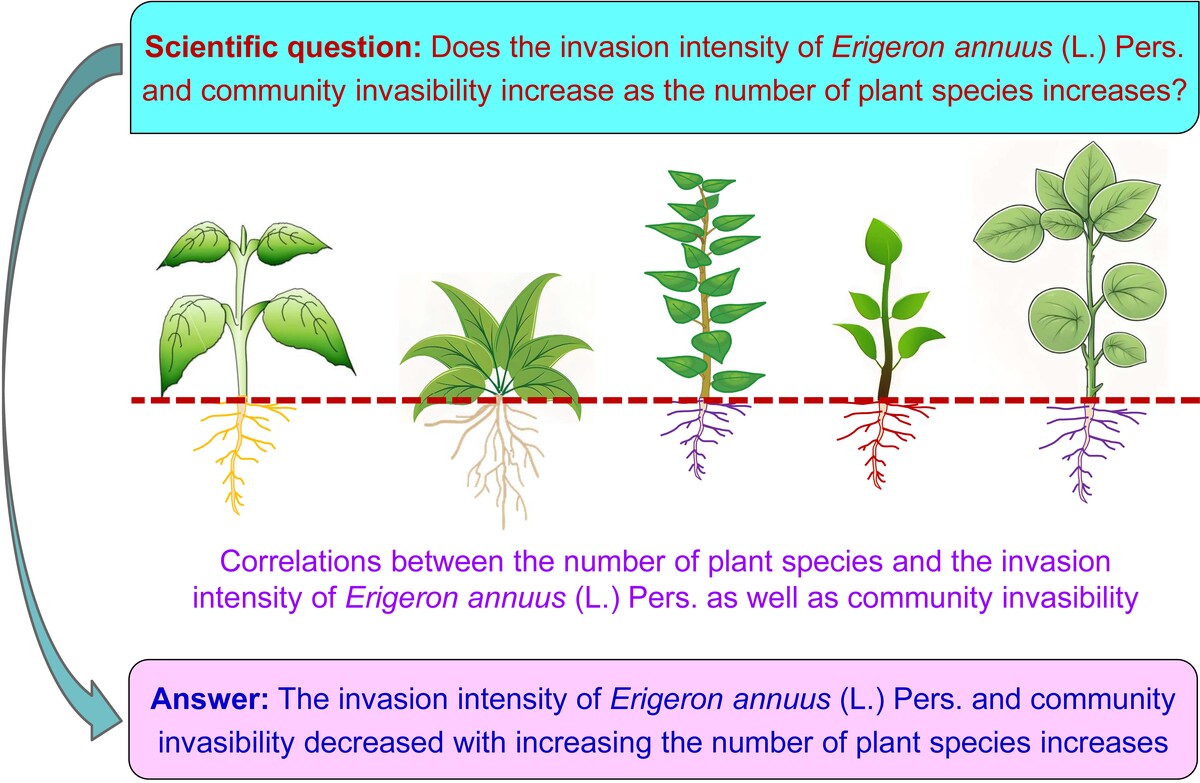
Does the invasion intensity of Erigeron annuus (L.) Pers. and community invasibility increase as the number of plant species increases?
DOI:
https://doi.org/10.24425/jppr.2026.3254Abstract
Habitats with different numbers of plant species (S) may exhibit varying levels of invasibility when invaded by invasive plants (IPS). Nevertheless, there are still doubts about the relationship between S and IPS’ invasion intensity as well as the community invasibility. It is also unclear which environmental factor has the greatest influence on the community invasibility, especially in habitats with different S. A cross-plot comparison approach was employed to estimate the differences in IPS’ relative abundance and invasion intensity, the community invasibility, and plant taxonomic diversity along a gradient of S under the invasion of Erigeron annuus (L.) Pers. Plant diversity, dominance, evenness, and richness evidently increased with increasing S. The relative abundance and invasion intensity of E. annuus, as also the mean, maximum, and minimum relative abundances of all plants, and the community invasibility significantly decreased with increasing S. The community invasibility was positively regulated by the relative abundance and invasion intensity of E. annuus, but negatively regulated by plant diversity, dominance, evenness, and richness. Therefore, protecting the diversity of native plants is crucial for enhancing the resistance to IPS’ invasion.
References
Abella S.R., Engel E.C., Springer J.D., Covington W.W. 2012. Relationships of exotic plant communities with native vegetation, environmental factors, disturbance, and landscape ecosystems of Pinus ponderosa forests, USA. Forest Ecology and Management 271: 65-74. DOI: https://doi.org/10.1016/j.foreco.2012.01.035
Ahmad R., Lone S.A., Rashid I., Khuroo A.A. 2025. A global synthesis of the ecological effects of co-invasions. Journal of Ecology 113: 570-581. DOI: https://doi.org/10.1111/1365-2745.14475
Bart D., Davenport T., Carpenter Q. 2015. Stress and land‒use legacies alter the relationship between invasive‒ and native‒ plant richness. Journal of Vegetation Science 26: 80-88. DOI: https://doi.org/10.1111/jvs.12220
Bartomeus I., Sol D., Pino J., Vicente P., Font X. 2012. Deconstructing the native–exotic richness relationship in plants. Global Ecology and Biogeography Letters 21: 524-533. DOI: https://doi.org/10.1111/j.1466-8238.2011.00708.x
Beshai R.A., Truong D.A., Henry A.K., Sorte C.J.B. 2023. Biotic resistance or invasional meltdown? Diversity reduces invasibility but not exotic dominance in southern California epibenthic communities. Biological Invasions 25: 533-549. DOI: https://doi.org/10.1007/s10530-022-02932-1
Byun C., de Blois S., Brisson J. 2013. Plant functional group identity and diversity determine biotic resistance to invasion by an exotic grass. Journal of Ecology 101: 128-139. DOI: https://doi.org/10.1111/1365-2745.12016
Catford J.A., Smith A.L., Wragg P.D., Clark A.T., Kosmala M., Cavender-Bares J., Reich P.B., Tilman D. 2019. Traits linked with species invasiveness and community invasibility vary with time, stage and indicator of invasion in a long-term grassland experiment. Ecology Letters 22: 593-604. DOI: https://doi.org/10.1111/ele.13220
Dong L.J., Yu H.W., He W.M. 2015. What determines positive, neutral and negative impacts of Solidago canadensis invasion on native plant species richness? Scientific Reports 5: 16804. DOI: https://doi.org/10.1038/srep16804
Driscoll D.A. 2017. Disturbance maintains native and exotic plant species richness in invaded grassy woodlands. Journal of Vegetation Science 28: 573-584. DOI: https://doi.org/10.1111/jvs.12513
Du Y.Z., Liu Y.S., Li Y., Li C., Wang C.Y., Cheng H.Y., Du D.L. 2025. The invasive tree Rhus typhina L. decreases plant diversity and richness but increases plant functional diversity in the invaded communities. Biologia 80: 1647-1658. DOI: https://doi.org/10.1007/s11756-025-01923-6
Ellis E.C., Antill E.C., Kreft H. 2012. All is not loss: Plant biodiversity in the Anthropocene. Plos One 7: e30535. DOI: https://doi.org/10.1371/journal.pone.0030535
Fenouillas P., Ah-Peng C., Amy E., Bracco I., Dafreville S., Gosset M., Ingrassia F., Lavergne C., Lequette B., Notter J.C., Pause J.M., Payet G., Payet N., Picot F., Poungavanon N., Strasberg D., Thomas H., Triolo J., Turquet V., Rouget M. 2021. Quantifying invasion degree by alien plants species in Reunion Island. Austral Ecology 46: 1125-1137. DOI: https://doi.org/10.1111/aec.13048
Hao Q., Ma J.S. 2023. Invasive alien plants in China: An update. Plant Diversity 45: 117-121. DOI: https://doi.org/10.1016/j.pld.2022.11.004
Hector A., Hautier Y., Saner P., Wacker L., Bagchi R., Joshi J., Scherer-Lorenzen M., Spehn E.M., Bazeley-White E., Weilenmann M., Caldeira M.C., Dimitrakopoulos P.G., Finn J.A., Huss-Danell K., Jumpponen A., Mulder C.P.H., Palmborg C., Pereira J.S., Siamantziouras A.S.D., Terry A.C., Troumbis A.Y., Schmid B., Loreau M. 2010. General stabilizing effects of plant diversity on grassland productivity through population asynchrony and overyielding. Ecology 91: 2213-2220. DOI: https://doi.org/10.1890/09-1162.1
Liu Y.S., Du Y.Z., Li C., Li Y., Wang C.Y., Du D.L. 2026. Co-invasion of three invasive alien plants increases plant taxonomic diversity and community invasibility. Plant Diversity: 10.1016/j.pld.2025.1005.1013. DOI: https://doi.org/10.1016/j.pld.2025.05.013
Liu Y.Y., Li Z., Xu L., Fu Q., Wang Y.J. 2022. Effects of region and elevation on adaptation of leaf functional traits of an invasive plant Erigeron annuus in China. Phyton 91: 115-128. DOI: https://doi.org/10.32604/phyton.2022.015395
Lu Y.J., Wang Y.F., Wu B.D., Wang S., Wei M., Du D.L., Wang C.Y. 2020. Allelopathy of three Compositae invasive alien species on indigenous Lactuca sativa L. enhanced under Cu and Pb pollution. Scientia Horticulturae 267: 109323. DOI: https://doi.org/10.1016/j.scienta.2020.109323
Meffin R., Miller A.L., Hulme P.E., Duncan R.P. 2010. BIODIVERSITY RESEARCH: Experimental introduction of the alien plant Hieracium lepidulum reveals no significant impact on montane plant communities in New Zealand. Diversity and Distributions 16: 804-815. DOI: https://doi.org/10.1111/j.1472-4642.2010.00684.x
Negesse Z., Pan K.W., Guadie A., Justine M.F., Azene B., Pandey B., Wu X.G., Sun X.M., Zhang L. 2025. Plant invasions alter soil biota and microbial activities: a global meta-analysis. Plant and Soil 513: 1031-1050. DOI: https://doi.org/10.1007/s11104-025-07227-7
Peng S.J., Kinlock N.L., Gurevitch J., Peng S.L. 2019. Correlation of native and exotic species richness: a global meta-analysis finds no invasion paradox across scales. Ecology 100: e02552. DOI: https://doi.org/10.1002/ecy.2552
Rastogi R., Qureshi Q., Shrivastava A., Jhala Y.V. 2023. Multiple invasions exert combined magnified effects on native plants, soil nutrients and alters the plant-herbivore interaction in dry tropical forest. Forest Ecology and Management 531: 120781. DOI: https://doi.org/10.1016/j.foreco.2023.120781
Sato R.Y., Costa A.P.L., Padial A.A. 2021. The invasive tropical tanner grass decreases diversity of the native aquatic macrophyte community at two scales in a subtropical tidal river. Acta Botanica Brasilica 35: 140-150. DOI: https://doi.org/10.1590/0102-33062020abb0360
Swierszcz S., Czarniecka-Wiera M., Szymura T.H., Szymura M. 2024. From invasive species stand to species-rich grassland: Long-term changes in plant species composition during Solidago invaded site restoration. Journal of Environmental Management 353: 13. DOI: https://doi.org/10.1016/j.jenvman.2024.120216
Trevenen E.J., Veneklaas E.J., Teste F.P., Dobrowolski M.P., Mucina L., Renton M. 2024. Plant interactions can lead to emergent relationships between plant community diversity, productivity and vulnerability to invasion. Scientific Reports 14: 13932. DOI: https://doi.org/10.1038/s41598-024-59996-3
Wang C.Y., Liu J., Xiao H.G., Zhou J.W., Du D.L. 2016. Floristic characteristics of alien invasive seed plant species in China. Anais da Academia Brasileira de Ciências 88: 1791-1797. DOI: https://doi.org/10.1590/0001-3765201620150687
Wang C.Y., Yu Y.L., Cheng H.Y., Du D.L. 2022. Which factor contributes most to the invasion resistance of native plant communities under the co-invasion of two invasive plant species? Science of the Total Environment 813: 152628. DOI: https://doi.org/10.1016/j.scitotenv.2021.152628
Xiao Y.K., He J.X., Aishan T., Sui Q., Zhou Y.F., Yimingniyazi A. 2024. Effects of different degrees of Xanthium spinosum invasion on the invasibility of plant communities in the Yili Grassland of Northwest China. Biology 13: 14. DOI: https://doi.org/10.3390/biology13010014
Xu Z.L., Zhong S.S., Yu Y.L., Wang Y.Y., Cheng H.Y., Du D.L., Wang C.Y. 2023. Rhus typhina L. triggered greater allelopathic effects than Koelreuteria paniculata Laxm under ammonium fertilization. Scientia Horticulturae 309: 111703. DOI: https://doi.org/10.1016/j.scienta.2022.111703
Yan X.L., Liu Q.R., Shou H.Y., Zeng X.F., Zhang Y., Chen L., Liu Y., Ma H.Y., Qi S.Y., Ma J.S. 2014. The categorization and analysis on the geographic distribution patterns of Chinese alien invasive plants. Biodiversity Science 22: 667-676. DOI: https://doi.org/10.3724/SP.J.1003.2014.14069
Zhang H.S., Li C., Li Y., Xu Z.L., Zhong S.S., Liu J., Du D.L., Wang C.Y. 2024. Relationship between plant diversity and community stability and invasibility in the heterogeneous landscape of urban habitats undergoing Solidago canadensis invasion. Plant Ecology & Diversity 17: 75-84. DOI: https://doi.org/10.1080/17550874.2024.2372713
Zhang K.M., Gu R.Y., Yang Y.B., Yan J., Ma Y.P., Shen Y. 2025. Recent distribution changes of invasive Asteraceae species in China: A five-year analysis (2016–2020). Journal of Environmental Management 376: 124445. DOI: https://doi.org/10.1016/j.jenvman.2025.124445
Downloads
Additional Files
Published
How to Cite
Issue
Section
License
Copyright (c) 2026 Journal of Plant Protection Research

This work is licensed under a Creative Commons Attribution 4.0 International License.





