Assessing honeybee vulnerability to residue-level acetamiprid and thermal stress under different nutritional conditions
DOI:
https://doi.org/10.24425/jppr.2026.2998Abstract
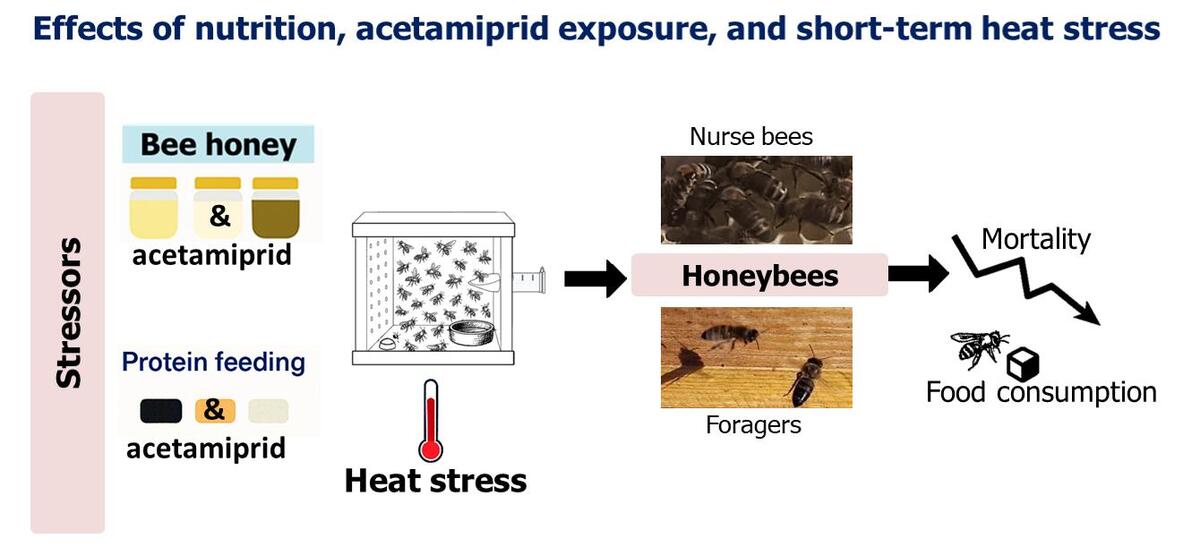
Honeybees, which serve as vital pollinators, are often exposed to agrochemicals as non-target organisms. Among these substances, the widely used insecticide acetamiprid is of particular concern, as it is frequently detected in bee products. Honeybees are also routinely subjected to multiple stressors simultaneously, including pesticide exposure and heat stress—the latter becoming increasingly problematic under ongoing climate change. Nutrition adds an additional layer of complexity to honeybee resilience, shaping how individuals respond to these concurrent stressors. In this study, the survival of nurse and forager honeybees was evaluated under two abiotic stressors—acetamiprid exposure at a residue level (52.78 µg kg⁻¹) and short-term heat stress (45°C for 2.5 h)—while providing bees with different dietary treatments: three types of honey and three commercial protein diets. Mortality of nurse bees was significantly higher in all acetamiprid-exposed groups than in the pesticide-free control, with honey-based diets providing better protection than protein-based diets. Regarding forager bees, mortality differed significantly between treatments, with buckwheat honey showing the lowest rates compared to protein diets and sugar candy. Age was a determining factor, as foragers exhibited higher mortality and lower consumption than nurses across treatments. Honey—particularly buckwheat —provided the most favorable outcomes, combining high consumption with reduced mortality under the study conditions. This study advances understanding of how nutrition can mitigate the impacts of multiple stressors on honey bees.
References
Abou-Shaara H. F., Owayss A. A., Ibrahim Y. Y., Basuny N. K. 2017. A review of impacts of temperature and relative humidity on various activities of honey bees. Insectes Sociaux 64(4): 455-463. DOI: https://doi.org/10.1007/s00040-017-0573-8 DOI: https://doi.org/10.1007/s00040-017-0573-8
Akgün N., Çelik Ö. F., Kelebekli L. 2021. Physicochemical properties, total phenolic content, and antioxidant activity of chestnut, rhododendron, acacia and multifloral honey. Journal of Food Measurement and Characterization 15(4): 3501-3508. DOI: https://doi.org/10.1007/s11694-021-00937-3 DOI: https://doi.org/10.1007/s11694-021-00937-3
Al-Esawy M. T. 2023. Honey bee immunity and physiology are enhanced by consuming high-fat diets. Journal of Plant Protection Research 63(2):185-195. DOI: https://doi.org/10.24425/jppr.2023.145753 DOI: https://doi.org/10.24425/jppr.2023.145753
Barroso G., Pereira A. M., Bueno O. C., Nocelli R. C. F., Malaspina O. 2025. Behavioral impairments in Africanized Apis mellifera exposed to lethal and sublethal doses of acetamiprid, fipronil, and thiamethoxam. Ecotoxicology 1-13. DOI: https://doi.org/10.1007/s10646-025-02904-w DOI: https://doi.org/10.1007/s10646-025-02904-w
Bencatova S., Knazovická V., Staron M., Gasper J., Tutka S., Rajcakova L. 2025. Detection of the insecticide substance acetamiprid in honey bee population components under realistic field conditions. Journal of Environmental Science and Health Part B 1-12. DOI: https://doi.org/10.1080/03601234.2025.2511485 DOI: https://doi.org/10.1080/03601234.2025.2511485
Bernklau E., Arathi H. S. 2023. Seasonal patterns of beneficial phytochemical availability in honey and stored pollen from honey bee colonies in large apiaries. Journal of Economic Entomology 116(4): 1069-1077. DOI: https://doi.org/10.1093/jee/toad096 DOI: https://doi.org/10.1093/jee/toad096
Capela N., Xu M., Simões S., Azevedo-Pereira H. M., Peters J., Sousa J. P. 2022. Exposure and risk assessment of acetamiprid in honey bee colonies under a real exposure scenario in Eucalyptus sp. landscapes. Science of the Total Environment 840: 156485. DOI: https://doi.org/10.1016/j.scitotenv.2022.156485 DOI: https://doi.org/10.1016/j.scitotenv.2022.156485
Deng J., Liu R., Lu Q., Hao P., Xu A., Zhang J., Tan J. 2018. Biochemical properties, antibacterial and cellular antioxidant activities of buckwheat honey in comparison to manuka honey. Food Chemistry 252: 243-249. DOI: https://doi.org/10.1016/j.foodchem.2018.01.115 DOI: https://doi.org/10.1016/j.foodchem.2018.01.115
Derewiaka D., Majewska E., Pruszkowska P. 2024. The effects of bee additives on the physico-chemical and antioxidant properties of rapeseed honey. Applied Sciences 14(3): 1292. DOI: https://doi.org/10.3390/app14031292 DOI: https://doi.org/10.3390/app14031292
Dżugan M., Grabek-Lejko D., Swacha S., Tomczyk M., Bednarska S., Kapusta I. 2020. Physicochemical quality parameters, antibacterial properties and cellular antioxidant activity of Polish buckwheat honey. Food Bioscience 34: 100538. DOI: https://doi.org/10.1016/j.fbio.2020.100538 DOI: https://doi.org/10.1016/j.fbio.2020.100538
Gonzalez V. H., Hranitz J. M., McGonigle M. B., Manweiler R. E., Smith D. R., Barthell J. F. 2022. Acute exposure to sublethal doses of neonicotinoid insecticides increases heat tolerance in honey bees. PLoS One 17(2): e0240950. DOI: https://doi.org/10.1371/journal.pone.0240950 DOI: https://doi.org/10.1371/journal.pone.0240950
Hajian-Tilaki A., Kenari R. E., Razavi R., Farahmandfar R. 2024. Phenolic profile, antioxidant properties, and pollen spectra of Iranian-originated honeys. European Food Research and Technology 250(9): 2317-2329. DOI: https://doi.org/10.1007/s00217-024-04539-3 DOI: https://doi.org/10.1007/s00217-024-04539-3
Han W., Yang Y., Gao J., Zhao D., Ren C., Wang S., Zhao S., Zhong Y. 2019. Chronic toxicity and biochemical response of Apis cerana cerana (Hymenoptera: Apidae) exposed to acetamiprid and propiconazole alone or combined. Ecotoxicology 28(4): 399-411. DOI: https://doi.org/10.1007/s10646-019-02030-4 DOI: https://doi.org/10.1007/s10646-019-02030-4
Havard T., Laurent M., Chauzat, M. P. 2019. Impact of stressors on honey bees (Apis mellifera; Hymenoptera: Apidae): Some guidance for research emerge from a meta-analysis. Diversity 12(1): 7. DOI: https://doi.org/10.3390/d12010007 DOI: https://doi.org/10.3390/d12010007
Kim H., Frunze O., Lee J. H., Kwon H. W. 2024. Enhancing honey bee health: Evaluating pollen substitute diets in field and cage experiments. Insects 15(5): 361. DOI: https://doi.org/10.3390/insects15050361 DOI: https://doi.org/10.3390/insects15050361
Mackei M., Huber F., Sebők C., Vörösházi J., Tráj P., Márton R. A., Horváth E., Neogrády Z., Mátis G. 2024. Unraveling the acute sublethal effects of acetamiprid on honey bee neurological redox equilibrium. Scientific Reports 14(1): 27514. DOI: https://doi.org/10.1038/s41598-024-79274-6 DOI: https://doi.org/10.1038/s41598-024-79274-6
Manzer S., Thamm M., Hilsmann L., Krischke B., Steffan-Dewenter I., Scheiner R. 2024. The neonicotinoid acetamiprid reduces larval and adult survival in honeybees (Apis mellifera) and interacts with a fungicide mixture. Environmental Pollution 360: 124643. DOI: https://doi.org/10.1016/j.envpol.2024.124643 DOI: https://doi.org/10.1016/j.envpol.2024.124643
Mao W., Schuler M. A., Berenbaum M. R. 2013. Honey constituents up-regulate detoxification and immunity genes in the western honey bee Apis mellifera. Proceedings of the National Academy of Sciences 110(22): 8842-8846. DOI: https://doi.org/10.1073/pnas.1303884110 DOI: https://doi.org/10.1073/pnas.1303884110
Martinello M., Mutinelli F. 2021. Antioxidant activity in bee products: A review. Antioxidants 10(1): 71. DOI: https://doi.org/10.3390/antiox10010071 DOI: https://doi.org/10.3390/antiox10010071
Mokbel E.S.M.S. 2018. Resistance risk assessment: realized heritability, cross resistance and resistance stability of acetamiprid in the cotton aphid, Aphis gossypii Glover (Homoptera: Aphididae). Journal of Plant Protection Research 58(4):328-334. DOI: https://doi.org/10.24425/jppr.2018.124641 DOI: https://doi.org/10.24425/jppr.2018.124641
Neumann P., Straub L. 2023. Beekeeping under climate change. Journal of Apicultural Research 62(5): 963-968. DOI: https://doi.org/10.1080/00218839.2023.2247115 DOI: https://doi.org/10.1080/00218839.2023.2247115
Ozols N., Brusbārdis V., Filipovičs M., Gailis J., Radenkovs V., Rubene B., Zagorska V. 2024. Pesticide contamination of honey-bee-collected pollen in the context of the landscape composition in Latvia. Toxics 12(12): 862. DOI: https://doi.org/10.3390/toxics12120862 DOI: https://doi.org/10.3390/toxics12120862
Papežíková I., Palíková M., Syrová E., Zachová A., Somerlíková K., Kováčová V., Pecková L. 2020. Effect of feeding honey bee (Apis mellifera Hymenoptera: Apidae) colonies with honey, sugar solution, inverted sugar, and wheat starch syrup on nosematosis prevalence and intensity. Journal of Economic Entomology 113(1): 26-33. DOI: https://doi.org/10.1093/jee/toz251 DOI: https://doi.org/10.1093/jee/toz251
Piechowicz B., Łaś S., Łaś M., Łuc K., Zaręba L., Kobylarz D., Kuliga A., Grodzicki P., Zienkiewicz A., Romerowicz-Misielak M. 2025. The effects of deltamethrin (a synthetic pyrethroid insecticide), an anionic surfactant alone, and a co-formulated mixture of these substances on the honeybee (Apis mellifera) temperature preference, CO2 emission, and expression of detoxification-related genes. Journal of Plant Protection Research 65(2):187-199. DOI: https://doi.org/10.24425/jppr.2025.153285 DOI: https://doi.org/10.24425/jppr.2025.153825
Ricigliano V. A., Williams S. T., Oliver, R. 2022. Effects of different artificial diets on commercial honey bee colony performance, health biomarkers, and gut microbiota. BMC Veterinary Research 18(1): 52. DOI: https://doi.org/10.1186/s12917-022-03151-5 DOI: https://doi.org/10.1186/s12917-022-03151-5
Rodney S., Purdy J. 2020. Dietary requirements of individual nectar foragers, and colony-level pollen and nectar consumption: a review to support pesticide exposure assessment for honey bees. Apidologie 51(2): 163-179. DOI: https://doi.org/10.1007/s13592-019-00694-9 DOI: https://doi.org/10.1007/s13592-019-00694-9
Rowe E. B., Prathibha P., Marting P. R., Smith M. L. 2025. Honey bee beards: internal and external factors driving mass thermoregulatory evacuation. Insectes Sociaux 1-11. DOI: https://doi.org/10.1007/s00040-025-01046-w DOI: https://doi.org/10.1007/s00040-025-01046-w
Sabo R., Staroň M., Sabová L., Majchrák T., Bischoff G., Pistorius J., Janke M., Alkassab A. T. 2024. Honey bees for pesticide monitoring in the landscape: Which bee matrices should be used?. Chemosphere 364: 143130. DOI: https://doi.org/10.1016/j.chemosphere.2024.143130 DOI: https://doi.org/10.1016/j.chemosphere.2024.143130
Shi J., Wang X., Luo Y. 2025. Honey bees prefer moderate sublethal concentrations of acetamiprid and experience increased mortality. Pesticide Biochemistry and Physiology 208: 106320. DOI: https://doi.org/10.1016/j.pestbp.2025.106360 DOI: https://doi.org/10.1016/j.pestbp.2025.106320
St. Clair A. L., Zhang G., Dolezal A. G., O’Neal M. E., & Toth A. L. 2020. Diversified farming in a monoculture landscape: effects on honey bee health and wild bee communities. Environmental Entomology 49(3): 753-764. DOI: https://doi.org/10.1093/ee/nvaa031 DOI: https://doi.org/10.1093/ee/nvaa031
Stanley J., Chandrasekaran S., Preetha G., Kuttalam S., Jasmine R.S. 2016. Selective toxicity of diafenthiuron to non-target organisms: honey bees, coccinellids, chelonus, earthworms, silkworms and fish. Journal of Plant Protection Research 56(1):1-5. DOI: https://doi.org/10.1515/jppr-2016-0001 DOI: https://doi.org/10.1515/jppr-2016-0001
Staron M., Rajčáková Ľ., Planý M., Abou-Shaara H. 2026. Interactive effects of diet, tebuconazole, and elevated temperature on survival and body water loss in honey bee workers. Environmental Toxicology and Pharmacology, 121:104913. DOI: https://doi.org/10.1016/j.etap.2025.104913 DOI: https://doi.org/10.1016/j.etap.2025.104913
Swiatly-Blaszkiewicz A., Klupczynska-Gabryszak A., Matuszewska-Mach E., Matysiak J., Attard E., Kowalczyk D., Adamkiewicz A.; Kupcewicz B., Matysiak J. 2025. Pesticides in honeybee products—determination of pesticides in bee pollen, propolis, and royal jelly from Polish apiary. Molecules 30(2): 275. DOI: https://doi.org/10.3390/molecules30020275 DOI: https://doi.org/10.3390/molecules30020275
Tsuruda J. M., Chakrabarti P., Sagili R. R. 2021. Honey bee nutrition. Veterinary Clinics of North America: Food Animal Practice 37(3): 505-519. DOI: https://doi.org/10.1016/j.cvfa.2021.06.006 DOI: https://doi.org/10.1016/j.cvfa.2021.06.006
Xu X., Zhou S., Huang J., Geng F., Zhu X., Abou-Shaara H. F. 2025. Influence of hyperthermia treatment on varroa infestation, viral infections, and honey bee health in beehives. Insects 16(2): 168. DOI: https://doi.org/10.3390/insects16020168 DOI: https://doi.org/10.3390/insects16020168
Zhang Y., Chen D., Du M., Ma L., Li P., Qin R., Yang J., Yin Z., Wu X., Xu H. 2021. Insights into the degradation and toxicity difference mechanism of neonicotinoid pesticides in honeybees by mass spectrometry imaging. Science of the Total Environment 774: 145170. DOI: https://doi.org/10.1016/j.scitotenv.2021.145170 DOI: https://doi.org/10.1016/j.scitotenv.2021.145170
Downloads
Published
How to Cite
Issue
Section
License
Copyright (c) 2026 Journal of Plant Protection Research

This work is licensed under a Creative Commons Attribution 4.0 International License.