
Interaction of spatial planting arrangement and plant density on intraspecific competition in two maize cultivars
DOI:
https://doi.org/10.24425/jppr.2026.3649Abstract
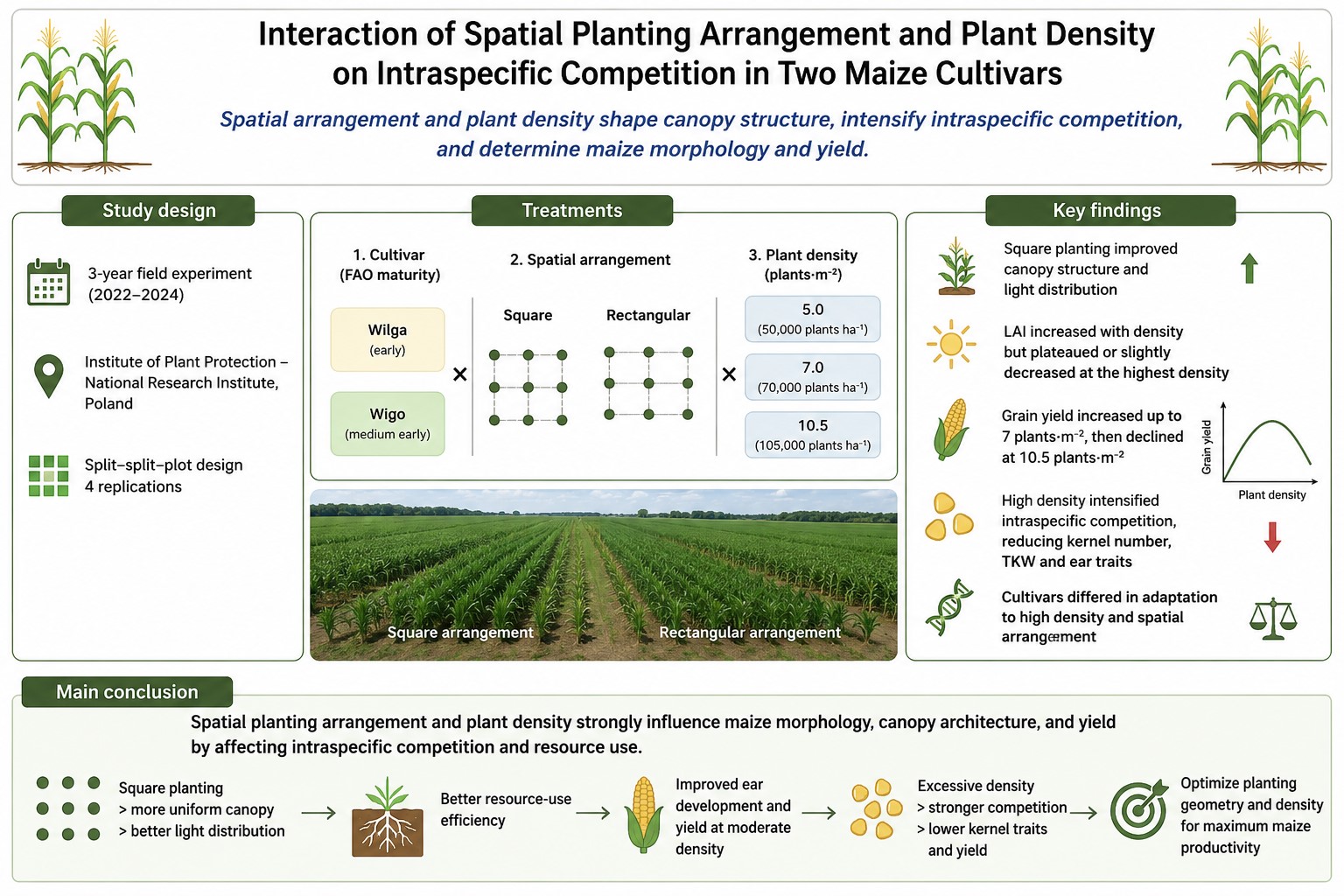
A three-year field study was carried out to assess the intraspecific competitiveness of selected maize (Zea mays L.) cultivars under different plant densities and spatial arrangements during the growing season. The central hypothesis posited that plant spacing, population density per unit area, and cultivar type significantly influence maize morphology and yield performance. Furthermore, these factors were expected to affect growth dynamics and the level of competition between individual plants within the same species. Intraspecific competition is closely tied to plant density, as higher population levels intensify competition for light, water, and nutrient availability. The field experiment was conducted at the Institute of Plant Protection – National Research Institute, utilizing a rigorous three-factor split-split-plot design with four replications in a randomized complete block design. The first factor included two maize cultivars, 'Wilga' and 'Wigo', which differed in their vegetation period according to the FAO maturity scale. The second factor involved plant arrangement patterns, specifically square and rectangular. The third factor was plant density, set at 5, 7, and 10.5 plants·m-² corresponding to 50,000, 70,000, and 105,000 plants per hectare, respectively. This study showed that plant spatial arrangement and population density strongly influenced maize morphology, canopy structure, and yield by affecting intraspecific competition and resource use. The square planting pattern outperformed the conventional rectangular pattern, promoting more uniform canopies, better light distribution, and improved resource efficiency, resulting in more consistent yields at moderate densities. Certain hybrids performed better under high density conditions.
References
Abate T., Shiferaw B., Menkir A., Wegary D., Kebede Y. 2015. Factors that transformed maize productivity in Ethiopia. Food Security 7: 965–981. DOI: https://doi.org/10.1007/s12571-015-0488-z
Abuzar M.R., Sadozai G.U., Baloch M.S., Shah I.H., Javaid T., Hussain N. 2011. Effect of plant population densities on yield of maize. Journal of Animal and Plant Sciences 21(4): 692–695.
Al-Naggar A.M.M., Atta M.M.M. 2017. Elevated plant density effects on performance and genetic parameters controlling maize (Zea mays L.) agronomic traits. Egyptian Journal of Plant Breeding 21: 227–241. DOI: https://doi.org/10.9734/JABB/2017/31550
Assefa Y., Carter P., Hinds M., Bhalla G., Schön R., Jeschke M., Paszkiewicz S., Smith S., Ciampitti I.A. 2018. Analysis of long-term study indicates both agronomic optimal plant density and increase maize yield per plant contributed to yield gain. Scientific Reports 8: 4937. DOI: https://doi.org/10.1038/s41598-018-23362-x
Azrai M., Zainuddin B., Syam’un E., Musa Y., Efendi R., Priyanto S.B., Andayani N.N., Aqil M. 2025. Canopy architectural and physiological traits for optimizing maize yield under high planting density. Frontiers in Sustainable Food Systems 9: 1469305. DOI: https://doi.org/10.3389/fsufs.2025.1469305
Badu-Apraku B., Fakorede M.A.B., Nelimor C., Osuman A.S., Bonkoungou T.O., Muhyideen O., Akinwale R.O. 2023. Recent advances in breeding maize for drought, heat and combined heat and drought stress tolerance in sub-Saharan Africa. CABI Reviews 2023: 1–22. DOI: https://doi.org/10.1079/cabireviews.2023.0011
Bereś P.K. 2012. Distribution of Ostrinia nubilalis Hbn. egg clusters on maize plants in south-eastern Poland in 2004–2008. Journal of Plant Protection Research 52: 106–113. DOI: https://doi.org/10.2478/v10045-012-0017-4
Çakir R. 2004. Effect of water stress at different development stages on vegetative and reproductive growth of corn. Field Crops Research 89: 1–16. DOI: https://doi.org/10.1016/j.fcr.2004.01.005
Duan M., Zhang X., Wei Z., Chen X., Zhang B. 2024. Effect of maize canopy structure on light interception and radiation use efficiency at different canopy layers. Agronomy 14: 1511. DOI: https://doi.org/10.3390/agronomy14071511
Dubas A. 1988. Obsada roślin a produktywność kukurydzy. W: Materiały konferencyjne „Obsada a produktywność roślin uprawnych”. IUNG, Puławy: 112–120.
Erenstein O., Jaleta M., Sonder K., Mottaleb K., Prasanna B.M. 2022. Global maize production, consumption and trade: trends and R&D implications. Food Security 14: 1295–1319. DOI: https://doi.org/10.1007/s12571-022-01288-7
Feng L., Shi K., Liu X., Yang H., Pu T., Wu Y., Yong T. 2024. Optimizing trade-offs between light transmittance and intraspecific competition under varying crop layouts in a maize–soybean strip relay cropping system. Field Crops Research. DOI: https://doi.org/10.1016/j.cj.2024.10.010
Ghannoum O. 2009. C4 photosynthesis and water stress. Annals of Botany 103: 635–644. DOI: https://doi.org/10.1093/aob/mcn093
Greveniotis V., Zotis S., Sioki E., Ipsilandis C. 2019. Field population density effects on field yield and morphological characteristics of maize. Agriculture 9: 160. DOI: https://doi.org/10.3390/agriculture9080160
Haarhoff S.J., Swanepoel P.A. 2022. Plant population and row spacing affects growth and yield of rainfed maize in semi-arid environments. Frontiers in Plant Science 13: 761121. DOI: https://doi.org/10.3389/fpls.2022.761121
He L., Sun W., Chen X., Han L., Li J., Ma Y. 2021. Modeling maize canopy morphology in response to increased plant density. Frontiers in Plant Science 11: 533514. DOI: https://doi.org/10.3389/fpls.2020.533514
Kucharczyk H., Bereś P.K., Dąbrowski Z.T. 2011. Species composition and seasonal dynamics of thrips populations on maize (Zea mays L.) in south-eastern Poland. Journal of Plant Protection Research 51: 210–216. DOI: https://doi.org/10.2478/v10045-011-0036-6
Lai Z., Liao Z., Liu Y., Kou H., Li Z., Fan J. 2025. Optimized planting density and nitrogen rate improved grain yield of drip-fertigated maize by enhancing canopy structure and photosynthetic capacity. Journal of Agriculture and Food Research 21: 101813. DOI: https://doi.org/10.1016/j.jafr.2025.101813
Lashkari M., Madani H., Ardakani M.R., Golzardi F., Zargari K. 2011. Effect of plant density on yield and yield components of different corn (Zea mays L.) hybrids. Journal of Agricultural and Environmental Sciences 10: 450–457.
Li J., Xie R.Z., Wang K.R., Hou P., Ming B. 2018. Response of canopy structure, light interception and grain yield to plant density in maize. Journal of Agricultural Science 156: 303–315. DOI: https://doi.org/10.1017/S0021859618000692
Lobell D.B., Cassman K.G., Field C.B. 2009. Crop yield gaps: their importance, magnitude and causes. Annual Review of Environment and Resources 34: 179–204. DOI: https://doi.org/10.1146/annurev.environ.041008.093740
Maddonni G.A., Otegui M.E. 1996. Leaf area, light interception, and crop development in maize. Field Crops Research 48: 81–87. DOI: https://doi.org/10.1016/0378-4290(96)00019-7
Maddonni G.A., Otegui M.E., Cirilo A.G. 2001. Plant population density, row spacing and hybrid effects on maize canopy architecture and light attenuation. Field Crops Research 71: 183–193. DOI: https://doi.org/10.1016/S0378-4290(01)00158-7
Maddonni G.A., Otegui M.E. 2006. Intra-specific competition in maize: contribution of extreme plant hierarchies to grain yield and kernel composition. Field Crops Research 97: 155–166. DOI: https://doi.org/10.1016/j.fcr.2005.09.013
Maresma Á., Ballesta A., Santiveri F., Lloveras J. 2019. Sowing date affects maize development and yield in irrigated Mediterranean environments. Agriculture 9: 67. DOI: https://doi.org/10.3390/agriculture9030067
Martínez-Ortiz M.A., Salinas-Moreno Y. 2024. Challenges and opportunities in the specialization of maize cultivation. Agro Productividad 17(9): 81–92. DOI: https://doi.org/10.32854/agrop.v17i9.3037
Michalski T., Weber Z., Gołębniak B. 2000. Occurrence of diseases on triticale and barley plants grown in pure stands and their mixtures. Journal of Plant Protection Research 40: 198–204.
Moll R.H., Kamprath E.J. 1977. Effects of population density upon agronomic traits associated with genetic increases in yield of Zea mays L. Agronomy Journal 69: 81–84. DOI: https://doi.org/10.2134/agronj1977.00021962006900010021x
Page E.R., Tollenaar M., Lee E.A., Lukens L. 2010. Timing, effect, and recovery from intraspecific competition in maize. Agronomy Journal 102: 1007–1013. DOI: https://doi.org/10.2134/agronj2009.0397
Pelech E.A., Evers J.B., Pedersen T.L. 2023. Leaf, plant, to canopy: a mechanistic study on aboveground plasticity and plant density within a maize–soybean intercrop system for the Midwest USA. Plant Cell & Environment 46: 5123–5142. DOI: https://doi.org/10.1111/pce.14487
Ranum P., Peña-Rosas J.P., García-Casal M.N. 2014. Global maize production, utilization, and consumption. Annals of the New York Academy of Sciences 1312: 105–112. DOI: https://doi.org/10.1111/nyas.12396
Roth G.W. 1997. Potential of narrow corn production in Pennsylvania. Pennsylvania State University Agronomy Facts 52.
Sangoi L. 2001. Understanding plant density effects on maize growth and development: an important issue to maximize grain yield. Ciência Rural 31: 159–168. DOI: https://doi.org/10.1590/S0103-84782001000100027
Sangoi L., Gracietti M.A., Rampazzo C., Bianchetti P. 2002. Response of Brazilian maize hybrids from different eras to changes in plant density. Field Crops Research 79: 39–51. DOI: https://doi.org/10.1016/S0378-4290(02)00124-7
Shapiro S.S., Wilk M.B. 1965. An analysis of variance test for normality (complete samples). Biometrika 52: 591–611. DOI: https://doi.org/10.1093/biomet/52.3-4.591
Shen H., Chen Y., Wang Y., Xing X., Ma X. 2020. Evaluation of the potential effects of drought on summer maize yield in the Western Guanzhong Plain, China. Agronomy 10(8): 1095. DOI: https://doi.org/10.3390/agronomy10081095
Shiferaw B., Smale M., Braun H.J., Duveiller E., Reynolds M., Muricho G. (2013) Crops that feed the world 10: past successes and future challenges to the role played by wheat in global food security. Food Security 5: 291–317. DOI: https://doi.org/10.1007/s12571-013-0263-y
Song Y., Rui Y., Bedane G., Li J. 2016. Morphological characteristics of maize canopy development as affected by increased plant density. PLoS ONE 11: e0158610. DOI: https://doi.org/10.1371/journal.pone.0154084
Stewart D.W., Costa C., Dwyer L.M., Smith D.L. 2003. Canopy structure, light interception, and photosynthesis in maize. Agronomy Journal 95: 1465–1474. DOI: https://doi.org/10.2134/agronj2003.1465
Sulewska H., Koziara W., Śmiatacz K., Szymańska G., Panasiewicz K. 2013. Wpływ gęstości siewu na plonowanie odmian kukurydzy o różnej klasie wczesności. Nauka Przyroda Technologie 7(3): 1–10.
Széles A., Horváth É., Simon K., Zagyi P., Huzsvai L. 2023. Maize production under drought stress: nutrient supply, yield prediction. Plants 12(18): 3301. DOI: https://doi.org/10.3390/plants12183301
Szmigiel A., Oleksy A. 2004. Wpływ gęstości siewu na plon odmian kukurydzy o różnej klasie wczesności. Biuletyn Instytutu Hodowli i Aklimatyzacji Roślin 231: 437–444.
Szulc P., Jagła M., Nowosad K., Bocianowski J., Olejarski P. 2017. Path analysis in assessment of cause and effect dependencies of yield structure components in maize cultivars differing in genetic profiles. Fresenius Environmental Bulletin 26(12): 7309–7318.
Testa G., Reyneri A., Blandino M. 2016. Maize grain yield enhancement through high plant density cultivation with different inter-row and intra-row spacings. European Journal of Agronomy 72: 28–37. DOI: https://doi.org/10.1016/j.eja.2015.09.006
Tetio-Kagho F., Gardner F.P. 1988. Responses of maize to plant population density. II. Reproductive development, yield, and yield adjustments. Agronomy Journal 80: 935–940. DOI: https://doi.org/10.2134/agronj1988.00021962008000060019x
Timlin D.J., Fleisher D.H., Kemanian A.R., Reddy V.R. 2014. Plant density and leaf area index effects on the distribution of light transmittance to the soil surface in maize. Agronomy Journal 106: 1828–1837. DOI: https://doi.org/10.2134/agronj14.0160
Tharp B.E., Kells J.J. 2001. Effect of glufosinate-resistant corn (Zea mays) population and row spacing on light interception, corn yield, and common lambsquarters growth. Weed Technology 15: 413–418. DOI: https://doi.org/10.1614/0890-037X(2001)015[0413:EOGRCZ]2.0.CO;2
Toler J.E., Murdock E.C., Stapleton G.S. 1999. Corn leaf orientation effects on light interception, intraspecific competition, and grain yields. Journal of Production Agriculture 12: 100–104. DOI: https://doi.org/10.2134/jpa1999.0396
Wang Q., Sun Z., Bai W., Zhang D. 2021. Light interception and use efficiency differ with maize plant density in maize–peanut intercropping. Frontiers of Agricultural Science and Engineering 8: 591–604. DOI: https://doi.org/10.15302/J-FASE-2021403
Voldeng H.D., Bloukman G.E. 1975. Interaction between genotype and density on the yield components of Zea mays. II. Grain production. Journal of Agricultural Science 84(1): 61–74. DOI: https://doi.org/10.1017/S0021859600052088
Yan J., Warburton M., Crouch J. 2011. Association mapping for enhancing maize (Zea mays L.) genetic improvement. Crop Science 51: 433–449. DOI: https://doi.org/10.2135/cropsci2010.04.0233
Zhai L., Zhang L., Yao H., Zheng M., Ming B., Xie R. 2022. Optimal cultivar × sowing date × plant density for grain yield and resource use efficiency of summer maize in China. Agriculture 12: 7. DOI: https://doi.org/10.3390/agriculture12010007
Zhao L., Duan X., Zhang X., Zhang X., Song L., Chen P., Liang M., Zhang C., Wang C. 2025. Planting strategy optimization can increase maize yield by delaying leaf senescence and improving photosynthetic capacity. Agronomy 15: 1099. DOI: https://doi.org/10.3390/agronomy15051099
Downloads
Published
How to Cite
Issue
Section
License
Copyright (c) 2025 Journal of Plant Protection Research

This work is licensed under a Creative Commons Attribution 4.0 International License.





