
Selection of banana mutants for Fusarium wilt resistance using in vitro and in vivo techniques with pathogen filtrate and conidia of Fusarium
DOI:
https://doi.org/10.24425/jppr.2026.3175Abstract
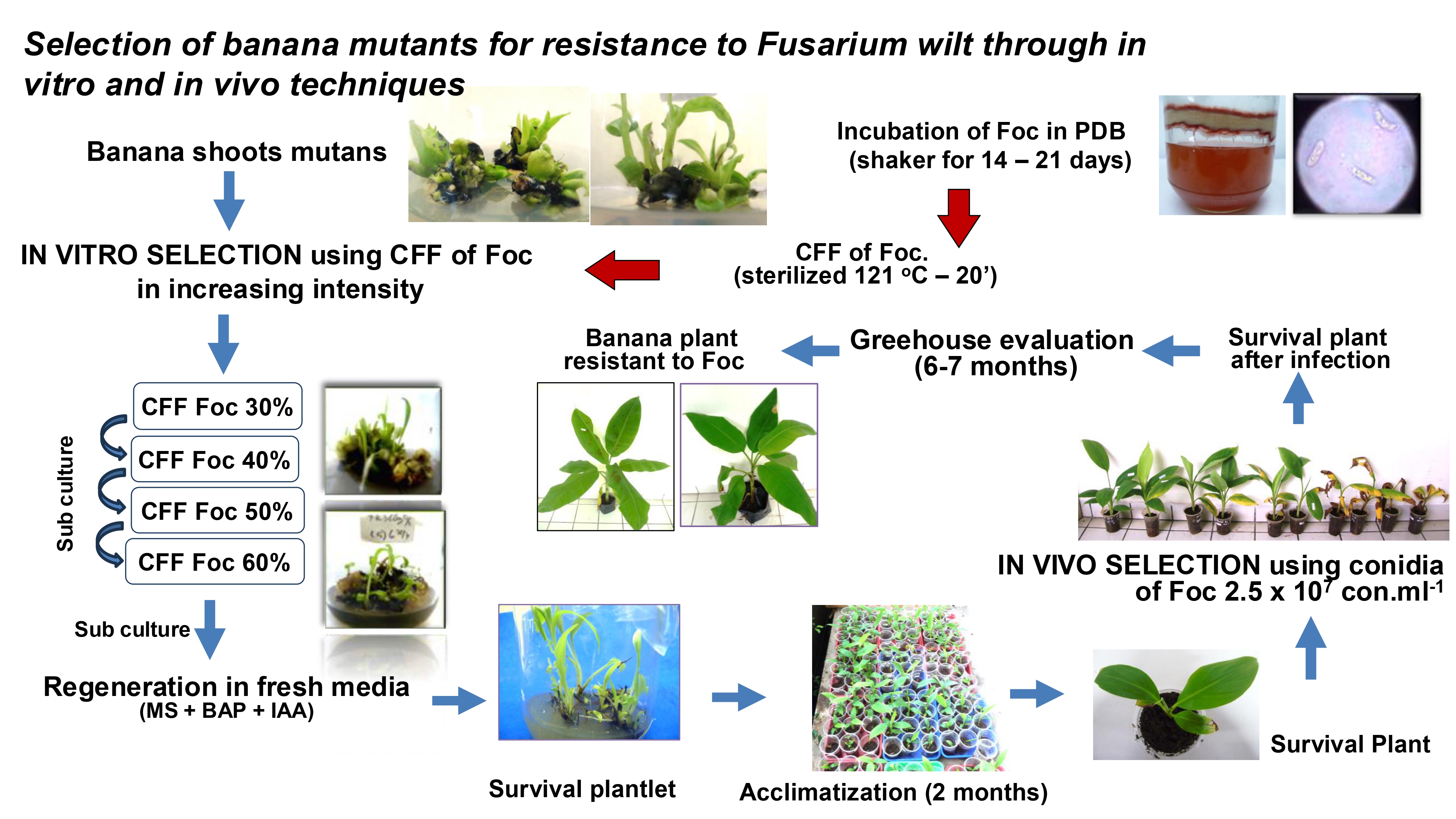
Fusarium oxysporum f. sp. cubense (Foc) is the most destructive fungus that causes Fusarium wilt disease, which has led to the loss of some banana germplasm. This research aims to identify banana mutants (Musa acuminata, AAA) resistant to Fusarium wilt using both in vitro selection with culture fluid filtrate (CFF) and in vivo selection methods with conidia of Foc Tropical Race 4 (TR4). Explants from in vitro shoot mutants, derived from gamma irradiation, were cultivated on Murashige and Skoog's media supplemented with increasing concentrations of CFF of Foc, ranging from 40% to 60% (v/v). This study demonstrates that the technique effectively selected banana shoots that were insensitive to CFF from Foc. The presence of CFF as a selective agent reduced the growth of the banana shoots by 13.88% to 48.99%, depending on the gamma irradiation dose from which the variants originated. A correlation analysis revealed a strong negative relationship (R² = 0.70) between CFF concentration and the shoots and nodule-like meristems produced. In vivo selection using a conidial suspension of Foc TR4 at a concentration of 2.5 × 10⁷ mL-1 resulted in 118 plants (23.7%) surviving. Evaluation of banana plants in the greenhouse 24 weeks after infection identified 28 plants (34.6%) from the selected mutans as potentially resistant to Fusarium wilt; most of these plants originated from gamma-irradiated explants at doses of 30 and 50 Gy. This study demonstrates that developing a banana mutant cultivar, 'Ampyang', which is resistant to Fusarium wilt, through gamma irradiation and both in vitro and in vivo selection, is a promising method for identifying resistant plants. However, further assessments via molecular characterization and field evaluations in disease-endemic areas are necessary to confirm the resistance of the obtained mutants.
References
Abeyawardana O.A.J., Koudela M. 2019. In vitro selection for Fusarium oxysporum f. sp. conglutinans resistance in brassica vegetables. International Journal of Scientific Reports 5 (2): 35–44. DOI: https://doi.org/10.18203/issn.2454-2156.IntJSciRep20190250 DOI: https://doi.org/10.18203/issn.2454-2156.IntJSciRep20190250
Andersen E.J., Ali S., Byamukama E., Yen Y., Nepal M.P. 2018. Disease resistance mechanisms in plants. Genes 9: 339. DOI: http://dx.doi.org/10.3390/genes9070339 DOI: https://doi.org/10.3390/genes9070339
Balasubramanian V., Vashisht D., Cletus J., Sakthivel N. 2012. Plant β-1,3-glucanases: their biological functions and transgenic expression against phytopathogenic fungi. Biotechnology Letters 34 (11): 1983–1990. DOI: https://doi.org/10.1007/S10529-012-1012-6 DOI: https://doi.org/10.1007/s10529-012-1012-6
Bhoi A., Yadu B., Chandra J. Keshavkant S. 2022. Mutagenesis: A coherent technique to develop biotic stress resistant plants. Plant Stress 3: 100053. DOI: https://doi.org/10.1016/j.stress.2021.100053 DOI: https://doi.org/10.1016/j.stress.2021.100053
Bidabadi S.H., Sijun Z. 2018. Banana Fusarium Wilt (Fusarium oxysporum f. sp. cubense) control and resistance, in the context of developing wilt-resistant bananas within sustainable production systems. Horticultural Plant Journal 4 (5): 208–218. DOI: https://doi.org/10.1016/j.hpj.2018.08.001
[BPS-SI] BPS-Statistic Indonesia. 2025. Production of fruit, 2021-2023 [ 22 Jun 2024]
https://www.bps.go.id/en/statistics-table/2/NjIjMg==/produksi-tanaman
Carlier J., De Weel D., Escalant J.V. 2003. Global evaluation of Musa germplasm for resistance to Fusarium wilt, Mycosphaerella leaf spot diseases and nematodes. Performance evaluation (A. Vézina and C. Picq, eds). INIBAP Technical Guidelines 7. The International Network for the Improvement of Banana and Plantain, Montpellier, France. INIBAP ISBN: 2-2-910810-58-5
Carlier J., De Lapeyre de Bellaire L., Abadie C., Chillet M., Carval D., Miller R. N., Thangavelu R., Essoh Ngando J. 2024. The Sigatoka leaf disease complex in banana. Burleigh Dodds Science Publishing Limited. Cambridge, UK, 36 pp. DOI: https://doi.org/10.19103/as.2022.0108.01 DOI: https://doi.org/10.19103/AS.2022.0108.01
Chandra R., Kamle M., Bajpai A., Muthukumar M., Kalim S. 2010. In vitro selection: A candidate approach for disease resistance breeding in fruit crops. Asian Journal of Plant Sciences 9 (8): 437−446. DOI: https://doi.org/10.3923/ajps.2010.437.446
Chong P.A., Santos-Ordóñez E. 2020. New biotechnology promising approach for disease control on banana and plantain. Chapter 1. p. 13–23. In. “Agricultural, Forestry and Bioindustry Biotechnology and Biodiscovery” (P. Chong, D. Newman, D. Steinmacher, eds). Springer, Cham. 329 pp. https://doi.org/10.1007/978-3-030-51358-0_2 DOI: https://doi.org/10.1007/978-3-030-51358-0_2
Companioni B., Mora N., Díaz L., Pérez A., Arzola M., Espinosa P., Hernández M., Ventura J., Perez M. C., Santos R., Lorenzo J. C. 2005. Identification of discriminant factors after treatment of resistant and susceptible banana leaves with Fusarium oxysporum f. sp. cubense culture filtrates. Plant Breeding 124 (1): 79–85. DOI: https://doi.org/10.1111/J.1439-0523.2004.00997.X DOI: https://doi.org/10.1111/j.1439-0523.2004.00997.x
Dale J., James A., Paul J-Y., Khanna H., Smith M., Peraza-Echeverria S., Garcia-Bastidas F., Kema G., Waterhouse P., Mengersen K., and Harding R. 2016. Transgenic Cavendish bananas with resistance to Fusarium wilt tropical race 4. Nature Communications 8: 1496. DOI: https://doi.org/10.1038/s41467-017-01670-6 DOI: https://doi.org/10.1038/s41467-017-01670-6
Datta S. K., Chakrabarty D., and Mandal A.K.A. 2018. Plant mutation breeding: Past, present and future perspectives. Plant Cell, Tissue and Organ Culture 132 (3): 1–20. DOI: https://doi.org/10.1007/s11240-017-1334-6
Dita M., Teixeira L.A.J., O'Neill W., Pattison A.B., Weinert M.P., Li,C.Y., Zheng S.J., Staver C., Thangavelu R., Viljoen A. 2020. Current state of Fusarium wilt of banana in the subtropics. Acta Horticulturae 1272: 45–56. DOI: https://doi.org/10.17660/ActaHortic.2020.1272.7 DOI: https://doi.org/10.17660/ActaHortic.2020.1272.7
Duong H.T., Pham D.T., Pham V.T., Le A.H., Nguyen T.D , Nguyen N.X., Khuat C.T., Dinh H.T. 2024. Report on emerging foliar soft rot disease on ginseng Panax vietnamensis and the identification of Neocosmospora ipomoeae and Fusarium miscanthi as the causal pathogens. Journal of Plant Protection Research 64 (4): 373–380. DOI: https://doi.org/10.24425/jppr.2024.153177 DOI: https://doi.org/10.24425/jppr.2024.153177
Epp D. 1987. Somaclonal variation in banana: a case study with Fusarium wilt. p. 140–150. In: “Banana and plantain breeding strategies” (G.J. Persley, E.A. De Langhe, eds.). ACIAR Publ. Canberra, Australia.
FAO. 2025. Food and Agricultural Organization. OCOP Indonesia - Lady Finger Banana. https://www.fao.org/indonesia/programmes-and-projects/ocop-indonesia/en/
Ferreira M. dos S., Rebouças T.A., Rocha A. de J., Oliveira W.D. dos S., Santos A.C.L.S. dos S., Jesus, J.P.F.L. de, Ferreira C. F., Santos-Serejo J. A. dos, Haddad F., Amorim E. P. 2024. Selection and characterization of somaclonal variants of Prata Banana (AAB) Resistant to Fusarium Wilt. Agronomy 14 (8): 1740. DOI: https://doi.org/10.3390/agronomy14081740 DOI: https://doi.org/10.3390/agronomy14081740
Fourie G., Steenkamp E.T., Ploetz R.C., Gordon T.R.,Viljoen A. 2011. Current status of the taxonomic position of Fusarium oxysporum formae specialis cubense within the Fusarium oxysporum complex. Review. Infection, Genetics and Evolution 11: 533–542. DOI: https://doi.org/10.1016/j.meegid.2011.01.012 DOI: https://doi.org/10.1016/j.meegid.2011.01.012
García-Velasco R., Portal-González N., Santos-Bermúdez R., Yanes-Paz E., Lorenzo-Feijoo J.C Companioni-González B. 2020. Fast method applied in previous evaluation of resistance of banana to Fusarium oxysporum f. sp. cubense. Mexican Journal of Phytopathology 38 (3): 384–397. DOI: https://doi.org/10.18781/r.mex.fit.2004-1 DOI: https://doi.org/10.18781/R.MEX.FIT.2004-1
Hermanto C. Sutanto A., Jumjunidang., Edison H.S., J.W. Daniells J.W., O'Neill W.T., Sinohin V.G.O., . Molina A.B, P., Taylor P. 2011. Incidence and distribution of Fusarium wilt disease of banana in Indonesia. Acta Horticulturae 897: 313−322. DOI: https://doi.org/10.17660/ActaHortic.2011.897.43 DOI: https://doi.org/10.17660/ActaHortic.2011.897.43
Hervás A., Landa B., Jimenez-Dıaz R.M. 1997. Influence of chickpea genotype and Bacillus sp. on protection from Fusarium wilt by seed treatment with nonpathogenic Fusarium oxysporum. European Journal of Plant Pathology 103: 631–642. DOI: https://doi.org/10.1023/A:1008658209966 DOI: https://doi.org/10.1023/A:1008658209966
Huang J.-S. 2001. Plant Pathogenesis and Resistance. Biochemistry and Physiology of Plant-microbe Interaction. Kluwer Academic Publishers, Netherlands.
Huo Y., Liu S.-W., Huang H. C., Li Z., Ahmad M., Zhuo M., Chen W., Li C., Liu B., Li Y. 2025. Transcriptome analysis provides insights into the role of TLP16 in Musa acuminata Resistance to Fusarium oxysporum f. sp. cubense wilt. BMC Plant Biology 25: 9. DOI: https://doi.org/10.1186/s12870-024-06032-1 DOI: https://doi.org/10.1186/s12870-024-06032-1
Hwang S.C., Ko W.H. 2004. Cavendish banana cultivars resistant to Fusarium wilt acquired through somaclonal variation in Taiwan. Plant Disease 88 (6): 580–588. DOI: https://doi.org/10.1094/pdis.2004.88.6.580 DOI: https://doi.org/10.1094/PDIS.2004.88.6.580
Indrayanti R., Khairatunnisa F., Sedayu A., Asharo R. K. 2021. In vitro induce mutation of banana cv. Tanduk and early detection of shoots variant resistances to Fusarium oxysporum f. sp cubense. Jurnal Hortikultura Indonesia (JHI) 12 (2): 147–156. DOI: https://doi.org/10.29244/jhi.12.2.147-156 DOI: https://doi.org/10.29244/jhi.12.2.147-156
Indrayanti R., Zahratunnisa H., Destyana, N., Adisyahputra, Sukmawati D., Desnurvia R. 2024. Induced variability of tomato seeds (Lycopersicon esculentum) by gamma irradiation and early detection of tomato variants resistance to anthracnose. Pakistan Journal of Phytopatholgy 36 (02): 267–280. DOI: 10.33866/phytopathol.036.02.1047 DOI: https://doi.org/10.33866/phytopathol.036.02.1047
Izurdiaga D., Sánchez-López Á. M., Fernández-San Millán A., Poveda J. 2024. Cell-free filtrates from plant pathogens: Potential new sources of bioactive molecules to improve plant health. Crop Protection 176: 106477. DOI: https://doi.org/10.1016/j.cropro.2023.106477 DOI: https://doi.org/10.1016/j.cropro.2023.106477
Jankowicz-Cieslak J., Mba C., Till B.J. 2017. Mutagenesis for Crop Breeding and Functional Genomics. p. 3-18. In: ”Biotechnologies for Plant Mutation Breeding”. (J. Jankowicz-Cieslak, T. Tai, J. Kumlehn, B. Till. eds.). Springer, Cham. DOI: https://doi.org/10.1007/978-3-319-45021-6_1 344 pp. DOI: https://doi.org/10.1007/978-3-319-45021-6_1
Kodym A., Afzaa R., Forstera B.P., Ukaid Y., Nakagawae H., Mba C.. 2012. Mutation induction and mutant development. Methodology for physical and chemical mutagenic treatments. Chapter 3. p. 169-181. In: ”Plant Mutation Breeding and Biotechnology” (Q.Y. Shu, B.P. Forster, H. Nakagawa, eds.). IAEA Vienna, Austria. 631 pp. DOI: https://doi.org/10.1079/9781780640853.0169
Kumar M., Brar A., Yadav M., Chawade A., Vivekanand V., Pareek, N. 2018. Chitinases—Potential candidates for enhanced plant resistance towards fungal pathogens. Agriculture 8 (7): 88. DOI: https://doi.org/10.3390/AGRICULTURE8070088 DOI: https://doi.org/10.3390/agriculture8070088
Kumari P., R. Singhand R. Punia. 2017. Evaluation of different inoculation methods for mango anthracnose disease development. International Journal of Current Microbiology and Applied Sciences 6 (11): 3028–3032. DOI: https://doi.org/10.20546/ijcmas.2017.611.355 DOI: https://doi.org/10.20546/ijcmas.2017.611.355
Lee Y.M, Teo L, Ong K.P. 2001. Fusarium wilt of Cavendish banana and its control in Malaysia. p. 252–259. In: “Banana Fusarium Wilt Management: Towards Sustainable Cultivation” (A.B. Molina et al. eds). INIBAP/ The Asia and Pacific Network, Los Banos, Laguna, Philippines.
Li C., Zuo C., Deng G., Kuang R., Yang Q., Hu C., Sheng O., Zhang S., Ma L., Wei Y., Yang J., Liu S., Biswas M. K., Viljoen A., Yi G. 2013. Contamination of bananas with beauvericin and fusaric acid produced by Fusarium oxysporum f. sp. cubense. Plos One 8 (7): e70226. DOI: https://doi.org/10.1371/journal.pone.0070226 DOI: https://doi.org/10.1371/journal.pone.0070226
Mak C., Mohamed A.A, Liew K.W, Ho Y.W. 2004. Early screening technique for Fusarium wilt resistance in banana micropropagated plant. In: “Banana Improvement: Cellular, Molecular Biology, and Induced Mutation” (S.M. Jain, R. Swensen R., eds). Enfield. Sciences Publisher. Inc. New Hampshire, USA. DOI: https://www.fao.org/4/ae216e/ae216e0k.htm#bm20 [10 Aug 2026]
Mba C., Afza R., Bado S., Jain S.M. 2010. Induced mutagenesis in plants using physical and chemical agents. Chapter 7. p 111–130. In: ”Plant Cell Culture: Essential Methods” (M.R. Davey, P. Anthony, eds). John Wiley and Sons, Ltd. UK. 341 pp. DOI: https://doi.org/10.1002/9780470686522.ch7
Moerschbacher B., Mendgen K. 2000. Structural aspects of defense. p 231–277. In: “Mechanisms of Resistance to Plant Diseases” (A.J. Slusarenko, R.S.S. Fraser, L.C. Van Loon. eds.) Dordrecht. Kluwer Acadademic Publishers, Dordrecht, Nederlands, 630 pp. DOI: https://doi.org/10.1007/978-94-011-3937-3_8
Moore N.Y, Pegg K.G, Buddenhagen I.W, Bentley S. 2001. Fusarium wilt of banana: a diverse clonal pathogen of domesticated clonal host. P. 212–224. In: “Fusarium” (B.A Summerel. J.F. Lesli, D. Backhouse, W.L. Bryden, L.W. Burgesseds, eds.). APS Press, Minnesota, USA.
Munhoz T., Vargas J., Teixeira L., Staver C., Dita M.A. 2024. Fusarium Tropical Race 4 in Latin America and the Caribbean: status and global research advances towards disease management. Frontier in Plant Science 15: 1397617. DOI: https://doi.org/10.3389/fpls.2024.1397617 DOI: https://doi.org/10.3389/fpls.2024.1397617
Nasir N. Jumjunidang, Riska, Eliesti F. 2003. The occurrence of Fusarium oxysporum f. sp. cubense race 4 in Indonesia. In: Proceeding of 2nd International Symposium on Fusarium wilt on banana. 22−26 September 2003. Salvador de Bahia.
Nawrot-Chorabik K., 2013. The use of interaction in dual culture in vitro to evaluate the pathogenicity of fungi and susceptibility of host plant genotype. p. 287–301. In: “Environmental Biotechnology New Approaches and Prospective Applications. Chapter 12”. (M. Petre, ed.). Poland: InTech. DOI: http://dx.doi.org/10.5772/53214 DOI: https://doi.org/10.5772/53214
Oladosu Y., Rafii M.Y., Abdullah N., Hussin G., Ramli A., Rahim H.A., Miah G., Usman M.. 2016. Principle and application of plant mutagenesis in crop improvement: a review, Biotechnol. Biotechnologic Equipment 30 (1): 1–16. https://doi.org/10.1080/13102818.2015.1087333 DOI: https://doi.org/10.1080/13102818.2015.1087333
Ordonez N, Seidl M.F, Waalwijk C., Drenth A., Kilian A., Thomma B.P.H.J,. Ploetz R.C, Kema G.H. J.. 2015. Worse comes to worst: bananas and panama disease – when plant and pathogen clones meet. PLoS Pathology 11 (11): e1005197. DOI: https://doi.org/10.1371/journal.ppat.1005197 DOI: https://doi.org/10.1371/journal.ppat.1005197
Pegg K.G., Coates L.M., O'Neill W.T., Turner D.W. 2019. The epidemiology of fusarium wilt of banana. Frontiers in Plant Science 10: 1395. DOI: https://doi.org/10.3389/fpls.2019.01395 DOI: https://doi.org/10.3389/fpls.2019.01395
Perincherry L., Lalak-Kańczugowska J., Stępień Ł. 2019. Fusarium- produced mycotoxins in plant-pathogen interactions. Toxins 11: 664. https://doi.org/10.3390/toxins11110664 DOI: https://doi.org/10.3390/toxins11110664
Portal González N., Soler A., Ribadeneira C., Solano J., Portieles R., Herrera Isla L., Companioni B., Borras-Hidalgo O., Santos Bermudez R. 2021. Phytotoxic metabolites produce by Fusarium oxysporum f. sp. cubense Race 2. Frontiers in Microbiology.12: 629395. DOI: https://doi.org/10.3389/fmicb.2021.629395 DOI: https://doi.org/10.3389/fmicb.2021.629395
Portal N., Soler A., M. Alphonsine P. A., Borras-Hidalgo O., Portieles R., Peña-Rodriguez L. M., Yanes E., Herrera L., Solano J., Ribadeneira C., Walton J. D., Santos R. 2018. Nonspecific toxins as components of a host-specific culture filtrate from Fusarium oxysporum f. sp. cubense race 1. Plant Pathology: 67 (2): 467–476. DOI: https://doi.org/10.1111/ppa.12736 DOI: https://doi.org/10.1111/ppa.12736
Ploetz R.C, Kepler A.K, Daniells J., Nelson S.S. 2007. Banana and plantain—an overview with emphasis on Pacific island cultivars, ver.1. In. “Specific Profiles for Pasific Island Agroforestry” (C.R. Elevitch ed.). Permanent Agriculture Resources (PAR), Holualoa, Hawai. https://www.agroforestry.net/images/pdfs/Banana-plantain-overview.pdf
Ploetz R.C., Churchill A.C.L. 2011. Fusarium wilt: the banana disease that refuses to go away. Acta Horticulturae 897: 519–526. DOI: https://doi.org/10.17660/ActaHortic.2011.897.73 DOI: https://doi.org/10.17660/ActaHortic.2011.897.73
Ploetz R.C. 2015. Fusarium wilt of banana. Phytopathology 105: 152–1521. DOI: https://doi.org/10.1094/PHYTO-04-15-0101-RVW DOI: https://doi.org/10.1094/PHYTO-04-15-0101-RVW
Poon N.K, Teo C.H. 2019. Fusarium wilt disease of banana: current development of fusarium resistant banana. Journal of Microbiology & Biotechnology 4 (1): 000134. DOI: https://doi.org/10.23880/oajmb-16000134 DOI: https://doi.org/10.23880/oajmb-16000134
Prusky D., Romanazzi, G. 2023. Induced resistance in fruit and vegetables: a host physiological response limiting postharvest disease development. Annual Review of Phytopathology 61: 270–300. DOI: https://doi.org/10.1146/annurev-phyto-021722-035135 DOI: https://doi.org/10.1146/annurev-phyto-021722-035135
Ramírez-Mosqueda, M.A., Iglesias-Andreu L.G., Luna-Rodríguez M., Castro-Luna A.A. 2015. In vitro phytotoxicity of culture filtrates of Fusarium oxysporum f. sp. vanillae in Vanilla planifolia Jacks. Scientia Horticulturae 197: 573–578. DOI: https://doi.org/10.1016/j.scienta. 2015.10.019 DOI: https://doi.org/10.1016/j.scienta.2015.10.019
Rebouças T.A., De Jesus Rocha A., Cerqueira T.S., Adorno P.R., Barreto R.Q., Ferreira M.D. S., Morais Lino L. S., Batista de Oliveira Amorim V., Almeida dos Santos-Serejo J., Haddad F., Ferreira C.F., Amorim E.P. 2021. Pre-selection of banana somaclones resistant to Fusarium oxysporum f. sp. cubense, subtropical race 4. Crop Protection, 147, 105692. https://doi.org/10.1016/j.cropro.2021.105692 DOI: https://doi.org/10.1016/j.cropro.2021.105692
Reglinski T., Neil Havis N., Rees H.J., de Jong H. 2023. The practical role of induced resistance for crop protection. Review. Phytopathology 113 (4): 719–731. DOI: https://doi.org/10.1094/PHYTO-10-22-0400-IA DOI: https://doi.org/10.1094/PHYTO-10-22-0400-IA
Santos M.C., Viteri L.O., Araujo S.H., Mourão D.C., Câmara M.P., Amaral A.G., Oliveira E.E, Santos G.R.D. 2025. Molecular characterization and pathogenicity of Colletotrichum on banana fruits: wound effects on virulence and cross-infection. Microbiology Research 16 (1): 4. DOI: https://doi.org/10.3390/microbiolres16010004 DOI: https://doi.org/10.3390/microbiolres16010004
Saraswathi M. S., Kannan G., Uma S., Thangavelu R., Backiyarani S. 2016. Improvement of banana cv. Rasthali (Silk, AAB) against Fusarium oxysporum f. sp. cubense (VCG 0124/5) through induced mutagenesis: Determination of LD50 specific to mutagen, explants, toxins and in vitro and in vivo screening for Fusarium wilt resistance. Indian Journal of Experimental Biology. 54 (5): 345–353. https://www.researchgate.net/publication/303147453
Scheerer L., Pemsl D., Dita M., Vicente L. Perez and Staver, C. 2018. A quantified approach to projecting losses caused by Fusarium wilt Tropical race 4. Acta Horticulturae 1196: 211–218. DOI: https://doi.org/10.17660/ActaHortic.2018.1196.26 DOI: https://doi.org/10.17660/ActaHortic.2018.1196.26
Siamak S.B., Zheng S. 2018. Banana Fusarium Wilt (Fusarium oxysporum f. sp. cubense) control and resistance, in the context of developing wilt-resistant bananas within sustainable production systems. Horticultural Plant Journal 4 (5): 208−218. DOI: https://doi.org/10.1016/j.hpj.2018.08.001 DOI: https://doi.org/10.1016/j.hpj.2018.08.001
Sharma P., Jha A.B., Dubey R.S., Pessarakl M. 2012. Review Article. Reactive oxygen species, oxidative damage, and antioxidative defense mechanism in plants under stressful conditions. Journal of Botany 2012: 217037. DOI: https://doi.org/10.1155/2012/217037 DOI: https://doi.org/10.1155/2012/217037
Singh N., R. Kumar R., Ray S.K. 2018. An innovative approach to study Ralstonia solanacearum pathogenicity in 6 to 7 days old tomato seedlings by root dip inoculation. Bio-protocol. 8(21): e3065. https://doi.org/10.21769/BioProtoc.3065 DOI: https://doi.org/10.21769/BioProtoc.3065
Soumare A., Diédhiou A.G., Arora N.K., Tawfeeq Al Ani L.K., Ngom M., Fall S. Hafidi M., Ouhdouch Y., Kouisni L., Sy M.O. 2021. Potential role and utilization of plant growth promoting microbes in plant tissue culture. Frontiers in Microbiology, Article 649878. DOI: 10.3389/fmicb.2021.649878 DOI: https://doi.org/10.3389/fmicb.2021.649878
Somrith A., Singburaudom N., Piasai O. 2011. Vegetative compatibility groups of Fusarium oxysporum f. sp. cubense. Agriculture and Natural Resources 45 (3): 451–460. DOI: https://li01.tci-thaijo.org/index.php/anres/article/view/245320
Thakur M., Sharma D. Sharma S. 2002. In vitro selection and regeneration of carnation (Dianthus caryophyllus L.) plants resistant to culture filtrate of Fusarium oxysporum f. sp. dianthi. Plant Cell Report 20: 825–828. DOI: https://doi.org/10.1007/s00299-001-0412-1 DOI: https://doi.org/10.1007/s00299-001-0412-1
Thakker J.N., Patel P., Dhandhukia P.C. 2011. Induction of defence-related enzymes in susceptible variety of banana: role of Fusarium-derived elicitors. Archives of Phytopathology and Plant Protection 44 (20): 1976–1984. DOI: https://doi.org/10.1080/03235408.2011.559032 DOI: https://doi.org/10.1080/03235408.2011.559032
Tripathi L., Tripathi J. N., Tenkouano A., Bramel P. 2008. Banana and Plantain. Compendium of Transgenic Crop Plants: 77–108. DOI: https://doi.org/10.1002/9781405181099.k0503 DOI: https://doi.org/10.1002/9781405181099.k0503
Valmayor R.V., Jamaluddin S.H., Silayoi B., Kusumo S., Danh L.D., Pascua O.C., Espino R.R.C (2000). Banana cultivar names and synonyms in Southeast Asia. p 55–65. In: “Advancing banana and plantain R & D in Asia and the Pacific” (Molina A.B., Roa V.N., eds). INIBAP-ASPNET, Philippines, 151 pp. DOI: https://hdl.handle.net/10568/105378
Wibowo A, Subandiyah S, Sumardiyono C., Sulistyowati L., Taylor P.M.F. 2011. The occurrence of tropical race 4 of Fusarium oxysporum f. sp. cubense in Indonesia. The Plant Pathology Journal. Korean Society of Plant Pathology 27 (3): 280–284. DOI: https://doi.org/10.5423/ppj.2011.27.3.280 DOI: https://doi.org/10.5423/PPJ.2011.27.3.280
Downloads
Published
How to Cite
Issue
Section
License
Copyright (c) 2026 Journal of Plant Protection Research

This work is licensed under a Creative Commons Attribution 4.0 International License.