Plant defense mechanisms against insect herbivores: ecological insights for sustainable pest management
DOI:
https://doi.org/10.24425/jppr.2026.7313Abstract
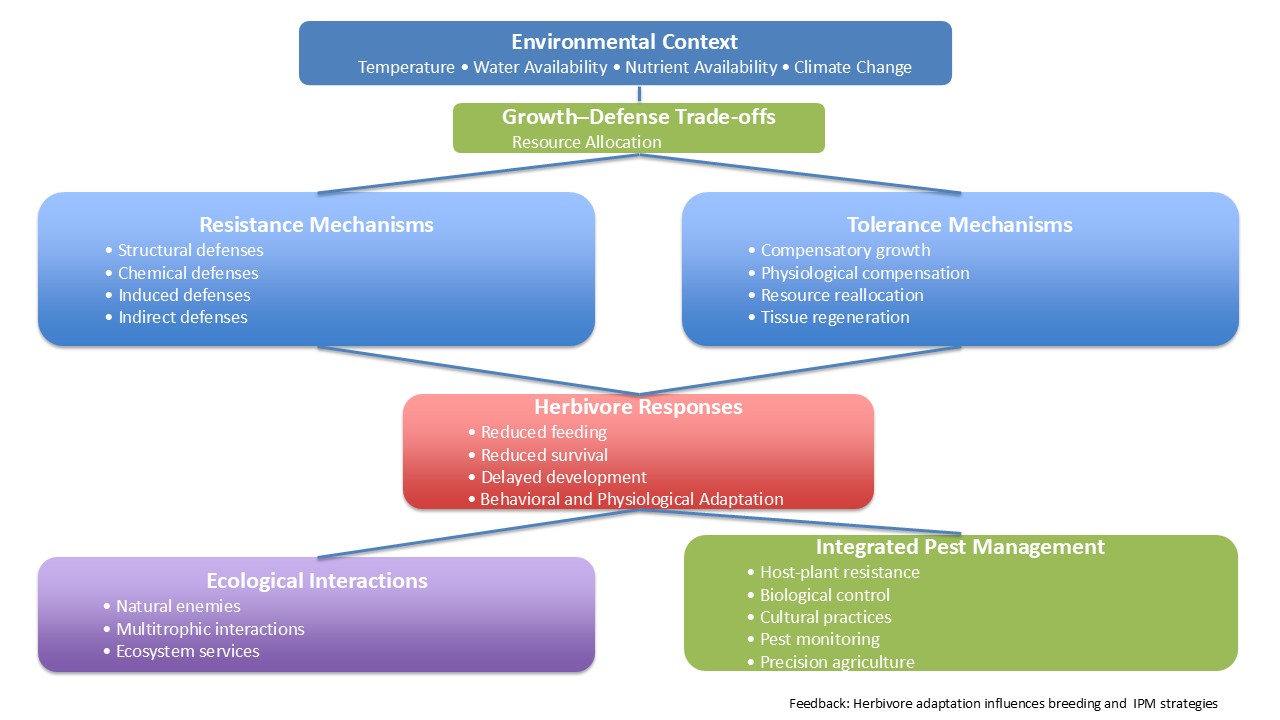
Insect herbivory remains a major constraint on agricultural productivity and ecosystem stability worldwide. Plants have evolved diverse structural, chemical, and inducible defense mechanisms that reduce herbivore damage while shaping ecological and evolutionary interactions across trophic levels. Beyond direct deterrence, plant defenses influence herbivore specialization, multitrophic interactions, and community structure, generating dynamic feedback between plants and insects. Although plant defense biology has been extensively examined from molecular and evolutionary perspective, there is potential need to explicitly connect these mechanisms to applied pest management frameworks. Here, we integrated structural barriers, secondary metabolite production, inducible signaling pathways, and herbivore-induced plant volatiles within a unified ecological context and examined how these traits influence herbivore performance, specialization, and adaptation. We further evaluated how plant defense traits can be incorporated into durable integrated pest management (IPM) strategies through selective breeding, a resistance trait pyramid, ecological intensification, and adaptive monitoring. By bridging mechanistic defense biology with ecological theory and agricultural implementation, this review summarized pathways for harnessing plant-based resistance to reduce insecticide reliance and promote resilient agroecosystems.
References
Acevedo F.E., Peiffer M., Ray S., Tan C.W., Felton G.W. 2021. Silicon-mediated enhancement of herbivore resistance in agricultural crops. Frontiers in Plant Science 12: 631824. DOI: https://doi.org/10.3389/fpls.2021.631824
Agrawal A.A. 2020. A scale-dependent framework for trade-offs, syndromes, and specialization in organismal biology. Ecology 101 (2): e02924. DOI: https://doi.org/10.1002/ecy.2924
Agrawal A.A., Fishbein M. 2006. Plant defense syndromes. Ecology 87 (Suppl. 7): S132–S149. DOI:https://doi.org/10.1890/0012-9658(2006)87[132:PDS]2.0.CO;2
Al-Amri S.M. 2026. Functional plasticity of crop volatiles: Integrating genetic regulation and ecological application for sustainable crop-pests management. Journal of Agricultural and Food Chemistry 74 (18): 14106–14126. DOI: https://doi.org/10.1021/acs.jafc.5c13670
Alam A., Abbas S., Hussain H., Mehar I., Ahmad B., Khan K.A., Chen R. 2025. Molecular strategies for crop resistance: Advancing plant defense mechanisms against insect herbivores. International Journal of Tropical Insect Science 45: 2465–2488. DOI: https://doi.org/10.1007/s42690-025-01668-4
Alves J.J.A., Silva I.F.P., Andrade A.B.A., Acácio R.D.S., Goulart H.F., Santana A.E.G. 2026. Sweet potato pests: Perspectives on the use of pheromones for control and monitoring. Journal of Plant Protection Research 66 (2): 135–147. DOI: https://doi.org/10.24425/jppr.2026.1064
Ali H., Zhuo Z. (eds.). 2025. Integrated Pest Management: Emerging Technologies and Sustainable Approaches. 1st ed. CRC Press, Boca Raton, FL, USA, 252 pp. DOI: https://doi.org/10.1201/9781003516538
Ali J.G., Agrawal A.A. 2012. Specialist versus generalist insect herbivores and plant defense. Trends in Plant Science 17 (5): 293–302. DOI: https://doi.org/10.1016/j.tplants.2012.02.006
Barbehenn R.V., Constabel C.P. 2011. Tannins in plant–herbivore interactions. Phytochemistry 72 (13): 1551–1565. DOI: https://doi.org/10.1016/j.phytochem.2011.01.040
Bathoova M., Svubova R., Gimes L., Kostolani D., Slovakova L., Martinka M. 2025. The potential of silicon in crop protection against phloem-feeding and chewing insect pests: A review. Journal of Experimental Botany 76 (14): 3912–3926. DOI: https://doi.org/10.1093/jxb/eraf102
Boege K., Marquis R.J. 2005. Facing herbivory as you grow up: The ontogeny of resistance in plants. Trends in Ecology and Evolution 20 (8): 441–448. DOI: https://doi.org/10.1016/j.tree.2005.05.001
Bui H., Greenhalgh R., Ruckert A., Gill G.S., Lee S., Ramirez R.A., Clark R.M. 2018. Generalist and specialist mite herbivores induce similar defense responses in maize and barley but differ in susceptibility to benzoxazinoids. Frontiers in Plant Science 9: 1222. DOI: https://doi.org/10.3389/fpls.2018.01222
Carmo E.B., Macedo-Rego R.C., Peñaflor M.F.G. 2025. Herbivory by multiple arthropods does not hinder the attraction of natural enemies to plant volatiles: Insights from a meta-analysis. Current Opinion in Insect Science 69: 101347. DOI: https://doi.org/10.1016/j.cois.2025.101347
Cochenille T., Baracchini C., Doury G., Six A., Tougeron K., Ameline A. 2026. Testing optimal defense theory: Root resistance selection in chicory (Cichorium intybus) reduces foliar defense and alters aphid performance and feeding behavior. Pest Management Science. DOI: https://doi.org/10.1002/ps.70855
Cope R.B. 2025. Cottonseed toxicity. p. 973–986. In: "Veterinary Toxicology" (R.C. Gupta, ed.). Academic Press, London, UK. DOI: https://doi.org/10.1016/B978-0-443-29007-7.00068-6
Després L., David J.P., Gallet C. 2007. The evolutionary ecology of insect resistance to plant chemicals. Trends in Ecology and Evolution 22 (6): 298–307. DOI: https://doi.org/10.1016/j.tree.2007.02.010
Dicke M., Baldwin I.T. 2010. The evolutionary context for herbivore-induced plant volatiles: Beyond the "cry for help". Trends in Plant Science 15 (3): 167–175. DOI: https://doi.org/10.1016/j.tplants.2009.12.002
Ehrlich P.R., Raven P.H. 1964. Butterflies and plants: A study in coevolution. Evolution 18 (4): 586–608. DOI: https://doi.org/10.1111/j.1558-5646.1964.tb01674.x
Endara M.J., Forrister D.L., Coley P.D. 2023. The evolutionary ecology of plant chemical defenses: From molecules to communities. Annual Review of Ecology, Evolution, and Systematics 54: 107–127. DOI: https://doi.org/10.1146/annurev-ecolsys-102221-045254
Erb M., Reymond P. 2019. Molecular interactions between plants and insect herbivores. Annual Review of Plant Biology 70: 527–557. DOI: https://doi.org/10.1146/annurev-arplant-050718-095910
Farhan M., Pan J., Zhao J., Yang H., Zhang S. 2026. Aphid adaptation to plant secondary metabolites: Adaptive mechanism of resistance evolution and future prospects. Horticulture Research 13 (1): uhaf269. DOI: https://doi.org/10.1093/hr/uhaf269
Feng R., Jia S., Hao Z., Moreira X. 2026. Species-specific responses of leaf herbivory and defenses along a latitudinal gradient. Ecology 107 (5): e70403.
Fiorucci A.S. 2020. To grow or defend? More on the plant Cornelian dilemma. Plant Physiology 183 (2): 437–438. DOI: https://doi.org/10.1104/pp.20.00497
Friedman M. 2002. Tomato glycoalkaloids: Role in the plant and in the diet. Journal of Agricultural and Food Chemistry 50 (21): 5751–5780. DOI: https://doi.org/10.1021/jf020560c
Fürstenberg-Hägg J., Zagrobelny M., Bak S. 2013. Plant defense against insect herbivores. International Journal of Molecular Sciences 14 (5): 10242–10297. DOI: https://doi.org/10.3390/ijms140510242
Glauser G., Marti G., Villard N., Doyen G.A., Wolfender J.L., Turlings T.C.J., Erb M. 2011. Induction and detoxification of maize 1,4-benzoxazin-3-ones by insect herbivores. The Plant Journal 68 (5): 901–911. DOI: https://doi.org/10.1111/j.1365-313X.2011.04740.x
Gong B., Zhang G. 2014. Interactions between plants and herbivores: A review of plant defense. Acta Ecologica Sinica 34 (6): 325–336. DOI: https://doi.org/10.1016/j.chnaes.2013.07.010
Halkier B.A., Gershenzon J. 2006. Biology and biochemistry of glucosinolates. Annual Review of Plant Biology 57: 303–333. DOI: https://doi.org/10.1146/annurev.arplant.57.032905.105228
Hanley M.E., Lamont B.B., Fairbanks M., Rafferty C.M. 2007. Plant structural traits and their role in anti-herbivore defence. Perspectives in Plant Ecology, Evolution and Systematics 8 (4): 157–178. DOI: https://doi.org/10.1016/j.ppees.2007.01.001
He Z., Webster S., He S.Y. 2022. Growth–defense trade-offs in plants. Current Biology 32 (12): R634–R639. DOI: https://doi.org/10.1016/j.cub.2022.04.070
Herms D.A., Mattson W.J. 1992. The dilemma of plants: To grow or defend. The Quarterly Review of Biology 67 (3): 283–335.
Heil M., Ton J. 2008. Long-distance signalling in plant defence. Trends in Plant Science 13 (6): 264–272. DOI: https://doi.org/10.1016/j.tplants.2008.03.005
Hopkins R.J., van Dam N.M., van Loon J.J.A. 2009. Role of glucosinolates in insect–plant relationships. Annual Review of Entomology 54: 57–83. DOI: https://doi.org/10.1146/annurev.ento.54.110807.090623
Howe G.A., Jander G. 2008. Plant immunity to insect herbivores. Annual Review of Plant Biology 59: 41–66. DOI: https://doi.org/10.1146/annurev.arplant.59.032607.092825
Huot B., Yao J., Montgomery B.L., He S.Y. 2014. Growth–defense trade-offs in plants: A balancing act to optimize fitness. Molecular Plant 7 (8): 1267–1287. DOI: https://doi.org/10.1093/mp/ssu049
Jan U., Gul A., Ashraf N. 2026. Unveiling the arms race between plants and insects. p. 253–278. In: Insect-Plant Interactions: Mechanisms and Strategies. Volume 2 (Editor(s), eds.). Apple Academic Press, Palm Bay, FL, USA.
Johnson S.N., Waterman J.M., Hartley S.E., Cooke J., Ryalls J.M., Lagisz M., Nakagawa S. 2024. Plant silicon defences suppress herbivore performance, but mode of feeding is key. Ecology Letters 27 (10): e14519. DOI: https://doi.org/10.1111/ele.14519
Jones A.C., Felton G.W., Tumlinson J.H. 2022. The dual function of elicitors and effectors from insects: Reviewing the "arms race" against plant defenses. Plant Molecular Biology 109 (4): 427–445. DOI: https://doi.org/10.1007/s11103-021-01203-2
Kalske A., Kessler A. 2023. Herbivory selects for tolerance and constitutive defence across stages of community succession. Proceedings of the Royal Society B: Biological Sciences 290 (1993): 20222458. DOI: https://doi.org/10.1098/rspb.2022.2458
Karban R., Baldwin I.T. 1997. Induced Responses to Herbivory. University of Chicago Press, Chicago, IL, USA, 330 pp.
Kessler A., Baldwin I.T. 2002. Plant responses to insect herbivory: The emerging molecular analysis. Annual Review of Plant Biology 53: 299–328. DOI: https://doi.org/10.1146/annurev.arplant.53.100301.135207
Kumaraswamy S., Huang Y. 2026. Plant resistance: Scientific basis and latest research progress. Frontiers in Plant Science 17: 1789793. DOI: https://doi.org/10.3389/fpls.2026.1789793
Lewis M.T., Poelstra J.W., Michel A.P. 2025. Host plant flooding stress in soybeans differentially impacts avirulent and virulent soybean aphid (Aphis glycines) biotypes. Scientific Reports 15 (1): 4897. DOI: https://doi.org/10.1038/s41598-025-87561-z
Li X., Zhang P., Jackson E., Zhang Y. 2025. Salicylic acid and jasmonic acid in plant immunity. Horticulture Research 12 (7): uhaf082. DOI: https://doi.org/10.1093/hr/uhaf082
Li Z.X., Tan J.F., Yao N., Xie R.H. 2024. From trade-off to synergy: How nutrient status modulates plant resistance to herbivorous insects. Advanced Biotechnology 2: 37. DOI: https://doi.org/10.1007/s44307-024-00045-5
Ma J.F., Yamaji N. 2006. Silicon uptake and accumulation in higher plants. Trends in Plant Science 11 (8): 392–397. DOI: https://doi.org/10.1016/j.tplants.2006.06.007
Mahanta D.K., Komal J., Samal I., Bhoi T.K., Kumar P.D., Mohapatra S., Mastinu A. 2025. Plant defense responses to insect herbivores through molecular signaling, secondary metabolites, and associated epigenetic regulation. Plant-Environment Interactions 6 (1): e70035. DOI: https://doi.org/10.1002/pei3.70035
Mason C.J., Ray S., Davidson-Lowe E., Ali J., Luthe D.S., Felton G.W. 2022. Plant nutrition influences resistant maize defense responses to the fall armyworm (Spodoptera frugiperda). Frontiers in Ecology and Evolution 10: 844274. DOI: https://doi.org/10.3389/fevo.2022.844274
Massey F.P., Hartley S.E. 2009. Physical defences wear you down: Progressive and irreversible impacts of silica on insect herbivores. Journal of Animal Ecology 78 (1): 281–291. DOI: https://doi.org/10.1111/j.1365-2656.2008.01472.x
Mitani-Ueno N., Ma J.F. 2021. Linking transport system of silicon with its accumulation in different plant species. Soil Science and Plant Nutrition 67 (1): 10–17. DOI: https://doi.org/10.1080/00380768.2020.1845972
Mithöfer A., Boland W. 2012. Plant defense against herbivores: Chemical aspects. Annual Review of Plant Biology 63: 431–450. DOI: https://doi.org/10.1146/annurev-arplant-042110-103854
Mobarak S.H., Basit A., Gui S.H., Hu C.X., Yu X.L., Felton G.W., Liu T.X. 2025. Volatile organic compounds as mediators in plant–herbivore interactions: Mechanisms and evolutionary consequences. Entomologia Generalis 45 (4): 975–990. DOI: https://doi.org/10.1127/entomologia/3516
Mooney K.A., Gruner D.S., Barber N.A., Van Bael S.A., Philpott S.M., Greenberg R. 2010. Interactions among predators and the cascading effects of vertebrate insectivores on arthropod communities and plants. Proceedings of the National Academy of Sciences of the United States of America 107 (16): 7335–7340. DOI: https://doi.org/10.1073/pnas.1001934107
Moles A.T., Peco B., Wallis I., Foley W.J., Poore A.G., Seabloom E.W., Hui F.K.C. 2013. Correlations between physical and chemical defences in plants: Trade-offs, syndromes, or just many different ways to skin a herbivorous cat? New Phytologist 198 (1): 252–263. DOI: https://doi.org/10.1111/nph.12116
Mostafa S., Wang Y., Zeng W., Jin B. 2022. Plant responses to herbivory, wounding, and infection. International Journal of Molecular Sciences 23 (13): 7031. DOI: https://doi.org/10.3390/ijms23137031
Natukunda M.I., MacIntosh G.C. 2020a. The resistant soybean–Aphis glycines interaction: Current knowledge and prospects. Frontiers in Plant Science 11: 1223. DOI: https://doi.org/10.3389/fpls.2020.01223
Natukunda M.I., Hohenstein J.D., McCabe C.E., Graham M.A., Qi Y., Singh A.K., MacIntosh G.C. 2020b. Interaction between Rag genes results in a unique synergistic transcriptional response that enhances soybean resistance to soybean aphids. BMC Genomics 22: 887. DOI: https://doi.org/10.1186/s12864-021-08147-3
Nishu Verma K., Noor S.A., Mathur V. 2026. Aboveground insect herbivory shapes plant-soil feedback and ecosystem resilience. Biologia Futura 77: 257–276. DOI: https://doi.org/10.1007/s42977-025-00305-y
Oerke E.C. 2006. Crop losses to pests. Journal of Agricultural Science 144 (1): 31–43. DOI: https://doi.org/10.1017/S0021859605005708
Okamura Y., Sato A., Tsuzuki N., Sawada Y., Hirai M.Y., Heidel-Fischer H.M. 2019. Differential regulation of host plant adaptive genes in Pieris butterflies exposed to a range of glucosinolate profiles in their host plants. Scientific Reports 9: 7256. DOI: https://doi.org/10.1038/s41598-019-43703-8
Pearse I.S., Paul R., Ode P.J. 2018. Variation in plant defense suppresses herbivore performance. Current Biology 28 (12): 1981–1986. DOI: https://doi.org/10.1016/j.cub.2018.04.070
Pearse I.S., LoPresti E., Schaeffer R.N., Wetzel W.C., Mooney K.A., Ali J.G., Weber M.G. 2020. Generalising indirect defence and resistance of plants. Ecology Letters 23 (7): 1137–1152. DOI: https://doi.org/10.1111/ele.13512
Peiffer M., Tooker J.F., Luthe D.S., Felton G.W. 2009. Plants on early alert: Glandular trichomes as sensors for insect herbivores. New Phytologist 184 (3): 644–656. DOI: https://doi.org/10.1111/j.1469-8137.2009.03002.x
Piesik D., Miler N., Lemańczyk G., Bocianowski J., Buszewski B. 2015a. Botrytis cinerea infection in three cultivars of chrysanthemum in 'Alchimist' and its mutants: Volatile induction of pathogen-infected plants. Scientia Horticulturae 193: 127–135. DOI: https://doi.org/10.1016/j.scienta.2015.06.040
Piesik D., Bocianowski J., Sendel S., Krawczyk K., Kotwica K. 2020b. Beetle orientation responses of Gastrophysa viridula and Gastrophysa polygoni (Coleoptera: Chrysomelidae) to a blend of synthetic volatile organic compounds. Environmental Entomology 49 (5): 1071–1076. DOI: https://doi.org/10.1093/ee/nvaa082
Qian J., Zhu C., Jian G., Zeng L., Yang Y. 2024. Release patterns and potential utility of herbivore-induced plant volatiles in crops: A review. Environmental and Experimental Botany 219: 105659. DOI: https://doi.org/10.1016/j.envexpbot.2024.105659
Reynolds O.L., Keeping M.G., Meyer J.H. 2009. Silicon-augmented resistance of plants to herbivorous insects: A review. Annals of Applied Biology 155 (2): 171–186. DOI: https://doi.org/10.1111/j.1744-7348.2009.00348.x
Roychowdhury R., Hada A., Biswas S., Mishra S., Prusty M.R., Das S.P., Sarker U. 2025. Jasmonic acid (JA) in plant immune response: Unravelling complex molecular mechanisms and networking of defence signalling against pathogens. Journal of Plant Growth Regulation 44 (1): 89–114. DOI: https://doi.org/10.1007/s00344-024-11264-4
Russavage E.M., Helms A.M., Thompson M.N., Szczepaniec A., Rooney W.L., Kerns D.L., Eubanks M.D. 2025. Indirect plant defense may provide economically important pest suppression in sorghum. Pest Management Science 81 (11): 7478–7488. DOI: https://doi.org/10.1002/ps.8813
Salgado-Luarte C., González-Teuber M., Madriaza K., Gianoli E. 2023. Trade-off between plant resistance and tolerance to herbivory: Mechanical defenses outweigh chemical defenses. Ecology 111 (3): 617–629. DOI: https://doi.org/10.1002/ecy.3860
Sansinenea E., Argentel-Martínez L., Peñuelas-Rubio O., Hwang H., Toprak U., Mitra D., El-Shabasy A., Upadhyay S.K., Shin J.-H., Azizoglu U. 2026. Next-generation insect pest management: Genetic innovations and emerging biocontrol strategies. Frontiers in Plant Science 17: 1868879. DOI: https://doi.org/10.3389/fpls.2026.1868879
Santos L.F.C., Ruiz-Sánchez E., Andueza-Noh R.H., Garruña-Hernández R., Latournerie-Moreno L., Mijangos-Cortés J.O. 2020. Leaf damage by Spodoptera frugiperda J.E. Smith (Lepidoptera: Noctuidae) and its relation to leaf morphological traits in maize landraces and commercial cultivars. Journal of Plant Diseases and Protection 127 (1): 103–109. DOI: https://doi.org/10.1007/s41348-019-00276-y
Savary S., Willocquet L., Pethybridge S.J., Esker P., McRoberts N., Nelson A. 2019. The global burden of pathogens and pests on major food crops. Nature Ecology and Evolution 3: 430–439. DOI: https://doi.org/10.1038/s41559-018-0793-y
Sobral M., Sampedro L., Neylan I., Siemens D., Dirzo R. 2021. Phenotypic plasticity in plant defense across life stages: Inducibility, transgenerational induction, and transgenerational priming in wild radish. Proceedings of the National Academy of Sciences of the United States of America 118 (33): e2005865118. DOI: https://doi.org/10.1073/pnas.2005865118
Sendel S., Bocianowski J., Buszewski B., Piesik M., Mayhew C.A., Piesik D. 2022. Volatile organic compounds released by wheat as a result of striped shieldbug feeding and insect behaviour. Journal of Applied Entomology 146 (6): 710–724. DOI: https://doi.org/10.1111/jen.12997
Souza B.H. 2025. Host plant resistance: Is it time for a new model? Neotropical Entomology 54 (1): 82.
Stamp N. 2003. Out of the quagmire of plant defense hypotheses. The Quarterly Review of Biology 78 (1): 23–55. DOI: https://doi.org/10.1086/367580
Stenberg J.A. 2017. A conceptual framework for integrated pest management. Trends in Plant Science 22(9): 759–769. DOI: https://doi.org/10.1016/j.tplants.2017.06.010
Stipanovic R.D., Lopez J.D. Jr., Dowd M.K., Puckhaber L.S., Duke S.E. 2006. Effect of racemic and (+)- and (−)-gossypol on the survival and development of Helicoverpa zea larvae. Journal of Chemical Ecology 32 (5): 959–968. DOI: https://doi.org/10.1007/s10886-006-9052-9
Stout M.J., Bernaola L., Acevedo F. 2024. Recent history and future trends in host-plant resistance. Annals of the Entomological Society of America 117 (3): 139–149. DOI: https://doi.org/10.1093/aesa/saae006
Togola A., Boukar O., Belko N., Chamarthi S.K., Fatokun C., Tamò M., Oigiangbe N. 2017. Host plant resistance to insect pests of cowpea (Vigna unguiculata L. Walp.): Achievements and future prospects. Euphytica 213: 239. DOI: https://doi.org/10.1007/s10681-017-2030-1
Tonğa A., Ali J. 2026. Jasmonate-mediated plant responses to sap-sucking herbivores: A comprehensive review with emerging implications. p. 59–104. In: Insect-Plant Interactions: Mechanisms and Strategies. Volume 2. Apple Academic Press, Palm Bay, FL, USA. DOI: https://doi.org/10.1201/9781779644305-3
Turlings T.C., Erb M. 2018. Tritrophic interactions mediated by herbivore-induced plant volatiles: Mechanisms, ecological relevance, and application potential. Annual Review of Entomology 63: 433–452. DOI: https://doi.org/10.1146/annurev-ento-020117-043507
Vasantha-Srinivasan P., Noh M.Y., Park K.B., Kim T.Y., Jung W.J., Senthil-Nathan S., Han Y.S. 2025. Plant immunity to insect herbivores: Mechanisms, interactions, and innovations for sustainable pest management. Frontiers in Plant Science 16: 1599450. DOI: https://doi.org/10.3389/fpls.2025.1599450
War A.R., Paulraj M.G., War M.Y., Ignacimuthu S. 2012. Mechanisms of plant defense against insect herbivores. Plant Signaling and Behavior 7 (10): 1306–1320. DOI: https://doi.org/10.4161/psb.21663
Wasternack C., Song S. 2017. Jasmonates: Biosynthesis, metabolism, and signaling by proteins activating and repressing transcription. Journal of Experimental Botany 68 (6): 1303–1321. DOI: https://doi.org/10.1093/jxb/erw443
Wang X., Kang J., Wang H., Wang S., Tang B., Lu J. 2023. Phenotypic plasticity plays an essential role in the confrontation between plants and herbivorous insects. CABI Agriculture and Bioscience 4 (1): 58. DOI: https://doi.org/10.1186/s43170-023-00201-2
Wink M. (ed.). 2010. Annual Plant Reviews. Volume 40: Biochemistry of Plant Secondary Metabolism. Blackwell Publishing Ltd., Chichester, UK, 464 pp. DOI: https://doi.org/10.1002/9781444320503
Wójcicka A. 2010. Cereal phenolic compounds as biopesticides of cereal aphids. Polish Journal of Environmental Studies 19 (6): 1337–1343.
Wyckhuys K.A.G., Bushley K., Gratton C., Gurr G.M., Pozsgai G., Tscharntke T., Wanger T.C., Lu Y., Elkahky M. 2025. Restoring functional farmland biodiversity for biological pest control. Trends in Plant Science 30 (10): 1097–1110. DOI: https://doi.org/10.1016/j.tplants.2025.03.012
Xu Y., Ghori N., Hussain S., Xu X., Su Z., Zhang D., Bai G. 2024. Evaluating a worldwide wheat collection for resistance to Hessian fly biotype "Great Plains". Frontiers in Plant Science 15: 1402218. DOI: https://doi.org/10.3389/fpls.2024.1402218
You Y., van Kan J.A. 2021. Bitter and sweet make tomato hard to (b)eat. New Phytologist 230 (1): 90–100. DOI: https://doi.org/10.1111/nph.17104
Zhao G. 2024. Plant compensatory growth: Its mechanisms and implications to agricultural sustainability under global environmental changes. International Journal of Sustainable Development and World Ecology 31 (3): 348–360. DOI: https://doi.org/10.1080/13504509.2023.2289475
Zhou W., Arcot Y., Medina R.F., Bernal J., Cisneros-Zevallos L., Akbulut M.E. 2024. Integrated pest management: An update on the sustainability approach to crop protection. ACS Omega 9 (40): 41130–41147. DOI: https://doi.org/10.1021/acsomega.4c06628
Zhou G., Qi J., Ren N., Cheng J., Erb M., Mao B., Lou Y. 2009. Silencing OsHI-LOX makes rice more susceptible to chewing herbivores but enhances resistance to phloem feeders. The Plant Journal 60: 638–648. DOI: https://doi.org/10.1111/j.1365-313X.2009.03988.x
Züst T., Agrawal A.A. 2017. Trade-offs between plant growth and defense against insect herbivory: An emerging mechanistic synthesis. Annual Review of Plant Biology 68:513–534. DOI: https://doi.org/10.1146/annurev-arplant-042916-040856
Downloads
Published
How to Cite
Issue
Section
License
Copyright (c) 2025 Journal of Plant Protection Research

This work is licensed under a Creative Commons Attribution 4.0 International License.





