Suppression of maize downy mildew by Streptomyces hygroscopicus, Trichoderma asperellum, and Paenibacillus polymyxa
DOI:
https://doi.org/10.24425/jppr.2026.5979Abstract
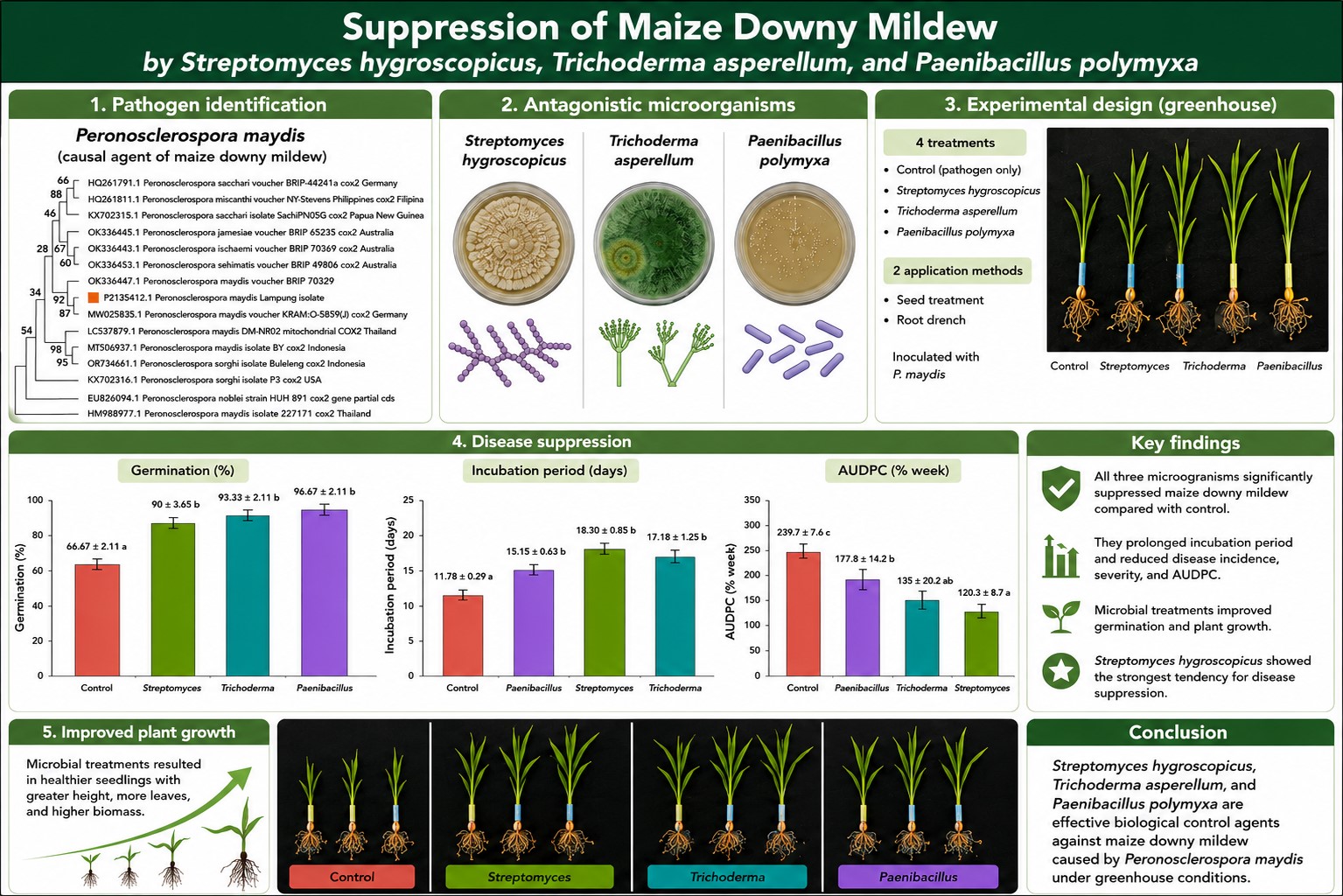
This study identified the causal agent of maize (Zea mays L.) downy mildew in Lampung and evaluated the suppressive effects of three antagonistic microorganisms. The pathogen was identified as Peronosclerospora maydis (Racib.) C.G. Shaw based on cox2 sequence and phylogenetic analyses. Streptomyces hygroscopicus (Jensen) Waksman & Henrici, Trichoderma asperellum Samuels, Lieckf. & Nirenberg, and Paenibacillus polymyxa (Prazmowski) Ash, Priest & Collins were evaluated via a seed germination assay and a greenhouse experiment with soil-drenching and foliar-spraying applications. Microbial treatments increased germination from 66.67% to 90.00–96.67% and prolonged the incubation period from 11.78 to 15.15–18.30 days. At 5 weeks post-treatment, disease severity decreased from 96.88% to 63.13–81.87%, and AUDPC decreased from 239.69 (control) to 120.31–177.81. Streptomyces hygroscopicus and T. asperellum significantly reduced final disease severity, whereas P. polymyxa showed an intermediate response. The application method had no significant effect, indicating that S. hygroscopicus and T. asperellum are promising biological control agents against maize downy mildew.
References
Adhi S.R., Widiantini F., Yulia E. 2024. Early detection of fungicide resistance through sensitivity testing of various fungicide active ingredients and genetic variation of downy mildew-causing Peronosclerospora maydis from maize (corn) production centers in Java, Indonesia. AGRIVITA Journal of Agricultural Science 46 (2): 276–288. DOI: https://doi.org/10.17503/agrivita.v46i2.4276 DOI: https://doi.org/10.17503/agrivita.v46i2.4276
Aeny T.N., Prasetyo J., Suharjo R., Dirmawati S.R., Efri, Niswati A. 2018. Short communication: Isolation and identification of actinomycetes potential as the antagonist of Dickeya zeae pineapple soft rot in Lampung, Indonesia. Biodiversitas 19 (6): 2252–2258. DOI: https://doi.org/10.13057/biodiv/d190610 DOI: https://doi.org/10.13057/biodiv/d190610
Backer R., Rokem J.S., Ilangumaran G., Lamont J., Praslickova D., Ricci E., Subramanian S., Smith D.L. 2018. Plant Growth-Promoting Rhizobacteria: Context, Mechanisms of Action, and Roadmap to Commercialization of Biostimulants for Sustainable Agriculture. Frontiers in Plant Science 9: 1473. DOI: https://doi.org/10.3389/fpls.2018.01473 DOI: https://doi.org/10.3389/fpls.2018.01473
Bocianowski J., Tratwal A., Nowosad K. 2020. Genotype by environment interaction for area under the disease-progress curve (AUDPC) value in spring barley using additive main effects and multiplicative interaction model. Australasian Plant Pathology 49 (4): 525–529. DOI: https://doi.org/10.1007/s13313-020-00723-7 DOI: https://doi.org/10.1007/s13313-020-00723-7
Dobrzyński J., Naziębło A. 2024. Paenibacillus as a biocontrol agent for fungal phytopathogens: Is P. polymyxa the only one worth attention? Microbial Ecology 87: 134. DOI: https://doi.org/10.1007/s00248-024-02450-8 DOI: https://doi.org/10.1007/s00248-024-02450-8
Guzmán-Guzmán P., Kumar A., de los Santos-Villalobos S., Parra-Cota F.I., Orozco-Mosqueda M.d.C., Fadiji A.E., Hyder S., Babalola O.O., Santoyo G. 2023. Trichoderma Species: Our Best Fungal Allies in the Biocontrol of Plant Diseases—A Review. Plants 12 (3): 432. DOI: https://doi.org/10.3390/plants12030432 DOI: https://doi.org/10.3390/plants12030432
Habibullah M., Joko T., Wibowo A., Widiastuti A. 2025. Maize induced resistance against downy mildew mediated by benzoic acid increased photosynthesis rate and chlorophyll content. Journal of Tropical Plant Pests and Diseases 25 (2): 255–261. DOI: https://doi.org/10.23960/jhptt.225255-261 DOI: https://doi.org/10.23960/jhptt.225255-261
Hanafiah D.S., Syamsafitri, Mariati, Hanum C., Muhdi, Rakasiwi G., Abdurrahman M.H., Nur M.A., Sahtika D. 2025. Identification and characterization of corn plants for downy mildew resistance in North Sumatra, Indonesia. Biodiversitas 26 (5): 2130–2138. DOI: https://doi.org/10.13057/biodiv/d260511 DOI: https://doi.org/10.13057/biodiv/d260511
Hudspeth D.S.S., Nadler S.A., Hudspeth M.E.S. 2000. A cox2 molecular phylogeny of the Peronosporomycetes. Mycologia 92 (4): 674–684. DOI: https://doi.org/10.1080/00275514.2000.12061208 DOI: https://doi.org/10.1080/00275514.2000.12061208
Khan M.S., Gao J., Chen X., Zhang M., Yang F., Du Y., Moe T.S., Munir I., Xue J., Zhang X. 2020. Isolation and characterization of plant growth-promoting endophytic bacteria Paenibacillus polymyxa SK1 from Lilium lancifolium. BioMed Research International 2020: 8650957. DOI: https://doi.org/10.1155/2020/8650957 DOI: https://doi.org/10.1155/2020/8650957
Kumar S., Stecher G., Suleski M., Sanderford M., Sharma S., Tamura K. 2024. MEGA12: molecular evolutionary genetics analysis version 12 for adaptive and green computing. Molecular Biology and Evolution 41 (11): msae263. DOI: https://doi.org/10.1093/molbev/msae263 DOI: https://doi.org/10.1093/molbev/msae263
Montesdeoca-Flores D.T., Hernández-Bolaños E., León-Barrios M., Hernández-Amador E., Díaz-González S., Abreu-Acosta N., Luis-Jorge, J.C. 2023. Antifungal Activity of Streptomyces spp. Extracts In Vitro and on Post-Harvest Tomato Fruits against Plant Pathogenic Fungi. Horticulturae 9 (12): 1319. DOI: https://doi.org/10.3390/horticulturae9121319 DOI: https://doi.org/10.3390/horticulturae9121319
Mugiastuti E., Manan A., Soesanto L. 2023. Biological control of maize downy mildew with the antagonistic bacterial consortium. Biodiversitas 24 (9): 4644–4650. DOI: https://doi.org/10.13057/biodiv/d240904 DOI: https://doi.org/10.13057/biodiv/d240904
Pakki S., Djaenuddin N. 2019. The effectiveness combination of resistant varieties and metalaxyl fungicide in controlling downy mildew disease (Peronosclerospora maydis) in maize plant. Journal of Tropical Plant Pests and Diseases 19 (1): 42–51. DOI: https://doi.org/10.23960/j.hptt.11942-51 DOI: https://doi.org/10.23960/j.hptt.11942-51
Précigout P.A., Claessen D., Makowski D., Robert C. 2020. Does the latent period of leaf fungal pathogens reflect their trophic type? A meta-analysis of biotrophs, hemibiotrophs, and necrotrophs. Phytopathology 110 (2): 345–361. DOI: https://doi.org/10.1094/PHYTO-04-19-0144-R DOI: https://doi.org/10.1094/PHYTO-04-19-0144-R
R Core Team. 2024. R: a language and environment for statistical computing. R Foundation for Statistical Computing, Vienna, Austria. Available from: https://www.R-project.org/
Sinclair J.B., Dhingra O.D. 2017. Basic Plant Pathology Methods. 2nd ed. CRC Press, Boca Raton, FL, USA, 434 pp. DOI: https://doi.org/10.1201/9781315138138 DOI: https://doi.org/10.1201/9781315138138
Suharjo R., Swibawa G., Prasetyo J., Fitriana Y., Danaatmadja Y., Budiawan A., Roberts S., Noorhajati N., Amad M., Thines M. 2020. Peronosclerospora australiensis is a synonym of P. maydis. Mycological Progress 19 (12): 1309–1315. DOI: https://doi.org/10.1007/s11557-020-01628-x DOI: https://doi.org/10.1007/s11557-020-01628-x
Townsend G.R., Heuberger J.W. 1943. Methods for estimating losses caused by diseases in fungicide experiments. Plant Disease Reporter 27: 340–343
Velásquez A.C., Castroverde C.D.M., He S.Y. 2018. Plant-pathogen warfare under changing climate conditions. Current Biology 28 (10): R619–R634. DOI: https://doi.org/10.1016/j.cub.2018.03.054 DOI: https://doi.org/10.1016/j.cub.2018.03.054
Viaene T., Langendries S., Beirinckx S., Maes M., Goormachtig S. 2016. Streptomyces as a plant’s best friend? FEMS Microbiology Ecology 92 (2): fiw119. DOI: https://doi.org/10.1093/femsec/fiw119 DOI: https://doi.org/10.1093/femsec/fiw119
Vitale A. 2023. Epidemiology and Control of Plant Diseases. Plants 12 (4): 793. DOI: https://doi.org/10.3390/plants12040793 DOI: https://doi.org/10.3390/plants12040793
Yuan P., Zhu L., Song Z., Wang Y., Chen X. 2025a. From biocontrol to synthesis: innovative progress of Paenibacillus in mechanism analysis, gene editing and platform construction. International Journal of Molecular Sciences 26 (22): 10886. DOI: https://doi.org/10.3390/ijms262210886 DOI: https://doi.org/10.3390/ijms262210886
Yuan P., Song Z., Zhang L., Pan Z., Chen X. 2025b. Exploring the multifunctional role of Paenibacillus metabolites in various fields. International Journal of Molecular Sciences 26 (24): 12089. DOI: https://doi.org/10.3390/ijms262412089 DOI: https://doi.org/10.3390/ijms262412089
Downloads
Published
How to Cite
Issue
Section
License
Copyright (c) 2025 Journal of Plant Protection Research

This work is licensed under a Creative Commons Attribution 4.0 International License.





