
Enhancing sunflower growth and defense against Sclerotinia sclerotiorum stress with cyanogenic bacterial endophytes
DOI:
https://doi.org/10.24425/jppr.2026.3286Abstract
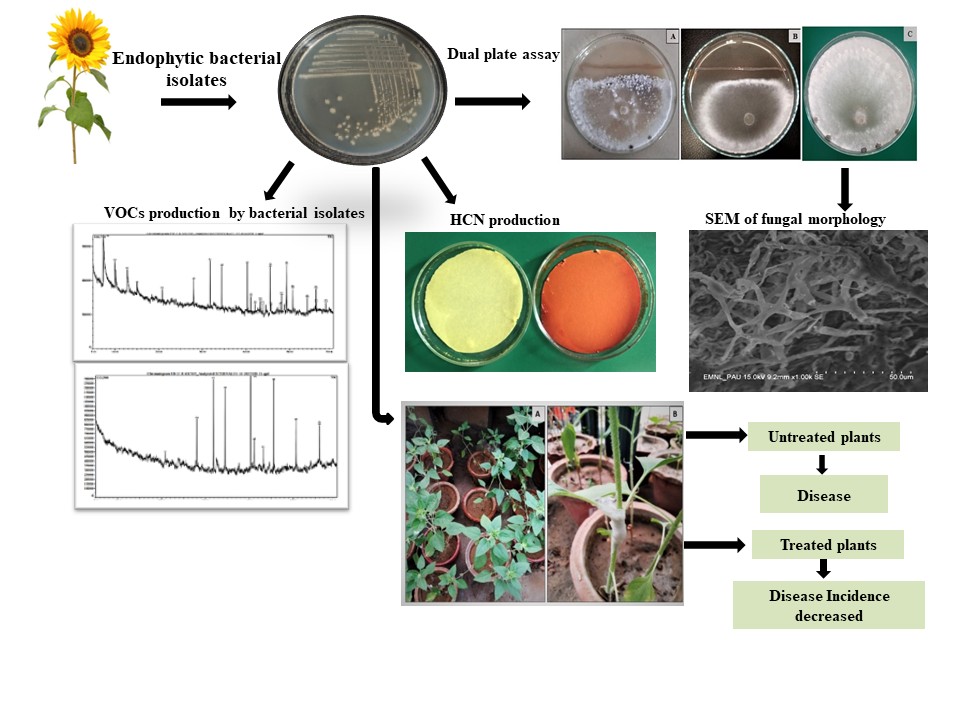
The present study was designed to check the ability of cyanogenic antagonistic bacterial endophytes to produce volatile organic compounds and enhance growth of sunflower under Sclerotinia sclerotiorum stress. Forty endophytic bacteria were isolated and screened for antagonism against Sclerotinia sclerotiorum. Out of 40 endophytes, two isolates SEB1 and SEB21 exhibited fungal growth inhibition of 30.0 and 36.6%, respectively, in dual plate assay and 78.7 and 82%, respectively, in liquid media. Scanning electron microscopy showed rupturing, breakage and shrinkage of the fungal hyphae in the presence of the antagonistic bacterial strains. In addition, the bacterial strains also exhibited phosphate solubilization, and production of hydrogen cyanide, siderophores, auxins, ammonia, lipase and cellulases. The isolates were identified as Sphingobacterium solani SEB1 and Pseudomonas sp. SEB21 by 16S rRNA gene sequencing. GCMS analysis confirmed the presence of dimethyl-sulfone, phenol, 3-hexadecene, 2,4-ditertbutylphenol, 1-docosene, 1-octadecene, 2,4-dimethylphenylimino-4-nitrophenyl, nonylcyclopropane 1-nonadecene, octacosane, n-octadecanol, isopropyl myristate, 3-hexadecene, 7,9-di-tert-butyl-1-oxosiro-4,5-deca-6,9-diene, 3,5-bis (1,1-dimethylethyl)-phenol, isopropyl myristate, 7,9-ditert-butyl-1-oxospiro (4,5) deca-6,9-diene-2,8-dione, 1-tricosene and octacosanol as major volatile organic compounds produced by the bacterial strains. SEM analysis showed colonization of plant tissues by both the bacterial strains validating their endophytic nature. The bacterial treatments showed disease control up to 88.9% and significantly improved vigor index, plant growth, total phenol and chlorophyll content over the uninoculated control in sunflower grown under greenhouse conditions. The treatment SsSEB1+PspSEB21 in the presence of the fungal pathogen showed 1.41%, 0.47% and 6.8% N, P and K content in plants, respectively, which was the highest among all the treatments. Further field-level evaluations are recommended to validate the effectiveness of Sphingobacterium solani SEB1 and Pseudomonas sp. SEB21 as biological control agents. Sphingobacterium solani as a biocontrol agent and a plant growth-promoting endophyte is reported here for the first time.
References
Albert D., Zboralski A., Ciotola M., Cadieux M., Biessy A., Blom J., Beaulieu C., Filion M. 2024. Identification and genomic characterization of Pseudomonas spp. displaying biocontrol activity against Sclerotinia sclerotiorum in lettuce. Frontiers in Microbiology 15: 1304682. DOI: https://doi.org/10.3389/fmicb.2024.1304682
Ansary W.R., Prince F.R.K., Haque E., Sultana F., West H.M., Rahman M., Mondol A.M., Akanda A.M., Rahman M., Clarke M.L., Islam T. 2018. Endophytic Bacillus spp. from medicinal plants inhibit mycelial growth of Sclerotinia sclerotiorum and promote plant growth. Zeitschrift für Naturforschung 73 (5-6): 247-256. DOI: https://researchrepository.wvu.edu/faculty_publications
Aulton M.E., Taylor K.M.G. 2013. Aulton's Pharmaceutics: The Design and Manufacture of Medicines. 4th ed. Elsevier, 435 pp.
Bakker A.W., Schippers B.O. 1987. Microbial cyanide production in the rhizosphere in relation to potato yield reduction and Pseudomonas spp-mediated plant growth-stimulation. Soil Biology and Biochemistry 19 (4): 451-457. DOI: https://doi.org/10.1016/0038-0717(87)90037-X
Balachandar R., Karmegam N., Saravanan M., Subbaiya R., Gurumoorthy P. 2018. Synthesis of bioactive compounds from vermicast isolated actinomycetes species and its antimicrobial activity against human pathogenic bacteria. Microbial Pathogenesis 121: 155-165. DOI: https://doi.org/10.1016/j.micpath.2018.05.027
Bansal R., Vyas P., Sharma S. 2025. Formulation and field performance of liquid phosphate-solubilizing bacteria for improved growth, yield and nutrient content of potato. Frontiers in Microbiology 16: 1734471. DOI: https://doi.org/10.3389/fmicb.2025.1734471
Bornman S., Thomas C., Ntladi S. Wilken P.M. 2024. Sclerotinia sclerotiorum is the causal agent of Sclerotinia stem rot on peanut (groundnut) in South Africa. Australasian Plant Disease Notes 19 (1): 13. DOI: https://doi.org/10.1007/s13314-024-00537-2
Cappuccino J.C. Sherman N. 1992. Microbiology: A laboratory manual (125-179). New York.
Claus G.W. 1989. Understanding Microbes: A Laboratory Textbook for Microbiology. Macmillan, 547 pp.
Collmer A., Ried J.L., Mount M.S. 1988. Assay methods for pectic enzymes. Methods in Enzymology 161: 329-335. DOI: https://doi.org/10.1016/0076-6879(88)61037-8
Das T.S., Ramesh L., Agastian P. 2016. GC-MS analysis of bioactive constituents of Aristolochia bracteolata Linn with in-vitro antioxidant properties. Journal of Applied Pharmaceutical Sciences 6 (12): 061-066. DOI: https://doi.org/10.7324/JAPS.2016.601209
de Almeida Lopes K.B., Carpentieri‐Pipolo V., Fira D., Balatti P.A., López S.M.Y., Oro T.H., Stefani Pagliosa E., Degrassi G. 2018. Screening of bacterial endophytes as potential biocontrol agents against soybean diseases. Journal of Applied Microbiology 125 (5): 1466-1481. DOI: https://doi.org/10.1111/jam.14041
Derbyshire M.C., Newman T.E., Khentry Y., Owolabi Taiwo A. 2022. The evolutionary and molecular features of the broad‐host‐range plant pathogen Sclerotinia sclerotiorum. Molecular Plant Pathology 23 (8): 1075-1090. DOI: https://doi.org/10.1111/mpp.13221
Deshwal V.K. 2012. Pseudomonas aeruginosa as biological control agent against plant pathogenic fungus Sclerotina sclerotiorum. International Journal of Plant, Animal and Environmental Sciences 2 (1): 14-17.
Dhouib H., Zouari I., Abdallah D.B., Belbahri L., Taktak W., Triki M.A., Tounsi S. 2019. Potential of a novel endophytic Bacillus velezensis in tomato growth promotion and protection against Verticillium wilt disease. Biological Control 139: 104092. DOI: https://doi.org/10.1016/j.biocontrol.2019.104092
Farkaš V., Lišková M., Biely P. 1985. Novel media for detection of microbial producers of cellulase and xylanase. FEMS Microbiology Letters 28 (2): 137-140. DOI: https://doi.org/10.1111/j.1574-6968.1985.tb00779.x
Gholamhoseini M., Ghalavand A., Dolatabadian A., Jamshidi E., Khodaei-Joghan A. 2013. Effects of arbuscular mycorrhizal inoculation on growth, yield, nutrient uptake and irrigation water productivity of sunflowers grown under drought stress. Agricultural Water Management 117: 106-114. DOI: https://doi.org/10.1016/j.agwat.2012.11.007
Goes K.C.G.P.D., Fisher M.L.D.C., Cattelan A.J., Nogueira M.A., Carvalho C.G.P.D., Oliveira A.L.M.D. 2012. Biochemical and molecular characterization of high population density bacteria isolated from sunflower. Journal of Microbiology and Biotechnology 22 (4): 437-447. DOI: https://doi.org/10.4014/jmb.1109.09007
Goswami S.K., Singh V., Chakdar H., Choudhary P. 2018. Harmful effects of fungicides-Current status. International Journal of Agriculture Environment and Biotechnology 11: 1011-1019.
Gulati A., Rahi P., Vyas P. 2008. Characterization of phosphate-solubilizing fluorescent pseudomonads from the rhizosphere of seabuckthorn growing in the cold deserts of Himalayas. Current Microbiology 56: 73-79. DOI: https://doi.org/10.1007/s00284-007-9042-3
Gulya T.J., Woods D.M., Bell R., Mancl M.K. 1991. Diseases of sunflower in California. 75: 572-574.
Gupta R., Singal R., Shankar A., Kuhad R.C., Saxena R.K. 1994. A modified plate assay for screening phosphate solubilizing microorganisms. The Journal of General and Applied Microbiology 40 (3): 255-260. DOI: https://doi.org/10.2323/jgam.40.255
Harveson R.M., Markell S.G., Block C.C., Gulya T.J. 2016. Compendium of sunflower diseases and pests. 140 pp.
Hillis W.E., Swain T. 1959. The phenolic constituents of Prunus domestica. II.—The analysis of tissues of the Victoria plum tree. Journal of the Science and Food Agriculture 10 (2): 135-144. DOI: https://doi.org/10.1002/jsfa.2740100211
Huang L., Li F., Liu R., Guo J., Yang Z., Bai L. 2019. Antifungal activity of an endophytic strain of Phomopsis sp. on Sclerotinia sclerotiorum, the causal agent of Sclerotinia disease. Journal of Plant Pathology 101: 521-528. DOI: https://doi.org/10.1007/s42161-018-00225-y
Jackson ML. 1973, Soil Chemical Analysis. New Delhi, India, 187 pp.
Kai M., Effmert U., Piechulla B. 2016. Bacterial-plant-interactions: approaches to unravel the biological function of bacterial volatiles in the rhizosphere. Frontiers in Microbiology 7: 108. DOI: https://doi.org/10.3389/fmicb.2016.00108
Kai M., Elmassry M., Farag M.A. 2020. Sampling, detection, identification, and analysis of bacterial volatile organic compounds (VOCs). p. 281-304. In “Bacterial Volatile Compounds as Mediators of Airborne Interactions” (Choong-Min Ryu, Laure Weisskopf, Birgit Piechulla, eds.). Springer Singapore, 336 pp.
Kannan V., Sureendar R. 2009. Synergistic effect of beneficial rhizosphere microflora in biocontrol and plant growth promotion. Journal of Basic Microbiology 49 (2): 158-164. DOI: 10.1002/jobm.200800011
Kara Y, Koca S, Vaizogullar HE, Kuru A. 2013. Studying phytoremediation capacity of jojoba (Simmondsia chinensis) and sunflower (Helianthus annuus) in hydroponic systems. Current Opinions in Biotechnology 1: 24-S34. DOI: http://dx.doi.org/10.1016/j.copbio.2013.05.061
Karpagasundari C., Kulothungan S. 2014. Analysis of bioactive compounds in Physalis minima leaves using GC MS, HPLC, UV-VIS and FTIR techniques. Journal of Pharmacognosy and Phytochemistry 3 (4): 196-201. DOI: http://www.phytojournal.com/vol3Issue4/Issue_nov_2014/47.1.pdf
Kaur A., Devi S.R., Vyas P. 2018. Stress-tolerant antagonistic plant growth-promoting rhizobacteria from Zea mays. Journal of Plant Protection Research 58 (2): 115-123. DOI:
DOI: https://doi.org/10.24425/119127
Kaur A., Vyas P., Gupta N., Kapoor R., Pathak L. 2025. Endophytic Bacillus inaquosorum and Bacillus safensis enhanced growth, proline content and antioxidant enzymes in Avena sativa L. under salt stress. Current Microbiology 82 (12): 549. DOI: 10.1007/s00284-025-04536-z
Khan I.H., Javaid A. 2019. Antifungal, antibacterial and antioxidant components of ethyl acetate extract of quinoa stem. Plant Protection 3 (3): 125-130. DOI: https://doi.org/10.33804/PP.003.03.3109
Kinden D.A., Brown M.F. 1975. Technique for Scanning Electron Microscopy of Fungal. Phytopathology 65: 74-76.
Loper J.E., Schroth M.N. 1986. Influence of bacterial sources of indole-3-acetic acid on root elongation of sugar beet. Phytopathology 76 (4): 386-389.
López S.M., Pastorino G.N., Balatti P.A. 2021. Volatile organic compounds profile synthesized and released by endophytes of tomato (Solanum lycopersici L.) and their antagonistic role. Archives of Microbiology 203 (4): 1383-1397. DOI: https://doi.org/10.1007/s00203-020-02136-y
Lusty C. J., Doudoroff M. 1966. Poly-beta-hydroxybutyrate depolymerases of Pseudomonas lemoignei. Proceedings of the National Academy of Sciences 56 (3): 960-965. DOI: doi: 10.1073/pnas.56.3.960.
Martins C.D., Liduino V.S., Oliveira F.J., Sérvulo E.F.C. 2014. Phytoremediation of soil multi-contaminated with hydrocarbons and heavy metals using sunflowers. International Journal of Engineering & Technology 14 (5): 1-6. DOI: https://api.semanticscholar.org/CorpusID:49234963
Matysiak J., Malinski Z. 2007. 2-(2, 4-dihydroxyphenyl)-1, 3, 4-thiadiazole analogues: Antifungal activity in vitro against Candida species. Russian Journal of Bioorganic Chemistry 33: 594-601. DOI: https://api.semanticscholar.org/CorpusID:23747444
Mends M.T., Yu E., Strobel G.A., Riyaz-Ul-Hassan S., Booth E., Geary B., Sears J., Taatjes C.A., Hadi M.Z. 2012. An endophytic Nodulisporium sp. producing volatile organic compounds having bioactivity and fuel potential. Journal of Petroleum and Environmental Biotechnology 3 (3): 1-17. DOI: 10.4172/2157-7463.1000117
Motlagh M.R.S., Rad S.A., Mohesien M.T., Mossa M.I., Seidavi A., Ghosh S.,Sheir D.H., Dashora K., Abdel-Azeem A.M. 2023. Potential of selected tobacco endophytic fungi against Sclerotinia sclerotiorum, the causal agent of tobacco collar rot disease. Sydowia 75: 221-232.
Sydowia 75 (2023) 221
DOI 10.12905/0380.sydowia75-2023-0221
Nguyen D.T.C., Nguyen T.T., Le H.T., Nguyen T.T.T., Bach L.G., Nguyen T.D., Vo D.V.N., Van Tran T. 2021. The sunflower plant family for bioenergy, environmental remediation, nanotechnology, medicine, food and agriculture: a review. Environmental Chemistry Letters 19: 3701-3726. DOI:10.1007/s10311-021-01266-z
Niu X., Cui W., Cui M., Zhang X., Zhang S., Xu B. Gao M. 2018. Sphingobacterium solani sp. nov., isolated from potato stems. International Journal of Systematic and Evolutionary Microbiology 68 (4): 1012-1017. DOI: https://doi.org/10.1099/ijsem.0.002605
Olsen S.R. 1954. Estimation of available phosphorus in soils by extraction with sodium bicarbonate (No. 939). US Department of Agriculture.
Pilorgé E. 2020. Sunflower in the global vegetable oil system: situation, specificities and perspectives. OCL 27: 34. DOI: https://doi.org/10.1051/ocl/2020028
Rabuske J.E., Muniz M.F.B., Brun T., Saldanha M.A., Sarzi J.S., Savian L.G., Walker C., Rolim J.M., Zabot G.L., Mazutti, M.A. 2023. Trichoderma asperellum in the biocontrol of Lasiodiplodia theobromae and Pseudofusicoccum kimberleyense. Journal of Plant Protection Research 63 (4): 488-498. DOI: https://doi.org/10.24425/jppr.2023.147832
Rai S.K., Charak D., Bharat R., 2016. Scenario of oilseed crops across the globe. Plant Archives 16 (1): 125-132. DOI: http://www.plantarchives.org/PDF%2016%20-%201/125-132%20(PA3-3149).pdf
Schwyn B., Neilands J. 1987. Universal chemical assay for the detection and determination of siderophores. Analytical biochemistry 160 (1): 47-56. DOI: https://doi.org/10.1016/0003-2697(87)90612-9
Servi H., Keskin B.E., Yılancıoğlu K., Çelik S. 2019. Essential oil composition and antibacterial activities of Gypsophila species. International Journal of Secondary Metabolites 6 (1): 20-27. DOI: https://doi.org/10.21448/ijsm.454942
Smolińska U., Kowalska B. 2018. Biological control of the soil-borne fungal pathogen Sclerotinia sclerotiorum––a review. Journal of Plant Pathology 100: 1-12. DOI: https://doi.org/10.1007/s42161-018-0023-0
Sundaramoorthy S., Raguchander T., Ragupathi N., Samiyappan R. 2012. Combinatorial effect of endophytic and plant growth promoting rhizobacteria against wilt disease of Capsicum annum L. caused by Fusarium solani. Biological Control 60 (1): 59-67. DOI: https://doi.org/10.1016/j.biocontrol.2011.10.002
Tan D., Fu L., Han B., Sun X., Zheng P., Zhang J. 2015. Identification of an endophytic antifungal bacterial strain isolated from the rubber tree and its application in the biological control of banana Fusarium wilt. PLoS One 10: e0131974. DOI: https://doi.org/10.1371/journal.pone.0131974
Topolovec-Pintarić S., Kovaček A.M., Malev O., Kušan I., Matočec N., Pošta A., Pole L., Mešić A. 2025. Biological control of Sclerotinia sclerotiorum on greenhouse lettuce using Trichoderma koningiopsis Agg. Microbiology Research 16 (2): 35. DOI:
https://doi.org/10.3390/microbiolres16020035
Vinayarani G., Prakash H. 2018. Growth promoting rhizospheric and endophytic bacteria from Curcuma longa L. as biocontrol agents against rhizome rot and leaf blight diseases. Plant Pathology 34 (3): 218-235. doi: 10.5423/PPJ.OA.11.2017.0225
Vyas P., Singh B. 2024. Plant growth-promoting endophytes from Stevia rebaudiana identified to possess bio-control potential against maize sheath blight pathogen Rhizoctonia solani. European Journal of Plant Pathology 168 (3): 571-591. DOI: https://doi.org/10.1007/s10658-023-02785-x
Vyas P., Kaur K., Sardana V., Sharma S. 2025. Seed biopriming with endophytic Pseudomonas putida and Serratia proteamaculans consortium enhanced growth, nutrient content and yield of rapeseed-mustard. Indian Journal of Microbiology 65: 1703-1717. DOI: https://doi.org/10.1007/s12088-024-01443-y
Wang Y. 2024. Progress in the study of pathogenic factors of Sclerotinia sclerotiorum. Theoretical and Natural Science 59 (1): 138-145. DOI: 10.54254/2753-8818/59/20241378
Weisburg W.G., Barns S.M., Pelletier D.A., Lane D.J. 1991. 16S ribosomal DNA amplification for phylogenetic study. Journal of Bacteriology 173 (2): 697-703. DOI: doi: 10.1128/jb.173.2.697-703.1991.
Wielkopolan B., Jakubowska M., Dobosz R., Bocianowski J., Bruzzoniti M.C., Mayhew C.A., Narloch I., Dawidowicz K., Piesik D. 2025. The effects of biotic and abiotic stress on the emission of volatile organic compounds by sugar beet plants. Journal of Plant Protection Research 65 (3): 413-423. DOI: https://doi.org/10.24425/jppr.2025.155780
Zhang Y., Li T., Xu M., Guo J., Zhang C., Feng Z., Peng X., Li Z., Xing K., Qin S. 2021. Antifungal effect of volatile organic compounds produced by Pseudomonas chlororaphis subsp. aureofaciens SPS-41 on oxidative stress and mitochondrial dysfunction of Ceratocystis fimbriata. Pesticide Biochemistry and Physiology 173: 104777. DOI: 10.1016/j.pestbp.2021.104777.
Downloads
Published
How to Cite
Issue
Section
License
Copyright (c) 2026 Journal of Plant Protection Research

This work is licensed under a Creative Commons Attribution 4.0 International License.