
Application of Lantana camara L. leaf extracts and essential oils for increasing yield and improving pest management in the production of tomato (Solanum lycopersicum L.) cultivar VF
DOI:
https://doi.org/10.24425/jppr.2026.158065Abstract
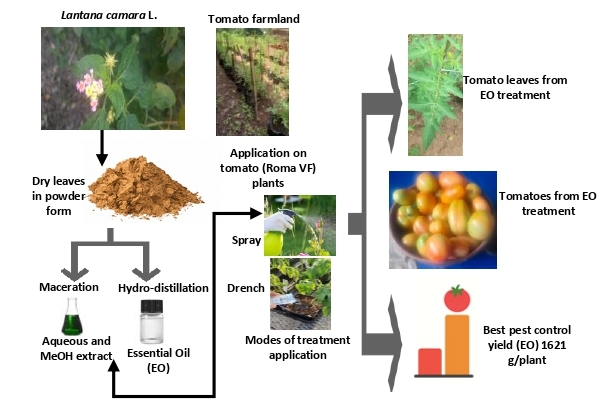
Tomato (Solanum lycopersicum L.) is the most commonly consumed vegetable in Nigeria, and synthetic pesticides are frequently used to protect tomatoes against pests and diseases. However, the environment and human health are negatively impacted by their use, prompting consideration of alternative, environmentally safe treatments. Lantana camara L. (commonly known as sage, family Verbenaceae), a commonly occurring plant, has shown promise as a natural alternative for controlling tomato pests and may serve as an eco-friendly substitute for synthetic pesticides. Therefore, the potential of extracts of L. camara and essential oils (EOs) for the production and protection of the tomato variety “Roma VF” was studied under field conditions in Ibadan, Nigeria. Fresh L. camara leaves were collected from plants growing on the University of Ibadan campus, Oyo State and identified at the Herbarium section, Department of Botany, University of Ibadan (UIH 23103). The leaves were air-dried, pulverized and subjected to hydrodistillation for EO extraction. The methanol and aqueous extracts of L. camara were obtained by maceration in methanol and water, respectively. An in vivo pesticidal bioassay was conducted to determine the biocidal potential of L. camara leaves using aqueous extract, methanolic extract, EO and water (as control) via two modes of application (spraying and drenching). The data were analysed using ANOVA and DMRT. The EO treatment gave the best control of the pests and resulted in higher fruit yield (1821 g · plant‒1) compared to the control (512.5 g · plant‒1). Thus, the EO from L. camara leaves demonstrated promising biocidal potential and can be effectively used to protect tomatoes against pests for increased fruit yield.
References
Abdul I.M., Ahmed K.Y., Badamasi S. 2020. Review of the problems of tomato value chain in Nigeria: remedial option. International Journal of Agriculture, Forestry and Fisheries 8 (3): 90–95.
Abo-Elyousr K.A.M., Seleim M.A.A., Abd-El-Moneem K.M.H. 2014. Integrated effect of glomus mosseae and selected plant oils on the control of bacterial wilt disease of tomato. Crop Protection 66: 67–71. DOI: https://doi.org/10.1016/j.cropro.2014.07.022
Araya A. Abraha G., Ibrahim F., Tarekegn Y. 2018. Effectiveness of phyto-pesticidal extracts against the emerging tomato leaf miner in northern ethiopia. Journal of Hill Agriculture 9 (1): 94. DOI: http://doi.org/10.5958/2230-7338.2018.00017.4
Bashir S., Jabeen K., Iqbal S., Javed S., Naeem A. 2019. Lantana camara: phytochemical analysis and antifungal prospective. Planta Daninha 37: 1–7. DOI: https://doi.org/10.1590/S0100-83582019370100137
Bassolé I.H.N., Juliani H.R. 2012. Essential oils in combination and their antimicrobial properties. Molecules 17 (4): 3989–4006. DOI: https://doi.org/10.3390/molecules17043989
Bowers J.H., Locke J.C. 2004. Effect of formulated plant extracts and oils on population density of Phytophthora nicotianae in soil and control of Phytophthora blight in the greenhouse. Plant Disease 8 (1): 11–16. DOI: https://doi.org/10.1094/PDIS.2004.88.1.11
Gondal A.S., Ijaz M., Riaz K., Khan A. 2012. Effect of different doses of fungicide (mancozeb) against alternaria leaf blight of tomato in tunnel. Journal of Plant Pathology and Microbiology 03 (03): 125–131. DOI: http://doi.org/10.4172/2157-7471.1000125
Hassanein N.M., Abou Zeid M.A., Youssef K.A., Mahmoud D.A. 2008. Efficacy of leaf extracts of neem (azadirachta indica) and chinaberry (melia azedrach) against early blight and wilt diseases of tomato. Australian Journal of Basic and Applied Sciences 2 (3): 763–772.
Hendricks K.E., Christman M.C., Roberts P.D. 2020. The effect of weather and location of fruit within the tree on the incidence and severity of citrus black spot on fruit. Scientific Reports 10 (1): 1389–1400. DOI: https://doi.org/10.1038/s41598-020-58188-z
Hussein N., Hussein M., Gadel Hak S., Shaalan H., Hammad M. 2015. Effect of two plant extracts and four aromatic oils on Tuta absoluta population and productivity of tomato cultivar Gold Stone. Journal of Plant Protection and Pathology 6 (6): 969–985. DOI: http://doi.org/10.21608/jppp.2015.74529
Kagale S., Marimuthu T., Thayumanavan B., Nandakumar R., Samiyappan R. 2004. Antimicrobial activity and induction of systemic resistance in rice by leaf extract of datura metel against Rhizoctonia solani and Xanthomonas oryzae pv. oryzae. Physiological and Molecular Plant Pathology 65 (2): 91–100. DOI:m https://doi.org/10.1016/j.pmpp.2004.11.008
Kumar R., Guleria N., Deeksha M.G., Kumari N., Kumar R., Jha A. K., Parmar N., Ganguly P., de Aguiar Andrade E.H., Ferreira O.O., de Oliveira M.S., and Chandini. 2024. From an invasive weed to an insecticidal agent: exploring the potential of lantana camara in insect management strategies ‒ a review. International Journal of Molecular Sciences 25 (23): 12788. DOI: https://doi.org/10.3390/ijms252312788
Nahak G., Sahu R.K. 2015. Biopesticidal effect of leaf extract of neem (azadirachta indica a. juss) on growth parameters and diseases of tomato. Journal of Applied and Natural Science 7 (1): 482–488. DOI: https://doi.org/10.31018/jans.v7i1.636
Nashwa S.M.A.. Abo-Elyou K.A.M. 2012. Evaluation of various plant extracts against the early blight disease of tomato plants under greenhouse and field conditions. Plant Protection Science 48 (2): 74–79. DOI: https://doi.org/10.17221/14/2011-PPS
Nea F., Tanoh E.A., Wognin E.L., Kemene K.T., Genva M., Saive M., Tonzibo Z.F., Fauconnier M. L. 2019. A new chemotype of Lantana rhodesiensis moldenke essential oil from Côte D’ivoire: chemical composition and biological activities. Industrial Crops and Products 141 (1): 111766. DOI: https://doi.org/10.1016/j.indcrop.2019.111766
Nowicki M., Kozik E.U., Foolad M.R. 2013. Late Blight of Tomato in Translational Genomics for Crop Breeding: Biotic Stress. p. 241–265. Volume 1. Wiley Online Library. DOI: https://doi.org/10.1002/9781118728475.ch13
Pharmacopoeia. 1988. British Pharmacopoeia.
Regnier T., Combrinck S., Du Plooy W. 2012. Essential oils and other plant extracts as food preservatives in progress in food preservation. Wiley-Blackwell: 539–579. DOI: https://doi.org/10.1002/9781119962045.ch26
Singh V.K., Singh A.K., Kumar, A. 2017. Disease management of tomato through pgpb: current trends and future perspective. 3 Biotech 7 (1): 255–265. DOI: https://doi.org/10.1007/s13205-017-0896-1
Solórzano-Santos F., Miranda-Novales M.G. 2012. Essential oils from aromatic herbs as antimicrobial agents. Current Opinion in Biotechnology 2(2): 136–141. DOI: https://doi.org/10.1016/j.copbio.2011.08.005
Sotade A.A., Aiyelaagbe O.O., Aduramigba-Modupe A.O., Akinbuluma M.D., Aiyelaagbe I. O. O. 2022. Growth and yield response of tomato (solanum lycopersicum l.) to leaf extracts of Lantana camara l. African Journal of Organic Agriculture and Ecology 6: 41–47.
Sotade A.A., Ajiboye, C.O., Aiyelaagbe, O.O. 2023. Composition, antioxidant and antimicrobial activities of volatile oils from Lantana camara linn. ASRIC Journal on Natural Sciences 3 (1): 125–31
Zhu P., Zhang Y., Deng M., Zhang Y., Luo J., Han R., Xu L. 2025. Microplastics and nanoplastics alter the physicochemical properties of willow trees and lead to mortality in leaf beetle larvae. Plant, Cell & Environment 48 (5): 2895–2909. DOI: http://dx.doi.org/10.1111/pce.15317
Downloads
Published
How to Cite
Issue
Section
License
Copyright (c) 2026 Journal of Plant Protection Research

This work is licensed under a Creative Commons Attribution 4.0 International License.