
The spread of alien aphid species Cinara curvipes and Cinara cedri in Europe – the impact of climate and plant trade
DOI:
https://doi.org/10.24425/jppr.2026.1063Abstract
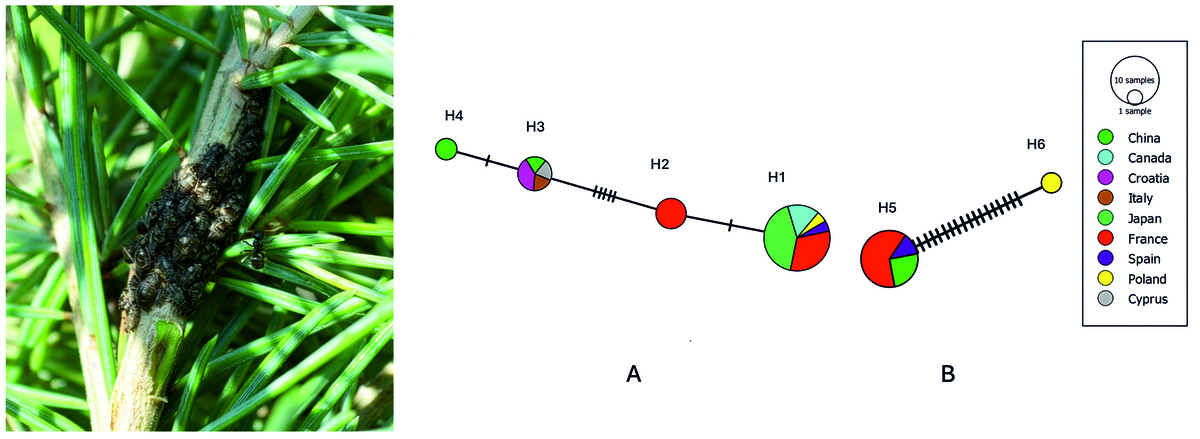
Aphids are a strict group of insects that are particularly stimulated by current climate changes. Recent modifications in their life cycles, development, migration dates and geographical ranges are attributed to changes of local climates. Cinara curvipes, a species trophically related mainly to Abies spp., has been observed in Poland since 2015, while Cinara cedri, feeding on Cedrus sp., has been observed since 2022. Their presence is always associated with mass occurrence on host plants. The aim of this study was molecular identification of the species C. cedri and C. curvipes, collected in Poland. Potential pathways of introduction and spread of these species across Europe and the world was discussed. Based on the analysis of two genetic markers (COI and EF1-α), haplotype networks illustrating the relationships between populations from different parts of Europe and the world were presented. A contrasting pattern of low intraspecific variation in C. curvipes, but high in C. cedri was demonstrated, which may be associated with the modes of reproduction, mechanisms of dispersal of these two species, as well as introgressive hybridization between C. cedri and aphids belonging to Cinara (Cupressobium). Genetic relationships between mitochondrial haplotypes have shown that these species have reached Poland from western and southern Europe. These species have spread from their natural range mainly through imported plant material. Human activity and climate warming have enabled them to successfully settle.
References
Alves G.C., Nutter F.W., Gleason M.L. 2018. Infestation by Myzus persicae increases susceptibility of Brassica napus to Rhizoctonia solani. Frontiers in Plant Science 9: 1903. DOI: https://doi.org/10.3389/fpls.2018.01903 DOI: https://doi.org/10.3389/fpls.2018.01903
Ballard J.W.O., Whitlock M.C. 2004. The incomplete natural history of mitochondria. Molecular Ecology 13 (4): 729–744. DOI: https://doi.org/10.1046/j.1365-294X.2003.02063.x DOI: https://doi.org/10.1046/j.1365-294X.2003.02063.x
Beğen H.A., Görür G., Şenol Ö. 2019. Cinara (Hemiptera: Aphidoidea) species distributed in Turkey and their host plants. Turkish Journal of Biodiversity 2 (1): 24–33. DOI: https://doi.org/10.38059/biodiversity.538473 DOI: https://doi.org/10.38059/biodiversity.538473
Binazzi F., Strangi A., Paoli F., Sabbatini-Peverieri G., Roversi P.F., Binazzi A. 2017. A new aphid subspecies on the endemic Cyprus cedar Cedrus brevifolia: Cinara cedri brevifoliae ssp. n. (Aphididae Lachninae). Bulletin of Insectology 70 (1): 75-82
Caillaud M.C., Via S. 2000. Specialized feeding behavior influences both ecological specialization and assortative mating in sympatric host races of pea aphids. The American Naturalist 156: 606–621. DOI: https://doi.org/10.1086/316991 DOI: https://doi.org/10.1086/316991
Chen R., Jiang L.Y., Qiao G.X. 2012. The effectiveness of three regions in mitochondrial genome for aphid DNA barcoding: a case in Lachininae. PLOS ONE 7 (10): e46190. DOI: https://doi.org/10.1371/journal.pone.0046190 DOI: https://doi.org/10.1371/journal.pone.0046190
Cinara cedri Mimeur, 1936. 2023. GBIF Backbone Taxonomy. Checklist dataset. DOI: https://doi.org/10.15468/39omei [Online] [Available from: GBIF] [Accessed 23 March 2025].
Cinara curvipes (Patch, 1912). 2023. GBIF Backbone Taxonomy. Checklist dataset. DOI: https://doi.org/10.15468/39omei [Online] [Available from: GBIF.org] [Accessed 23 March 2025].
Dong Q.Z., Wei K., Meng Q.X. 1987. Long distance migration of Sitobion miscanthi in Ningxia Province. Acta Entomologica Sinica 30: 277–288.
Durak R. 2011. Molecular and morphological identification of Cinara juniperi and Cinara mordvilkoi. Bulletin of Insectology 64 (2): 195–199.
Durak R. 2014. The overwintering strategy of the anholocyclic aphid Cinara tujafilina. Physiological Entomology 39: 313–321. DOI: https://doi.org/10.1111/phen.12077 DOI: https://doi.org/10.1111/phen.12077
Durak R., Borowiak-Sobkowiak B. 2013. Influence of temperature on the biological parameters of the anholocyclic species Cinara tujafilina (Hemiptera: Aphidoidea). Open Life Sciences 8 (6): 570–577. DOI: https://doi.org/10.2478/s11535-013-0161-x DOI: https://doi.org/10.2478/s11535-013-0161-x
Durak R., Depciuch J., Kapusta I., Kisala J., Durak T. 2021. Changes in chemical composition and accumulation of cryoprotectants as the adaptation of anholocyclic aphid Cinara tujafilina to overwintering. International Journal of Molecular Sciences 22: 511. DOI: https://doi.org/10.3390/ijms22020511 DOI: https://doi.org/10.3390/ijms22020511
Durak R., Lachowska-Cierlik D., Bartoszewski S. 2014. Relationships within aphids Cinara (Cupressobium) (Hemiptera) based on mitochondrial and nuclear DNA sequences. Journal of Applied Genetics 55: 89–96. DOI: https://doi.org/10.1007/s13353-013-0184-7 DOI: https://doi.org/10.1007/s13353-013-0184-7
Durak R., Sadowska-Woda I., Machordom A., Borowiak-Sobkowiak B. 2008. Biological and genetic studies of Polish population of Cinara tujafilina. Bulletin of Insectology 61 (1): 159–160.
Eastop V.F. 1972. A taxonomic review of the species of Cinara Curtis occurring in Britain (Hemiptera: Aphididae). Bulletin of the British Museum (Natural History) Entomology 27: 101–186.
Favret C., Aphid Taxon Community, (eds.) (2026) Blackman & Eastop’s Aphids on the World’s Plants, version 2.0. [Online] [Available from: https://aphidsonworldsplants.info/] [Accessed 22 October 2025].
Favret C., Voegtlin D.J. 2004. Speciation by host-switching in pinyon Cinara (Insecta: Hemiptera: Aphididae). Molecular Phylogenetics and Evolution 32 (1): 139–151. DOI: https://doi.org/10.1016/j.ympev.2003.12.005 DOI: https://doi.org/10.1016/j.ympev.2003.12.005
Figueroa C., Simon J.C., Le Gallic J.F., Prunier-Leterme N., Briones L.M., Dedryver C.A., Niemeyer H.M. 2005. Genetic structure and clonal diversity of an introduced pest in Chile, the cereal aphid Sitobion avenae. Heredity 95: 24–33. DOI: https://doi.org/10.1038/sj.hdy.6800662 DOI: https://doi.org/10.1038/sj.hdy.6800662
Folmer O., Black M., Hoeh W., Lutz R., Vrijenhoek R. 1994. DNA primers for amplification of mitochondrial cytochrome c oxidase subunit I from diverse metazoan invertebrates. Molecular Marine Biology and Biotechnology 3 (5): 294–299.
Foottit R.G., Maw H.V., Von Dohlen C.D., Hebert P.D.N. 2008. Species identification of aphids (Insecta: Hemiptera: Aphididae) through DNA barcodes. Molecular Ecology Resources 8 (6): 1189–1201. DOI: https://doi.org/10.1111/j.1755-0998.2008.02297.x DOI: https://doi.org/10.1111/j.1755-0998.2008.02297.x
Guo J., Li J., Massart S., He K., Francis F., Wang Z. 2023. Analysis of the genetic diversity of two Rhopalosiphum species from china and Europe based on nuclear and mitochondrial genes. Insects 14 (1): 57. DOI: https://doi.org/10.3390/insects14010057 DOI: https://doi.org/10.3390/insects14010057
Gwiazdowski R.A., Foottit R.G., Maw H.E.L., Hebert P.D. 2015. The Hemiptera (Insecta) of Canada: constructing a reference library of DNA barcodes. PLOS One 10 (4): e0125635. DOI: https://doi.org/10.1371/journal.pone.0125635 DOI: https://doi.org/10.1371/journal.pone.0125635
Hałaj R., Osiadacz B. 2015. On foreign land: The conquest of Europe by Cinara curvipes (Patch, 1912). Deutsche Entomologische Zeitschrift 62 (2): 261–265. DOI: https://doi.org/10.3897/dez.62.6457 DOI: https://doi.org/10.3897/dez.62.6457
Harrington R., Clark S.J., Welham S.J., Verrier P.J., Denholm C.H., Hulle M. 2007. Environmental change and the phenology of European aphids. Global Change Biology 13 (8): 1550–1564. DOI: https://doi.org/10.1111/j.1365-2486.2007.01394.x DOI: https://doi.org/10.1111/j.1365-2486.2007.01394.x
Harrison J.S., Mondor E.B. 2011. Evidence for an invasive aphid "superclone": extremely low genetic diversity in Oleander aphid (Aphis nerii) populations in the southern United States. PLOS One 6 (3): e17524. DOI: https://doi.org/10.1371/journal.pone.0017524 DOI: https://doi.org/10.1371/journal.pone.0017524
Hebert P.D., Cywinska A., Ball S.L., DeWaard J.R. 2003. Biological identifications through DNA barcodes. Proceedings of the Royal Society of London Series B-Biological Sciences 270 (1512): 313–321. DOI: https://doi.org/10.1098/rspb.2002.2218 DOI: https://doi.org/10.1098/rspb.2002.2218
Hebert P.D., Ratnasingham S., Zakharov E.V., Telfer A.C., Levesque-Beaudin V., Milton M.A., DeWaard J.R. 2016. Counting animal species with DNA barcodes: Canadian insects. Philosophical Transactions of the Royal Society B-Biological Sciences 371 (1702): 20150333. DOI: https://doi.org/10.1098/rstb.2015.0333 DOI: https://doi.org/10.1098/rstb.2015.0333
Jayasinghe W.H., Akhter M.S., Nakahara K., Maruthi M.N. 2022. Effect of aphid biology and morphology on plant virus transmission. Pest Management Science 78 (2): 416–427. DOI: https://doi.org/10.1002/ps.6629 DOI: https://doi.org/10.1002/ps.6629
Ji Y., Li G., Zhou C., Yin S. 2021. Influence of temperature on the development and reproduction of Cinara cedri (Hemiptera: Aphidoidea: Lachninae). Bulletin of Entomological Research 111(5):579-584. DOI: https://doi.org/10.1017/S0007485321000419 DOI: https://doi.org/10.1017/S0007485321000419
Jousselin E., Cruaud A., Genson G., Chevenet F., Foottit R.G., Cœur d’acier A. 2013. Is ecological speciation a major trend in aphids? Insights from a molecular phylogeny of the conifer-feeding genus Cinara. Frontiers in Zoology 18: 10 (1): 56. DOI: https://doi.org/10.1186/1742-9994-10-56 DOI: https://doi.org/10.1186/1742-9994-10-56
Jousselin E., Cœur d’acier A., Clamens A.L., Galan M., Cruaud C., Barbe V., Manzano-Marín A. 2024. Discordance between mitochondrial, nuclear, and symbiont genomes in aphid phylogenetics: Who is telling the truth? Zoological Journal of the Linnean Society 201 (4): zlae098. DOI: https://doi.org/10.1093/zoolinnean/zlae098 DOI: https://doi.org/10.1093/zoolinnean/zlae098
Jurc M., Poljaković-Pajnik L., Jurc D. 2009. The first record of Cinara curvipes (Patch, 1912) (Homoptera, Aphididae) in Slovenia and its possible economic impact. Zbornik gozdarstva in lesarstwa 88: 21–29.
Kandul N.P., Lukhtanov V.A., Dantchenko A.V., Coleman J.W., Sekercioglu C.H., Haig D., Pierce N.E. 2004. Phylogeny of Agrodiaetus Hübner 1822 (Lepidoptera: Lycaenidae) inferred from mtDNA sequences of COI and COII and nuclear sequences of EF1-α: karyotype diversification and species radiation. Systematic Biology 53 (2): 278–298. DOI: https://doi.org/10.1080/10635150490423692 DOI: https://doi.org/10.1080/10635150490423692
Kanturski M. 2022. Going North. Morphology and new records of Cinara cedri (Hemiptera, Aphididae: Lachninae) in Europe. Abstract Book. XI International Anniversary Symposium on Aphids (XI ISA), Katowice-Targanice, 11–17 September 2022.
Konopiński M.K., Amirowicz A., Kotlík P., Kukuła K., Bylak A., Pekarik L., Šediva A. 2013. Back from the Brink: The Holocene History of the Carpathian Barbel Barbus carpathicus. PLOS ONE 8 (12): e82464. DOI: https://doi.org/10.1371/journal.pone.0082464 DOI: https://doi.org/10.1371/journal.pone.0082464
Leigh J.W., Bryant D. 2015. PopART: full-feature software for haplotype network construction. Methods in Ecology and Evolution 6 (9): 1110–1116. DOI: https://doi.org/10.1111/2041-210X.12410 DOI: https://doi.org/10.1111/2041-210X.12410
Manzano‐Marín A., Szabó G., Simon J.C., Horn M., Latorre A. 2017. Happens in the best of subfamilies: establishment and repeated replacements of co‐obligate secondary endosymbionts within Lachninae aphids. Environmental Microbiology 19 (1): 393–408. DOI: https://doi.org/10.1111/1462-2920.13633 DOI: https://doi.org/10.1111/1462-2920.13633
Meseguer A.S., Coeur d'acier A., Genson G., Jousselin E. 2015. Unravelling the historical biogeography and diversification dynamics of a highly diverse conifer‐feeding aphid genus. Journal of Biogeography 42 (8): 1482–1492. DOI: https://doi.org/10.1111/jbi.12531 DOI: https://doi.org/10.1111/jbi.12531
Meseguer A.S., Manzano‐Marín A., Cœur d’acier A., Clamens A.L., Godefroid M., Jousselin E. 2017. Buchnera has changed flatmate but the repeated replacement of co‐obligate symbionts is not associated with the ecological expansions of their aphid hosts. Molecular Ecology 26 (8): 2363–2378. DOI: https://doi.org/10.1111/mec.13910 DOI: https://doi.org/10.1111/mec.13910
Michelena J.M., Assael F., Mendel Z. 2005. Description of Pauesia (Pauesia) anatolica (Hymenoptera: Braconidae, Aphidiinae) sp. nov., a parasitoid of the cedar aphid Cinara cedri. Phytoparasitica 33 (5): 499–505. DOI: https://doi.org/10.1007/BF02981399 DOI: https://doi.org/10.1007/BF02981399
Normark B.B. 2000. Molecular systematics and evolution of the aphid family Lachnidae. Molecular Phylogenetics and Evolution 14 (1): 131–140. DOI: https://doi.org/10.1006/mpev.1999.0699 DOI: https://doi.org/10.1006/mpev.1999.0699
Nozaki T., Kobayashi Y., Shigenobu S. 2022. First record of the cedar bark aphid, Cinara cedri cedri Mimeur, 1936 (Hemiptera: Aphidoidea) in Japan, and identification of infecting Wolbachia strains. BioInvasions Records 11 (4): 900–911. DOI: https://doi.org/10.3390/bir.2022.11.4.09 DOI: https://doi.org/10.3391/bir.2022.11.4.09
Oğuzoğlu Ş., Avci M. 2019a. Distribution, biology, morphology and damage of Cinara cedri Mimeur, 1936 (Hemiptera: Aphididae) in the Isparta Regional Forest Directorate. Forestist 69 (1): 1–10. DOI: https://doi.org/10.26650/forestist.2019.346284 DOI: https://doi.org/10.26650/forestist.2019.346284
Oğuzoğlu Ş., Avci M. 2019b. Natural enemies of Cinara cedri Mimeur 1936 (Hemiptera: Aphididae) in cedar forests in Isparta Regional Forest Directorate. Kastamonu University Journal of Forestry Faculty 19 (2): 173–185. DOI: https://doi.org/10.17475/kastorman.625698 DOI: https://doi.org/10.17475/kastorman.625698
Ortiz-Rivas B., Martínez-Torres D. 2010. Combination of molecular data support the existence of three main lineages in the phylogeny of aphids (Hemiptera: Aphididae) and the basal position of the subfamily Lachninae. Molecular Phylogenetics and Evolution 55 (1): 305–317. DOI: https://doi.org/10.1016/j.ympev.2009.12.005 DOI: https://doi.org/10.1016/j.ympev.2009.12.005
Rozas J., Ferrer-Mata A., Sánchez-DelBarrio J.C., Guirao-Rico S., Librado P., Ramos-Onsins S.E., Sánchez-Gracia A. 2017. DnaSP 6: DNA Sequence Polymorphism Analysis of Large Datasets. Molecular Biology and Evolution 34 (12): 3299–3302. DOI: https://doi.org/10.1093/molbev/msx248 DOI: https://doi.org/10.1093/molbev/msx248
Scheurer S., Binazzi A. 2004. Notes on bio-ecology and ethology of Cinara curvipes (Patch), a newly introduced species into Europe (Aphididae Lachninae). Redia 87: 61–65.
Singh R., Singh G. 2016. Chapter 3 - Aphids and Their Biocontrol. Ecofriendly pest management for food security. Academic Press: 63–108. DOI: https://doi.org/10.1016/B978-0-12-803265-7.00003-8 DOI: https://doi.org/10.1016/B978-0-12-803265-7.00003-8
Taberlet P., Fumagalli L., Wust-Saucy A.G., Cosson J.F. 1998. Comparative phylogeography and postglacial colonization routes in Europe. Molecular Ecology 7 (4): 453–464. DOI: https://doi.org/10.1046/j.1365-294x.1998.00289.x DOI: https://doi.org/10.1046/j.1365-294x.1998.00289.x
Tamura K., Stecher G., Kumar S. 2021. MEGA11: Molecular Evolutionary Genetics Analysis version 11. Molecular Biology and Evolution 38 (7): 3022–3027. DOI: https://doi.org/10.1093/molbev/msab120 DOI: https://doi.org/10.1093/molbev/msab120
von Dohlen C.D., Kurosu U., Aoki S. 2002. Phylogenetics and evolution of the eastern Asian-eastern North American disjunct aphid tribe, Hormaphidini (Hemiptera: Aphididae). Molecular Phylogenetics and Evolution 23 (2): 257–267. DOI: https://doi.org/10.1016/S1055-7903(02)00025-8 DOI: https://doi.org/10.1016/S1055-7903(02)00025-8
Vorwerk S., Forneck A. 2006. Reproductive mode of grape phylloxera (Daktulosphaira vitifoliae, Homoptera: Phylloxeridae) in Europe: Molecular evidence for predominantly asexual populations and a lack of gene flow between them. Genome 49 (6): 678–687. DOI: https://doi.org/10.1139/g06-028 DOI: https://doi.org/10.1139/g06-028
Wang X.Y., Yang X.M., Lu B., Zhou L.H., Wu K.M. 2017. Genetic variation and phylogeographic structure of the cotton aphid, Aphis gossypii, based on mitochondrial DNA and microsatellite markers. Scientific Reports 7 (1): 1920. DOI: https://doi.org/10.1038/s41598-017-02105-4 DOI: https://doi.org/10.1038/s41598-017-02105-4
Wang Y., Li Y., Duan T. 2023. Arbuscular mycorrhizal fungus changes alfalfa response to pathogen infection activated by pea aphid infestation. Frontiers in Microbiology 13: 1074592. DOI: https://doi.org/10.3389/fmicb.2022.1074592 DOI: https://doi.org/10.3389/fmicb.2022.1074592
Watson G.W., Voegtlin D.J., Murphy S.T., Foottit R.G. 1999. Biogeography of the C. cupressi complex (Hemiptera: Aphididae) on Cupressaceae, with description of a pest species introduced into Africa. Bulletin of Entomological Research 89 (3): 271–283. DOI: https://doi.org/10.1017/S0007485399000395 DOI: https://doi.org/10.1017/S0007485399000395
Wieczorek K., Bugaj-Nawrocka A., Borowiak-Sobkowiak B., Endrestøl A., Ravn H.P., Solarz W., Durak R. 2025. Adapting to change: exploring the distribution dynamics of the alien and potentially invasive aphid species Cinara curvipes (Hemiptera: Aphididae) in the context of global warming. European Zoological Journal 92 (1): 258–279. DOI: https://doi.org/10.1080/24750263.2024.2449152 DOI: https://doi.org/10.1080/24750263.2024.2449152
Xu Z.H., Chen J.L., Cheng D.F., Liu Y., Frédéric F. 2011. Genetic variation among the geographic population of the grain aphid, Sitobion avenae (Hemiptera: Aphididae) in China inferred from mitochondrial COI gene sequence. Agricultural Sciences in China 10 (7): 1041–1048. DOI: https://doi.org/10.1016/S1671-2927(11)60092-8 DOI: https://doi.org/10.1016/S1671-2927(11)60092-8
Zvereva E., Lanta V., Kozlov M. 2010. Effects of sap-feeding insect herbivores on growth and reproduction of woody plants: A meta-analysis of experimental studies. Oecologia 163 (4): 949–960. DOI: https://doi.org/10.1007/s00442-010-1633-1 DOI: https://doi.org/10.1007/s00442-010-1633-1
Zhan Y., Tian H., Ji X., Liu Y. 2020. Myzus persicae (Hemiptera: Aphididae) infestation increases the risk of bacterial contamination and alters nutritional content in storage Chinese cabbage. Journal of the Science of Food and Agriculture 100 (7): 3007–3012. DOI: https://doi.org/10.1002/jsfa.10331 DOI: https://doi.org/10.1002/jsfa.10331
Downloads
Published
How to Cite
Issue
Section
License
Copyright (c) 2026 Journal of Plant Protection Research

This work is licensed under a Creative Commons Attribution 4.0 International License.