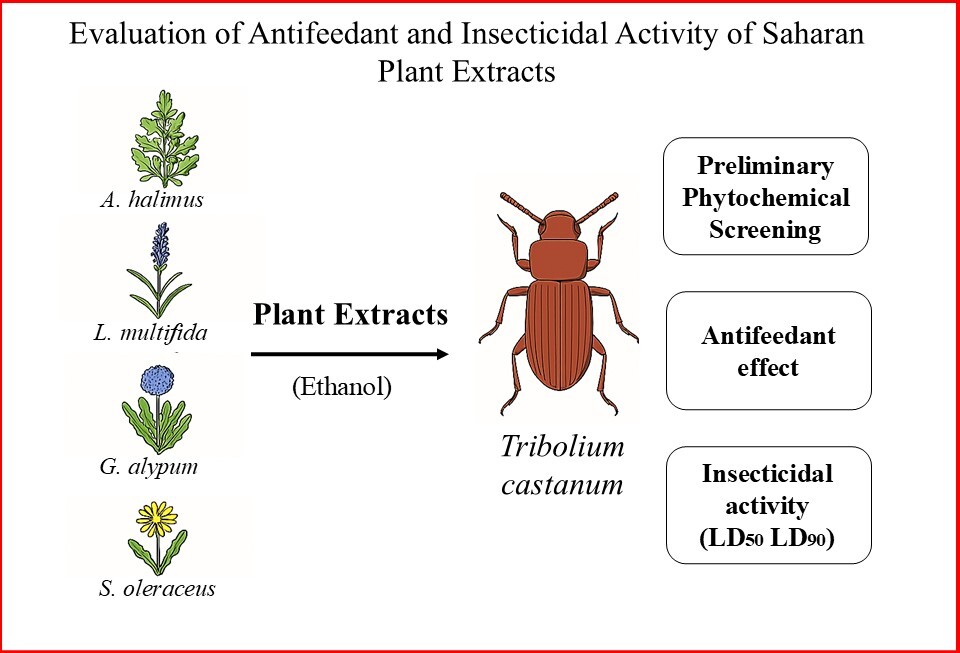
Antifeedant and insecticidal activity of four medicinal plants from arid regions on adults of the red flour beetle Tribolium castaneum (Coleoptera, Tenebrionidae)
DOI:
https://doi.org/10.24425/jppr.2026.1433Abstract
Antifeedant and insecticidal activity of four medicinal plants from arid regions on adults of the red flour beetle Tribolium castaneum (Coleoptera, Tenebrionidae)
References
Aissani F., Grara N., Guelmamene R. 2022. Phytochemical screening and toxicity investigation of hydro-methanolic and aqueous extracts from aerial parts of Sonchus oleraceus L. in Swiss albino mice. Comparative Clinical Pathology 31(2): 509–528. DOI: https://doi.org/10.1007/s00580-022-03349-x DOI: https://doi.org/10.1007/s00580-022-03349-x
Ajaha A., Annaz H., Bouayad N., Aarab A., Rharrabe K. 2023. Antifeedant and growth disruption activities of five phytoecdysteroids in the red flour beetle Tribolium castaneum: Structure-activity relationship. International Journal of Tropical Insect Science 43 (4): 1179–1188. DOI: https://doi.org/10.1007/s42690-023-01014-6 DOI: https://doi.org/10.1007/s42690-023-01014-6
Arora S., Stanley J., Srivastava C. 2021. Temporal dynamics of phosphine fumigation against insect pests in wheat storage. Crop Protection 144: 105602. DOI: https://doi.org/10.1016/j.cropro.2021.105602 DOI: https://doi.org/10.1016/j.cropro.2021.105602
Astuti L.P., Rizali A., Firnanda R., Widjayanti T. 2020. Physical and chemical properties of four products affect the development of Tribolium castaneum. Journal of Stored Products Research 86: 101555. DOI: https://doi.org/10.1016/j.jspr.2019.101555 DOI: https://doi.org/10.1016/j.jspr.2019.101555
Bass C., Puinean A.M., Zimmer C.T., Denholm I., Field L.M., Foster S.P., Gutbrod O., Nauen R., Slater R., Williamson M.S. 2014. The evolution of insecticide resistance in the peach potato aphid, Myzus persicae. Insect Biochemistry and Molecular Biology 51: 41–51. DOI: https://doi.org/https://doi.org/10.1016/j.ibmb.2014.05.003 DOI: https://doi.org/10.1016/j.ibmb.2014.05.003
Behaz Z.F., Allache F.D., Mebrek N., Belhadj A. 2024. Inventorization of ethnobotanical use of some medicinal halophytes plants in the Algerian arid zone (Biskra). Journal of Pharmacy and Pharmacognosy Research 12 (6): 1143–1155. DOI: https://doi.org/10.56499/jppres24.2017_12.6.1143 DOI: https://doi.org/10.56499/jppres24.2017_12.6.1143
Chaouche T.M., Haddouchi F., Boudjemai O., Ghellai I. 2020. Antioxidant and hemolytic activity of Ziziphus jujuba Mill. and Rhamnus alaternus L. (Rhamnaceae) extracts from Algeria. Bulletin de la Société Royale des Sciences de Liège 89: 1–14. DOI: https://doi.org/10.13140/RG.2.2.12443.90409 DOI: https://doi.org/10.25518/0037-9565.9386
Ebadollahi A. 2011. Antifeedant activity of essential oils from Eucalyptus globulus Labill and Lavandula stoechas L. on Tribolium castaneum Herbst (Coleoptera: Tenebrionidae). Biharean Biologist 5 (1): 8–10.
Eigenbrode S.D., Bosque-Pérez N.A., Davis T.S. 2018. Insect-borne plant pathogens and their vectors: Ecology, evolution, and complex interactions. Annual Review of Entomology 63: 169–191. DOI: https://doi.org/10.1146/annurev-ento-020117-043119 DOI: https://doi.org/10.1146/annurev-ento-020117-043119
El-Kamali H.H. 2009. Effect of certain medicinal plants extracts against storage pest, Tribolium castaneum Herbst. American-Eurasian Journal of Sustainable Agriculture 3 (2): 139–142.
Gabrys B., Szczepanik M., Dancewicz K., Szumny A., Wawrzeńczyk Cz. 2006. Environmentally safe insect control: Feeding deterrent activity of alkyl-substituted γ- and δ-lactones to peach potato aphid (Myzus persicae [Sulz.]) and Colorado potato beetle (Leptinotarsa decemlineata Say). Polish Journal of Environmental Studies 15(4): 549–556.
Gacem M.A., Telli A., Gacem H., Ould-El-Hadj-Khelil A. 2019. Phytochemical screening, antifungal and antioxidant activities of three medicinal plants from Algerian steppe and Sahara (preliminary screening studies). SN Applied Sciences 1 (12). https://doi.org/10.1007/s42452-019-1797-1 DOI: https://doi.org/10.1007/s42452-019-1797-1
Haddouchi F., Chaouche T., Saker M., Ghellai I., Boudjemai O. 2021. Phytochemical screening, phenolic content and antioxidant activity of Lavandula species extracts from Algeria. İstanbul Journal of Pharmacy 51 (1): 111–117. DOI: https://doi.org/10.26650/istanbuljpharm.2020.0051 DOI: https://doi.org/10.26650/IstanbulJPharm.2020.0051
Halla N., Boucherit K., Boucherit-Otmani Z., Touati F.Z., Rahmani N., Aid I. 2018. Ammodaucus leucotrichus and Citrullus colocynthis from Algerian Sahara: Ethnopharmacological application, phytochemical screening, polyphenols content and antioxidant activity of hydromethanolic extracts. Journal of King Saud University – Science 31 (4): 541–548. DOI: https://doi.org/10.1016/j.jksus.2018.03.018 DOI: https://doi.org/10.1016/j.jksus.2018.03.018
Kanda D., Kaur S., Koul O. 2017. A comparative study of monoterpenoids and phenylpropanoids from essential oils against stored grain insects: Acute toxins or feeding deterrents. Journal of Pest Science 90 (2): 531–545. DOI: https://doi.org/10.1007/s10340-016-0800-5 DOI: https://doi.org/10.1007/s10340-016-0800-5
Madike L.N., Takaidza S., Pillay M. 2017. Preliminary phytochemical screening of crude extracts from the leaves, stems, and roots of Tulbaghia violacea. International Journal of Pharmacognosy and Phytochemical Research 9 (10): 1300–1308. DOI: https://doi.org/10.25258/phyto.v9i10.10453 DOI: https://doi.org/10.25258/phyto.v9i10.10453
Maire R. 1964. Flore de l’Afrique du Nord: Maroc, Algérie, Tunisie, Tripolitaine, Cyrénaïque et Sahara. Vol. 33, Encyclopédie Biologique; Vol. 63, Flore de l’Afrique du Nord. P. Lechevalier, Paris, France. 579 p. ISBN 9782720505195
Manandhar A., Milindi P., Shah A. 2018. An overview of the post-harvest grain storage practices of smallholder farmers in developing countries. Agriculture 8 (4): 57. DOI: https://doi.org/10.3390/agriculture8040057 DOI: https://doi.org/10.3390/agriculture8040057
Mangang I.B., Tiwari A., Rajamani M., Manickam L. 2020. Comparative laboratory efficacy of novel botanical extracts against Tribolium castaneum. Journal of the Science of Food and Agriculture 100 (4): 1541–1546. DOI: https://doi.org/10.1002/jsfa.10162 DOI: https://doi.org/10.1002/jsfa.10162
Mayanglambam S., Raghavendra A., Rajashekar Y. 2022. Use of Ageratina adenophora (Spreng.) essential oil as insecticidal and antifeedant agents against diamondback moth, Plutella xylostella (L.). Journal of Plant Diseases and Protection 129 (2): 439–448. DOI: https://doi.org/10.1007/s41348-022-00573-z DOI: https://doi.org/10.1007/s41348-022-00573-z
Naboulsi I., Fakhouri K. el Lamzira R., Ramdani C., Thierry G., Bitchagno M., Boulamtat R., ben Bakrim W., Mahdi I., Aboulmouhajir A., Yasri A., el Bouhssini M., Ward J.L., Sobeh M. 2022. Insecticidal activities of Atriplex halimus L., Salvia rosmarinus Spenn., and Cuminum cyminum L. against Dactylopius opuntiae (Cockerell) under laboratory and greenhouse conditions. Insects 13 (10): 930. DOI: https://doi.org/10.3390/insects13100930 DOI: https://doi.org/10.3390/insects13100930
Nawrot J., Bloszyk E., Harmatha J.U.R.A., Novotny L., Drozdz B. 1986. Action of antifeedants of plant origin on beetles infesting stored products. Acta Entomol. Bohemoslov 83: 327–335.
Pathak V.M., Verma V.K., Rawat B.S., Kaur B., Babu N., Sharma A., Dewali S., Yadav M., Kumari R., Singh S., Mohapatra A., Pandey V., Rana N., Cunill J.M. 2022. Current status of pesticide effects on environment, human health, and its ecofriendly management as bioremediation: A comprehensive review. Frontiers in Microbiology 13: 2833. DOI: https://doi.org/10.3389/fmicb.2022.962619 DOI: https://doi.org/10.3389/fmicb.2022.962619
Quézel P., Santa S. 1962; 1963. Nouvelle Flore de l’Algérie et des Régions Désertiques Méridionales. CNRS, Paris.
Roonjho A.R., Gillani W.A., Rasool A., Akhtar N., Mahmood T., Arsalan A., Afzal M., Khan I., Ranjha M.A., Khan J. 2013. Repellency effects of different plant extracts to cotton mealy bug, Tinsley (Hemiptera: Pseudococcidae). Pakistan Journal of Agricultural Research 26 (3): 213–219.
Schneider-Orelli O. 1947. Entomologisches Praktikum: Einführung in die land- und forstwirtschaftliche Insektenkunde (2nd ed.). Aarau, Switzerland: Sauerländer. Original work from the Entomological Institute of the Swiss Federal Institute of Technology, Zurich.
Shaikh J.R., Patil M. 2020. Qualitative tests for preliminary phytochemical screening: An overview. International Journal of Chemical Studies 8 (2): 603–608. DOI: https://doi.org/10.22271/chemi.2020.v8.i2i.8834 DOI: https://doi.org/10.22271/chemi.2020.v8.i2i.8834
Sharma A., Kumar V., Shahzad B., Tanveer M., Sidhu G.P.S., Handa N., Kohli S.K., Yadav P., Bali A.S., Parihar R.D. 2019. Worldwide pesticide usage and its impacts on ecosystem. SN Applied Sciences 1 (1): 1–16. DOI: https://doi.org/10.1007/s42452-019-1485-1 DOI: https://doi.org/10.1007/s42452-019-1485-1
Swamy S.V.S.G., Vishnuvardhan S., Wesley B.J. 2020. Prevalence of grain insect pests in milled rice stored in public warehouses. Journal of Entomology and Zoology Studies 8: 1356–1360.
Tine S., Tine-Djebbar F., Debab A., Mesloub A., Soltani N. 2023. Insecticidal efficacy and physiological effects of Eucalyptus globulus essential oil and its constituent, 1,8-Cineole against Tribolium confusum (Jacquelin du Val, 1868) (Coleoptera, Tenebrionidae). Journal of Plant Diseases and Protection 130 (4): 769–780. DOI: https://doi.org/10.1007/s41348-023-00766-0 DOI: https://doi.org/10.1007/s41348-023-00766-0
Yahya E.M., Zouhri A., Labhar A., Zeouk I., Ahari M.H., Salhi A., Amhamdi H. 2023. Ethnobotanical use, phytochemical study, and antioxidant activity of Globularia alypum. Arabian Journal of Medicinal and Aromatic Plants 9 (1): 115–127.
Yun T.S., Park S.Y., Yu J., Hwang Y., Hong K.J. 2018. Isolation and identification of fungal species from the insect pest Tribolium castaneum in rice processing complexes in Korea. The Plant Pathology Journal 34 (4): 356–366. DOI: https://doi.org/10.5423/PPJ.OA.02.2018.0027 DOI: https://doi.org/10.5423/PPJ.OA.02.2018.0027
Downloads
Published
How to Cite
Issue
Section
License
Copyright (c) 2026 Journal of Plant Protection Research

This work is licensed under a Creative Commons Attribution 4.0 International License.