
From single agents to multi-enemy systems: a systematic review of mealybug (hemiptera: pseudococcidae) biological control research
DOI:
https://doi.org/10.24425/jppr.2026.6993Abstract
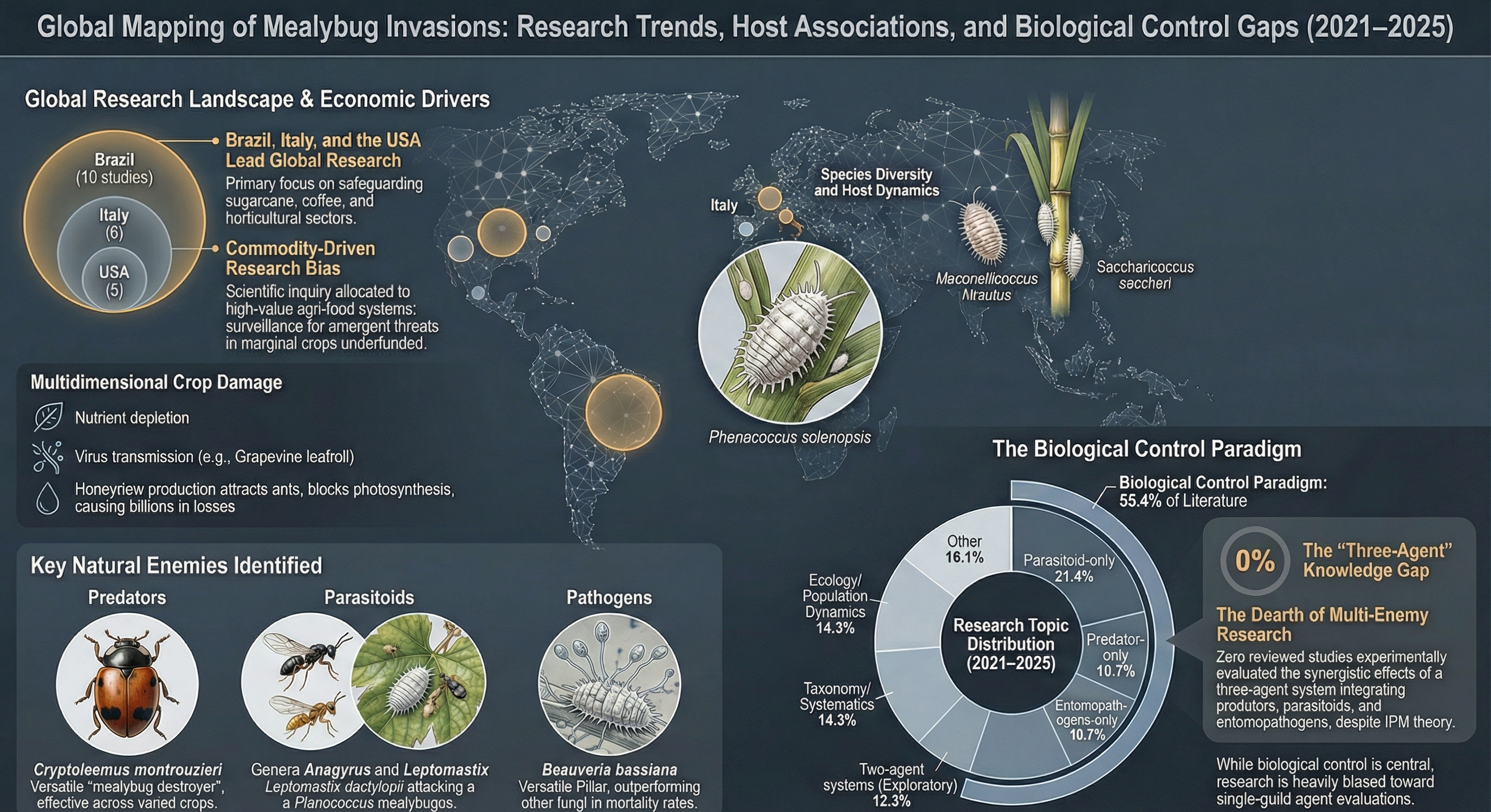
Mealybugs (Hemiptera: Pseudococcidae) are major insect pests causing significant economic losses across diverse crops. This systematic review summarizes research on mealybugs, focusing on study types, species, host plants, and natural enemy groups in biological control, with emphasis on management-oriented literature to identify gaps in Integrated Pest Management (IPM). Literature searches in Scopus, PubMed, and Web of Science yielded 1,342 records, of which 56 peer-reviewed articles published between 2021 and 2025 met inclusion criteria through a PICOC-based screening. Research was geographically concentrated, with Brazil, Italy, the United States, and China as leading contributors. The 56 articles reported 35 mealybug species, highlighting a focus on biocontrol rather than global Pseudococcidae diversity. Phenacoccus solenopsis Tinsley, 1898 was the most studied species, and citrus and grapevine were the main host plants. Over half of the studies (53.6%) examined biological control, but research favored single-agent approaches: parasitoid-only studies (21.4%), predator-only and entomopathogen-only studies (10.7% each). Multi-agent systems were scarcely explored; six studies examined predator-parasitoid combinations, while only one investigated predator-entomopathogen interactions. Notably, no study examined three-agent systems. This gap is critical, as multi-agent outcomes are context-dependent, ranging from synergy to interference. The review identifies two key gaps: limited multi-agent experiments and absence of frameworks to manage their interactions. Addressing these gaps is essential to advance evidence-based, ecologically complex IPM strategies for mealybug management, emphasizing the need for research that evaluates multi-agent interactions and their practical implementation in pest management.
References
Asiri B.M.K., Bakry M.M.S. 2025. Impact of weather parameters on seasonal abundance of the striped mealybug, Ferrisia virgata (Cockerell, 1893) (Hemiptera: Pseudococcidae) on mango trees in Egypt. Polish Journal of Entomology 94: 75–92. DOI: https://doi.org/10.5604/01.3001.0055.1684
Bakry M.M.S., Abdel-Baky N.F. 2024. Influence of weather conditions and plant growth on populations of the solenopsis mealybug (Phenacoccus solenopsis Tinsley) infesting maize plants. Brazilian Journal of Biology 84. DOI: https://doi.org/10.1590/1519-6984.283233
Ballesteros C., Chorbadjian R.A., Zaviezo T. 2023. Mating behavior of Pseudococcus calceolariae and Pseudococcus longispinus (Hemiptera: Pseudococcidae): are asexual reproduction and hybridization possible? Journal of Insect Science 23(4). DOI: https://doi.org/10.1093/jisesa/iead058
Bickford D., Lohman D.J., Sodhi N.S., Ng P.K., Meier R., Winker K., Ingram K.K., Das I. 2007. Cryptic species as a window on diversity and conservation. Trends in Ecology & Evolution 22(3): 148–155. DOI: https://doi.org/10.1016/j.tree.2006.11.004
Bilgin M.G., Çalışkan-Keçe A.F., Ulusoy M.R. 2021. The determination some biological parameters of Phenacoccus madeirensis Green (Hemiptera: Pseudococcidae) on vegetable plants. Turkish Journal of Zoology 45(4): 296–303. DOI: https://doi.org/10.3906/zoo-2102-36
Burgio G., Magagnoli S., Casoli L., Profeta M., Grasso D.A., Schifani E., Giannetti D., Parrilli M. 2025. Use of Sugar Dispensers at Lower Density Can Decrease Mealybug (Hemiptera: Pseudococcidae) Infestation in Vineyards by Disrupting Ants. Insects 16(5). DOI: https://doi.org/10.3390/insects16050468
Caballero A., Kaydan M.B., Raupach M.J. 2024. Description of Peliococcus schmuttereri Caballero and Kaydan sp. n. from specimens of an invalid species, Spinococcus kozari Schmutterer, 2002 (Hemiptera: Pseudococcidae). Journal of Natural History 58(41–44): 1657–1668. DOI: https://doi.org/10.1080/00222933.2024.2391443
Carvalho M.M.P., Reis L.A.C., Pinheiro M.L.C., Moreira M.M., Vieira D.A., Souza B. 2023. Is a diet of Planococcus citri nymphs and adults suitable for Chrysoperla externa for use in biological control? Revista Brasileira de Entomologia 67(1). DOI: https://doi.org/10.1590/1806-9665-RBENT-2022-0010
Chen H.-Y., Li H.-L., Pang H., Zhu C.-D., Zhang Y.-Z. 2021. Investigating the parasitoid community associated with the invasive mealybug Phenacoccus solenopsis in southern China. Insects 12(4). DOI: https://doi.org/10.3390/insects12040290
Correa M.C.G., Palero F., da Silva V.C.P., Kaydan M.B., Germain J.F., Abd-Rabou S., Daane K.M., Cocco A., Poulin E., Malausa T. 2023. Identifying cryptic species of Planococcus infesting vineyards to improve control efforts. Journal of Pest Science 96(2): 573–586. DOI: https://doi.org/10.1007/s10340-022-01532-1
Cui S., Zhang H., Liu L., Lyu W., Xu L., Zhang Z., Han Y. 2024. Hypervolume Niche Dynamics and Global Invasion Risk of Phenacoccus solenopsis under Climate Change.
de López M.A., Kondo T., Molina-Moreira N. 2025. A new threat to Ecuadorian flora: first report of the pink hibiscus mealybug, Maconellicoccus hirsutus (Green, 1908) (Hemiptera: Pseudococcidae) and its potential biological control agent. Revista Brasileira de Entomologia 69(2). DOI: https://doi.org/10.1590/1806-9665-RBENT-2025-0007
de Paula F.F., Souza B., Bezerra C.E.S. 2022. Compatibility between the predators Cryptolaemus montrouzieri (Coleoptera: Coccinellidae) and Chrysoperla externa (Neuroptera: Chrysopidae) in the control of Planococcus citri (Hemiptera: Pseudococcidae) associated with rose crop. Revista Brasileira de Entomologia 66. DOI: https://doi.org/10.1590/1806-9665-RBENT-2022-0081
Diepenbrock L.M., Ahmed M.Z. 2021. First Report of Nipaecoccus viridis (Hemiptera: Pseudococcidae) Associated with Citrus Production in the United States. Journal of Integrated Pest Management 11(1). DOI: https://doi.org/10.1093/jipm/pmaa004
Dos Santos A.C.B., Rêgo A.S., Lemos R.N.S., Dias G.S., da Silva Lopes G. 2022. BIOLOGICAL ASPECTS OF Ceraeochrysa everes (NEUROPTERA: CHRYSOPIDAE) FED ON PINK HIBISCUS MEALYBUG1. Revista Caatinga 35(2): 363–370. DOI: https://doi.org/10.1590/1983-21252022v35n212rc
Douglass R., Miller G.L.M., Watson G.W. 2002. Climate Change Conditions, Using MaxEnt. 825–836.
El-Aalaoui M., Rammali S., Kamal F.Z., Calin G., Rarinca V., Hriţcu L.D., Ciobică A., Sbaghi M. 2024. Effectiveness of the entomopathogenic fungus Alternaria murispora and the predatory ladybird Harmonia convergens in controlling Phenacoccus solenopsis (Tinsley). Frontiers in Sustainable Food Systems 8. DOI: https://doi.org/10.3389/fsufs.2024.1469247
Enders M., Havemann F., Ruland F., Bernard-Verdier M., Catford J.A., Gómez-Aparicio L., Haider S., Heger T., Kueffer C., Kühn I., Meyerson L.A., Musseau C., Novoa A., Ricciardi A., Sagouis A., Schittko C., Strayer D.L., Vilà M., Essl F., Hulme P.E., van Kleunen M., Kumschick S., Lockwood J.L., Mabey A.L., McGeoch M.A., Palma E., Pyšek P., Saul W.-C., Yannelli F.A., Jeschke J.M. 2018. A conceptual map of invasion biology: Integrating hypotheses into a consensus network. Global Ecology and Biogeography 29(6): 978–991. DOI: https://doi.org/10.1111/geb.13082
Ezeh A.E., Zalucki M.P., Day M.D., Taylor T., Furlong M.J. 2025. Thermal biology of Hypogeococcus pungens (Hemiptera: Pseudococcidae) explains its variable performance as a classical biological control agent for Harrisia martinii (Cactaceae) in Australia. Environmental Entomology 54(3): 454–466. DOI: https://doi.org/10.1093/ee/nvaf026
Finch E.A., Wyckhuys K.A.G., Rwomushana I. 2024. Potential distribution of Acerophagus papayae, a parasitoid of the papaya mealybug (Paracoccus marginatus), across Africa. Biological Control 198. DOI: https://doi.org/10.1016/j.biocontrol.2024.105628
Gerő K., Alfreðsson M., Szita É. 2025. New data on the scale insect (Hemiptera, Coccomorpha) fauna of Iceland, with description of a new species. ZooKeys 1236: 119–128. DOI: https://doi.org/10.3897/zookeys.1236.150789
Gupta A., Sampathkumar M., Mohan M., Shylesha A.N., Venkatesan T., Shashank P.R., Dhanyakumar O., Ramkumar P., Sakthivel N., Geetha B. 2021. Assessing adverse impact of the native biological control disruptors in the colonies of the recent invasive pest Phenacoccus manihoti Matile-Ferrero (Hemiptera: Pseudococcidae) in India. Global Ecology and Conservation 32. DOI: https://doi.org/10.1016/j.gecco.2021.e01878
Herrick N.J., Cloyd R.A. 2023. Performance of Entomopathogenic Fungal-Based Insecticides against the Citrus Mealybug (Hemiptera: Pseudococcidae) on Coleus (Lamiales: Lamiaceae) Plants under Greenhouse Conditions. Journal of Entomological Science 58(2): 187–200. DOI: https://doi.org/10.18474/JES22-33
Huang J., Zhi F.Y., Zhang J., Li X.W., Lu Y.B. 2022. The parasitoid Aenasius arizonensis prefers its natural host but can parasitize a nonnatural host in the laboratory: an opportunity for control of a new invasive mealybug. Journal of Pest Science 95(2): 593–604. DOI: https://doi.org/10.1007/s10340-021-01406-y
Kahya D., Çalışkan-Keçe A.F., Ulusoy M.R. 2021. Determining some biological parameters of Aenasius arizonensis (Girault) (hymenoptera: Encyrtidae) on cotton mealybug and the rate of parasitism in field conditions. Turkish Journal of Zoology 45(Special issue 1): 416–424. DOI: https://doi.org/10.3906/zoo-2102-2
Khudhair A.H., Kareem A.A., Watson G.W., Kresslein R.L., Beasley J., Topakçi N., Polaszek A. 2025. Parasitoids of the invasive cotton mealybug, Phenacoccus solenopsis Tinsley (Hemiptera, Pseudococcidae), in Iraq. BioControl 70(2): 157–165. DOI: https://doi.org/10.1007/s10526-024-10299-6
Kondo T., Woolley J.B., Campos-Patiño Y. 2022. Report and diagnoses of Hambletonia pseudococcina Compere (Hymenoptera: Encyrtidae) and Pseudiastata sp. (Diptera: Drosophilidae): Natural enemies of Dysmicoccus brevipes (Cockerell) (Hemiptera: Pseudococcidae) in Valle del Cauca, Colombia. Revista Colombiana de Ciencias Horticolas 16(1). DOI: https://doi.org/10.17584/rcch.2022v16i1.13160
Laterza I., Vitale M.L., Agostinacchio M.F., Bennani Z., de Lillo E., Tamburini G., Verrastro V., Cavallo G., Desneux N., Biondi A., Santovito E., Cornara D. 2024. Novel approaches to assess lethal and sublethal effects when evaluating risks of biopesticides toward beneficial arthropod. CABI Agriculture and Bioscience 5(1). DOI: https://doi.org/10.1186/s43170-024-00249-8
Le K.H., Tran T.H.D., Tran D.H., Nguyen T.D., van Doan C. 2023. Parasitoid Wasp Acerophagus papayae: A Promising Solution for the Control of Papaya Mealybug Paracoccus marginatus in Cassava Fields in Vietnam. Insects 14(6). DOI: https://doi.org/10.3390/insects14060528
Li C., Wang C., Yang X., Wang D., Wang F. 2025. Modeling the potential global distribution of the invasive Jack Beardsley mealybug (Hemiptera: Pseudococcidae) under climate change. Journal of Economic Entomology 118(2): 589–599. DOI: https://doi.org/doi.org/10.1093/jee/toaf029
Li Z., Shi L., Wen J., Zhang Y., Chen K. 2025. Functional response and control efficacy of Plesiochrysa ramburi and Apertochrysa roseusfrontata (Neuroptera: Chrysopidae) on the Grey Pineapple Mealybug. Biological Control 210. DOI: https://doi.org/10.1016/j.biocontrol.2025.105899
Liang X., Chen Q., Wu C., Liu Y., Han Z., Wu M. 2021. Reference Gene Selection for Analyzing the Transcription Patterns of Two Fatty Acyl-CoA Reductase Genes from Paracoccus marginatus (Hemiptera: Pseudococcidae). Journal of Insect Science 21(5). DOI: https://doi.org/10.1093/jisesa/ieab072
Lin Q., Ruan G., Tang M., Guo X., Yang M., Wang X., Chen X. 2025. Functional Response, Interference, and Predation Efficiency of Diomus guilavoguii (Coleoptera: Coccinellidae) on Paracoccus marginatus (Hemiptera: Pseudococcidae). Insects 16(9). DOI: https://doi.org/10.3390/insects16090971
Mardiningsih T.L., Sartiami D., Djiwanti S.R., Rohimatun, Hardiyanti S., Heryanto R., Amaria W. 2025. Molecular identification and characterization of Maconellicoccus multipori (Takahashi) (Hemiptera: Pseudococcidae) on Piper nigrum L. Journal of Tropical Plant Pests and Diseases 25(2): 201–207. DOI: https://doi.org/10.23960/jhptt.225201-207
Masten Milek T., Pellizzari G. 2016. The invasive mealybug Paracoccus burnerae expands its range: New distribution and host-plant records. In Springer Nature. 225–228. DOI: https://doi.org/2-s2.0-84992415343
Mathulwe L.L., Malan A.P., Stokwe N.F. 2023. Formulation of Metarhizium pinghaense and Metarhizium robertsii and the infection potential of the formulations against Pseudococcus viburni (Hemiptera: Pseudococcidae) after storage. African Entomology 31. DOI: https://doi.org/10.17159/2254-8854/2023/a12814
Middleton E.G., Demard E.P., Diepenbrock L.M. 2024. Evaluation of potential natural enemies of hibiscus mealybug, Nipaecoccus viridis (Hemiptera: Pseudococcidae) in Florida citrus. Florida Entomologist 107(s1). DOI: https://doi.org/10.1515/flaent-2024-0059
Mills N.J. 2018. Parasitoid interactions and biological control. p. 212–236. In: "Ecology of Predator-Prey Interactions" (P. Barbosa, I. Castellanos, eds.). Oxford University Press, Oxford, UK.
Monteiro G.G., Paulo H.H., Nascimento D.D., Pelegrini G., Lacerda L.M., Chacón-Orozco J., Leite L.G., Polanczyk R.A. 2024. Virulence of entomopathogenic nematodes and their symbiotic bacteria, under laboratory conditions, aiming controlling Saccharicoccus sacchari (Cockerell, 1895) (Hemiptera: Pseudococcidae) on sugarcane. Brazilian Journal of Biology 84. DOI: https://doi.org/10.1590/1519-6984.253780
Monteiro G.G., Peronti A.L.B.G., Martinelli N.M. 2023. Distribution, abundance and seasonality of scale insects in sugarcane crops in the state of São Paulo. Brazilian Journal of Biology 83. DOI: https://doi.org/10.1590/1519-6984.250879
Monteiro G.G., Peronti A.L.B.G., Martinelli N.M. 2024. Biological development of Saccharicoccus sacchari (Cockerell, 1895) (Hemiptera: Pseudococcidae) on sugarcane in different temperatures. Brazilian Journal of Biology 84. DOI: https://doi.org/10.1590/1519-6984.279770
Moreno I., Tarazona-Velásquez R., Campos-Patiño Y., Rodríguez-Arévalo K.A., Kondo T. 2021. Prevalence of Dysmicoccus brevipes (Cockerell, 1893) (hemiptera: Pseudococcidae) in md2 pineapple crop areas in colombia. Pesquisa Agropecuaria Tropical 51. DOI: https://doi.org/10.1590/1983-40632021v5167838
Moretti E., Schmidt-Jeffris R.A. 2025. Evaluation of drone and ground releases of Cryptolaemus montrouzieri for mealybug (Pseudococcus maritimus) control in apples. Biological Control 207. DOI: https://doi.org/10.1016/j.biocontrol.2025.105805
Muştu M., Derya F.N., Tarhanacı B. 2022. Host stage preference and demographic parameters of Leptomastix dactylopii (Hymenoptera: Encyrtidae) on vine mealybug Planococcus ficus (Hemiptera: Pseudococcidae). Egyptian Journal of Biological Pest Control 32(1). DOI: https://doi.org/10.1186/s41938-022-00572-0
Ness J.H., Bronstein J.L. 2004. The effects of invasive ants on prospective ant mutualists. Biological Invasions 6(4): 445–461. DOI: https://doi.org/10.1023/B:BINV.0000041556.88920.dd
Olabiyi D.O., Duren E.B., Price T., Avery P.B., Hahn P.G., Stelinski L.L., Diepenbrock L.M. 2022. Suitability of Formulated Entomopathogenic Fungi Against Hibiscus Mealybug, Nipaecoccus viridis (Hemiptera: Pseudococcidae), Deployed Within Mesh Covers Intended to Protect Citrus from Huanglongbing. Journal of Economic Entomology 115(1): 212–223. DOI: https://doi.org/10.1093/jee/toab243
Oliveira P.V, Santos A.R., Olive E.L., Britto K.B., de Almeida F.A.N., Pacheco Da Silva V.C., Machado C.B., Fornazier M.J., Ventura J.A., Culik M.P., Paneto G.G. 2023. Molecular Species Delimitation Using COI Barcodes of Mealybugs (Hemiptera: Pseudococcidae) from Coffee Plants in Espírito Santo, Brazil. Diversity 15(2). DOI: https://doi.org/10.3390/d15020305
Othim S.T.O., Opisa S., Rwomushana I., Luke B. 2024. Unleashing nature’s defenders: Farmer-managed natural enemies field reservoirs (NEFRs) enhance management of the invasive papaya mealybug (Paracoccus marginatus) in coastal Kenya. Biological Control 193. DOI: https://doi.org/10.1016/j.biocontrol.2024.105528
Pacheco Da Silva V.C., Aquino D.A., Crochard D., Malausa T., Botton M., Palero F. 2021. Parasitoids (Hymenoptera) of Mealybug Pests (Hemiptera: Pseudococcidae) from Southern Brazil: Molecular and Morphological Characterization. Neotropical Entomology 50(5): 759–766. DOI: https://doi.org/10.1007/s13744-020-00841-3
Panti O.P., García-de la Cruz R.G., Hernández H.G., Soto S.S., Ramírez P.A.M., Reyes F.I. 2024. Bio-efficacy of entomopathogenic fungi and vegetable oils against the pink pineapple mealybug: Dysmicoccus brevipes (Cockerell). Revista de La Facultad de Ciencias Agrarias 56(1): 83–93. DOI: https://doi.org/10.48162/rev.39.125
Plata Á., Gómez-Martínez M.A., Beitia F.J., Tena A. 2024. Native ants facilitate the invasion by Delottococcus aberiae in Mediterranean citrus. Journal of Pest Science 97(1): 255–267. DOI: https://doi.org/10.1007/s10340-023-01615-7
Puig A.S., Wurzel S., Suarez S., Marelli J.-P., Niogret J. 2021. Mealybug (Hemiptera: Pseudococcidae) species associated with cacao mild mosaic virus and evidence of virus acquisition. Insects 12(11). DOI: https://doi.org/10.3390/insects12110994
Ricciardi R., Benelli G., Suma P., Cosci F., Di Giovanni F.D., Zeni V., Conte G., Marchesini E., Savino F., Ladurner E., Iodice A., Canale A., Lucchi A. 2022. One device for two pests: a new double dispenser for mating disruption of Lobesia botrana and Planococcus ficus. Entomologia Generalis 42(2): 289–307. DOI: https://doi.org/10.1127/entomologia/2021/1228
Ricciardi R., Zeni V., Michelotti D., Di Giovanni F., Cosci F., Canale A., Zang L.S., Lucchi A., Benelli G. 2021. Old parasitoids for new mealybugs: Host location behavior and parasitization efficacy of Anagyrus vladimiri on Pseudococcus comstocki. Insects 12(3). DOI: https://doi.org/10.3390/insects12030257
Ricupero M., Porcu E., Russo A., Zappalà L., Siscaro G. 2025. New Records of Phenacoccus solenopsis Natural Enemies in Europe and Taxonomic Additions on Anagyrus matritensis. Insects 16(2). DOI: https://doi.org/10.3390/insects16020169
Rizwan M., Raza A.B.M., Majeed M.Z., Arsha M. 2022. Population Dynamics of Mealybug Drosicha mangiferae (Green) (Hemiptera: Pseudococcidae) in Citrus Orchards of District Sargodha (Punjab, Pakistan). Punjab University Journal of Zoology 37(1): 23–28. DOI: https://doi.org/10.17582/JOURNAL.PUJZ/2022.37.1.23.28
Rohimatun, Rahmah N.N., Sartiani D., Aisyah M.D.N., Miftakhurohmah, Melati, Rusmin D., Madiningsih T.L. 2024. Invasive mealybug Pseudococcus jackbeardsleyi Gimpel and Miller on Curcuma aeruginosa Roxb. on the seed rhizome in storage: A record of a new host. Journal of Plant Protection Research 64(4): 298–306. DOI: https://doi.org/10.24425/jppr.2024.152883
Shea K., Chesson P. 2002. Community ecology theory as a framework for biological invasions. Trends in Ecology & Evolution 17(4): 170–176. DOI: https://doi.org/10.1016/S0169-5347(02)02495-3
Shoba P., Rajagopal R., Alfarhan A., Nandhakumari P. 2024. Evaluation of the insecticidal activity of Acorus calamus rhizome and Chrysopogon zizanioides roots essential oils against mealybug, Phenacoccus solenopsis. Discover Life. DOI: https://doi.org/10.1007/s11084-024-09668-z
Si Q., Hu J., Hua Z., Wang J., Ji M., Xu G., Wu B. 2025. Mechanisms of multi-species mealybug invasions in Hainan Island of China : Integrating niche, distribution, and habitat drivers. 1–20. DOI: https://doi.org/10.1371/journal.pone.0333679
Sisodiya D.B. 2023. A Notorious Pest of Fruit Crop. 03(Ii): 151–156.
Soler J.M., Falcó-Garí J.V, Herrero B., Aquino D.A. 2021. The Anagyrus (Hymenoptera: Encyrtidae) parasitoids of the obscure mealybug Pseudococcus viburni (Hemiptera: Pseudococcidae) in Spain, with description of a new species. Zootaxa 4980(1): 83–98. DOI: https://doi.org/10.11646/zootaxa.4980.1.5
Straub C.S., Finke D.L., Snyder W.E. 2008. Are the conservation of natural enemy biodiversity and biological control compatible goals? Biological Control 45(2): 225–237. DOI: https://doi.org/10.1016/j.biocontrol.2007.05.013
Subramanian S., Boopathi T., Nebapure S.M., Yele Y., K. Shankarganesh. 2021. Mealybugs. In Polyphagous Pests of Crops. In Springer Nature. 231–272.
Thomson L.J., Macfadyen S., Hoffmann A.A. 2010. Predicting the effects of climate change on natural enemies of agricultural pests. Biological Control 52(3): 296–306. DOI: https://doi.org/10.1016/j.biocontrol.2009.01.022
Vacas S., Navarro-Fuertes I., García-García V., Marzo Bargues J., Abad-Somovilla A., Primo J., Navarro-Llopis V. 2024. New Monoterpenoid as the Sex Pheromone of Spanish Populations of the Longtailed Mealybug Pseudococcus longispinus (Hemiptera: Pseudococcidae). Journal of Agricultural and Food Chemistry 72(22): 12478–12488. DOI: https://doi.org/10.1021/acs.jafc.4c00921
Wang L., Liu X., Ruan Y. 2023. Sex-specific differences in symbiotic microorganisms associated with an invasive mealybug (Phenacoccus solenopsis Tinsley) based on 16S ribosomal DNA. PeerJ 11. DOI: https://doi.org/10.7717/peerj.15843
Zarkani A., Ercan C., Apriyanto D., Kaydan M.B. 2023. Studies on mealybugs (Hemiptera: Pseudococcidae) in Indonesia, with description of a new species and three new country records. Zootaxa 5228(2): 157–172. DOI: https://doi.org/10.11646/zootaxa.5228.2.4
Zarkani A., Reonaldi H.A.A., Fauzi A., Apriyanto D., Yahumri Y., Rosfiansyah, Kaydan M.B. 2025. Two new species of the mealybug genus Paraputo Laing (Hemiptera, Pseudococcidae) from Borneo Island, Indonesia. ZooKeys 1249: 49–68. DOI: https://doi.org/10.3897/zookeys.1249.159569
Zart M., de MacEdo M.F., Rando J.S.S., Doneze G.S., Brito C.P., de Souza Poletto R., Alves V.S. 2021. Performance of entomopathogenic nematodes on the mealybug, Dysmicoccus brevipes (Hemiptera: Pseudococcidae) and the compatibility of control agents with nematodes. Journal of Nematology 53. DOI: https://doi.org/10.21307/JOFNEM-2021-020
Downloads
Published
How to Cite
Issue
Section
License
Copyright (c) 2025 Journal of Plant Protection Research

This work is licensed under a Creative Commons Attribution 4.0 International License.





