Organic soil-derived Saccharopolyspora thermophila for enhancing plant growth and controlling Fusarium wilt disease in tomato
DOI:
https://doi.org/10.24425/jppr.2026.158069Abstract
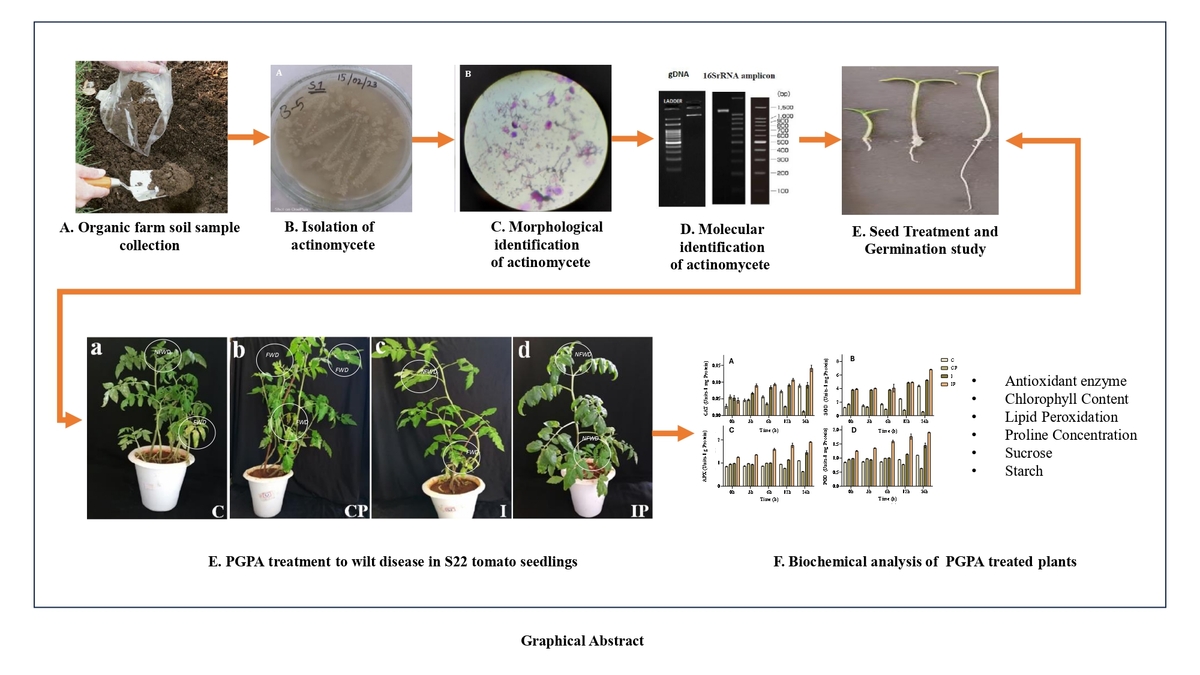
This study investigated the effects of Saccharopolyspora thermophila, a plant growth-promoting actinomycete (PGPA), on tomato plants (Suvarna 22) and its potential to mitigate Fusarium wilt disease. Saccharopolyspora thermophila was isolated from organic farm soil and molecularly identified through 16S rRNA sequencing. Seed treatment with S. thermophila significantly enhanced germination rates (83% vs 59% in control) and seedling vigor (625 vs 192 in control). Treated plants exhibited improved growth parameters, including increased plant height (83.3%), chlorophyll content (88.2%), and fruit yield (66.7%). Under pathogen challenge, S. thermophila-treated plants showed reduced disease incidence (37% vs 92% in untreated plants). Biochemical analyses revealed that S. thermophila treatment enhanced antioxidant enzyme activities (CAT, SOD, APX, POD) and maintained higher chlorophyll content under pathogen stress. The treatment also moderated pathogen- induced increases in lipid peroxidation and proline levels, indicating improved stress tolerance. Interestingly, S. thermophila treatment counteracted pathogen-induced starch depletion and moderated sucrose accumulation, suggesting a complex interplay in plant metabolism regulation. These findings demonstrated the potential of S. thermophila as a PGPA to enhance tomato plant growth, productivity, and resilience against Fusarium wilt disease. The study provides insights into the physiological and biochemical mechanisms underlying PGPA-mediated plant growth promotion and disease resistance, offering promising avenues for sustainable agricultural practices.
References
AbdElgawad H., Abuelsoud W., Madany M.M.Y., Selim S., Zinta G., Mousa A.S.M., Hozzein W.N. 2020. Actinomycetes enrich soil rhizosphere and improve seed quality as well as productivity of legumes by boosting nitrogen availability and metabolism. Biomolecules 10 (12): 1675. DOI: https://doi.org/10.3390/biom10121675
Abdul-Baki A.A., Anderson J.D. 1973. Vigor determination in soybean seed by multiple criteria. Crop Science 13 (6): 630–633. DOI: https://doi.org/10.2135/cropsci1973.0011183X001300060013x
Abhayashree M.S., Murali M., Amruthesh K.N. 2016. Abiotic elicitors mediated resistance and enhanced defense related enzymes in Capsicum annuum L. against anthracnose disease. Scientia Horticulturae 204: 172–178. DOI: https://doi.org/10.1016/j.scienta.2016.04.004
Aebi H. 1984. Catalase in vitro. Methods in Enzymology 105: 121–126. DOI: https://doi.org/10.1016/s0076-6879(84)05016-3
Aldesuquy H.S., Mansour F.A., Abo-Hamed S.A. 1998. Effect of the culture filtrates of Streptomyces on growth and productivity of wheat plants. Folia Microbiologica 43 (5): 465–470. DOI: https://doi.org/10.1007/BF02820792
de Andrade L.A., Santos C.H.B., Frezarin E.T., Sales L.R., Rigobelo E.C. 2023. Plant growth-promoting rhizobacteria for sustainable agricultural production. Microorganisms 11 (4): 1088. DOI: https://doi.org/10.3390/microorganisms11041088
Aydi Ben Abdallah R., Jabnoun-Khiareddine H., Nefzi A., Sonia M.-T., Daami-Remadi M. 2016. Biocontrol of Fusarium wilt and growth promotion of tomato plants using endophytic bacteria isolated from Solanum elaeagnifolium stems. Journal of Phytopathology 164. DOI: https://doi.org/10.1111/jph.12501
Aydi-Ben-Abdallah R., Jabnoun-Khiareddine H., Daami-Remadi M. 2020. Fusarium wilt biocontrol and tomato growth stimulation, using endophytic bacteria naturally associated with Solanum sodomaeum and S. bonariense plants. Egyptian Journal of Biological Pest Control 30 (1): 113. DOI: https://doi.org/10.1186/s41938-020-00313-1
Backer R., Rokem J.S., Ilangumaran G., Lamont J., Praslickova D., Ricci E., Subramanian S., Smith D.L. 2018. Plant growth-promoting rhizobacteria: context, mechanisms of action, and roadmap to commercialization of biostimulants for sustainable agriculture. Frontiers in Plant Science 9. DOI: https://doi.org/10.3389/fpls.2018.01473
Barka E.A., Vatsa P., Sanchez L., Gaveau-Vaillant N., Jacquard C., Klenk H.-P., Clément C., Ouhdouch Y., van Wezel G.P. 2015. Taxonomy, physiology, and natural products of actinobacteria. Microbiology and Molecular Biology Reviews 80 (1): 1–43. DOI: https://doi.org/10.1128/mmbr.00019-15
Baskaran R., Vijayakumar R., Mohan P.M. 2011. Enrichment method for the isolation of bioactive actinomycetes from mangrove sediments of Andaman Islands, India. Malaysian Journal of Microbiology 7: 26–32. DOI: https://doi.org/10.21161/mjm.24410
Bates L.S., Waldren R.P., Teare I.D. 1973. Rapid determination of free proline for water-stress studies. Plant and Soil 39 (1): 205–207. DOI: https://doi.org/10.1007/BF00018060
Berger S., Sinha A.K., Roitsch T. 2007. Plant physiology meets phytopathology: plant primary metabolism and plant–pathogen interactions. Journal of Experimental Botany 58 (15–16): 4019–4026. DOI: https://doi.org/10.1093/jxb/erm298
Bhatti A.A., Haq S., Bhat R.A. 2017. Actinomycetes benefaction role in soil and plant health. Microbial Pathogenesis 111: 458–467. DOI: https://doi.org/10.1016/j.micpath.2017.09.036
Blackman L.M., Hardham A.R. 2008. Regulation of catalase activity and gene expression during Phytophthora nicotianae development and infection of tobacco. Molecular Plant Pathology 9 (4): 495–510. DOI: https://doi.org/10.1111/j.1364-3703.2008.00478.x
Boubekri K., Soumare A., Mardad I., Lyamlouli K., Ouhdouch Y., Hafidi M., Kouisni L. 2022. Multifunctional role of Actinobacteria in agricultural production sustainability: a review. Microbiological Research 261: 127059. DOI: https://doi.org/10.1016/j.micres.2022.127059
Boukhatem Z.F., Merabet C., Tsaki H. 2022. Plant growth promoting actinobacteria, the most promising candidates as bioinoculants? Frontiers in Agronomy 4. DOI: https://doi.org/10.3389/fagro.2022.849911
Brunelle T., Chakir R., Carpentier A., et al. 2024. Reducing chemical inputs in agriculture requires a system change. Communications Earth & Environment 5 (1): 1–9. DOI: https://doi.org/10.1038/s43247-024-01533-1
Cagampang G.B., Rodriguez F.M. 1980. Methods of analysis for screening crops of appropriate qualities. IPB Bulletin. Analytical Services Laboratory, Institute of Plant Breeding, University of the Philippines at Los Baños, Los Baños, 61 pp.
Chai A., Yuan L., Li X., Li L., Shi Y., Xie X., Li B. 2023. Effect of temperature and humidity on dynamics and transmission of Pseudomonas amygdali pv. lachrymans aerosols. Frontiers in Plant Science 14: 1087496. DOI: https://doi.org/10.3389/fpls.2023.1087496
Chakraborty N., Chandra S., Acharya K. 2017. Biochemical basis of improvement of defense in tomato plant against Fusarium wilt by CaCl₂. Physiology and Molecular Biology of Plants 23 (3): 581–596. DOI: https://doi.org/10.1007/s12298-017-0450-y
Cruz de Carvalho M.H. 2008. Drought stress and reactive oxygen species. Plant Signaling & Behavior 3 (3): 156–165.
Cuesta G., García-de-la-Fuente R., Abad M., Fornes F. 2012. Isolation and identification of actinomycetes from a compost-amended soil with potential as biocontrol agents. Journal of Environmental Management 95 Suppl: S280–S284. DOI: https://doi.org/10.1016/j.jenvman.2010.11.023
Devlin M., Brodie J. 2023. Nutrients and eutrophication. p. 75–100. In: “Marine Pollution – Monitoring, Management and Mitigation.” (Reichelt-Brushett A., ed.). Springer Nature Switzerland, Cham. DOI: https://doi.org/10.1007/978-3-031-10127-4_4
Diwan D., Rashid Md.M., Vaishnav A. 2022. Current understanding of plant–microbe interaction through the lenses of multi-omics approaches and their benefits in sustainable agriculture. Microbiological Research 265: 127180. DOI: https://doi.org/10.1016/j.micres.2022.127180
Djebaili R., Pellegrini M., Rossi M., Forni C., Smati M., Del Gallo M., Kitouni M. 2021. Characterization of plant growth-promoting traits and inoculation effects on Triticum durum of actinomycetes isolates under salt stress conditions. Soil Systems 5 (2): 26. DOI: https://doi.org/10.3390/soilsystems5020026
Ebrahimi-Zarandi M., Saberi Riseh R., Tarkka M.T. 2022. Actinobacteria as effective biocontrol agents against plant pathogens, an overview on their role in eliciting plant defense. Microorganisms 10 (9): 1739. DOI: https://doi.org/10.3390/microorganisms10091739
Fatmawati U., Meryandini A., Nawangsih A.A., Wahyudi A.T. 2020. Damping-off disease reduction using actinomycetes that produce antifungal compounds with beneficial traits. Journal of Plant Protection Research 60 (3): 233–243. DOI: https://doi.org/10.24425/jppr.2020.133318
Gao Y., Han Y., Li X., Li M., Wang C., Li Z., Wang Y., Wang W. 2022. A salt-tolerant Streptomyces paradoxus D2-8 from rhizosphere soil of Phragmites communis augments soybean tolerance to soda saline-alkali stress. Polish Journal of Microbiology 71 (1): 43–53. DOI: https://doi.org/10.33073/pjm-2022-006
Giannopolitis C.N., Ries S.K. 1977. Superoxide dismutases: I. Occurrence in higher plants. Plant Physiology 59 (2): 309–314. DOI: https://doi.org/10.1104/pp.59.2.309
Giller K.E., Delaune T., Silva et al. 2021. The future of farming: who will produce our food? Food Security 13 (5): 1073–1099. DOI: https://doi.org/10.1007/s12571-021-01184-6
Glick B.R. 2012. Plant growth-promoting bacteria: mechanisms and applications. Scientifica 2012: 963401. DOI: https://doi.org/10.6064/2012/963401
Goodfellow M., Fiedler H.-P. 2010. A guide to successful bioprospecting: informed by actinobacterial systematics. Antonie Van Leeuwenhoek 98 (2): 119–142. DOI: https://doi.org/10.1007/s10482-010-9460-2
Gowtham H.G., Murali M., Singh S.B., Lakshmeesha T.R., Narasimha Murthy K., Amruthesh K.N., Niranjana S.R. 2018. Plant growth promoting rhizobacteria-Bacillus amyloliquefaciens improves plant growth and induces resistance in chilli against anthracnose disease. Biological Control 126: 209–217. DOI: https://doi.org/10.1016/j.biocontrol.2018.05.022
Gupta R., Anand G., Gaur R., Yadav D. 2021. Plant–microbiome interactions for sustainable agriculture: a review. Physiology and Molecular Biology of Plants 27 (1): 165–179. DOI: https://doi.org/10.1007/s12298-021-00927-1
Hansen J., Møller I. 1975. Percolation of starch and soluble carbohydrates from plant tissue for quantitative determination with anthrone. Analytical Biochemistry 68 (1): 87–94. DOI: https://doi.org/10.1016/0003-2697(75)90682-X
Havir E.A., McHale N.A. 1987. Biochemical and developmental characterization of multiple forms of catalase in tobacco leaves. Plant Physiology 84 (2): 450–455. DOI: https://doi.org/10.1104/pp.84.2.450
Htwe A.Z., Moh S.M., Soe K.M., Moe K., Yamakawa T. 2019. Effects of biofertilizer produced from Bradyrhizobium and Streptomyces griseoflavus on plant growth, nodulation, nitrogen fixation, nutrient uptake, and seed yield of mung bean, cowpea, and soybean. Agronomy 9 (2): 77. DOI: https://doi.org/10.3390/agronomy9020077
Jaemsaeng R., Jantasuriyarat C., Thamchaipenet A. 2018. Molecular interaction of 1-aminocyclopropane-1-carboxylate deaminase (ACCD)-producing endophytic Streptomyces sp. GMKU 336 towards salt-stress resistance of Oryza sativa L. cv. KDML105. Scientific Reports 8 (1): 1950. DOI: https://doi.org/10.1038/s41598-018-19799-9
Jalal A., Oliveira C.E. da S., Rosa P.A.L., Galindo F.S., Teixeira Filho M.C.M. 2023. Beneficial microorganisms improve agricultural sustainability under climatic extremes. Life 13 (5): 1102. DOI: https://doi.org/10.3390/life13051102
Jiao X., Takishita Y., Zhou G., Smith D.L. 2021. Plant associated rhizobacteria for biocontrol and plant growth enhancement. Frontiers in Plant Science 12: 634796. DOI: https://doi.org/10.3389/fpls.2021.634796
Kaari M., Joseph J., Manikkam R., Sreenivasan A., Venugopal G., Alexander B., Krishnan S. 2022. Anti-biofilm activity and biocontrol potential of Streptomyces cultures against Ralstonia solanacearum on tomato plants. Indian Journal of Microbiology 62 (1): 32–39. DOI: https://doi.org/10.1007/s12088-021-00963-1
Kämpfer P., Glaeser S.P., Parkes L., van Keulen G., Dyson P. 2014. The family Streptomycetaceae. p. 889–1010. In: “The Prokaryotes: Actinobacteria.” (Rosenberg E., DeLong E.F., Lory S., Stackebrandt E., Thompson F., eds.). Springer, Berlin, Heidelberg. DOI: https://doi.org/10.1007/978-3-642-30138-4_184
Kaur G., Asthir B. 2015. Proline: a key player in plant abiotic stress tolerance. Biologia Plantarum 59 (4): 609–619. DOI: https://doi.org/10.1007/s10535-015-0549-3
Kazerooni E.A., Maharachchikumbura S.S.N., Al-Sadi A.M., Rashid U., Kim I.-D., Kang S.-M., Lee I.-J. 2022. Effects of the rhizosphere fungus Cunninghamella bertholletiae on the Solanum lycopersicum response to diverse abiotic stresses. International Journal of Molecular Sciences 23 (16): 8909. DOI: https://doi.org/10.3390/ijms23168909
Kimura M. 1980. A simple method for estimating evolutionary rates of base substitutions through comparative studies of nucleotide sequences. Journal of Molecular Evolution 16 (2): 111–120. DOI: https://doi.org/10.1007/BF01731581
Koc Y.E., Aycan M., Mitsui T. 2024. Self-defense mechanism in rice to salinity: proline. J. 7 (1): 103–115. DOI: https://doi.org/10.3390/j7010006
Kong X., Han L., Yang L., Shi Z., Lang J., Ye M., Xiao B., Chen X., Zhou N. 2024. Effects of actinomycetes on the growth, antioxidant and genes expression in Fritillaria taipaiensis P. Y. Li. Heliyon 10 (14): e34846. DOI: https://doi.org/10.1016/j.heliyon.2024.e34846
Koul B., Chopra M., Lamba S. 2022. Microorganisms as biocontrol agents for sustainable agriculture. p. 45–68. In: “Relationship Between Microbes and the Environment for Sustainable Ecosystem Services”. Vol. 1. (Samuel J., Kumar A., Singh J., eds.). Elsevier. DOI: https://doi.org/10.1016/B978-0-323-89938-3.00003-7
Kumar S., Stecher G., Li M., Knyaz C., Tamura K. 2018. MEGA X: molecular evolutionary genetics analysis across computing platforms. Molecular Biology and Evolution 35 (6): 1547–1549. DOI: https://doi.org/10.1093/molbev/msy096
Landhäusser S.M., Chow P.S., Dickman L.T., et al. 2018. Standardized protocols and procedures can precisely and accurately quantify non-structural carbohydrates. Tree Physiology 38 (12): 1764–1778. DOI: https://doi.org/10.1093/treephys/tpy118
Li Y., He N., Hou J., Xu L., Liu C., Zhang J., Wang Q., Zhang X., Wu X. 2018. Factors influencing leaf chlorophyll content in natural forests at the biome scale. Frontiers in Ecology and Evolution 6. DOI: https://doi.org/10.3389/fevo.2018.00064
Lopes M.J. dos S., Dias-Filho M.B., Gurgel E.S.C. 2021. Successful plant growth-promoting microbes: inoculation methods and abiotic factors. Frontiers in Sustainable Food Systems 5. DOI: https://doi.org/10.3389/fsufs.2021.606454
Lu Z., Liu Z., Wang L., Zhang Y., Qi W., Goodfellow M. 2001. Saccharopolyspora flava sp. nov. and Saccharopolyspora thermophila sp. nov., novel actinomycetes from soil. International Journal of Systematic and Evolutionary Microbiology 51 (2): 319–325. DOI: https://doi.org/10.1099/00207713-51-2-319
Malviya M.K., Pandey A., Sharma A., Tiwari S.C. 2013. Characterization and identification of actinomycetes isolated from ‘fired plots’ under shifting cultivation in northeast Himalaya, India. Annals of Microbiology 63 (2): 561–569. DOI: https://doi.org/10.1007/s13213-012-0504-x
Mattioli R., Costantino P., Trovato M. 2009. Proline accumulation in plants. Plant Signaling & Behavior 4 (11): 1016–1018.
Mayee C.D., Datar V.V. 1986. Phytopathometry. Technical bulletin (Marathwada Agricultural University). Marathwada Agricultural University, Parbhani, 146 pp.
McGovern R.J. 2015. Management of tomato diseases caused by Fusarium oxysporum. Crop Protection 73: 78–92. DOI: https://doi.org/10.1016/j.cropro.2015.02.021
Mo L., Zohner C.M., Reich P.B., et al. 2023. Integrated global assessment of the natural forest carbon potential. Nature 624 (7990): 92–101. DOI: https://doi.org/10.1038/s41586-023-06723-z
Morkunas I., Ratajczak L. 2014. The role of sugar signaling in plant defense responses against fungal pathogens. Acta Physiologiae Plantarum 36 (7): 1607–1619. DOI: https://doi.org/10.1007/s11738-014-1559-z
Murali M., Sudisha J., Amruthesh K.N., Ito S.-I., Shetty H.S. 2013. Rhizosphere fungus Penicillium chrysogenum promotes growth and induces defence-related genes and downy mildew disease resistance in pearl millet. Plant Biology (Stuttgart, Germany) 15 (1): 111–118. DOI: https://doi.org/10.1111/j.1438-8677.2012.00617.x
Nakano Y., Asada K. 1980. Spinach chloroplasts scavenge hydrogen peroxide on illumination. Plant and Cell Physiology 21 (8): 1295–1307. DOI: https://doi.org/10.1093/oxfordjournals.pcp.a076128
Narsing Rao M.P., Lohmaneeratana K., Bunyoo C., Thamchaipenet A. 2022. Actinobacteria–plant interactions in alleviating abiotic stress. Plants 11 (21): 2976. DOI: https://doi.org/10.3390/plants11212976
Nawrocka J., Małolepsza U., Szymczak K., Szczech M. 2018. Involvement of metabolic components, volatile compounds, PR proteins, and mechanical strengthening in multilayer protection of cucumber plants against Rhizoctonia solani activated by Trichoderma atroviride TRS25. Protoplasma 255 (1): 359–373. DOI: https://doi.org/10.1007/s00709-017-1157-1
Nazari M.T., Machado B.S., Marchezi G., Crestani L., Ferrari V., Colla L.M., Piccin J.S. 2022. Use of soil actinomycetes for pharmaceutical, food, agricultural, and environmental purposes. 3 Biotech 12 (9): 232. DOI: https://doi.org/10.1007/s13205-022-03307-y
Naziya B., Murali M., Amruthesh K.N. 2020. Plant Growth-Promoting Fungi (PGPF) instigate plant growth and induce disease resistance in Capsicum annuum L. upon infection with Colletotrichum capsici (Syd.) Butler & Bisby. Biomolecules 10 (1): 41. DOI: https://doi.org/10.3390/biom10010041
Nielsen S.S. 2010. Phenol-sulfuric acid method for total carbohydrates. DOI: https://doi.org/10.1007/978-1-4419-1463-7_6
Palaniyandi S.A., Damodharan K., Yang S.H., Suh J.W. 2014. Streptomyces sp. strain PGPA39 alleviates salt stress and promotes growth of “Micro Tom” tomato plants. Journal of Applied Microbiology 117 (3): 766–773. DOI: https://doi.org/10.1111/jam.12563
Pandey V., Ranjan S., Deeba F., Pandey A.K., Singh R., Shirke P.A., Pathre U.V. 2010. Desiccation-induced physiological and biochemical changes in resurrection plant, Selaginella bryopteris. Journal of Plant Physiology 167 (16): 1351–1359. DOI: https://doi.org/10.1016/j.jplph.2010.05.001
Perea-Brenes A., Garcia J.L., Cantos M., Cotrino J., Gonzalez-Elipe A.R., Gomez-Ramirez A., Lopez-Santos C. 2023. Germination and first stages of growth in drought, salinity, and cold stress conditions of plasma-treated barley seeds. ACS Agricultural Science & Technology 3 (9): 760–770. DOI: https://doi.org/10.1021/acsagscitech.3c00121
Poli Y., Nallamothu V., Balakrishnan D., Ramesh P., Desiraju S., Mangrauthia S.K., Voleti S.R., Neelamraju S. 2018. Increased catalase activity and maintenance of Photosystem II distinguishes high-yield mutants from low-yield mutants of rice var. Nagina22 under low-phosphorus stress. Frontiers in Plant Science 9: 1543. DOI: https://doi.org/10.3389/fpls.2018.01543
Porra R.J., Thompson W.A., Kriedemann P.E. 1989. Determination of accurate extinction coefficients and simultaneous equations for assaying chlorophylls a and b extracted with four different solvents: verification of the concentration of chlorophyll standards by atomic absorption spectroscopy. Biochimica et Biophysica Acta (BBA) – Bioenergetics 975 (3): 384–394. DOI: https://doi.org/10.1016/S0005-2728(89)80347-0
Rajput V.D., Harish, Singh R.K., et al. 2021. Recent developments in enzymatic antioxidant defence mechanism in plants with special reference to abiotic stress. Biology 10 (4): 267. DOI: https://doi.org/10.3390/biology10040267
Ramalakshmi S., Ooi C.W., Ariff A.B., Ramanan R.N. 2014. Colorimetric quantification of sucrose in presence of thermo-sensitive polymers present in aqueous two-phase systems. MethodsX 1: 229–232. DOI: https://doi.org/10.1016/j.mex.2014.09.006
Ramzi A.B., Che Me M.L., Ruslan U.S., Baharum S.N., Nor Muhammad N.A. 2019. Insight into plant cell wall degradation and pathogenesis of Ganoderma boninense via comparative genome analysis. PeerJ 7: e8065. DOI: https://doi.org/10.7717/peerj.8065
Rao M.V., Hale B.A., Ormrod D.P. 1995. Amelioration of ozone-induced oxidative damage in wheat plants grown under high carbon dioxide (role of antioxidant enzymes). Plant Physiology 109 (2): 421–432. DOI: https://doi.org/10.1104/pp.109.2.421
Reganold J.P., Wachter J.M. 2016. Organic agriculture in the twenty-first century. Nature Plants 2 (2): 1–8. DOI: https://doi.org/10.1038/nplants.2015.221
Rojas C.M., Senthil-Kumar M., Tzin V., Mysore K. 2014. Regulation of primary plant metabolism during plant-pathogen interactions and its contribution to plant defense. Frontiers in Plant Science 5. DOI: https://doi.org/10.3389/fpls.2014.00017
Sachdev S., Ansari S.A., Ansari M.I., Fujita M., Hasanuzzaman M. 2021. Abiotic stress and reactive oxygen species: generation, signaling, and defense mechanisms. Antioxidants 10 (2): 277. DOI: https://doi.org/10.3390/antiox10020277
Saeed S.W.Z., Naseer I., Zahir Z.A., Hilger T., Shahid S., Iqbal Z., Ahmad M. 2023. Bacillus strains with catalase enzyme improve the physiology and growth of rice (Oryza sativa L.). Stresses 3 (4): 736–748. DOI: https://doi.org/10.3390/stresses3040050
Sahoo R., Sow S., Ranjan S., et al. 2024. Unveiling the potential of plant growth promoting rhizobacteria (PGPR) in phytoremediation of heavy metal. Discover Applied Sciences 6 (6): 324. DOI: https://doi.org/10.1007/s42452-024-06024-8
Sahu P.K., Jayalakshmi K., Tilgan J., et al. 2022. ROS generated from biotic stress: Effects on plants and alleviation by endophytic microbes. Frontiers in Plant Science 13. DOI: https://doi.org/10.3389/fpls.2022.1042936
Salehi B., Azzini E., Zucca P., et al. 2020. Plant-derived bioactives and oxidative stress-related disorders: A key trend towards healthy aging and longevity promotion. Applied Sciences 10 (3): 947. DOI: https://doi.org/10.3390/app10030947
Sarker U., Oba S. 2018. Catalase, superoxide dismutase and ascorbate-glutathione cycle enzymes confer drought tolerance of Amaranthus tricolor. Scientific Reports 8 (1): 16496. DOI: https://doi.org/10.1038/s41598-018-34944-0
Sayed A.M., Abdel‐Wahab N.M., Hassan H.M., Abdelmohsen U.R. 2020. Saccharopolyspora: an underexplored source for bioactive natural products. Journal of Applied Microbiology 128 (2): 314–329. DOI: https://doi.org/10.1111/jam.14360
Selim S., AbdElgawad H., Alsharari S.S., Atif M., Warrad M., Hagagy N., Madany M.M.Y., Abuelsoud W. 2021. Soil enrichment with actinomycete mitigates the toxicity of arsenic oxide nanoparticles on wheat and maize growth and metabolism. Physiologia Plantarum 173 (3): 978–992. DOI: https://doi.org/10.1111/ppl.13496
Sharma K., Butz A.F., Finckh M.R. 2010. Effects of host and pathogen genotypes on inducibility of resistance in tomato (Solanum lycopersicum) to Phytophthora infestans. Plant Pathology 59 (6): 1062–1071. DOI: https://doi.org/10.1111/j.1365-3059.2010.02341.x
Shirling E.B., Gottlieb D. 1966. Methods for characterization of Streptomyces species. International Journal of Systematic and Evolutionary Microbiology 16 (3): 313–340. DOI: https://doi.org/10.1099/00207713-16-3-313
Silva G. da C., Kitano I.T., Ribeiro I.A. de F., Lacava P.T. 2022. The potential use of actinomycetes as microbial inoculants and biopesticides in agriculture. Frontiers in Soil Science 2. DOI: https://doi.org/10.3389/fsoil.2022.833181
Šimkovicová M., Kramer G., Rep M., Takken F.L.W. 2024. Tomato R-gene-mediated resistance against Fusarium wilt originates in roots and extends to shoots via xylem to limit pathogen colonization. Frontiers in Plant Science 15. DOI: https://doi.org/10.3389/fpls.2024.1384431
Singh R., Dubey A.K. 2018. Diversity and applications of endophytic actinobacteria of plants in special and other ecological niches. Frontiers in Microbiology 9: 1767. DOI: https://doi.org/10.3389/fmicb.2018.01767
Soe K.M., Yamakawa T. 2013. Evaluation of effective Myanmar Bradyrhizobium strains isolated from Myanmar soybean and effects of coinoculation with Streptomyces griseoflavus P4 for nitrogen fixation. Soil Science and Plant Nutrition 59 (3): 361–370. DOI: https://doi.org/10.1080/00380768.2013.794437
Srinivas C., Devi D.N., Murthy K.N., et al. 2019. Fusarium oxysporum f. sp. lycopersici causal agent of vascular wilt disease of tomato: Biology to diversity – A review. Saudi Journal of Biological Sciences 26 (7): 1315–1324. DOI: https://doi.org/10.1016/j.sjbs.2019.06.002
Stepien P., Klobus G. 2005. Antioxidant defense in the leaves of C3 and C4 plants under salinity stress. Physiologia Plantarum 125: 31–40. DOI: https://doi.org/10.1111/j.1399-3054.2005.00534.x
Suman J., Rakshit A., Ogireddy S.D., Singh S., Gupta C., Chandrakala J. 2022. Microbiome as a key player in sustainable agriculture and human health. Frontiers in Soil Science 2. DOI: https://doi.org/10.3389/fsoil.2022.821589
Sun F., Ou Q., Wang N., Guo Z. xuan, Ou Y., Li N., Peng C. 2020. Isolation and identification of potassium-solubilizing bacteria from Mikania micrantha rhizospheric soil and their effect on M. micrantha plants. Global Ecology and Conservation 23: e01141. DOI: https://doi.org/10.1016/j.gecco.2020.e01141
Szabados L., Savouré A. 2010. Proline: a multifunctional amino acid. Trends in Plant Science 15 (2): 89–97. DOI: https://doi.org/10.1016/j.tplants.2009.11.009
Torres-Rodriguez J.A., Reyes-Pérez J.J., Quiñones-Aguilar E.E., Hernandez-Montiel L.G. 2022. Actinomycete potential as biocontrol agent of phytopathogenic fungi: Mechanisms, source, and applications. Plants 11 (23): 3201. DOI: https://doi.org/10.3390/plants11233201
Trivedi P., Pandey A., Palni L.M.S. 2012. Bacterial inoculants for field applications under mountain ecosystem: present initiatives and future prospects. p. 15–44. In: "Bacteria in Agrobiology: Plant Probiotics" (Maheshwari D.K., ed.). Springer, Berlin, Heidelberg, 345 pp. DOI: https://doi.org/10.1007/978-3-642-27515-9_2
Tudi M., Ruan H.D., Wang L., Lyu J., Sadler R., Connell D., Chu C., Phung D.T. 2021. Agriculture development, pesticide application and its impact on the environment. International Journal of Environmental Research and Public Health 18 (3): 1112. DOI: https://doi.org/10.3390/ijerph18031112
Upadhayay V.K., Chitara M.K., Mishra D., et al. 2023. Synergistic impact of nanomaterials and plant probiotics in agriculture: a tale of two-way strategy for long-term sustainability. Frontiers in Microbiology 14: 1133968. DOI: https://doi.org/10.3389/fmicb.2023.1133968
Velásquez A.C., Castroverde C.D.M., He S.Y. 2018. Plant and pathogen warfare under changing climate conditions. Current Biology 28 (10): R619–R634. DOI: https://doi.org/10.1016/j.cub.2018.03.054
Viel M., Collet F., Lanos C. 2018. Chemical and multi-physical characterization of agro-resources’ by-product as a possible raw building material. Industrial Crops and Products 120: 214–237. DOI: https://doi.org/10.1016/j.indcrop.2018.04.025
Wang H., Gao Z., Chen X., Li E., Li Y., Zhang C., Hou X. 2023. BcWRKY22 activates BcCAT2 to enhance catalase (CAT) activity and reduce hydrogen peroxide (H2O2) accumulation, promoting thermotolerance in non-heading Chinese cabbage (Brassica campestris ssp. chinensis). Antioxidants 12 (9): 1710. DOI: https://doi.org/10.3390/antiox12091710
Warrad M., Hassan Y.M., Mohamed M.S.M., Hagagy N., Al-Maghrabi O.A., Selim S., Saleh A.M., AbdElgawad H. 2020. A bioactive fraction from Streptomyces sp. enhances maize tolerance against drought stress. Journal of Microbiology and Biotechnology 30 (8): 1156–1168. DOI: https://doi.org/10.4014/jmb.2003.03034
Wharton P.S., Diéguez-Uribeondo J. 2004. The biology of Colletotrichum acutatum. Anales del Jardín Botánico de Madrid. 61 (1): 3–22. DOI: https://doi.org/10.3989/ajbm.2004.v61.i1.61
Yang Y., Nan R., Mi T., Song Y., Shi F., Liu X., Wang Y., Sun F., Xi Y., Zhang C. 2023. Rapid and nondestructive evaluation of wheat chlorophyll under drought stress using hyperspectral imaging. International Journal of Molecular Sciences 24 (6): 5825. DOI: https://doi.org/10.3390/ijms24065825
Yu C., Lv J., Xu, H. 2024. Plant growth-promoting fungi and rhizobacteria control Fusarium damping-off in Mason pine seedlings by impacting rhizosphere microbes and altering plant physiological pathways. Plant and Soil 499: 503–519. DOI: https://doi.org/10.1007/s11104-024-06475-3
Zhan X., Shao C., He R., Shi R. 2021. Evolution and efficiency assessment of pesticide and fertiliser inputs to cultivated land in China. International Journal of Environmental Research and Public Health 18 (7): 3771. DOI: https://doi.org/10.3390/ijerph18073771
Zhang T., Jian Q., Yao X., Guan L., Li L., Liu F., Zhang C., Li D., Tang H., Lu L. 2024. Plant growth-promoting rhizobacteria (PGPR) improve the growth and quality of several crops. Heliyon 10 (10): e31553. DOI: https://doi.org/10.1016/j.heliyon.2024.e31553
Downloads
Published
How to Cite
Issue
Section
License
Copyright (c) 2026 Journal of Plant Protection Research

This work is licensed under a Creative Commons Attribution 4.0 International License.