Methanolic extracts of Solidago gigantea leaves as sustainable antifeedants against a stored pest: Sitophilus granaries
DOI:
https://doi.org/10.24425/jppr.2026.3130Abstract
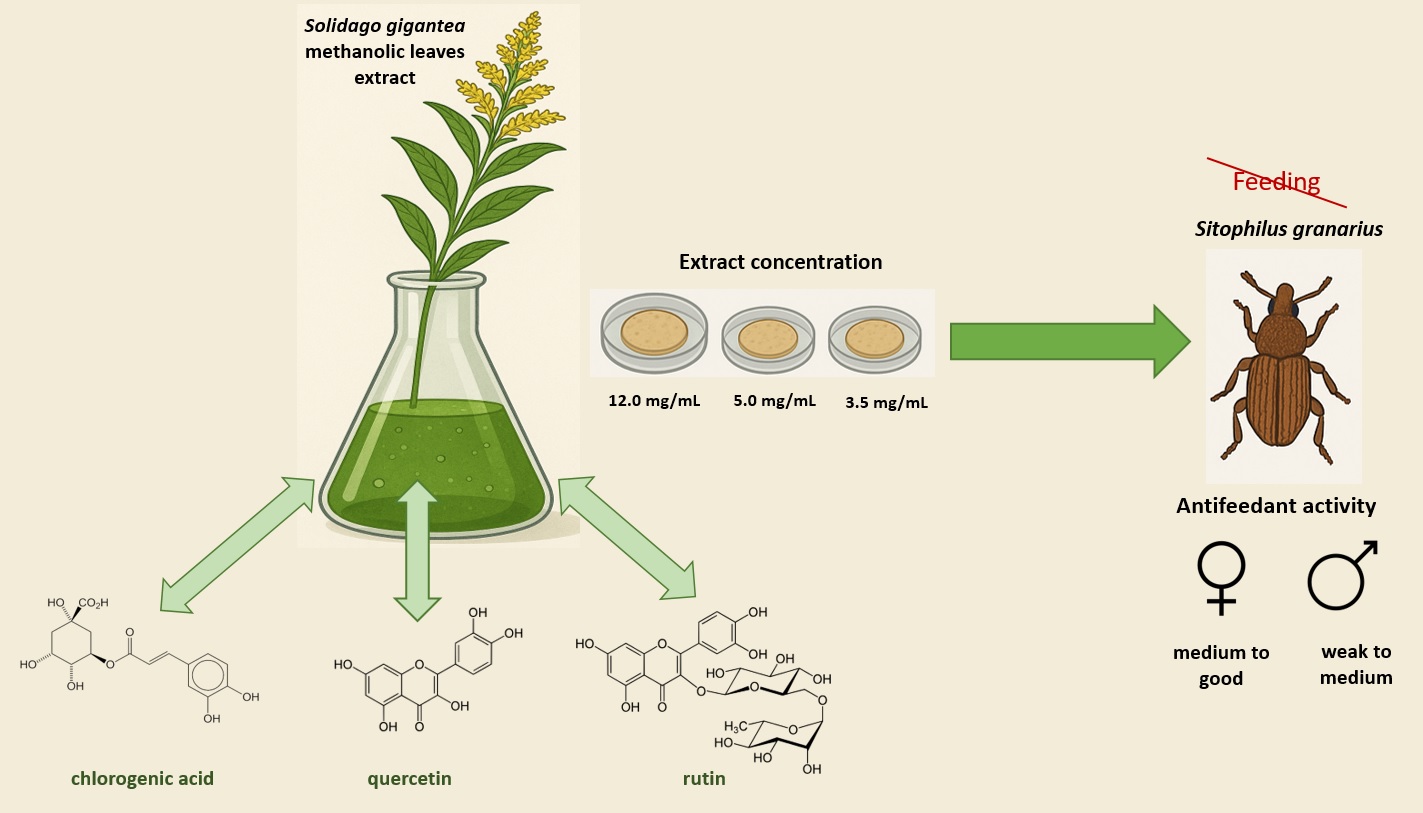
The development of natural insecticides is essential to minimize the adverse effects of synthetic plant protection products on the environment, human health, and non-target organisms. Natural bioactive compounds are considered safe, biodegradable, and often more selective, making them promising alternatives for sustainable pest management. Controlling insect pests in stored food products remains challenging due to restrictions on the use of chemical insecticides, which can leave harmful residues. Therefore, identification of plant-derived antifeedants is a viable solution. This study aimed to evaluate the antifeedant activity of methanolic leaf extracts from the invasive giant goldenrod (Solidago gigantea Aiton) against the grain weevil (Sitophilus granarius L.), a major storage pest. The chemical composition of the extracts was analyzed by LC-MS/MS, which identified 12 compounds. Chlorogenic acid, quercetin, and rutin were found at the highest concentrations, while citric acid, gallic acid, and kaempferol-3-rutinoside were present at the lowest concentrations. Antifeedant activity was assessed using the "wheat wafer test" at three extract concentrations (3.5, 5.0, and 12.0 mg⋅mL-1) dissolved in ethanol. The extracts demonstrated medium to good antifeedant activity against female grain weevils and weak to medium effects against males. A significant reduction in feeding was observed in most cases, depending on both the sex of the insect and the extract concentration. Methanolic leaf extracts of S. gigantea exhibited promising antifeedant properties and may serve as potential natural insect deterrents. Further studies are required to evaluate their efficacy, safety, and mode of action under storage and field conditions.
References
Adeyemi M.M., Adebote D.A., Amupitan J.O., Oyewale A.O., Agbaji A.S. 2010. Antifeedant activity of quercetin isolated from the stem bark of Bobgunnia madagascariensis (Desv.) J.H.Kirkbr & Wiersema (Caesalpiniaceae). Australian Journal of Basic And Applied Sciences 4: 3342–3346.
Andrić G., Kljajić P., Pražić-Golić M. 2014. Residual efficacy of cypermethrin and pirimiphos-methyl against Sitophilus granarius (L.) and Plodia interpunctella (Hübner) on concrete surface. Pesticides and Phytomedicine 29 (4): 275–281. DOI: https://doi.org/10.2298/PIF1404275A DOI: https://doi.org/10.2298/PIF1404275A
Athanassiou C.G., Phillips T.W., Wakil W. 2019. Biology and control of the khapra beetle, Trogoderma granarium, a major quarantine threat to global food security. Annual Review of Entomology 64: 131–148. DOI: https://doi.org/10.1146/annurev-ento-011118-111804 DOI: https://doi.org/10.1146/annurev-ento-011118-111804
Aznar-Fernández T., Cimmino A., Masi M., Rubiales D., Evidente A. 2019. Antifeedant activity of long-chain alcohols, and fungal and plant metabolites against pea aphid (Acyrthosiphon pisum) as potential biocontrol strategy. Natural Product Research 33: 2471–2479. DOI: https://doi.org/10.1080/14786419.2018.1452013 DOI: https://doi.org/10.1080/14786419.2018.1452013
Baglyas M., Ott P.G., Garádi Z., Glavnik V., Béni S., Vovk I., Móricz Á.M. 2022. High-performance thin-layer chromatography – antibacterial assay first reveals bioactive clerodane diterpenes in giant goldenrod (Solidago gigantea Ait.). Journal of Chromatography A (1677): 463308. DOI: https://doi.org/10.1016/j.chroma.2022.463308 DOI: https://doi.org/10.1016/j.chroma.2022.463308
Benelli G., Pavela R., Cianfaglione K., Nagy D.U., Canale A., Maggi F. 2019. Evaluation of two invasive plant invaders in Europe (Solidago canadensis and Solidago gigantea) as possible sources of botanical insecticides. Journal of Pest Science 92: 805–821. DOI: https://doi.org/10.1007/s10340-018-1034-5 DOI: https://doi.org/10.1007/s10340-018-1034-5
Bernays E.A., Cornelius M. 1992. Relationship between deterrence and toxicity of plant secondary compounds for the alfalfa weevil Hypera brunneipennis. Entomologia Experimentalis et Applicata 64: 289–292. DOI: https://doi.org/10.1111/j.1570-7458.1992.tb01619.x DOI: https://doi.org/10.1111/j.1570-7458.1992.tb01619.x
Bird T.G., Hedin P.A. 1986. Improved feeding bioassay for the boll weevil (Coleoptera: Curculionidae). Journal of Economic Entomology 79: 882–886. DOI: https://doi.org/10.1093/jee/79.3.882 DOI: https://doi.org/10.1093/jee/79.3.882
Boniecki P., Koszela K., Świerczyński K., Skwarcz J., Zaborowicz M., Przybył J. 2020. Neural visual detection of grain weevil (Sitophilus granarius L.). Agriculture 10 (25). DOI: https://doi.org/10.3390/agriculture10010025 DOI: https://doi.org/10.3390/agriculture10010025
Chaw J.L., Chan K.L., Gwendoline C.L.E. 2019. Allelopathic invasive plants as phytoinhibitor bioresource material in weed control: A review. Agriculture and Natural Resources 53: 439–448. DOI: https://doi.org/10.34044/j.anres.2019.53.5.01 DOI: https://doi.org/10.34044/j.anres.2019.53.5.01
Chmura D., Dyba P., Kraj P., Peplińska N., Pilorz A., Roman M. 2015. Invasion of alien Solidago taxa into urban habitats: a study of selected towns in southern Poland. Chemistry-Didactics-Ecology-Metrology 20 (1-2): 97–104. DOI: https://doi.org/10.1515/cdem-2015-0010 DOI: https://doi.org/10.1515/cdem-2015-0010
Darrag H.M., Almuhanna H.T., Hakami E. H. 2022. Secondary metabolites in basil, bio-insecticide, inhibition effect, and in silico molecular docking against proteolytic enzymes of the red palm weevil (Rhynchophorus ferrugineus). Plants 11 (8): 1087. DOI: https://doi.org/10.3390/plants11081087 DOI: https://doi.org/10.3390/plants11081087
Dinuţă A., Bunescu H., Bodiş I. 2009. Contributions to the knowledge of morphology of the granary weevil (Sitophilus Granarius L.), major pest of the stored cereals. Bulletin of University of Agricultural Sciences and Veterinary Medicine Cluj-Napoca. Agriculture 66: 59–66. DOI: https://doi.org/10.15835/buasvmcn-agr:3731 DOI: https://doi.org/10.15835/buasvmcn-agr:3731
Fisher A.M., McKenzie A-M.R., Price T.A.R., Bonsal M.B., Knell R.J. 2024. Do sex ratio distorting microbes inhibit the evolution of pesticide resistance? An experimental test. Evolutionary Applications 17: e70003. DOI: https://doi.org/10.1111/eva.70003 DOI: https://doi.org/10.1111/eva.70003
Gustavsson J., Cederberg C., Sonesson U., Emanuelsson A. 2013. The methodology of the FAO study: “Global food losses and food waste - extent, causes and prevention.” SIK report No. 857, The Swedish Institute for Food and Biotechnology
Guzikowa M., Maycock P.F. 2014. The invasion and expansion of three North American species of goldenrod (Solidago canadensis L. sensu lato. S. gigantea Ait. and S. graminifolia (L.) Salisb) in Poland. Acta Societatis Botanicorum Poloniae 55: 367–384. DOI: https://doi.org/10.5586/asbp.1986.034
Hagstrum D.W., Phillips T.W. 2017. Evolution of Stored-Product Entomology: Protecting the World Food Supply. Annual Review of Entomology 62: 379–397. DOI: https://doi.org/10.1146/annurev-ento-031616-035146 DOI: https://doi.org/10.1146/annurev-ento-031616-035146
Hasan W., Hussain G.J., Doggalli G., Alagumanian S., Jena N.K., Saravanan A., Hazarika S., Saravanamoorthy M.D. 2023. Plant‐based products as control agents of stored product insect pests: prospects, applications and challenges. International Journal of Plant & Soil Science 35: 866–873. DOI: https://doi.org/10.9734/ijpss/2023/v35i224198 DOI: https://doi.org/10.9734/ijpss/2023/v35i224198
Hasan W., Shreevani G.N, Kumari N, Verma K., Panigrahi C.K., Mohapatra P. 2025. Post-harvest losses of vegetables caused by pests: a review”. Uttar Pradesh Journal of Zoology 46 (10): 354-360. DOI: https://doi.org/10.56557/upjoz/2025/v46i104994 DOI: https://doi.org/10.56557/upjoz/2025/v46i104994
Hengsdijk H., De Boer W.J. 2017. Post-harvest management and post-harvest losses of cereals in Ethiopia. Food Security 9: 945–958. DOI: https://doi.org/10.1007/s12571-017-0714-y DOI: https://doi.org/10.1007/s12571-017-0714-y
Herrera-Mayorga V., Guerrero-Sánchez J.A., Méndez-Álvarez D., Paredes-Sánchez F.A., Rodríguez-Duran L.V., Niño-García N., Paz-González A.D., Rivera G. 2022. Insecticidal activity of organic extracts of Solidago graminifolia and its main metabolites (quercetin and chlorogenic acid) against Spodoptera frugiperda: an in vitro and in silico approach. Molecules 27: 3325. DOI: https://doi.org/10.3390/molecules27103325 DOI: https://doi.org/10.3390/molecules27103325
Hubert J., Stejskal V., Athanassiou C.G., Throne J.E. 2018. Health hazards associated with arthropod infestation of stored products. Annual Review of Entomology 63: 553–573. DOI: https://doi.org/10.1146/annurev-ento-020117-043218 DOI: https://doi.org/10.1146/annurev-ento-020117-043218
Jackowski J., Hurej M., Rój E., Popłoński J., Kośny L., Huszcza E., 2015. Antifeedant activity of xanthohumol and supercritical carbon dioxide extract of spent hops against stored product pests. Bulletin of Entomological Research 105: 456–461. DOI: https://doi.org/10.1017/S0007485315000255 DOI: https://doi.org/10.1017/S0007485315000255
Jackowski J., Popłoński J., Twardowska K., Magiera-Dulewicz J., Hurej M., Huszcza E. 2017. Deterrent activity of hops flavonoids and their derivatives against stored product pests. Bulletin of Entomological Research 107: 592–597. DOI: https://doi.org/10.1017/S0007485317000050 DOI: https://doi.org/10.1017/S0007485317000050
Jadhav D.R., Mallikarjuna N., Rathore A., Pokle D. 2012. Effect of some flavonoids on survival and development of Helicoverpa armigera (Hübner) and Spodoptera litura (Fab). Asian Journal of Agricultural Sciences 4: 298–307.
Jiang T. 2006. A survey of chemical and pharmacological studies on Solidago. Chinese Journal of Integrative Medicine 4 (4): 430–435. DOI: https://doi.org/10.3736/jcim20060425 DOI: https://doi.org/10.3736/jcim20060425
Kerebba N., Oyedeji A.O., Byamukama R., Kuria S.K., Oyedeji O.O. 2022. Evaluation for feeding deterrents against Sitophilus zeamais (Motsch.) from Tithonia diversifolia (Hemsl.) A. Gray. Journal of Biologically Active Products from Nature 12: 77–93. DOI: https://doi.org/10.1080/22311866.2021.2023046 DOI: https://doi.org/10.1080/22311866.2021.2023046
Keskin S., Ozkaya H. 2013. Effect of storage and insect infestation on the mineral and vitamin contents of wheat grain and flour. Journal of Economic Entomology 106: 1058–1063. DOI: https://doi.org/10.1603/EC12391 DOI: https://doi.org/10.1603/EC12391
Keskin S., Ozkaya H. 2015. Effect of storage and insect infestation on the technological properties of wheat. CyTA - Journal of Food 13: 134–139. DOI: https://doi.org/10.1080/19476337.2014.919962 DOI: https://doi.org/10.1080/19476337.2014.919962
Keszthelyi S., Lukács H., Pál-Fám F. 2021. Effects of different infra-red irradiations on the survival of granary weevil Sitophilus granarius: bioefficacy and sustainability. Insects 12 (2): 102. DOI: https://doi.org/10.3390/insects12020102 DOI: https://doi.org/10.3390/insects12020102
Kostyukovsky M., Trostanetsky A., Quinn E. 2016. Novel approaches for integrated grain storage management. Israel Journal of Plant Sciences 63 (1): 7–16. DOI: https://doi.org/10.1080/07929978.2016.1159410 DOI: https://doi.org/10.1080/07929978.2016.1159410
Kozuharova E., Pasdaran A., Al Tawaha A.R., Todorova T., Naychov Z., Ionkova I. 2022. Assessment of the potential of the invasive arboreal plant Ailanthus altissima (Simaroubaceae) as an economically prospective source of natural pesticides. Diversity 14: 680. DOI: https://doi.org/10.3390/d14080680 DOI: https://doi.org/10.3390/d14080680
Kroos G.M., Klementz D. 2016. Chemical control of pest insects in stored-product protection in Germany - present situation and challenges. Journal für Kulturpflanzen 68 (2): 38–44. DOI: https://doi.org/10.5073/JFK.2016.02.02
Kumar D., Kalita P. 2017. Reducing postharvest losses during storage of grain crops to strengthen food security in developing countries. Foods 6 (1): 8. DOI: https://doi.org/10.3390/foods6010008 DOI: https://doi.org/10.3390/foods6010008
Kundu A., Vadassery J. 2019. Chlorogenic acid‐mediated chemical defence of plants against insect herbivores. Journal of Plant Biology 21 (2): 185–189. DOI: https://doi.org/10.1111/plb.12947 DOI: https://doi.org/10.1111/plb.12947
Larson N.R., O’Neal S.T., Bernier U.R., Bloomquist J.R., Anderson T.D. 2020. Terpenoid-induced feeding deterrence and antennal response of honey bees. Insects 11 (2): 83. DOI: https://doi.org/10.3390/insects11020083 DOI: https://doi.org/10.3390/insects11020083
Laznik Ž., Bohinc T., Trdan S. 2018. Applicability of invasive alien plants in controlling harmful organisms of cultivated plants. Acta Agriculturae Slovenica 111 (2). DOI: https://doi.org/10.14720/aas.2018.111.2.22 DOI: https://doi.org/10.14720/aas.2018.111.2.22
Liao Y., Zeng L., Rao S., Gu D., Liu X., Wang Y., Zhu H., Hou X., Yang Z. 2020. Induced biosynthesis of chlorogenic acid in sweetpotato leaves confers the resistance against sweetpotato weevil attack. Journal of Advanced Research 24: 513–522. DOI: https://doi.org/10.1016/j.jare.2020.06.011 DOI: https://doi.org/10.1016/j.jare.2020.06.011
Lin D., Fang Y., Li L., Zhang L., Gao S., Wang R., Wang J. 2022. The insecticidal effect of the botanical insecticide chlorogenic acid on Mythimna separata (Walker) is related to changes in MsCYP450 gene expression. Frontiers in Plant Science 13: 1015095. DOI: https://doi.org/10.3389/fpls.2022.1015095 DOI: https://doi.org/10.3389/fpls.2022.1015095
Mołdoch J., Domaradzki K., 2024. Preliminary studies on the allelopathic potential of two invasive species of Solidago against selected cereal weeds. Current Agronomy 53 (1): 31–43. DOI: https://doi.org/10.2478/cag-2024-0004 DOI: https://doi.org/10.2478/cag-2024-0004
Móricz Á.M., Krüzselyi D., Ott P.G., Garádi Z., Béni S., Morlock G.E., Bakonyi J. 2021. Bioactive clerodane diterpenes of giant goldenrod (Solidago gigantea Ait.) root extract. Journal of Chromatography A 1635: 461727. DOI: https://doi.org/10.1016/j.chroma.2020.461727 DOI: https://doi.org/10.1016/j.chroma.2020.461727
Navarro-Roldán M.A., Avilla J., Bosch D., Valls J., Gemeno C. 2017. Comparative effect of three neurotoxic insecticides with different modes of action on adult males and females of three tortricid moth pests. Journal of Economic Entomology 110: 1740–1749. DOI: https://doi.org/10.1093/jee/tox113 DOI: https://doi.org/10.1093/jee/tox113
Navya E., Samson Vitty B., Aruna Kumari J., Supraja K.V.L., Prithvi Raj D., Venkatesh P. 2025. Ecological warfare: natural plant defense mechanism against insect pests. Journal of Experimental Agriculture International 47 (4): 139–150. DOI: https://doi.org/10.9734/jeai/2025/v47i43364. DOI: https://doi.org/10.9734/jeai/2025/v47i43364
Nawrot J., Bloszyk E., Harmatha J., Novotny L., Drozdz B. 1986. Action of antifeedants of plant origin on beetles infesting stored products. Acta Entomologica Bohemslovaca 83: 327–335.
Nayak M.K., Daglish G.J. 2018. Importance of stored product insects. p. 1-17. In: „Recent Advances in Stored Product Protection” (Athanassiou C.G., Arthur, F.H., eds.) Springer, Heidelberg, Berlin. DOI: https://doi.org/10.1007/978-3-662-56125-6_1 DOI: https://doi.org/10.1007/978-3-662-56125-6_1
Niedermayer S., Pollmann M., Steidle J. 2016. Lariophagus distinguendus (Hymenoptera: Pteromalidae) (Förster)—past, present, and future: the history of a biological control method using L. distinguendus against different storage pests. Insects 7 (3): 39. DOI: https://doi.org/10.3390/insects7030039 DOI: https://doi.org/10.3390/insects7030039
Olejarski P., Węgorek P. 2013. Resistance of stored grain insect pests to active substances used in Poland for protection of stored grains. Progress in Plant Protection 53: 249–256. DOI: https://doi.org/10.14199/PPP-2013-080 DOI: https://doi.org/10.14199/ppp-2013-080
Pachura N., Zimmer A., Grzywna K., Figiel A., Szumny A., Łyczko J. 2022. Chemical investigation on Salvia officinalis L. Affected by multiple drying techniques – The comprehensive analytical approach (HS-SPME, GC–MS, LC-MS/MS, GC-O and NMR). Food Chemistry 397: 133802. DOI: https://doi.org/10.1016/j.foodchem.2022.133802 DOI: https://doi.org/10.1016/j.foodchem.2022.133802
Pavela R. 2007. The feeding effect of polyphenolic compounds on the colorado potato beetle (Leptinotarsa decemlineata (Say)). Pest Technology 1 (1): 81–84.
Pavela R., Kovaříková K., Novák M. 2025. Botanical antifeedants: An alternative approach to pest control. Insects 16 (2): 136. DOI: https://doi.org/10.3390/insects16020136 DOI: https://doi.org/10.3390/insects16020136
Pimentel D. 2011. Food for thought: a review of the role of energy in current and evolving agriculture. Critical Reviews in Plant Sciences 30 (1-2): 35–44. DOI: https://doi.org/10.1080/07352689.2011.554349 DOI: https://doi.org/10.1080/07352689.2011.554349
Quellhorst H., Sakka M., Gourgouta M., Morrison W.R., Zhu K.Y., Athanassiou C.G. 2023. Efficacy of deltamethrin and pirimiphos-methyl in proportionally layer-treated maize against the larger grain borer and the maize weevil. Journal of Economic Entomology 116 (3): 1017–1024. DOI: https://doi.org/10.1093/jee/toad072 DOI: https://doi.org/10.1093/jee/toad072
Radušienė J., Karpavičienė B., Vilkickytė G., Marksa M., Raudonė L. 2024. Comparative analysis of root phenolic profiles and antioxidant activity of five native and invasive Solidago L. species. Plants 13 (1): 132. DOI: https://doi.org/10.3390/plants13010132 DOI: https://doi.org/10.3390/plants13010132
Riddick E.W., Wu Z., Eller F.J., Berhow M.A. 2018. Utilization of quercetin as an oviposition stimulant by lab-cultured coleomegilla maculata in the presence of conspecifics and a tissue substrate. Insects 9 (3): 77. DOI: https://doi.org/10.3390/insects9030077 DOI: https://doi.org/10.3390/insects9030077
Riddick E.W. 2021. Potential of quercetin to reduce herbivory without disrupting natural enemies and pollinators. Agriculture 11 (6): 476. DOI: https://doi.org/10.3390/agriculture11060476 DOI: https://doi.org/10.3390/agriculture11060476
Saad M.M.G., Abdelgaleil S.A.M. 2018. Effectiveness of monoterpenes and phenylpropenes on Sitophilus oryzae L. (Coleoptera: Curculionidae) in stored wheat. Journal of Asia-Pacific Entomology 21 (4): 1153–1158. DOI: https://doi.org/10.1016/j.aspen.2018.08.006 DOI: https://doi.org/10.1016/j.aspen.2018.08.006
San P.P., Zhang Y.Z., Helmy E.A.M., Adarkwah C., Tuda M. 2023. Sex-dependent effects of biosynthesized nanoparticles on stored bean pests and their non-target parasitoid. Crop Protection 173: 106352. DOI: https://doi.org/10.1016/j.cropro.2023.106352 DOI: https://doi.org/10.1016/j.cropro.2023.106352
Shelepova V., Tkacheva E.V., Vinogradova Y.K. 2021. North American species of Solidago as ornamental plants and a source of promising raw plant materials. IOP Conference Series: Earth and Environmental Science 845: 012150. DOI: https://doi.org/10.1088/1755-1315/845/1/012150 DOI: https://doi.org/10.1088/1755-1315/845/1/012150
Shelepova O., Vinogradova Y. 2021. Phytochemistry and inflorescences morphometry of invasive Solidago L. (goldenrods) species – valuable late autumn mellifers. Agrobiodiversity for Improving Nutrition Health and Life Quality 5 (2): 209–214. DOI: https://doi.org/10.15414/ainhlq.2021.0019 DOI: https://doi.org/10.15414/ainhlq.2021.0019
Silva T.R.F.B., Almeida A.C.D.S., Moura T.D.L., Silva A.R.D., Freitas S.D.S., Jesus F.G. 2016. Effect of the flavonoid rutin on the biology of Spodoptera frugiperda (Lepidoptera: Noctuidae). Acta Scientiarum Agronomy 38 (2): 165. DOI: https://doi.org/10.4025/actasciagron.v38i2.27956 DOI: https://doi.org/10.4025/actasciagron.v38i2.27956
Souto A.L., Sylvestre M., Tölke E.D., Tavares J.F., Barbosa-Filho J.M., Cebrián-Torrejón G. 2021. Plant-derived pesticides as an alternative to pest management and sustainable agricultural production: prospects, applications and challenges. Molecules 26 (16): 4835. DOI: https://doi.org/10.3390/molecules26164835 DOI: https://doi.org/10.3390/molecules26164835
Stejskal V., Aulicky R., Kucerova Z. 2014. Pest control strategies and damage potential of seed-infesting pests in the Czech stores - a review. Plant Protection Science 50 (4): 165–173. DOI: https://doi.org/10.17221/10/2014-PPS DOI: https://doi.org/10.17221/10/2014-PPS
Stejskal V., Hubert J., Aulicky R., Kucerova Z. 2015. Overview of present and past and pest-associated risks in stored food and feed products: European perspective. Journal of Stored Products Research 64 (B): 122–132. DOI: https://doi.org/10.1016/j.jspr.2014.12.006 DOI: https://doi.org/10.1016/j.jspr.2014.12.006
Strelec I., Šarkanj B., Mrša V., Ugarčić-Hardi Ž. 2014. Biochemical changes in S. granarius infested wheat grains. Journal of Food Biochemistry 38: 175–183. DOI: https://doi.org/10.1111/jfbc.12036 DOI: https://doi.org/10.1111/jfbc.12036
Szymura M., Szymura T.H. 2016. Historical contingency and spatial processes rather than ecological niche differentiation explain the distribution of invasive goldenrods (Solidago and Euthamia). Plant Ecology 217: 565–582. DOI: https://doi.org/10.1007/s11258-016-0601-1 DOI: https://doi.org/10.1007/s11258-016-0601-1
Szymura M., Szymura T.H., Wolski K., Świerszcz S. 2018. Can native grass species outcompete invasive goldenrods? Results of a replacement series experiment. Weed Research 58 (4): 304–317. DOI: https://doi.org/10.1111/wre.12306 DOI: https://doi.org/10.1111/wre.12306
Uikey J. 2024. Effect of plant based pesticides in grain dtorage management. International Journal For Multidisciplinary Research 6 (4). DOI: https://doi.org/10.36948/ijfmr.2024.v06i04.24964 DOI: https://doi.org/10.36948/ijfmr.2024.v06i04.24964
Wang R., Zhang Q., Qu C., Wang Q., Wang J., Luo C. 2023. Toxicity, baseline of susceptibility, detoxifying mechanism and sublethal effects of chlorogenic acid, a potential botanical insecticide, on Bemisia tabaci. Frontiers in Plant Science 14: 1150853. DOI: https://doi.org/10.3389/fpls.2023.1150853 DOI: https://doi.org/10.3389/fpls.2023.1150853
Woźniak D., Ślusarczyk S., Domaradzki K., Dryś A., Matkowski A. 2018. Comparison of polyphenol profile and pntimutagenic and pntioxidant pctivities in two species used as source of Solidaginis herba – Goldenrod. Chemistry & Biodiversity 15 (4): e1800023. DOI: https://doi.org/10.1002/cbdv.201800023 DOI: https://doi.org/10.1002/cbdv.201800023
Yactayo-Chang J.P., Tang H.V., Mendoza J., Christensen S. A., Block A.K. 2020. Plant defense chemicals against insect Pests. Agronomy 10 (8): 1156. DOI: https://doi.org/10.3390/agronomy10081156 DOI: https://doi.org/10.3390/agronomy10081156
Yousuf H. M.B., Yasin M., Khan M.A., Abbasi A., Arshad M., Aqueel M.A., Ul Haq I., Alsakkaf W.A.A., Mackled M.I., Rebouh N.Y., Ali H.M. 2025. Assessment of different cconventional and biofortified wheat genotypes based on biology and damage pattern of Rhyzopertha dominica and Trogoderma granarium. Insects 16 (1): 66. DOI: https://doi.org/10.3390/insects16010066 DOI: https://doi.org/10.3390/insects16010066
Zekič J., Vovk I., Glavnik V. 2020. Extraction and analyses of flavonoids and phenolic acids from canadian goldenrod and giant goldenrod. Forests 12 (1): 40. DOI: https://doi.org/10.3390/f12010040 DOI: https://doi.org/10.3390/f12010040
Zhang W., Guan W., Geng Z., Wang Y., Pang X., You C., Du S. 2020. Two new coumarins from Zanthoxylum dimorphophyllum spinifolium and their feeding deterrent activities against Tribolium castaneum. Industrial Crops and Products 143: 111889. DOI: https://doi.org/10.1016/j.indcrop.2019.111889 DOI: https://doi.org/10.1016/j.indcrop.2019.111889
Downloads
Published
How to Cite
Issue
Section
License
Copyright (c) 2026 Journal of Plant Protection Research

This work is licensed under a Creative Commons Attribution 4.0 International License.