Genetic and molecular oxidative stress responses in honeybees exposed to pesticide residues
DOI:
https://doi.org/10.24425/jppr.2026.3294Abstract
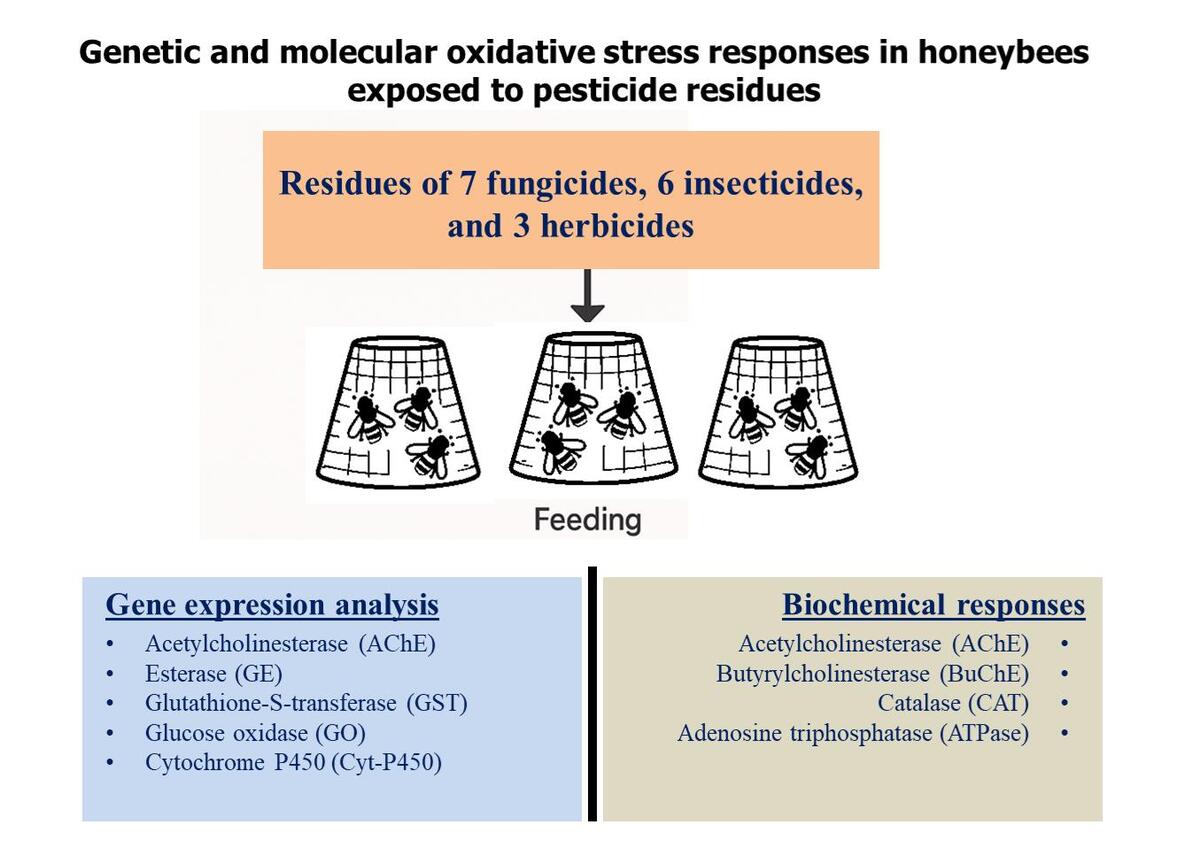
Pesticides pose a significant challenge to non-target organisms, particularly honeybees (Apis mellifera Linnaeus, 1758). Worker honeybees encounter pesticide residues during foraging in both open fields and hives, and these residues have been identified in bee products. However, the effects of these pesticides on bees at detected concentrations are not well understood. Therefore, this study aimed to assess the potential impacts of pesticide residues, including seven fungicides, six insecticides, and three herbicides, on gene expression and the activities of enzymes related to oxidative stress in worker bees. The following enzymes were included in the study: glucose oxidase, cytochrome P-450, acetylcholinesterase, general esterases, glutathione-S-transferase, butyrylcholinesterase, catalase, and adenosine triphosphatase. The results showed that chlorpyrifos (15.30 ng·ml-1), cypermethrin (10.72 ng·ml-1), and pendimethalin (3.42 ng·ml-1) significantly affected gene expression and the activities of the tested enzymes, while the control group and other pesticides did not. Untreated bees had higher specific enzyme activity and gene expression compared to most of the pesticides tested. Results from fludioxonil (14.45 ng·ml-1) and tolclofos-methyl (18.14 ng·ml-1) closely resembled those of the control group, indicating that these fungicides, at the tested concentrations, may not pose a threat to bee health. This research offers valuable insights into the potential negative effects of pesticide residues on the physiological balance of bees.
References
Belsky J., Joshi N.K. 2020. Effects of fungicide and herbicide chemical exposure on Apis and non-Apis bees in agricultural landscape. Frontiers in Environmental Science 8 (1): 522888. DOI: https://doi.org/10.3389/fenvs.2020.00081 DOI: https://doi.org/10.3389/fenvs.2020.00081
Bomtorin A.D., Mackert A., Rosa G.C., Moda L.M., Martins J.R., Bitondi M.M., Hartfelder K., Simoes Z.L. 2014. Juvenile hormone biosynthesis gene expression in the corpora allata of honeybee (Apis mellifera L.) female castes PLOS ONE 9(1):e86923. DOI: https://doi.org/10.1371/journal.pone.0086923 DOI: https://doi.org/10.1371/journal.pone.0086923
Bucekova M., Valachova J., Kohutova L., Prochazka E., Klaudiny E., Majtan J. 2014. Honeybee glucose oxidase—its expression in honeybee workers and comparative analyses of its content and H2O2-mediated antibacterial activity in natural honeys. Naturwissenschaften 101:661-670. DOI: https://doi.org/10.1007/s00114-014-1205-z DOI: https://doi.org/10.1007/s00114-014-1205-z
Carvalho S.M., Belzunces L.P., Carvalho G.A., Brunet J.L., Badiou‐Beneteau A. 2013. Enzymatic biomarkers as tools to assess environmental quality: a case study of exposure of the honeybee Apis mellifera to insecticides. Environmental Toxicology and Chemistry 32(9):2117-2124. DOI: https://doi.org/10.1002/etc.2288 DOI: https://doi.org/10.1002/etc.2288
Faita M.R., Cardozo M.M., Amandio D.T.T., Orth A.I., Nodari R.O. 2020. Glyphosate-based herbicides and Nosema sp. microsporidia reduce honey bee (Apis mellifera L.) survivability under laboratory conditions. Journal of Apicultural Research 59(4): 332-342. DOI: https://doi.org/10.1080/00218839.2020.1736782 DOI: https://doi.org/10.1080/00218839.2020.1736782
Fent K., Schmid M., Christen V. 2020. Global transcriptome analysis reveals relevant effects at environmental concentrations of cypermethrin in honey bees (Apis mellifera). Environmental Pollution 259: 113715. DOI: https://doi.org/10.1016/j.envpol.2019.113715 DOI: https://doi.org/10.1016/j.envpol.2019.113715
Goulson D. 2019. The insect apocalypse, and why it matters. Current Biology 29(19): R967-R971. DOI: https://doi.org/10.1016/j.cub.2019.06.069 DOI: https://doi.org/10.1016/j.cub.2019.06.069
Gradish A.E., Scott‐Dupree C.D., Shipp L., Harris C.R., Ferguson G. 2010. Effect of reduced risk pesticides for use in greenhouse vegetable production on Bombus impatiens (Hymenoptera: Apidae). Pest Management Science 66(2): 142-146. DOI: https://doi.org/10.1002/ps.1846 DOI: https://doi.org/10.1002/ps.1846
Han W., Yang Y., Gao J., Zhao D., Ren C., Wang S., Zhao S., Zhong Y. 2019. Chronic toxicity and biochemical response of Apis cerana cerana (Hymenoptera: Apidae) exposed to acetamiprid and propiconazole alone or combined. Ecotoxicology 28(4): 399-411. DOI: https://doi.org/10.1007/s10646-019-02030-4 DOI: https://doi.org/10.1007/s10646-019-02030-4
He Q., Yang Q., Liu Q., Hu Z., Gao Q., Dong Y., Cao H. 2022. The effects of beta‐cypermethrin, chlorbenzuron, chlorothalonil, and pendimethalin on Apis mellifera ligustica and Apis cerana cerana larvae reared in vitro. Pest Management Science 78(4): 1407-1416. DOI: https://doi.org/10.1002/ps.6757 DOI: https://doi.org/10.1002/ps.6757
Johnson R.M., Ellis M.D., Mullin C.A., Frazier M. 2010. Pesticides and honey bee toxicity–USA. Apidologie 41: 312-331. DOI: https://doi.org/10.1051/apido/2010018 DOI: https://doi.org/10.1051/apido/2010018
Liu Z., Chen C., Niu Q., Qi W., Yuan C., Su S., Liu S., Zhang Y., Zhang X., Ji T., Dai R., Wang S., Gao F., Guo H., Lv L., Ding G., Shi W. 2016. Survey results of honey bee (Apis mellifera) colony losses in China (2010–2013). Journal of Apicultural Research 55(1): 29-37. DOI: https://doi.org/10.1080/00218839.2016.1193375 DOI: https://doi.org/10.1080/00218839.2016.1193375
Manning R. 2018. Chemical residues in beebread, honey, pollen, and wax samples collected from bee hives placed on canola crops in Western Australia. Journal of Apicultural Research 57(5): 696-708. DOI: https://doi.org/10.1080/00218839.2018.1494889 DOI: https://doi.org/10.1080/00218839.2018.1494889
Motta E.V., Mak M., De Jong T.K., Powell J.E., O'Donnell A., Suhr K.J., Riddington I.M., Moran, N.A. 2020. Oral or topical exposure to glyphosate in herbicide formulation impacts the gut microbiota and survival rates of honey bees. Applied and Environmental Microbiology 86(8): e01150-20. DOI: https://doi.org/10.1128/AEM.01150-20 DOI: https://doi.org/10.1128/AEM.01150-20
Murawska A., Migdał P., Roman A. 2021. Effects of plant protection products on biochemical markers in honeybees. Agriculture 11(7): 648. DOI: https://doi.org/10.3390/agriculture11070648 DOI: https://doi.org/10.3390/agriculture11070648
Nassar A.M., Salim Y.M., Nour-Eldeen E., Younis M.S., Kelany M.M., Shebl M.A., Shafey A.S. Abou-Shaara, H.F. 2024. Seasonal screening of pesticide residues in beehive products collected from different districts in Egypt. Environmental Monitoring and Assessment 196(3): 297. DOI: https://doi.org/10.1007/s10661-024-12451-2 DOI: https://doi.org/10.1007/s10661-024-12451-2
Ohlinger B.D., Schürch R., Durzi S., Kietzman P.M., Silliman M.R., Couvillon M.J. 2022. Honey bees (Hymenoptera: Apidae) decrease foraging but not recruitment after neonicotinoid exposure. Journal of Insect Science 22(1): 16. DOI: https://doi.org/10.1093/jisesa/ieab095 DOI: https://doi.org/10.1093/jisesa/ieab095
Olgun T., Dayioğlu M., Özsoy N. 2020. Pesticide and pathogen-induced oxidative stress in honey bees (Apis mellifera L.). Mellifera 20: 32-52.
Rands S.A., Whitney H.M. 2011. Field margins, foraging distances, and their impacts on nesting pollinator success. PLOS ONE 6(10): e25971. DOI: https://doi.org/10.1371/journal.pone.0025971 DOI: https://doi.org/10.1371/journal.pone.0025971
Rondeau S., Raine N.E. 2022. Fungicides and bees: a review of exposure and risk. Environment International 165: 107311. DOI: https://doi.org/10.1016/j.envint.2022.107311 DOI: https://doi.org/10.1016/j.envint.2022.107311
Samson-Robert O., Labrie G., Mercier P., Chagnon M., Derome N., Fournier V. 2015. Increased acetyl cholinesterase expression in bumble bees during neonicotinoid-coated corn sowing. Scientific Reports 5: 12636. DOI: https://doi.org/10.1038/srep12636 DOI: https://doi.org/10.1038/srep12636
Serra‐Bonvehí J., Orantes‐Bermejo J. 2010. Acaricides and their residues in Spanish commercial beeswax. Pest Management Science 66(11): 1230-1235. DOI: https://doi.org/10.1002/ps.1999 DOI: https://doi.org/10.1002/ps.1999
Shan W., Guo D., Guo H., Tan S., Ma L., Wang Y., Xu B. 2022. Cloning and expression studies on glutathione-S-transferase like-gene in honey bee for its role in oxidative stress. Cell Stress and Chaperones 27(2): 121-134. DOI: https://doi.org/10.1007/s12192-022-01255-3 DOI: https://doi.org/10.1007/s12192-022-01255-3
Tosi S., Nieh J.C. 2019. Lethal and sublethal synergistic effects of a new systemic pesticide, flupyradifurone (Sivanto®), on honeybees. Proceedings of the Royal Society B: Biological Sciences, 286(1900): 20190433. DOI: https://doi.org/10.1098/rspb.2019.0433 DOI: https://doi.org/10.1098/rspb.2019.0433
Vilarem C., Piou V., Vogelweith F., Vétillard A. 2021. Varroa destructor from the laboratory to the field: Control, biocontrol and IPM perspectives—A review. Insects, 12(9): 800. DOI: https://doi.org/10.3390/insects12090800 DOI: https://doi.org/10.3390/insects12090800
Villalba A., Maggi M., Ondarza P.M., Szawarski N., Miglioranza K.S.B. 2020. Influence of land use on chlorpyrifos and persistent organic pollutant levels in honey bees, bee bread and honey: Beehive exposure assessment. Science of The Total Environment 713: 136554. DOI: https://doi.org/10.1016/j.scitotenv.2020.136554 DOI: https://doi.org/10.1016/j.scitotenv.2020.136554
Wagner D.L. 2020. Insect declines in the anthropocene. Annual Review of Entomology 65: 457-480. DOI: https://doi.org/10.1146/annurev-ento-011019-025151 DOI: https://doi.org/10.1146/annurev-ento-011019-025151
Wang Y., Zhu Y.C., Li W. 2020. Comparative examination on synergistic toxicities of chlorpyrifos, acephate, or tetraconazole mixed with pyrethroid insecticides to honey bees (Apis mellifera L.). Environmental Science and Pollution Research 27(7): 6971-6980. DOI: https://doi.org/10.1007/s11356-019-07214-3 DOI: https://doi.org/10.1007/s11356-019-07214-3
Wu Y., Zheng Y., Li-Byarlay H., Shi Y., Wang S., Zheng H., Hu F. 2020. CYP6AS8, a cytochrome P450, is associated with the10-HDA biosynthesis in honey bee (Apis mellifera) workers. Apidologie, 51: 1202–1212. DOI: https://doi.org/10.1007/s13592-019-00709-5 DOI: https://doi.org/10.1007/s13592-019-00709-5
Yao J., Zhu Y.C., Adamczyk J., Luttrell R. 2018. Influences of acephate and mixtures with other commonly used pesticides on honey bee (Apis mellifera) survival and detoxification enzyme activities. Comparative Biochemistry and Physiology Part C: Toxicology and Pharmacology 209: 9-17. DOI: https://doi.org/10.1016/j.cbpc.2018.03.005 DOI: https://doi.org/10.1016/j.cbpc.2018.03.005
Zhao H., Li G., Cui X., Wang H., Liu Z., Yang Y., Xu B. 2022. Review of effects of some insecticides on honey bee health. Pesticide Biochemistry and Physiology 188: 105219. DOI: https://doi.org/10.1016/j.pestbp.2022.105219 DOI: https://doi.org/10.1016/j.pestbp.2022.105219
Downloads
Published
How to Cite
Issue
Section
License
Copyright (c) 2026 Journal of Plant Protection Research

This work is licensed under a Creative Commons Attribution 4.0 International License.





