
Changes in weed biodiversity in onion and carrot agrocenoses in the Skierniewice region from 1995 to 2024
DOI:
https://doi.org/10.24425/jppr.2026.3132Abstract
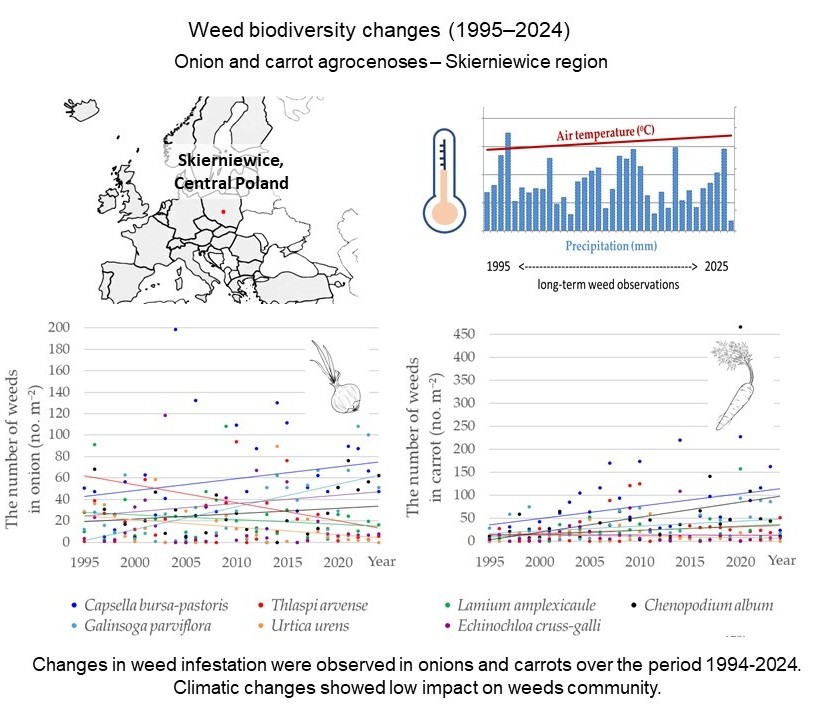
Observations of weed infestation were carried out in onion and carrot crops from 1995 to 2024 in the Skierniewice region. Weed infestation was assessed on unsprayed fields based on weed numbers determined between 29 and 78 days after sowing. Based on species composition and weed abundance, the weed community structure was determined using the Shannon-Wiener species diversity index (H), Simpson's dominance index (SI), Pearson correlation coefficients (r) and Multiple regression. Weed populations in onion and carrot exhibited substantial year-to-year variability and no long-term trends. The most abundant species in onion and carrot were Capsella bursa-pastoris, Thlaspi arvense, Chenopodium album, and Galinsoga parviflora. In onion, an increasing tendency in the number of Galinsoga parviflora Capsella bursa-pastoris, Thlaspi arvense, and Echinochloa crus-galli was observed, while the number of Chenopodium album plants showed a tendency to decrease. In carrot, an upward trend in the populations of Capsella bursa-pastoris and Chenopodium album was observed, although annual fluctuations remained substantial. The climatic effects on weed communities were weak and inconsistent across crops, explaining only a small weed variation and indicating that long-term weed dynamics are shaped primarily by non-climatic factors.
References
Andreasen C., Jensen H., Jensen S. 2018. Decreasing diversity in the soil seed bank after 50 years in Danish arable fields. Agriculture, Ecosystems & Environment 259: 61–71. https://doi.org/10.1016/j.agee.2018.02.034 DOI: https://doi.org/10.1016/j.agee.2018.02.034
Bai K., Ouyang Y., Qi J., Zhan Y., Wang, J. 2025. Niches and genotypes determine the diversity and composition of microbiomes after herbicide treatment in beckmannia syzigachne. Plants 14 (6): 876. https://doi.org/10.3390/plants14060876 DOI: https://doi.org/10.3390/plants14060876
Beckmann M., Gerstner K., Akin-Fajiye M., Ceaușu S., Kambach S., Kinlock N.L., Phillips H.R.P., Verhagen W., Gurevitch J., Klotz S., Newbold T., Verburg P.H., Winter M., Seppelt R. 2019. Conventional land-use intensification reduces species richness and increases production: A global meta-analysis. Global Change Biology 25 (6): 1941–1956. https://doi.org/10.1111/gcb.14606 DOI: https://doi.org/10.1111/gcb.14606
Berbeć A. K., Staniak M., Feledyn‑Szewczyk B., Kocira A., Stalenga J. 2020. Organic but also low‑input conventional farming systems support high biodiversity of weed species in winter cereals. Agriculture 10 (9): 413. https://doi.org/10.3390/agriculture10090413 DOI: https://doi.org/10.3390/agriculture10090413
Blank L., Rozenberg G., Gafni R. 2023. Spatial and temporal aspects of weeds distribution within agricultural fields – A review. Crop Protection 172: 106300. https://doi.org/10.1016/j.cropro.2023.106300 DOI: https://doi.org/10.1016/j.cropro.2023.106300
Bourgeois B., Gaba S., Plumejeaud C., Bretagnolle V. 2020. Weed diversity is driven by complex interplay between multi-scale dispersal and local filtering. Proceedings of the Royal Society B: Biological Sciences 287 (1930), 20201118. https://doi.org/10.1098/rspb.2020.1118 DOI: https://doi.org/10.1098/rspb.2020.1118
Chacko S. R., Raj S., Krishnasree R. K. 2021. Integrated weed management in vegetables: A review. Journal of Pharmacognosy and Phytochemistry 10 (1): 2694–2700. https://doi.org/10.22271/phyto.2021.v10.i1al.13765 DOI: https://doi.org/10.22271/phyto.2021.v10.i1al.13765
de Mol F., Fritzsche R., Gerowitt B. 2025. Weed biodiversity and herbicide intensity as linked via a decision support system. Pest Management Science 81 (10): 6667–6677. https://doi.org/10.1002/ps.70019 DOI: https://doi.org/10.1002/ps.70019
Dobrzański A. 1999. Weed management in vegetable crops [Ochrona warzyw przed chwastami]; Państwowe Wydawnictwo Rolnicze i Leśne (PWRiL): Warsaw, Poland.
Dobrzański A., Adamczewski K. 2009. The influence of weed control on agrophytocenosis biodiversity [Wpływ walki z chwastami na bioróżnorodność agrofitocenoz]. Progress in Plant Protection 49 (3): 982–995.
Domaradzki K., Snopczyński T., Jezierska-Domaradzka A. 2008. [Abutilon theophrasti Medik., new dangerous weed – characterization, appearance and control possibilities [Zaślaz pospolity (Abutilon theophrasti Medik.), nowy groźny chwast upraw polowych – charakterystyka, występowanie i możliwości zwalczania]. Progress in Plant Protection 48 (2): 567–574.
Domaradzki K., Bortniak M. 2023. Changes in segetal weed communities of selected crops over the last 50 years and forecasts for the future [Zmiany w zbiorowiskach chwastów segetalnych wybranych roślin uprawnych na przestrzeni ostatnich 50 lat oraz prognozy na przyszłość]. Progress in Plant Protection 63: 191–204. https://doi.org/10.14199/ppp-2023-020 DOI: https://doi.org/10.14199/ppp-2023-020
Emmerson M., Morales M.B., Oñate J.J., Batáry P., Berendse F., Liira J., Aavik T., Guerrero I., Bommarco R., Eggers S., Pärt T., Tscharntke T., Weisser W., Clement L., Bengtsson J. 2016. Chapter Two – How agricultural intensification affects biodiversity and ecosystem services. In Advances in Ecological Research 55: 43–97. https://doi.org/10.1016/bs.aecr.2016.08.005 DOI: https://doi.org/10.1016/bs.aecr.2016.08.005
Farooq M., Wahid A., Kobayashi N., Fujita D., Basra S.M.A. 2009. Plant drought stress: Effects, mechanisms and management. Agronomy for Sustainable Development 29: 185–212. https://doi.org/10.1051/agro:2008021 DOI: https://doi.org/10.1051/agro:2008021
Feledyn-Szewczyk B., Smagacz J., Kwiatkowski C., Harasim E., Woźniak A. 2020. Weed flora and soil seed bank composition as affected by tillage system in three-year crop rotation. Agriculture 10 (5): 186. https://doi.org/10.3390/agriculture10050186 DOI: https://doi.org/10.3390/agriculture10050186
Firbank L.G., Petit S., Smart S., Blain A., Fuller J. 2008. Assessing the impacts of agricultural intensification on biodiversity: A British perspective. Philosophical Transactions of the Royal Society B: Biological Sciences 363 (1492): 777–787. https://doi.org/10.1098/rstb.2007.2183 DOI: https://doi.org/10.1098/rstb.2007.2183
Feeley K. J., Bravo‑Avila C., Fadrique B., Perez T. M., Zuleta D. 2020. Climate‑driven changes in the composition of New World plant communities. Nature Climate Change 10 (10): 965–970. https://doi.org/10.1038/s41558-020-0873-2 DOI: https://doi.org/10.1038/s41558-020-0873-2
Fried G., Norton L.R., Reboud X. 2009. Environmental and management factors determining weed species composition and diversity in France. Agriculture, Ecosystems & Environment 128 (1–2): 68–76. https://doi.org/10.1016/j.agee.2008.05.003 DOI: https://doi.org/10.1016/j.agee.2008.05.003
Gmina Skierniewice, 2023. Program Ochrony Środowiska dla Gminy Skierniewice na lata 2023–2026 z perspektywą do roku 2030. Skierniewice: Urząd Gminy Skierniewice. https://www.bip.gminaskierniewice.pl/dokumenty/POS_Skierniewice_2023-2026.pdf
Gołębiowska H. 2012. Problems with the control of perennial weeds in a simplified cultivation system of maize crops in the conditions of Lower Silesia. Progress in Plant Protection 52 (3): 556–562.
Gołębiowska H., Snopczyński T., Domaradzki K., Rola H. 2015. Changes in weed infestation in corn crops in the southwestern region of Poland in 1963–2013 years [Zmiany w zachwaszczeniu kukurydzy w południowozachodnim rejonie Polski w latach 1963–2013]. Progress in Plant Protection 55 (3): 327–339.
Gonzalez-Andujar J., Gonzalez-Garcia I. 2025. Detecting and Explaining Long-Term Trends in a Weed Community in a Biennial Cereal–Legume Rotation. Agronomy 15 (2): 311. https://doi.org/10.3390/agronomy15020311 DOI: https://doi.org/10.3390/agronomy15020311
Hazarika J.R., Deka A.M., Borah B., Gogoi Bhabesh, Gogoi A., Kalita B., Bordoloi P. K., Deva Nath H. 2024. Weed flora shift as affected by cropping systems. International Journal of Research in Agronomy 7 (8S): 415–420. https://doi.org/10.33545/2618060X.2024.v7.i8Sf.1285 DOI: https://doi.org/10.33545/2618060X.2024.v7.i8Sf.1285
Karkanis A., Ntatsi G., Alemardan A., Petropoulos S., Bilalis D. 2019. Interference of weeds in vegetable crop cultivation in the changing climate of Southern Europe with emphasis on drought and elevated temperatures: A review. The Journal of Agricultural Science 156 (10): 1–11. https://doi.org/10.1017/S0021859619000108 DOI: https://doi.org/10.1017/S0021859619000108
Kejna M., Pospieszyńska A. 2023. Variability in the occurrence of thermal seasons in Poland in 1961–2020. Meteorological Applications 30 (4): e2132. https://doi.org/10.1002/met.2132 DOI: https://doi.org/10.1002/met.2132
Kiebacher T., Meier M., Kipfer T., Roth T. 2023. Thermophilisation of communities differs between land plant lineages, land use types and elevation. Scientific Reports 13 (1): 11395. https://doi.org/10.1038/s41598-023-38195-6 DOI: https://doi.org/10.1038/s41598-023-38195-6
Körner C. 2013. Growth controls photosynthesis – mostly. Nova Acta Leopoldina 114 (391): 273–283.
Kosterna E., Zaniewicz-Bajkowska A. 2014. Assessment of weed infestation in vegetable crops based on quantitative and qualitative analysis [Ocena zachwaszczenia upraw warzywnych na podstawie analizy ilościowej i jakościowej]. Annales Universitatis Mariae Curie-Skłodowska, Sectio E Agricultura 69 (2): 123–131.
Kumar S., Rana S.S., Hetta G., Rana N. 2024. Understanding and managing weed seed banks: A review. Agricultural Reviews 45 (3): 508-513. https://doi.org/10.18805/ag.R-2401 DOI: https://doi.org/10.18805/ag.R-2401
Li J., Gao X., Li M., Fang F. 2019. Resistance evolution and mechanisms to ALS-inhibiting herbicides in Capsella bursa-pastoris populations from China. Pesticide Biochemistry and Physiology 159: 17-21. doi: 10.1016/j.pestbp.2019.05.010. DOI: https://doi.org/10.1016/j.pestbp.2019.05.010
Li J. , Huang L., Li Y. , Wang R., Hu S., Huang Z. 2025. Multiple Resistance to PS II-Inhibiting and ALS-Inhibiting Herbicides in Common Lambsquarters (Chenopodium album L.) from China. Agronomy 15 (6): 1309. https://doi.org/10.3390/agronomy15061309 DOI: https://doi.org/10.3390/agronomy15061309
Ługowska M., Pawlonka Z., Skrzyczyńska J. 2016. The effects of soil conditions and crop types on diversity of weed communities. Acta Agrobotanica 69 (4): 9. DOI: https://doi.org/10.5586/aa.1687
Marosz M., Miętus M., Biernacik D. 2023. Features of multiannual air temperature variability in Poland (1951–2021). Atmosphere 14 (2): 282. https://doi.org/10.3390/atmos14020282 DOI: https://doi.org/10.3390/atmos14020282
Marshall E.J.P., Brown V.K., Boatman N.D., Lutman P.J.W., Squire G.R., Ward L.K. 2003. The role of weeds in supporting biological diversity within crop fields. Weed Research 43 (2): 77–89. DOI: https://doi.org/10.1046/j.1365-3180.2003.00326.x
Mayerová M., Mikulka J., Kolářová M., Soukup J. 2023. Impact of 40 years use of different herbicide strategies and crop rotations on weed communities in two sites of the Czech Republic. Agriculture 13 (1): 102. https://doi.org/10.3390/agriculture13010102 DOI: https://doi.org/10.3390/agriculture13010102
Mennan H., Jabran K., Zandstra B.H., Pala F. 2020. Non Chemical Weed Management in Vegetables by Using Cover Crops: A Review. Agronomy 10 (2): 257. https://doi.org/10.3390/agronomy10020257 DOI: https://doi.org/10.3390/agronomy10020257
Meyer S., Wesche K., Krause B., Leuschner C. 2013. Dramatic losses of specialist arable plants in Central Germany since the 1950s/60s – A cross-regional analysis. Diversity and Distributions 19 (9): 1175–1187. https://doi.org/10.1111/ddi.12102 DOI: https://doi.org/10.1111/ddi.12102
Muñoz F., Fried G., Armengot L., Bourgeois B., Bretagnolle V., Chadoeuf J., Mahaut L., Plumejeaud C., Storkey J., Violle, C. 2020. Ecological specialization and rarity of arable weeds: insights from a comprehensive survey in France. Plants 9 (7): 824. https://doi.org/10.3390/plants9070824 DOI: https://doi.org/10.3390/plants9070824
Mwangi O., Mucheru-Muna M., Kinyua M., Bolo P., Kihara J. 2024. Organic farming practices increase weed density and diversity over conventional practices: A meta-analysis. Heliyon 10 (12): e32761. https://doi.org/10.1016/j.heliyon.2024.e32761 DOI: https://doi.org/10.1016/j.heliyon.2024.e32761
Olesen J.E., Bindi M. 2002. Consequences of climate change for European agricultural productivity, land use and policy. European Journal of Agronomy 16 (4): 239–262. https://doi.org/10.1016/S1161-0301(02)00004-7 DOI: https://doi.org/10.1016/S1161-0301(02)00004-7
Passioura J.B. 2007. The drought environment: Physical, biological and agricultural perspectives. Journal of Experimental Botany 58 (2): 113–117. https://doi.org/10.1093/jxb/erl212 DOI: https://doi.org/10.1093/jxb/erl212
Pautasso M., Dehnen-Schmutz K., Holdenrieder O. 2010. Plant health and global change—Some implications for landscape management. Biological Reviews 85: 729–755. https://doi.org/10.1111/j.1469-185X.2010.00123.x DOI: https://doi.org/10.1111/j.1469-185X.2010.00123.x
Peters K., Breitsameter L., Gerowitt B. 2014. Impact of climate change on weeds in agriculture: A review. Agronomy for Sustainable Development 34: 707–721. https://doi.org/10.1007/s13593-014-0245-2 DOI: https://doi.org/10.1007/s13593-014-0245-2
Piórek K., Krechowski J. 2010. Penetration of species in the contact zone of roadsides and segetal communities [Przenikanie gatunków na styku przydroży i zbiorowisk segetalnych]. Fragmenta Agronomica 27 (3): 112–121.
Ramesh K., Matloob A., Aslam F., Florentine S. K., Chauhan B. S. 2017. Weeds in a changing climate: Vulnerabilities, consequences, and implications for future weed management. Frontiers in Plant Science 8: 95. https://doi.org/10.3389/fpls.2017.00095 DOI: https://doi.org/10.3389/fpls.2017.00095
Restuccia A., Lombardo S., Mauromicale G. 2019. Impact of a cultivation system upon the weed seedbank size and composition in a mediterranean environment. Agriculture 9 (9): 192. https://doi.org/10.3390/agriculture9090192 DOI: https://doi.org/10.3390/agriculture9090192
Rojas‑Sandoval J., Acevedo‑Rodríguez P. 2014. Galinsoga parviflora (gallant soldier). CABI Compendium. CAB International, DOI: 10.1079/cabicompendium.252990 DOI: https://doi.org/10.1079/cabicompendium.25299
Rola H., Sekutowski T., Gierczyk T. 2005. Effect of the soil tillage on weed infestation in maize monoculture [Wpływ systemów uprawy kukurydzy w monokulturze na stan zachwaszczenia łanu]. Pamiętnik Puławski 140: 245–249.
Ruisi P., Frangipane B., Amato G., Badagliacca G., Di Miceli G., Plaia A., Giambalvo D. 2015. Weed seedbank size and composition in a long-term tillage and crop sequence experiment. Weed Research 55: 320–328. https://doi.org/10.1111/wre.12142 DOI: https://doi.org/10.1111/wre.12142
Sawicka B., Krochmal‑Marczak B., Barbaś P., Pszczółkowski P., Ćwintal M. 2020. Biodiversity of weeds in fields of grain in south‑eastern Poland. Agriculture 10 (12): 589. https://doi.org/10.3390/agriculture10120589 DOI: https://doi.org/10.3390/agriculture10120589
Schwartz-Lazaro L.M., Copes J.T. 2019. A review of the soil seedbank from a weed scientists perspective. Agronomy 9 (7): 369. https://doi.org/10.3390/agronomy9070369 DOI: https://doi.org/10.3390/agronomy9070369
Siciński J. 2000. Weed communities of cultivated vegetables in the vicinity of the town of Łęczyca [Zbiorowiska chwastów upraw warzywnych w rejonie Łęczycy]. Acta Universitatis Lodziensis, Folia Botanica 15: 69–79.
Skrzypczak G., Adamczewski K. 2002. The World’s Most Dangerous Weeds in Cultivated Crops [Najgroźniejsze chwasty świata w roślinach uprawnych w XXI wieku]. Progress in Plant Protection 42 (1): 358–367.
Storkey J., Neve P. 2018. What good is weed diversity? Weed Research 58 (4): 239–243. https://doi.org/10.1111/wre.12310 DOI: https://doi.org/10.1111/wre.12310
Storkey J., Mead A., Macdonald A.J. 2021. Agricultural intensification and climate change have increased the threat from weeds. Global Change Biology 27 (11): 2416–2425. https://doi.org/10.1111/gcb.15585 DOI: https://doi.org/10.1111/gcb.15585
Swanton C., Nkoa R., Blackshaw R. 2015. Experimental methods for crop–weed competition studies. Weed Science 63 (SP1): 2–11. https://doi.org/10.1614/WS-D-13-00062.1 DOI: https://doi.org/10.1614/WS-D-13-00062.1
Szyga-Pluta K. 2022. Assessment of changing agroclimatic conditions in Poland based on selected indicators. Atmosphere 13 (8): 1232. https://doi.org/10.3390/atmos13081232 DOI: https://doi.org/10.3390/atmos13081232
Tétard-Jones C., Edwards R. 2016. Potential roles for microbial endophytes in herbicide tolerance in plants. Pest Management Science 72 (2): 203-9. doi: 10.1002/ps.4147. Epub 2015 Oct 9. DOI: https://doi.org/10.1002/ps.4147
Travlos I., Cheimona N., Roussis I., Bilalis D. 2018. Weed‑species abundance and diversity indices in relation to tillage systems and fertilization. Frontiers in Environmental Science 6: 11. https://doi.org/10.3389/fenvs.2018.00011 DOI: https://doi.org/10.3389/fenvs.2018.00011
Wanic M., Rola H., Wszelaki A. 2019. Changes in weed infestation of potato in southwestern Poland [Zmiany zachwaszczenia ziemniaka w warunkach Polski południowo-zachodniej]. Journal of Research and Applications in Agricultural Engineering 64 (1): 95–99.
Wesołowski M., Makowski P., Adamczewska-Sowińska K. 2015. Weed infestation in different vegetable cropping systems [Zachwaszczenie w różnych systemach upraw warzyw]. Infrastruktura i Ekologia Terenów Wiejskich 2 (3): 481–490.
Westbrook A. S., Wilcox N. R. K., Stup R. S., Xu S., Djuric N., Coffey R. E., Ozaslan, C. 2024. What we still don’t know about weed diversity: A scoping review. Weed Research 64 (6): 12662. https://doi.org/10.1111/wre.12662 DOI: https://doi.org/10.1111/wre.12662
Woźniak A. 2025. Weed community in crop rotation and in a 33–35-year winter wheat monoculture. Acta Agrobotanica 78: Article 195279. https://doi.org/10.5586/aa/195279 DOI: https://doi.org/10.5586/aa/195279
Zingsheim M. L., Döring T.F. 2024. Does weed diversity mitigate yield losses? Frontiers in Plant Science 15: 1395393. https://doi.org/10.3389/fpls.2024.1395393 DOI: https://doi.org/10.3389/fpls.2024.1395393
Downloads
Published
How to Cite
Issue
Section
License
Copyright (c) 2026 Journal of Plant Protection Research

This work is licensed under a Creative Commons Attribution 4.0 International License.