
First record of phyto-parasitic nematodes associated with potato in Erbil and Duhok Provinces Kurdistan Region, Iraq
DOI:
https://doi.org/10.24425/jppr.2026.2969Abstract
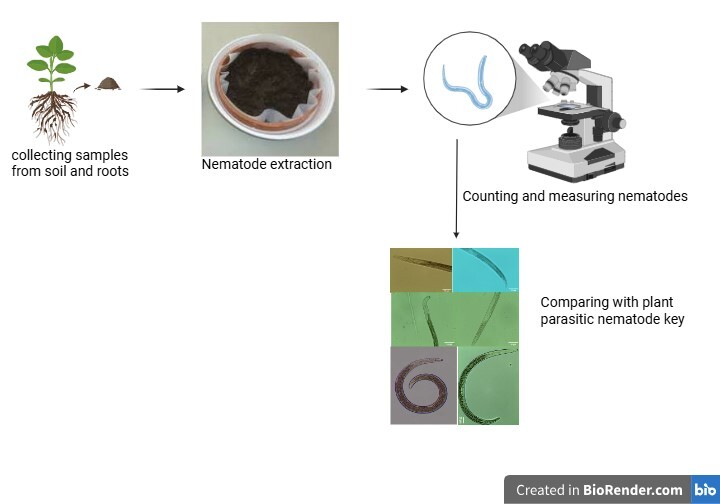
Potato is considered a crucial food crop globally; however, various biotic factors, including plant-parasitic nematodes, significantly restrict its productivity. This study aimed to identify nematodes associated with potato cultivation in Erbil and Duhok provinces of the Kurdistan Region of Iraq throughout the 2024 growing seasons. Notably, six phyto-parasitic nematodes were recorded for the first time, including: Tylenchorhynchus spp., Ditylenchus destructor, Pratylenchus spp., Paratylenchus spp., Helicotylenchus spp., and Tylenchus spp. The stunt nematode Tylenchorhynchus spp. was the most prevalent nematode in potato producing fields, with a higher population density (241.66 nematodes / 200 g of soil) and maximum percentage of absolute frequency (83.33%), relative frequency (17.41%) and absolute density (171.26%), followed by the pin nematode Paratylenchus, while the lowest percentage of population density (86.33 nematodes / 200 g of soil) was recorded by Tylenchus and minimum percentage of each, absolute frequency (8.33 %) and relative frequency (1.96%) was recorded by the spiral nematode Helicotylenchus. All nematode genera were extracted from infected potato roots and rhizosphere soil while the potato rot nematode Ditylenchus destructor was extracted from infected potato tubers and the surrounding soil. The results indicated that the prevalence and quantity of plant-parasitic nematodes in potato cultivation regions in Erbil and Duhok could potentially lead to significant output losses. Comprehensive surveys are necessary to accurately determine the distribution, frequency, and identification of plant-parasitic nematode species in these regions.
References
Ames T., Smit N.E., Braun A.R., O'Sullivan J.N., and Skoglund L.G. 1996. Sweetpotato: Major pests, diseases, and nutritional disorders: International Potato Center (CIP). Lima. Peru.
Barker K., and Davis E. 1996. Assessing plant-nematode infestations and infections. Advances in botanical research 23:103-136 DOI: https://doi.org/10.1016/S0065-2296(08)60104-4. DOI: https://doi.org/10.1016/S0065-2296(08)60104-4
Cornejo-Condori G., Lima-Medina I., Bravo-Portocarrero R., Barzola-Tito K., and Casa-Coila V. 2021. Nematodes associated with andean papaya (Carica pubescens L.) in Sandia, Puno, Peru. Bioagro 33 (3):191-202 DOI: https://doi.org/10.51372/bioagro333.5. DOI: https://doi.org/10.51372/bioagro333.5
Coyne D., JNicol J., and Claudius-Cole B. 2007. Practical plant nematology: a field and laboratory guide: Iita DOI: https://doi.org/10.22004/ag.econ.56182.
Coyne D., Steadman J., Godoy-Lutz G., Gilbertson R., Arnaud-Santana E., Beaver J., and Myers J. 2003. Contributions of the Bean/Cowpea CRSP to management of bean diseases. Field crops research 82 (2-3):155-168 DOI: https://doi.org/10.1016/S0378-4290(03)00035-2. DOI: https://doi.org/10.1016/S0378-4290(03)00035-2
Dobosz R., Rybarczyk-Mydłowska K., and Winiszewska G. 2020. Occurrence of Ditylenchus destructor Thorne, 1945 on a sand dune of the Baltic Sea. Journal of Plant Protection Research:31-40-31-40 DOI: https://doi.org/10.24425/jppr.2020.132206. DOI: https://doi.org/10.24425/jppr.2020.132206
Evlice E., and Bayram Ş. 2012. A survey of potato fields for root-knot nemaode in Central Anatolia, Turkey. Paper read at Proceedings of 31th International Symposium of the European Society of Nematologists.
Ghaderi R., and Hamzezarghani H. 2021. Nematode community structure in potato fields of Kurdistan province, western Iran. Journal of Crop Protection 10 (1):19-30 DOI: https://doi.org/10.48311/jcp.2021.1516.
Grupa-Urbańska A.M., Lebecka R., and Sołtys-Kalina D. 2025. Effect of potato tuber greening on blackleg development by Dickeya solani and Pectobacterium brasiliense. Journal of Plant Protection Research 65 (2):2 DOI: https://doi.org/10.24425/jppr.2025.153826. DOI: https://doi.org/10.24425/jppr.2025.153826
Husain S., Al-Zarari A., and Younis H. 1978. Occurrence of a cyst nematode, Heterodera mothi Khan & Husain, 1965 in Iraq. DOI: https://doi.org/10.1007/978-1-4613-2251-1_32. DOI: https://doi.org/10.1007/978-1-4613-2251-1_32
Kepenekci İ., Evlice E., and Öztürk G. 2014. Taxonomic characteristics of Meloidogyne exigua Goeldi which is a new root-knot nematodes for Turkey and other root-knot nematode species. Plant Protection Bulletin 54 (1):1-9.
Mai W. 2018. Plant-parasitic nematodes: a pictorial key to genera: Cornell University Press DOI: https://doi.org/10.7591/9781501728419. DOI: https://doi.org/10.7591/9781501728419
Marais M., Girgan C., Pofu K., Retief E., Shubane A., Sutherland R., Swart A., Truter M., and van Zyl J. 2023. Plant-parasitic nematodes associated with potatoes.
Mekete T., Dababat A., Sekora N., Akyazi F., and Abebe E. 2012. Identification key for agriculturally important plant-parasitic nematodes: a manual for nematology: CIMMYT.
Naserzadeh Y., Mahmoudi N., Pakina E., and Zargar M. 2020. Molecular identification and primer design for spotted wing drosophila (Drosophila suzukii). research on Crops 21 (2):364-369 DOI: https://doi.org/10.31830/2348-7542.2020.061. DOI: https://doi.org/10.31830/2348-7542.2020.061
Niloufar M., Yousef N., and Pakina E. 2020. The Occurrence Of Ditylenchus destructor Nematode On Potato In Iran. Paper read at НАУКА И ИННОВАЦИИ-СОВРЕМЕННЫЕ КОНЦЕПЦИИ, at Russian.
Norton R. W. 1978. Foundation of a communicator style construct. Human communication research 4 (2):99-112 DOI: https://doi.org/10.1111/j.1468-2958.1978.tb00600.x. DOI: https://doi.org/10.1111/j.1468-2958.1978.tb00600.x
Olabiyi T. 2007. Susceptibility of sweet potato (Ipomea batatas) varieties to root-knot nematode, Meloidogyne incognita. Am Eurasian J Agric Environ Sci 2:318-320.
Palomares-Rius J.E., Oliveira C.M., and Blok V.C. 2014. Plant parasitic nematodes of potato. In The potato: botany, production and uses: CABI Wallingford UK, 148-166 DOI: https://doi.org/10.1079/9781780642802.0148. DOI: https://doi.org/10.1079/9781780642802.0148
Prasad K.K. 2008. Management of potato nematodes: An overview. Journal of Horticultural Sciences 3 (2):89-106. DOI: https://doi.org/10.24154/jhs.v3i2.567
Sasser J., and Freckman D. 1987. A world perspective on nematology: the role of the society.
Sasser J.N. 1989. Plant-parasitic nematodes: the farmer's hidden enemy.
Seinhorst J. 1966. Killing nematodes for taxonomic study with hot fa 4: 1. Nematologica 12 (1):178-178a DOI: https://doi.org/10.1163/187529266X00239. DOI: https://doi.org/10.1163/187529266X00239
Southey J. 1986. Laboratory methods for work with plant and soil nematodes. Ministry of Agriculture Fisheries and Food. Technical Bulletin 2 DOI: https://www.cabidigitallibrary.org/doi/full/10.5555/19870839378.
Stephan Z., Alwan A., and Antone B. 1985. Occurrence of plant parasitic nematodes in vineyard soils in Iraq. Nematologia mediterranea.
Ulutas E., Ozarslandan A., Kaskavalci G., and Elekcioglu I. 2012. Molecular detection of Globodera rostochiensis Wollenweber (Tylenchida: Heteroderidae) in Aegean region potato fields. Turkish Journal of Entomology 36:155-160.
Whitehead A.G. 1997. Plant nematode control. UK: Cabi.
Downloads
Published
How to Cite
Issue
Section
License
Copyright (c) 2025 Journal of Plant Protection Research

This work is licensed under a Creative Commons Attribution 4.0 International License.