Effect of Fusarium and Rhizoctonia isolates on the pre-attachment stage of Phelipanche aegyptiaca
DOI:
https://doi.org/10.24425/jppr.2026.158071Abstract
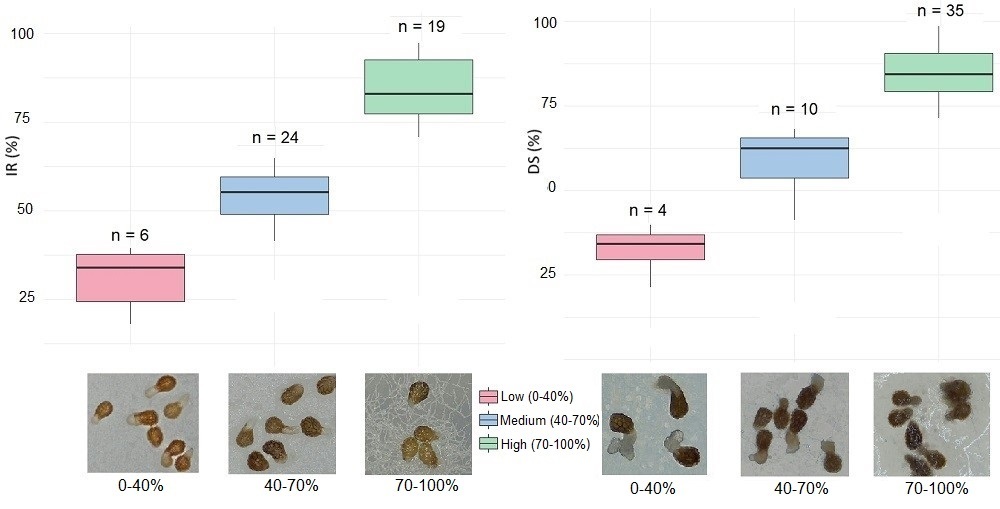
Phelipanche aegyptiaca is an obligate root-parasitic plant of the Orobanchaceae family that comprises the most threatening weed for major crops in regions with a Mediterranean climate zone, as well as in Asia, southern and Eastern Europe. The pre- -attachment stage is crucial for its successful attachment and parasitism, making this phase a key target for biological control strategies. In this study, the effect of 79 fungal isolates, including 49 Fusarium and 30 Rhizoctonia, on the pre-attachment stages of P. aegyptiaca were investigated. According to the experimental results, the Fusarium isolates inhibited the seed germination by the rate of 17.9 to 97.1%, while the disease severity values were between 21.3 and 99.8%. Approximately 40% of the 49 Fusarium isolates exhibited high inhibition effects (70−100%) and around 70% of the isolates caused high disease severity (70−100%) on the radicle. A positive correlation was observed between the inhibition rate and disease severity for the Fusarium isolates. Moreover, 15 Fusarium isolates displayed high effects in both parameters simultaneously. In contrast, the Rhizoctonia isolates exhibited seed inhibition rates ranging from 1.2 to 37.6% and disease severity values between 0 and 66.0%, with none showing high effects on any pre-attachment stages. These findings suggest that the Fusarium isolates have a great potential to use biocontrol agents against P. aegyptiaca, while the Rhizoctonia isolates have less, which may be due to differences in their secondary metabolite profiles or other pathogenicity-related traits. These findings pave the way for future research to optimize Fusarium-based biocontrol strategies and better understand the broader potential of these fungal isolates in managing P. aegyptiaca.
References
Abbas H.K., Boyette C.D., Hoagland R.E. 1995. Phytotoxicity of Fusarium, other fungal isolates, and of the phytotoxins fumonisin, fusaric acid, and moniliformin to jimsonweed. Phytoprotection 76 (1): 17–25. DOI: https://doi.org/10.7202/706081ar
Abbott W.S. 1925. A method of computing the effectiveness of an insecticide. Journal of Economic Entomology 18 (2): 265–267. DOI: https://doi.org/10.1093/jee/18.2.265a
Abouzeid M.A., El-Tarabily K.A. 2010. Fusarium spp. suppress germination and parasitic establishment of bean and hemp broomrapes. Phytopathologia Mediterranea 49 (1): 51–64. DOI: https://doi.org/10.14601/Phytopathol_Mediterr-3181
Adams G.C. 1996. Genetics of Rhizoctonia species. p. 101–116. In: “Rhizoctonia species: Taxonomy, Molecular Biology, Ecology, Pathology and Disease Control” (B. Sneh, S. Jabaji-Hare, S. Neate, G. Dijst, eds). Springer, 594 pp.
Ajayi‐Oyetunde O., Bradley C. 2018. Rhizoctonia solani: taxonomy, population biology and management of rhizoctonia seedling disease of soybean. Plant Pathology 67 (1): 3–17. DOI: https://doi.org/10.1111/ppa.12733
Aksoy E., Uygur F. 2008. Effect of broomrapes on tomato and faba bean crops. Türkiye Herboloji Dergisi 11 (1): 1–7.
Andersen T.F., Rasmussen H.N. 1996. The mycorrhizal species of Rhizoctonia. p. 379–390. In: “Rhizoctonia species: Taxonomy, Molecular Biology, Ecology, Pathology and Disease Control” (B. Sneh, S. Jabaji-Hare, S. Neate, G. Dijst, eds). Springer, 594 pp.
Bacon C., Porter J., Norred W., Leslie J. 1996. Production of fusaric acid by Fusarium species. Applied and Environmental Microbiology 62 (11): 4039–4043. DOI: 10.1128/aem.62.11.4039-4043.1996
Bai J.R., Wei Q., Shu J.S. Gan Z.X., Li B.J., Yan D.L., Huang Z.J., Guo Y.M., Wang X.X., Zhang L.X., Cui Y.N., Lu X.X., Lu J.H., Pan C.Y., Hu J.L., Du Y.C., Liu L., Li J.M. 2020. Exploration of resistance to Phelipanche aegyptiaca in tomato. Pest Management Science 76 (11): 3806–3821. DOI: https://doi.org/10.1002/ps.5932
Bailey B.A. Apel-Birkhold P.C., Akingbe O.O., Ryan J.L., O'Neill N.R., Anderson J.D. 2000. Nep1 protein from Fusarium oxysporum enhances biological control of opium poppy by Pleospora papaveracea. Phytopathology 90 (8): 812–818. DOI: https://doi.org/10.1094/PHYTO.2000.90.8.812
Başbağci G., Unal F., Uysal A., Dolar F.S. 2019. Identification and pathogenicity of Rhizoctonia solani AG–4 causing root rot on chickpea in Turkey. Spanish Journal of Agricultural Research 17 (2): 1007. DOI: 10.5424/sjar/2019172-13789
Başbağci G., Cignitas E., Kitis Y.E. 2023. Fungi isolated from broomrape species (Phelipanche spp.) in tomato greenhouses of the Western Mediterranean Region. Turkish Journal of Weed Science 26 (2): 106–113 (in Turkish)
Başbağcı G., Çiğnitaş E., Kitiş Y.E. 2024. Diversity and geographic distribution of fungi on broomrape species. Turkish Journal of Weed Science 27 (1): 49–75.
Bendejacq‐Seychelles A., Gibot‐Leclerc S., Guillemin J.P., Mouille G., Steinberg C. 2024. Phytotoxic fungal secondary metabolites as herbicides. Pest Management Science 80 (1): 92–102.
DOI: https://doi.org/10.1002/ps.7813
Bhuiyan M., Mendoza L.D.R., Lakshman D.K., Qi A., Khan M. 2024. Effects of inoculum density of R. solani AG 2–2IIIB and age of plant on root rot severity in sugar beet. Journal of Plant Protection Research 65 (1): 125–132. DOI: 10.24425/jppr.2025.153824
Boari A., Vurro M. 2004. Evaluation of Fusarium spp. and other fungi as biological control agents of broomrape (Orobanche ramosa). Biological Control 30 (2): 212–219. DOI: https://doi.org/doi:10.1016/j.biocontrol.2003.12.003
Bouwmeester H.J., Matusova R., Zhongkui S., Beale M.H. 2003. Secondary metabolite signalling in host-parasitic plant interactions. Current Opinion in Plant Biology 6 (4): 358–364. DOI: https://doi.org/https://doi.org/10.1016/S1369–5266(03)00065–7
Boyette C.D., Quimby Jr P.C., Connick Jr W.J., Daigle D.J., Fulgham F.E. 1991. Progress in the production, formulation, and application of mycoherbicides. p. 209–222. In: “Microbial Control of Weeds” (TeBees D.O., ed.). Springer New York, 284 pp. DOI: https://doi.org/10.1007/978-1-4615-9680-6
Boyette C.D., Quimby Jr P., Caesar A., Birdsall J., Connick Jr W., Daigle D., Jackson M., Egley G., Abbas H. 1996. Adjuvants, formulations, and spraying systems for improvement of mycoherbicides. Weed Technology 10 (3): 637–644. DOI: 10.1017/S0890037X00040562
Breslow N. 1970. A generalized Kruskal-Wallis test for comparing K samples subject to unequal patterns of censorship. Biometrika 57 (3): 579–594. DOI: https://doi.org/10.2307/2334776
Brun G., Braem L., Thoiron S., Gevaert K., Goormachtig S., Delavault P. 2018. Seed germination in parasitic plants: what insights can we expect from strigolactone research? Journal of Experimental Botany 69 (9): 2265–2280. DOI: https://doi.org/10.1093/jxb/erx472
Capasso R., Evidente A., Cutignano A., Vurro M., Zonno M.C., Bottalico A. 1996. Fusaric and 9, 10–dehydrofusaric acids and their methyl esters from Fusarium nygamai. Phytochemistry 41 (4): 1035–1039. DOI: https://doi.org/10.1016/0031-9422(95)00716-4
Cardoso C., Ruyter-Spira C., Bouwmeester H.J. 2011. Strigolactones and root infestation by plant-parasitic Striga, Orobanche and Phelipanche spp. Plant Science 180 (3): 414–420. DOI: https://doi.org/https://doi.org/10.1016/j.plantsci.2010.11.007
Cignitas E., Basbagci G., Sulu G., Kitis Y.E. 2024. Fusarium fujikuroi as a potential biocontrol agent of the parasitic weed Phelipanche aegyptiaca in tomato. Journal of Phythopathology 172 (3): e13344. DOI: https://doi.org/DOI: 10.1111/jph.13344
Cignitas E., Kitis Y.E. 2022. Molecular identification of Phelipanche species from the western Mediterranean region of Türkiye. 19th European Weed Research Society Symposium, 20–23 June 2022, Athens, Greece.
Core R. 2015. Team. R: a language and environment for statistical computing, 2021.
Delavault P., Montiel G., Brun G., Pouvreau J.-B., Thoiron S., Simier P. 2017. Communication between host plants and parasitic plants. Advances in Botanical Research 82: 55–82. DOI: https://doi.org/10.1016/bs.abr.2016.10.006
Desjardins A.E., Hohn T.M. 1997. Mycotoxins in plant pathogenesis. Molecular Plant-Microbe Interactions 10 (2): 147–152.
Dor E., Evidente A., Amalfitano C., Agrelli D., Hershenhorn J. 2007. The influence of growth conditions on biomass, toxins and pathogenicity of Fusarium oxysporum f. sp. orthoceras, a potential agent for broomrape biocontrol. Weed Research 47 (4): 345–352. DOI: https://doi.org/10.1111/j.1365-3180.2007.00567.x
Dor E., Hershenhorn J. 2009. Evaluation of the pathogenicity of microorganisms isolated from Egyptian broomrape (Orobanche aegyptiaca) in Israel. Weed Biology and Management 9 (3): 200–208. DOI: https://doi.org/10.1111/j.1445–6664.2009.00340.x
Dor E., Hershenhorn J., Andolfi A., Cimmino A., Evidente A. 2009. Fusarium verticillioides as a new pathogen of the parasitic weed Orobanche spp. Phytoparasitica 37 (4): 361–370. DOI: https://doi.org/10.1007/s12600–009–0049–0
Duafala T., Wilhelm S., Gold A., Sagen J. 1976. Rhizoctonia disease of broomrape, a possible biological control. The American Phytopathological Society 3: 272.
Eizenberg H., Goldwasser Y. 2018. Control of Egyptian broomrape in processing tomato: A summary of 20 years of research and successful implementation. Plant Disease 102 (8): 1477–1488. DOI: https://doi.org/10.1094/PDIS-01-18-0020-FE
FAOSTAT. 2022. Crops and livestock products. Retrieved 10.03.2024 from https://www.fao.org/faostat/en/#data/QCL
Fernández-Aparicio M., Reboud X., Gibot-Leclerc S. 2016. Broomrape weeds. Underground mechanisms of parasitism and associated strategies for their control: a review. Frontiers in Plant Science 7: 135. DOI: https://doi.org/10.3389/fpls.2016.00135
Ghannam I., Barakat R., Al-Masri M. 2007. Biological control of Egyptian broomrape (Orobanche aegyptiaca) using Fusarium spp. Phytopathologia Mediterranea 46 (2): 177–184. DOI: https://doi.org/10.14601/Phytopathol_Mediterr-2148
Gibot-Leclerc S., Guinchard L., Edel-Hermann V., Dessaint F., Cartry D., Reibel C., Gautheron N., Bernaud E., Steinberg C. 2022. Screening for potential mycoherbicides within the endophyte community of Phelipanche ramosa parasitizing tobacco. Fems Microbiology Ecology 98 (3). DOI: https://doi.org/10.1093/femsec/fiac024
Goldwasser Y., Rodenburg J. 2013. Integrated Agronomic Management of Parasitic Weed Seed Banks. In: “Parasitic Orobanchaceae” (Joel D., Gressel J., Musselman L., eds.). Springer, Berlin, Heidelberg. DOI: https://doi.org/10.1007/978-3-642-38146-1_22
Hameed K., Saadoun I., Shyab Z.A. 2001. Potential biological control of Orobanche by fungi isolated from diseased specimens in Jordan. The Plant Pathology Journal 17 (5): 257–263.
Herr L.J. 1995. Biological control of Rhizoctonia solani by binucleate Rhizoctonia spp. and hypovirulent R. solani agents. Crop Protection 14 (3): 179–186. DOI: https://doi.org/10.1016/0261-2194(95)00017-G
Joel D., Hershenhorn J., Eizenberg H., Aly R., Ejeta G., Rich P., Ransom J., Sauerborn J., Rubiales D. 2007. Biology and management of weedy root parasites. Horticultural Reviews 33: 267–349. DOI: https://doi.org/10.1002/9780470168011.ch4
Karam Pur F., Fasihi M., Heydari A. 2004. Identification of fungal pathogenic agents of broomrape on tomato fields AGRIS – International System for Agricultural Science and Technology. Available on: https://agris.fao.org/search/en/providers/122649/records/647247df53aa8c896304b6d0 [Accessed: May, 2024]
Lemańczyk G., Lisiecki K., Piesik D. 2023. Binucleate Rhizoctonia strain: a potential biocontrol agent in wheat production. Agronomy 13 (2): 523. DOI: https://doi.org/10.3390/agronomy13020523
Macías-Rubalcava M.L., Garrido-Santos M.Y. 2022. Phytotoxic compounds from endophytic fungi. Applied Microbiology and Biotechnology 106 (3): 931–950. DOI: https://doi.org/10.1007/s00253-022-11773-w
Maculewicz D. 2015. Binucleate Rhizoctonia spp. as a biocontrol agents against plant pathogens. Ecological Chemistry and Engineering A: 22 (2): 195–203. DOI: 10.2428/ecea.2015.22(2)16
Misra V.A., Wafula E.K., Wang Y., Depamphilis C.W., Timko M.P. 2019. Genome-wide identification of MST, SUT and SWEET family sugar transporters in root parasitic angiosperms and analysis of their expression during host parasitism. BMC Plant Biology 19: 1–18. DOI: https://doi.org/10.1186/s12870-019-1786-y
Parker C. 2012. Parasitic weeds: a world challenge. Weed Science 60 (2): 269–276. DOI: https://doi.org/10.1614/WS-D-11-00068.1
Pitrat M., Risser G., Epinat C., Ferrière C., Ricard M., Olivier C., RuYnato A., Lecoq H., Blancard D., Bertrand F., Nicot A., Glandard A., Molot P., Mas P. 1991. Techniques d’inoculation artificielle du melon avec différents agents pathogènes pour la sélection de variétes résistantes. Informal Technical Bulletin Edited by INRA, Montfavet, Station d’Amélioration des Plantes maraîchères and Station de Pathologie végétale.
Rispail N., Dita M.A., González‐Verdejo C., Pérez‐de‐Luque A., Castillejo M.A., Prats E., Román B., Jorrín J., Rubiales D. 2007. Plant resistance to parasitic plants: molecular approaches to an old foe. New Phytologist 173 (4): 703–712. DOI: https://doi.org/10.1111/j.1469-8137.2007.01980.x
Sneh B., Jabaji-Hare S., Neate S., Dijst G. 2013. Rhizoctonia Species: Taxonomy, Molecular Biology, Ecology, Pathology and Disease Control. Springer Science and Business Media, 578 pp.
Taheri P., Hosseini-Zahani F., Tarighi S. 2024. Binucleate Rhizoctonia induced tomato resistance against Rhizoctonia solani via affecting antioxidants and cell wall reinforcement. Heliyon 10 (6). DOI: https://doi.org/10.1016/j.heliyon.2024.e27881
Thomas H., Sauerborn J., Muller-Stover D., Kroschel J. 1999. Fungi of Orobanche aegyptiaca in Nepal with potential as biological control agents. Biocontrol Science and Technology 9 (3): 379–381. DOI: https://doi.org/10.1080/09583159929631
Townsend G.R., Heuberger J.W. 1943. Methods for estimating losses caused by diseases in fungicide experiments. Plant Disease Reporter 27: 340–343.
Vurro M., Prandi C., Baroccio F. 2016. Strigolactones: how far is their commercial use for agricultural purposes? Pest Management Science 72 (11): 2026–2034. DOI: https://doi.org/10.1002/ps.4254
Watson A.K. 2013. Biocontrol. p. 469–490. In: “Parasitic Mechanisms and Control Strategies” (Joel D.M., Gressel J., Musselman L.J., eds). Springer Heidelberg New York Dordrecht London, 513 pp. DOI 10.1007/978-3-642-38146-1
Wickham H. 2009. ggplot2: elegant graphics for data analysis New York. NY: Springer.
Xu D., Xue M., Shen Z., Jia X., Hou X., Lai D., Zhou L. 2021. Phytotoxic secondary metabolites from fungi. Toxins 13 (4): 261. DOI: https://doi.org/10.3390/toxins13040261
Yoshida S., Cui S., Ichihashi Y., Shirasu K. 2016. The haustorium, a specialized invasive organ in parasitic plants. Annual Review of Plant Biology 67 (1): 643–667.
Zrenner R., Genzel F., Verwaaijen B., Wibberg D., Grosch R. 2020. Necrotrophic lifestyle of Rhizoctonia solani AG3-PT during interaction with its host plant potato as revealed by transcriptome analysis. Scientific Reports 10 (1): 12574. DOI: https://doi.org/10.1038/s41598-020-68728-2
Downloads
Published
How to Cite
Issue
Section
License
Copyright (c) 2026 Journal of Plant Protection Research

This work is licensed under a Creative Commons Attribution 4.0 International License.