
Characteristics of Heterodera ripae Subbotin, Sturhan, Rumpenhorst & Moens, 2003 from Poland
DOI:
https://doi.org/10.24425/jppr.2026.6424Abstract
Specimens of plant parasitic nematode species Heterodera ripae were isolated from the root zone of common nettle (Urtica dioica), a perennial growing near agricultural fields in Winna Góra near Poznań (Wielkopolska region, Poland). The species identity was confirmed by analyses of the structure of the vulval cyst cones, morphology and anatomy of J2, measurements of both developmental stages as well as analyses of the rDNA and mtCOI sequences.
Molecular analyses of the Polish H. ripae 28S rDNA sequence revealed that it was the most similar to the H. ripae sequences from South Korea and clustered with them in a phylogenetic tree near a closely related H. ripae from China and H. humuli. Similarly, the mtCOI sequence of the Polish H. ripae population clustered with most H. ripae sequences deriving from Europe and Asia, however it was more distantly related to the sequence from China.
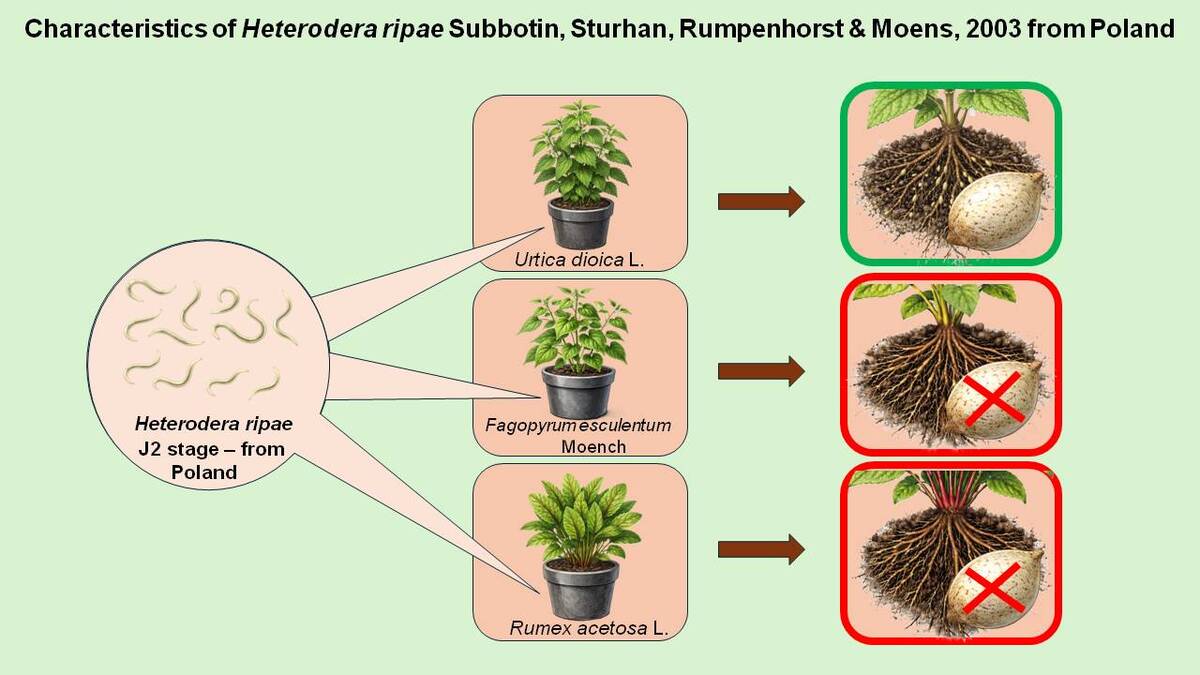
Under controlled conditions, H. ripae pathogenicity and potential harmfulness was tested on three plants: common nettle (U. dioica) which served as a control, buckwheat (Fagopyrum esculentum), and sorrel (Rumex acetosa). During the pathogenicity test, H. ripae did not develop new cysts, neither on the roots of F. esculentum nor R. acetosa. At a population of 100–120 nematode eggs and larvae, cysts of the nematode developed on the common nettle’s U. dioica roots, however plants showed no signs of growth inhibition. These numbers may have been too low to lead to plant starvation.
It was recommended that soils intended for cultivation of U. dioica as a horticultural crop should be tested for the presence of H. ripae and that plantations of this plant should be monitored for the presence of other herbivorous nematodes, including cyst-forming species.
References
Andersson S., Manduric S. 2006. Concerning a Swedish population of Heterodera ripae Subbotin, Sturhan, Waeyenberge et Moens, 2003. Nematologia Mediterranea 34 (2): 187–189.
Brzeski M.W. 1998. Heteroderidae. p. 217–234.. In: ”Nematodes of Tylenchida in Poland and Temperate Europe” (M.W. Brzeski, ed.). Museum and Institute of Zoology Polish Academy of Sciences, Warsaw, Poland, 396 pp.
Chandana R., Rawat S., Kumar S., Chethan D. 2025. Urtica dioica L.: A natural ally for eco-friendly management of Meloidogyne incognita in tomato. Journal of Biological Control 39 (1): 130–139. DOI: https://doi.org/10.18311/jbc/2025/45425
Derycke S., Vanaverbeke J., Rigaux A., Backeljau T., Moens T. 2010. Exploring the use of cytochrome oxidase c subunit 1 (COI) for DNA Barcoding of Free-Living Marine Nematodes. PLOS One 5 (10): e13716. DOI: https://doi.org/10.1371/journal.pone.0013716
Devkota H.P., Paudel K.R., Khanal S., Baral A., Panth N., Adhikari-Devkota A., Jha N.K., Das N., Singh S.K., Chellappan D.K., Dua K., Hansbro M.P. 2022. Stinging Nettle (Urtica dioica L.): Nutritional Composition, Bioactive Compounds, and Food Functional Properties. Molecules 27: 5219. DOI: https://doi.org/10.3390/molecules27165219
Eroshenko A.S., Subbotin S.A., Kazachenko I.P. 2001. Heterodera vallicola sp. n. (Tylenchida: Heteroderidae) from elm trees, Ulmus japonica (Rehd.) Sarg. in the Primorsky territory, the Russian Far East, with rDNA identification of closely related species. Russian Journal of Nematology 9 (1): 9–17.
GenBank. Available from: https://www.ncbi.nlm.nih.gov/genbank/ [Accessed 07 May 2025].
Grygierzec B., Szewczyk W. 2021. [Cultivation and collection of selected herbal plants.] Małopolski Ośrodek Doradztwa Rolniczego, Karniowice, Poland, 58 pp.
Hall T.A. 1999. BioEdit: a user-friendly biological sequence alignment editor and analysis program for Windows 95/98/NT. Nucleic Acids Symposium Series 41: 95–98. DOI: https://doi.org/10.4236/ajps.2015.61011
Holterman M., van der Wurff A., van den Elsen S., van Megen H., Bongers T., Holovachov O., Bakker J., Helder J. 2006. Phylum-wide analysis of SSU rDNA reveals deep phylogenetic relationships among nematodes and accelerated evolution toward crown clades. Molecular Biology and Evolution 23: 1792–1800. DOI: https://doi.org/10.1093/molbev/msl044
Madani M., Vovlas N., Castillo P., Subbotin S.A., Moens M. 2004. Molecular characterization of cyst nematode species (Heterodera spp.) from the Mediterranean basin using RFLPs and sequences of ITS rDNA. Journal of Phytopathology 152 (4): 229–234.
Martz F., Kankaanpää S. 2025. Stinging Nettle (Urtica dioica) Roots: The Power Underground—A Review. Plants 14: 279. DOI: https://doi.org/10.3390/plants14020279
Nemaplex. Available from: https://nemaplex.ucdavis.edu/taxadata/G060.aspx [Accessed 07 May 2025].
Ni C., Hui., Li Q.Y., Yang Z.F., Xu C.L., Xie H. 2025. Heterodera camelliae n. sp. (Nematoda: Heteroderinae), a new species of cyst‑forming nematode parasitizing tea plants in China. European Journal of Plant Pathology 171: 407–420. DOI: https://doi.org/10.1007/s10658-024-02956-4
Nunn G.B. 1992. Nematode molecular evolution. An investigation of evolutionary patterns among nematodes based upon DNA sequences. Ph. D. dissertation. University of Nottingham, UK, 187 pp.
Rambaut A., Suchard M.A., Xie D., Drummond A.J. 2014. Tracer v.1.6. Available from: http://beast.bio.ed.ac.uk/Tracer [Accessed 07 May 2025].
Ronquist F., Huelsenbeck J.P. 2003. MrBayes 3: Bayesian phylogenetic inference under mixed models. Bioinformatics 19: 1572–1574. DOI: https://doi.org/10.1093/bioinformatics/btg180
Rybarczyk-Mydłowska K., Sikora G., M. Kubicz. 2022. Morphological and molecular characteristics of Geocenamus longus and the first report of G. brevidens from a karst cave (Nematoda: Merliniidae Siddiqi, 1971). Zootaxa 5134 (3): 383–398. DOI: https://doi.org/10.11646/zootaxa.5134.3.3
Smith H.J., Gray F.A., Koch D.W. 2004. Reproduction of Heterodera schachtii Schmidt on Resistant Mustard, Radish, and Sugar Beet Cultivars. Journal of Nematology 36 (2): 123–130.
Sturhan D. 2006. Zystenbildende Nematoden und verwandte Heteroderiden in Deutschland. Aktuelle Beiträge zur Nematodenforschung 404: 18–30.
Sturhan D., Lišková M. 2006. Cyst nematodes in the Slovak Republik. Helminthologia 41 (4): 214–219.
Subbotin S., Sturhan D., Waeyenberge L., Moens M. 1997. Heterodera riparia sp. n. (Tylenchida: Heteroderidae) from common nettle, Urtica dioica L., and rDNA-RFLP separation of species of the H. humuli group. Russian Journal of Nematology 5 (2): 143–157. DOI: https://www.researchgate.net/publication/235683782
Subbotin S.A., Sturhan D., Rumpenhorst H.J., Moens M. 2003. Molecular and morphological characterisation of the Heterodera avenae species complex (Tylenchida: Heteroderidae). Nematology 5 (4): 515–538.
Subbotin S., Mundo-Okampo M., Baldwin J.G. 2010. Systematics of cyst nematodes (Nematoda: Heteroderinae). Brill, Boston, USA, 512 pp.
Subbotin S.A., Roubtsova T.V., Bostock R.M., Maafi Z.T., Chiznov V.N. 2022. DNA barcoding, phylogeny and phylogeography of the cyst nematode species of the Humuli group from the genus Heterodera (Tylenchida: Heteroderidae). Nematology 24: 873–886.
Subbotin S.A., Roubtsova T.V., Richard M. Bostock R.M., Maafi Z.T., Chiznov V.N., Palomares-Rius J.E., Castillo P. 2024. DNA barcoding, phylogeny and phylogeography of the cyst nematode species of the Schachtii group from the genus Heterodera (Tylenchida: Heteroderidae). Nematology 26: 71–97. DOI: https://doi.org/10.1163/15685411-bja10292
Wang D., Chen L., Duan Y. 2012. Description of a new record species of Heterodera from China (Tylenchida, Heteroderidae). Zoological Research 33 (E3−4): E57−59. DOI: https://doi.org/10.3724/SP.J.1141.2012.E03-04E57
Van Bezooijen J. 2006. Methods and techniques for nematology. Wageningen University, Wageningen, 118 pp.
Viotti C., Albrecht K., Amaducci S., Bardos P., Bertheau C., Blaudez D., Bothe L., Cazaux D., Ferrarini A., Govilas J., Gusovius H.J., Jeannin T., Lühr C., Müssig J., Pilla M., Placet V., Puschenreiter M., Tognacchini A., Yung L., Chalot M. 2022. Nettle, a Long-Known Fiber Plant with New Perspectives. Materials 15: 4288. DOI: https://doi.org/10.3390/ma15124288
Yang Z., Zhang H., Jiang Z., Wu Y., Liu M. 2024. Morphological and molecular characterization of Heterodera ripae, a new record cyst nematode in the rhizosphere soil of Fagopyrum esculentum. Scientific Reports 14: 9958. DOI: https://doi.org/10.1038/s41598-024-60826-9
Yoder M., De Ley I.T., King I., Mundo-Ocampo M., Mann J., Blaxter M., Poiras L., De Ley, P. 2006. DESS: a versatile solution for preserving morphology and extractable DNA of nematodes. Nematology 8: 367–376. DOI: https://doi.org/10.1163/156854106778493448
Downloads
Published
How to Cite
Issue
Section
License
Copyright (c) 2025 Journal of Plant Protection Research

This work is licensed under a Creative Commons Attribution 4.0 International License.





