
Rhizome diameter as a driver of sprout vigour in Japanese knotweed (Reynoutria japonica Houtt.): implications for management
DOI:
https://doi.org/10.24425/jppr.2026.3430Abstract
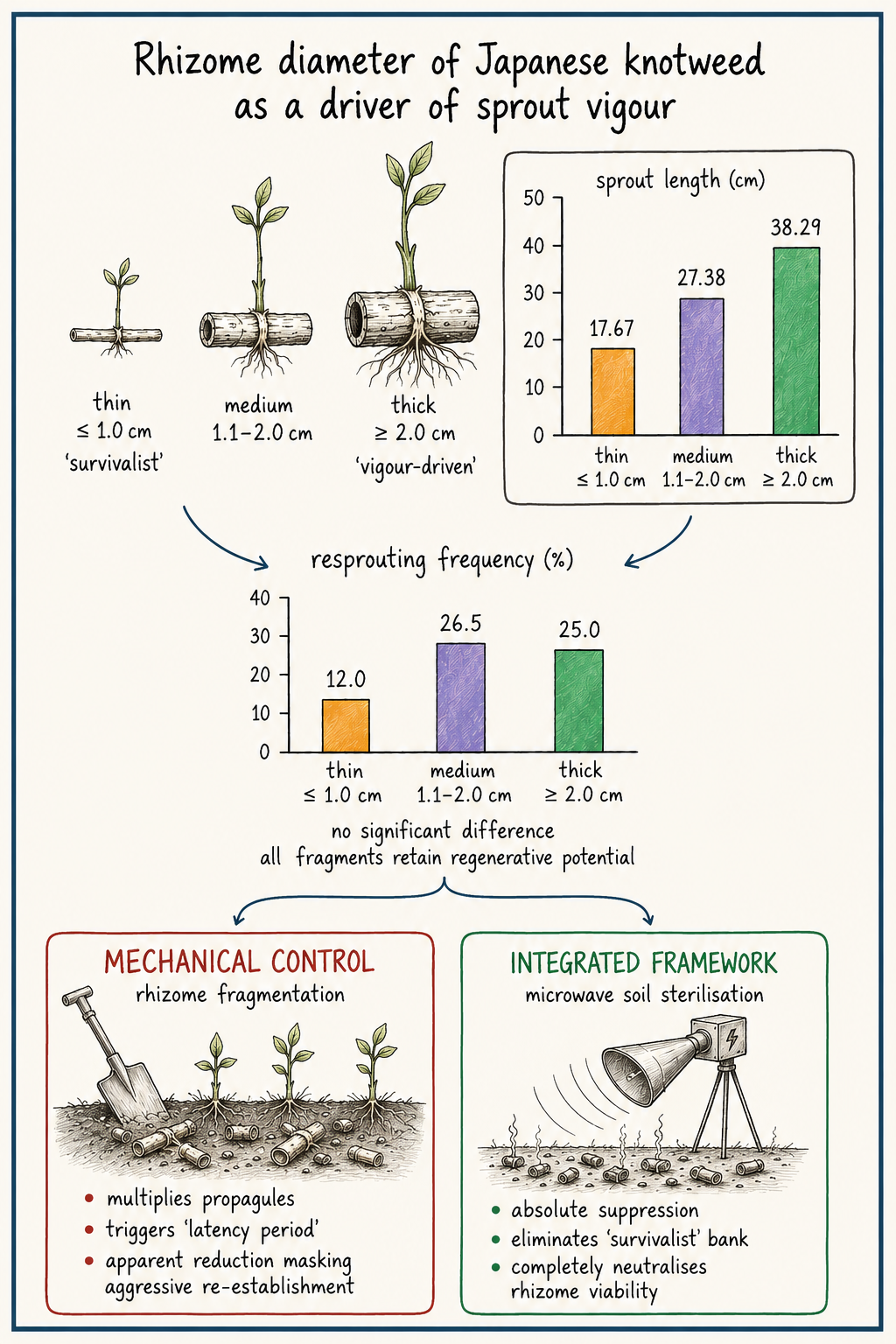
Understanding the regenerative capacity of Japanese knotweed (Reynoutria japonica Houtt.) is essential for developing effective management strategies. This study investigated how rhizome fragment diameter—classified as thin (≤ 1.0 cm), medium (1.1–2.0 cm), and thick (≥ 2.0 cm)—affects early sprouting. The one-way ANOVA and Tukey’s HSD post-hoc test revealed that sprout length increased significantly with rhizome diameter (p < 0.001), accounting for 62.40% of the variation in sprout growth. Specifically, thick fragments produced the longest sprouts (38.29 ± 1.70 cm), significantly outperforming medium (27.38 ± 1.43 cm) and thin (17.67 ± 1.76 cm) fragments. Despite these differences in vigour, resprouting frequency did not differ significantly between rhizome classes (p > 0.05), indicating that even the thinnest fragments retain regenerative potential. The hierarchical cluster analysis (HCA) further identified two functional clusters, separating thin fragments into a “survivalist” cluster characterised by reduced growth compared to medium and thick fragments, which form a “vigour-driven” cluster with a far superior regenerative potential. Moreover, these findings highlight a critical management loophole; that is, mechanical control alone may contribute to rhizome fragmentation, creating the impression of reduced infestations while viable fragments persist and regenerate following disturbance, a phenomenon termed the “latency period.” Thus, effective management must shift from strategies that merely fragment rhizomes to those that ensure the complete suppression of rhizome viability.
References
Beerling D.J., Bailey J.P., Conolly A.P. 1994. Fallopia japonica (Houtt.) Ronse Decraene. Journal of Ecology 82 (4): 959–979. DOI: https://doi.org/10.2307/2261459
Bímová K., Mandák B., Pyšek P. 2003. Experimental study of vegetative regeneration in four invasive Reynoutria taxa (Polygonaceae). Plant Ecology 166 (1): 1–11. DOI: https://doi.org/10.1023/A:1023299101998
Child L., Wade M. 2000. The Japanese Knotweed Manual: The Management and Control of an Invasive Alien Weed. Packard Publishing, Chichester, UK, 123 pp.
Conolly A.P. 1977. The distribution and history in the British Isles of some alien species of Polygonum and Reynoutria. Watsonia 11: 291–311.
Djeddour D.H., Shaw R.H. 2010. The biological control of Fallopia japonica in Great Britain: Review and current status. Outlooks on Pest Management 21 (1): 15–18. DOI: https://doi.org/10.1564/21feb04
Dommanget F., Evette A., Spiegelberger T., Gallet C., Pacé M., Imbert M., Navas M.-L. 2014. Differential allelopathic effects of Japanese knotweed on willow and cottonwood cuttings used in riverbank restoration techniques. Journal of Environmental Management 132: 71–78. DOI: https://doi.org/10.1016/j.jenvman.2013.10.024
Evans C.W., Moorhead D.J., Bargeron C.T., Douce G.K. 2006. Invasive Plant Responses to Silvicultural Practices in the South. University of Georgia, Bugwood Network, Tifton, GA, USA, 51 pp.
Gowton C., Budsock A., Matlaga D. 2016. Influence of disturbance on Japanese knotweed (Fallopia japonica) stem and rhizome fragment recruitment success within riparian forest understory. Natural Areas Journal 36 (3): 259–267. DOI: https://doi.org/10.3375/043.036.0306
International Union for Conservation of Nature. 1989. IUCN Policy Statement on Research Involving Species at Risk of Extinction. IUCN, Gland, Switzerland, 5 pp.
Jávorka S., Csapody V. 1979. Iconographia florae partis austro-orientalis Europae centralis. Akadémiai Kiadó, Budapest, Hungary, 703 pp.
Jones D., Bruce G., Fowler M.S., Law-Cooper R., Graham I., Abel A., Street-Perrott F.A., Eastwood D. 2018. Optimising physiochemical control of invasive Japanese knotweed. Biological Invasions 20 (8): 2091–2105. DOI: https://doi.org/10.1007/s10530-018-1684-5
Jones D., Eastwood D. 2019. Sustainable control of invasive Japanese knotweed. Outlooks on Pest Management 30 (5): 195–200. DOI: https://doi.org/10.1564/v30_oct_02
Jousson A., Conedera M., Maspoli G., Pezzatti G.B. 2026. Characterisation of underground organs as a basis for estimating rhizome resprouting potential: The case study of two invasive Reynoutria taxa (Polygonaceae). Weed Research 66 (1): e70044. DOI: https://doi.org/10.1111/wre.70044
Klimešová J., Klimeš L. 2007. Bud banks and their role in vegetative regeneration – A literature review and proposal for simple classification and assessment. Perspectives in Plant Ecology, Evolution and Systematics 8 (3): 115–129. DOI: https://doi.org/10.1016/j.ppees.2006.10.002
Landolt E. 1977. Ökologische Zeigerwerte zur Schweizer Flora. Geobotanisches Institut der ETH, Zürich, Switzerland, 208 pp.
Lavoie C. 2017. The impact of invasive knotweed species (Reynoutria spp.) on the environment: Review and research perspectives. Biological Invasions 19 (8): 2319–2337. DOI: https://doi.org/10.1007/s10530-017-1444-y
Lawson J.W., Fennell M., Smith M.W., Bacon K.L. 2021. Regeneration and growth in crowns and rhizome fragments of Japanese knotweed (Reynoutria japonica) and desiccation as a potential control strategy. PeerJ 9: e11783. DOI: http://doi.org/10.7717/peerj.11783
Price E.A.C., Gamble R., Williams G.G., Marshall C. 2002. Seasonal patterns of partitioning and remobilization of 14C in the invasive rhizomatous perennial Japanese knotweed (Fallopia japonica (Houtt.) Ronse Decraene). Evolutionary Ecology 15 (4): 347–362. DOI: https://doi.org/10.1023/A:1016036916017
Seiger L.A. 1996. Fallopia japonica: Japanese knotweed. p. 77. In: “Invasive Plants: Weeds of the Global Garden” (J.M. Randall, J. Marinelli, eds.). Brooklyn Botanic Garden, Brooklyn, NY, USA, 111 pp.
Seiger L.A. 1997. The status of Fallopia japonica (Reynoutria japonica; Polygonum cuspidatum) in North America. p. 95–102. In: “Plant invasions: Studies from North America and Europe” (J.H. Brock, M. Wade, P. Pyšek, D. Green, eds.). Backhuys Publishers, Leiden, The Netherlands, 223 pp.
Seiger L.A., Merchant H.C. 1997. Mechanical control of Japanese knotweed (Fallopia japonica [Houtt.] Ronse Decraene): Effects of cutting regime on rhizomatous reserves. Natural Areas Journal 17 (4): 341–345.
Słowiński K., Grygierzec B., Tabor S., Bucior S., Synowiec A. 2024. Control and disposal of invasive Japanese knotweed Reynoutria japonica Houtt. using microwave treatment. Journal of Visualized Experiments 213: e67660. DOI: https://doi.org/10.3791/67660
Taylor B., Glaister J. 2018. Japanese, giant and hybrid knotweeds. p. 49–52. In: “Practical Management of Invasive Non-Native Weeds in Britain and Ireland” (M. Fennell, L. Jones, M. Wade, eds.). Packard Publishing, Chichester, UK, 128 pp.
Urgenson L.S. 2006. Bohemian knotweed: Polygonum bohemicum; giant knotweed: Polygonum sachlinense; Japanese knotweed: Polygonum cuspidatum. p. 64–65. In: “Invasive species in the Pacific Northwest” (P.D. Boersma, S.H. Reichard, A.N. Van Buren, eds.). University of Washington Press, Seattle, WA, USA, 285 pp.
Weber E., Gut D. 2004. Assessing the risk of potentially invasive plant species in central Europe. Journal for Nature Conservation 12 (3): 171–179. DOI: https://doi.org/10.1016/j.jnc.2004.04.002
Downloads
Published
How to Cite
Issue
Section
License
Copyright (c) 2025 Journal of Plant Protection Research

This work is licensed under a Creative Commons Attribution 4.0 International License.





