
Diversity and abundance of drosophilid fruit flies and other insects in compost piles
DOI:
https://doi.org/10.24425/jppr.2025.155792Abstract
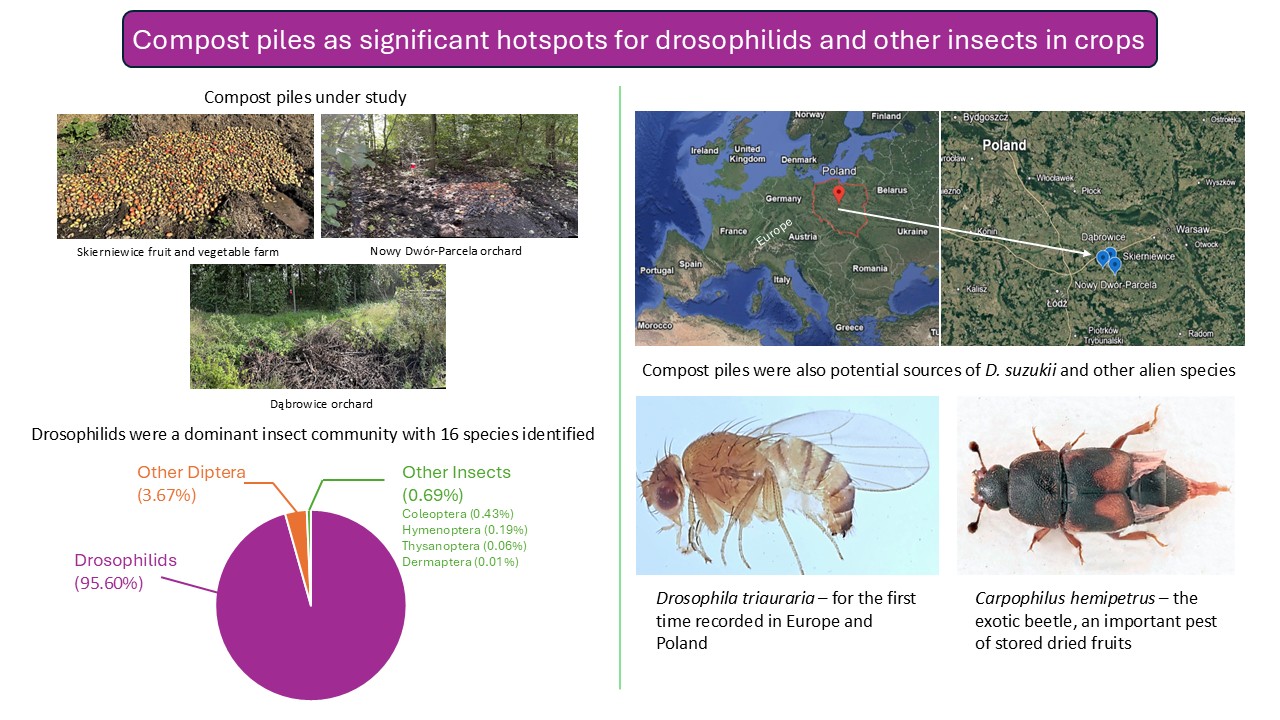
Compost piles serve as important habitats for various insect groups, including decomposers, predators, and parasitoids. While drosophilid fruit flies play a crucial role in organic matter recycling, the variation of their abundance and diversity in composters remains poorly understood. This study examines fruit fly assemblages across three compost localities in Poland: two orchards in Dąbrowice and Nowy Dwór-Parcela, and a vegetable-fruit farm in Skierniewice. Insects, collected using sweep netting and traps, varied in abundance. Dipteran flies were the most prevalent, representing 25 families, followed by beetles, bees, and wasps. Thrips and earwigs were the least represented. With 16 species from three genera, drosophilids were the predominant group, making up 95.6% of all specimens. These included seven cosmopolitan species, namely Drosophila melanogaster, D. hydei, D. immigrans, D. buskii, D. repleta, D. simulans, and Scaptomyza pallida, and three alien species, D. suzukii, Chymomyza amoena, and D. triauraria, the latter being a new Asian species recently reported in Poland and Europe. In addition to D. suzukii, another significant pest, Carpophilus hemipterus, was also recorded in the compost piles. Most species were fruit breeders or decaying plant material inhabitants, while others were mycetophagous (D. testacea, D. transversa, D. phalerata, D. funebris) or frugivorous-fungivorous (D. subobscura). Shannon-Wiener diversity indexes ranged between 1.1 and 1.4 across three localities, with the highest drosophilid diversity found at the Skierniewice farm. Drosophila melanogaster was the most numerous fruit fly at all the examined compost piles, while the relative abundance of other species depended on the composter site. These findings emphasize composters as underexplored hotspots for drosophilids, directing further study of their ecological niches and the potential presence of pest species.
References
Andreadis S.S., Witzgall P., Becher P.G. 2015. Survey of arthropod assemblages responding to live yeasts in an organic apple orchard. Frontiers in Ecology and Evolution 3: 121. DOI: https://doi.org/10.3389/fevo.2015.00121
Ashburner Mley R.S., Golic K.G. 2005. Drosophila. A Laboratory Handbook. Cold Spring Harbor, N.Y.: Cold Spring Harbor Laboratory Press.
Avidal 2024. Insektarium. Drosophilidae. [Available from: https://insektarium.net/diptera-2/drosophilidae-wywilznowate/] [Assessed 15 October 2024]
Bächli G., Vilela C.R., Andersson S., Saura A. 2004. The Drosophilidae (Diptera) of Fennoscandia and Denmark. Fauna Entomologica Scandinavica 39. Leiden: Brill. Vol. 39. Brill, Leiden, New York, 2004, 362 pp. ISBN 9-004-14074-3.
Bal H.K., Adams C., Grieshop M. 2017. Evaluation of off-season potential breeding sources for spotted wing drosophila (Drosophila suzukii Matsumura) in Michigan. Journal of Economic Entomology 110: 2466–2470. DOI: https://doi.org/10.1093/jee/tox252
Başpınar H., Akşit T., Kesici A., Deutsch F., Kiss B., Papp L. 2022. Seasonal abundance and diversity of family Drosophilidae (Diptera) and records of some other dipterans in fruit orchards in Aydın Province (Türkiye). Türkiye Entomoloji Dergisi 46 (3): 289–298. DOI: https://doi.org/10.16970/entoted.1088263
Boros L., Levavasseur F., Kebalo L.F., Bijon N., Morel K. 2022. Recycling local organic waste in peri-urban horticulture: a case-study in the Parisian region. Acta Horticulturae 1356: 1–10. DOI: https://doi.org/10.17660/ActaHortic.2022.1356.37. hal-03765968v2
Cannings R.A., Scudder G.G.E. 2005a. Families of Thysanoptera of British Columbia. In: Klinkenberg, Brian. (Editor) 2023. E-Fauna BC: Electronic Atlas of the Fauna of British Columbia. Department of Geography, University of British Columbia, Vancouver. [Available from: https://shorturl.at/6uDLm] [Assessed 01 October 2024].
Cannings R.A., Scudder G.G.E. 2005b. Families of Earwigs (Dermaptera) of British Columbia. In: Klinkenberg, Brian. (Editor) 2023. E-Fauna BC: Electronic Atlas of the Fauna of British Columbia. Department of Geography, University of British Columbia, Vancouver. [Available from: https://shorturl.at/mHBHJ] [Assessed 01 October 2024].
Capy P., Gibert P. 2004. Drosophila melanogaster, Drosophila simulans: so similar yet so different. Genetica 120 (1–3): 5–16. DOI: 10.1023/b:gene.0000017626.41548.97. PMID: 15088643
Cini A., Anfora G., Escudero-Colomar L.A., Grassi A., Santosuosso U., Seljak G., Papini A. 2014. Tracking the invasion of the alien fruit pest Drosophila suzukii in Europe. Journal of Pest Science 87: 559–566. DOI: https://doi.org/10.1007/s10340-014-0617-z
David P., Thebault E., Anneville O., Duyck P.F., Chapuis E., Loeuille N. 2017. Impacts of invasive species on food webs: a review of empirical data. Advances in Ecological Research 56: 1–60. DOI: https://doi.org/10.1016/bs.aecr.2016.10.001
Deconninck G., Boulembert M., Eslin P., Couty A., Dubois F., Gallet‐Moron E., Pincebourde S., Chabrerie O. 2024. Fallen fruit: A backup resource during winter shaping fruit fly communities. Agricultural and Forest Entomology 26 (2): 232–248. DOI: https://doi.org/10.1111/afe.12610
Delbac L., Rusch A., Binet D., Thiéry D. 2020. Seasonal variation of Drosophilidae communities in viticultural landscapes. Basic and Applied Ecology 48: 83–91. DOI: https://doi.org/10.1016/j.baae.2020.08.002
Emerich P.P., Valadão H., Silva J.R.V.P., Tidon R. 2012. High abundance of neotropical drosophilids (Diptera: Drosophilidae) in four cultivated areas of central Brazil. Neotropical Entomology 41: 83–88. DOI: https://doi.org/10.1007/s13744-011-0004-x
EPPO. 2013. Diagnostic. PM 7/115 (1) Drosophila suzukii. EPPO Bulletin 43: 417–424. DOI: https://doi.org/10.1111/epp.12059
Finet C., Kassner V.A., Carvalho A.B., Chung H., Day J.P., Day S., Delaney E.K., De Ré F.C., Dufour H.D., Dupim E., Izumitani H.F., Gautério T.B., Justen J., Katoh T., Kopp A., Koshikawa S., Longdon B., Loreto E.L., Nunes M.D.S., Raja K.K.B., Rebeiz M., Ritchie M.G., Saakyan G., Sneddon T., Teramoto M., Tyukmaeva V., Vanderlinde T., Wey E.E., Werner T., Williams T.M., Robe L.J., Toda M.J., Marlétaz F. 2021. DrosoPhyla: resources for drosophilid phylogeny and systematics. Genome Biology and Evolution 13: evab179. DOI: https://doi.org/10.1093/gbe/evab179
Franke-Whittle I.H., Juárez M.F.D., Insam H., Schweizer S., Naef A., Topp A.R., Kelderer M., Rühmer T., Baab G., Henfrey J., Manici L.M. 2019. Performance evaluation of locally available composts to reduce replant disease in apple orchards of central Europe. Renewable Agriculture and Food Systems 34 (6): 543–557. DOI: https://doi.org/10.1017/S1742170518000091
Gleason J.M., Roy P.R., Everman E.R., Gleason T.C., Morgan T.J. 2019. Phenology of Drosophila species across a temperate growing season and implications for behavior. PLoS One 14 (5): e0216601. DOI: https://doi.org/10.1371/journal.pone.0216601
Google 2023. Weather in Łódź Voivodeship, Poland. [Available from: https://www.google.com/search?q=weather+Łódź+Voivodeship+Poland] [Assessed September 2023]
Google-Maps 2025. Skierniewice, Dąbrowice, and Nowy Dwór-Pacela. [Available from: https://www.google.com/maps/search/?api=1] [Assessed 01 March 2025]
Gornostaev N.G., Ruchin A.B., Esin M.N., Lazebny O.E., Kulikov A.M. 2023. Vertical distribution of fruit flies (Diptera: Drosophilidae) in deciduous forests in the center of european Russia. Insects 14 (10): 822. DOI: https://doi.org/10.3390/insects14100822
Grimaldi D.A., Richenbacher C. 2023. Exceptional species diversity of Drosophilidae (Diptera) in a Neotropical Forest. American Museum Novitates 3997: 1–28. DOI: https://doi.org/10.1206/3997.1
Haenni J.P., Vaillant F. 1994. Description of dendrolimnobiontic larvae of Scatopsidae (Diptera) with a review of our knowledge of the preimaginal stages of the family. Mitteilungen der Schweizerischen Entomologischen Gesellschaft 67: 43–59. DOI: https://doi.org/10.5555/19960503658
Hochmüller C.J., Lopes-da-Silva M., Valente V.L., Schmitz H.J. 2010. The drosophilid fauna (Diptera, Drosophilidae) of the transition between the Pampa and Atlantic Forest Biomes in the state of Rio Grande do Sul, southern Brazil: first records. Papéis Avulsos de Zoologia 50: 286–295. DOI: https://doi.org/10.1590/S0031-10492010001900001
Hooper H., Grieshop M.J. 2021. Composting susceptible fruit wastes reduces Drosophila suzukii (Diptera: Drosophilidae) reproductive habitat. Pest Management Science 77 (1): 202–207. DOI: https://doi.org/10.1002/ps.6008
Hough R.L. 2014. Biodiversity and human health: evidence for causality? Biodiversity and Conservation 23: 267–288. DOI: https://doi.org/10.1007/s10531-013-0614-1
Jankowiak R., Bilański P., Ostafińska A., Linnakoski R. 2019. Ophiostomatales associated with wounds on hardwood trees in Poland. Plant Pathology 68 (7): 1407–1424.
Jelínek J., Carlton C., Cline A.R., Leschen R.A.B. 2010. Chapter 10.26. Nitidulidae Latreille, 1802. In: Leschen, R.A.B., Beutel, R.G., Lawrence, J.F. (eds.), Handbook of Zoology, Arthropoda: Insecta, Coleoptera, Beetles, Vol. 2: Morphology and Systematics. De Gruyter, Berlin, New York, p. 390e407.
Jiménez-Padilla Y., Ferguson L.V., Sinclair B.J. 2020. Comparing apples and oranges (and blueberries and grapes): Fruit type affects development and cold susceptibility of immature Drosophila suzukii (Diptera: Drosophilidae). Canadian Entomologist 152: 532–545. DOI: https://doi.org/10.4039/tce.2020.36
Kałmuk J., Daniel Kubisz D., Pawłowski J. 2024. Glischrochilus quadrisignatus (Say, 1835). In: Gatunki Obce w faunie Polski. Publikacja internetowa Instytutu Ochrony Przyrody PAN, (Kałmuk J, Kubisz D., Pawłowski J., eds.) [Available from: https://shorturl.at/LKQdL] [Assessed 17 November 2024] (in Polish)
Kałmuk J., Pawłowski J. 2024. Carpophilus hemipterus (Linnaeus, 1758). In: „Gatunki Obce w faunie Polski. Publikacja internetowa Instytutu Ochrony Przyrody PAN” (Kałmuk J, Kubisz D., Pawłowski. J., eds.) [Available from: https://shorturl.at/onKp5] [Assessed 17 November 2024].
Kienzle R., Groß L.B., Caughman S., Rohlfs M. 2020. Resource use by individual Drosophila suzukii reveals a flexible preference for oviposition into healthy fruits. Scientific Report 10: 3132. DOI: https://doi.org/10.1038/s41598-020-59595-y
Kovalenko P., Protsenko O., Shulga V., Serga S.V., Ślęzak-Parnikoza A., Wojciechowski K., Parnikoza I., Kozeretska I. 2017. Species diversity of Drosophilidae from Poland and Ukraine. The 12th International Conference of Young Naturalists. From biotechnology to nature protection. The interdisciplinary meeting of young naturalists, 22-24 November 2017, Zielona Góra. Poland, Poland. Book of Abstracts, 66 pp.
Kovalenko P., Serga S.V., Protsenko O., Gora N. V., Ślęzak-Parnikoza A., Zinchenko M.Yu., Wojciechowski K., Kozeretska I. A. 2021. Drosophilidae of Ukraine and Poland. The 7th International Conference “Drosophilia in Experimental genetics and biology. p. 33–36. 9.09-10,09. 2021, Odesa, Ukraine.
Łabanowska B.H., Piotrowski W. 2015. The spotted wing drosophila, Drosophila suzukii Matsumura (1931) – monitoring and first records in Poland. Journal of Horticultural Research 23: 49–57. DOI: https://doi.org/10.2478/johr-2015-0020
Liu J., Yan X., Song X., Zhang J., Wu D., Gao M. 2021. Distribution characteristics of insect diversity in long-term fixed monitoring plots in Northeast China. PLoS ONE 16 (8): e0250689. DOI: https://doi.org/10.1371/journal.pone.0250689
Máca J. 1972. Czechoslovac species of the genus Scaptomyza Hardy (Diptera: Drosophilidae) and their bionomics. Acta Entomologica Bohemoslovaca 69: 119–132.
Marchiori C.H. 2022. Importance of Sphaeroceridae family as accelerators of the putrefaction process, nutrient recycling and in its association with the cadaveric decomposition process (Insecta: Diptera). Biology and Pharmacy 4 (02): 28–42. DOI: https://doi.org/10.53022/oarjbp.2022.4.2.0039
Markow T.A., O'Grady P. 2006. Drosophila A Guide to Species Identification and Use. Elsevier 66: 157–158. Academic Press Inc (November 1, 2005).
Markow T.A., O'Grady P. 2008. Reproductive ecology of Drosophila. Functional Ecology 28: 747–759. DOI: https://doi.org/10.1111/j.1365-2435.2008.01457.x
Marshall A.S., Kirk-Spriggs H.A., Muller S.B., Paiero M.S., Yau T., Jackson D.M. 2016. Key to Diptera families-adults. Manual of Afrotropical Diptera 2106(1): 1–81. Publisher: SANBI Graphics & Editing, Editors: Ashley H. Kirk-Spriggs, Bradley J. Sinclair
Mata R.A., McGeoch M., Tidon R. 2010. Drosophilids (Insecta, Diptera) as tools for conservation biology. Natureza & Conservação 8: 60–65. DOI: https://doi.org/10.4322/natcon.00801009
Miller M.E., Marshall S.A., Grimaldi D.A. 2017. A review of the species of Drosophila (Diptera: Drosophilidae) and genera of Drosophilidae of northeastern North America. Canadian Journal of Arthropod Identification (31). DOI: doi:10.3752/cjai.2017.31
Minami N. 1979. Niche analysis of three closely related species of the genus Drosophila (With 4 Text-figures and 3 Tables). Journal of Faculty of Science, Hokkaido University. Series VI, Zoology 22 (1): 33–41.
Mitsui H., Beppu K., Kimura M.T. 2010. Seasonal life cycles and resource uses of flower- and fruit-feeding drosophilid flies (Diptera: Drosophilidae) in central Japan. Entomological Science 13: 60–67. DOI: https://doi.org/10.1111/j.1479-8298.2010.00372.x
Nowakowski J.T. 1991. Braulidae to Curtonotidae. p. 224-228. In: „Wykaz zwierząt Polski” (Razowski, J., ed.). Vol. I. Ossolineum, Wroclaw – Warszawa – Kraków, Poland (in Polish)
Ødegaard F., Tømmerås B.Å. 2000. Compost heaps – refuges and stepping‐stones for alien arthropod species in northern Europe. Diversity and Distributions 6 (1): 45–59.
Oksanen J., Simpson G., Blanchet F., Kindt R., Legendre P., Minchin P., O'Hara R., Solymos P., Stevens M., Szoecs E., Wagner H., Barbour M., Bedward M., Bolker B., Borcard D., Borman T., Carvalho G., Chirico M., De Caceres M., Durand S., Evangelista H., FitzJohn R., Friendly M., Furneaux B., Hannigan G., Hill M., Lahti L., McGlinn D., Ouellette M., Ribeiro Cunha E., Smith T., Stier A., Ter Braak C., Weedon J. 2024. vegan: Community Ecology Package. R package version 2.7-0 [Available from: https://github.com/vegandevs/vegan, https://vegandevs.github.io/vegan/] [Assessed 18 November 2024].
Pajač-Živković I., Barić B., Lemić D., Blažević I., Šubić M., Seljak G., Mešić A. 2016. The Drosophilid fauna (Diptera, Drosophilidae) of IPM vineyards in Croatia. Agriculturae Conspectus Scientificus 81 (4): 231–234.
Plotnikov I.S., Sidorenko V.S., Krivokhatsky V.A. 2013. Zoogeographic analysis of the Palaearctic fauna of Drosophilid flies (Diptera, Drosophilidae) with description of clusterization software for provincial faunas. Entomological Review 93: 831–843. DOI: 10.1134/S0013873813070051
Pyšek P., Hulme P.E., Simberloff D., Bacher S., Blackburn T.M., Carlton J.T., Dawson W., Essl F., Foxcroft L.C., Genovesi P., Jeschke J.M., Kühn I., Liebhold A.M., Mandrak N.E., Meyerson L.A., Pauchard A., Pergl J., Roy H.E., Seebens H., Kleunen M., Vilà M., Wingfield M.J., Richardson D.M. 2020. Scientists’ warning on invasive alien species. Biological Reviews 95: 1511–1534. DOI: https://doi.org/ 10.1111/brv.12627
Ribeiro L.B., Proença C.E.B., Tidon R. 2023. Host preferences shown by Drosophilids (Diptera) in a commercial fruit and vegetable distribution center follow the wild neotropical pattern. Insects 14: 375. DOI: https://doi.org/10.3390/ insects14040375
Richards O.W. 1977. Hymenoptera. Introduction and key to families. London: Royal Entomological Society.
Shorrocks B. 1977. An ecological classification of European Drosophila species. Oecologia 26: 335–345.
Shorrocks B., Charlesworth P. 1980. The distribution and abundance of the British fungal breeding Drosophila. Ecological Entomology 5 (1): 61–78.
Simpson E.H. 1949. Measurement of diversity. Nature 168: 668. DOI: https://dx.doi.org/10.1038/163688a0
Spellerberg I.F., Fedor P.J. 2003. A tribute to Claude Shannon (1916–2001) and a plea for more rigorous use of species richness, species diversity and the ‘Shannon–Wiener’ Index. Global Ecology and Biogeography 12: 177–179. DOI: https://doi.org/10.1046/j.1466-822X.2003.00015.x
Spencer 1941. Ecological factors and Drosophila speciation. Ohio Journal of Science 41:190–200.
Spencer W. 1940. On the biology of Drosophila immigrans Sturtevant with special reference to the genetic structure of populations. Ohio Journal of Science 40 (6): 345–361.
Szwejda H.J. 2023. Diptera pests occurring on vegetable crops in Poland. Journal of Horticultural Research 31 (1): 155–174. DOI: https://doi.org/10.2478/johr-2023-0030
Taxodros 2025. The database on Taxonomy of Drosophilidae; TaxoDros: Classification. [Online] [Available from: https://shorturl.at/aLi1y] [Accessed 26 February 2025].
Unwin D.M. 1985. Key to the Families of British Beetles. Mad River PressInc.
Weisser W.W., Siemann E. 2008. The various effects of insects on ecosystem functioning. p. 3–24. In: “Insects and Ecosystem Function”. Berlin, Heidelberg: Springer Berlin Heidelberg.
Werner T., Jaenike J. 2017. Drosophilids of the Midwest and Northeast. [Available from: https://hdl.handle.net/1802/34909] [Assessed 17 June 2024].
Wilcove D.S., Rothstein D., Dubow J., Phillips A., Losos E. 1998. Quantifying threats to imperilled species in the United States. BioScience 48: 607–615. DOI: https://doi.org/10.2307/1313420
Zatwarnicki T. 2007. Wywilznowate (Drosophilidae). In “Fauna of Poland. Characteristics and checklist of species” (Bogdanowicz W., Chudzicka E., Pilipiuk I., Skibinska E., eds.), Vol. 2.: 130–131, 216–217. Muzeum i Institut Zoologii PAN, Warszawa. (in Polish)
Zengin E. 2020. Occurrence of invasive species and seasonal dynamics of fruit flies (Diptera: Drosophilidae) species in Uşak province, Turkey. Revista de la Sociedad Entomológica Argentina 79 (1): 21–30, 2020 Sociedad Entomológica Argentina, Argentina. [Available from: https://www.redalyc.org/articulo.oa?id=322061697004] [Assessed 17 November 2024].
Zhang H., John R., Peng Z., Yuan J. Chu C., Du G., Zhou S. 2012. The relationship between species richness and evenness in plant communities along a successional gradient: a study from sub-alpine meadows of the Eastern Qinghai-Tibetan Plateau, China. PloS One 7(11): e49024. DOI: https://doi.org/ 10.1371/journal.pone.0049024
Published
How to Cite
Issue
Section
License
Copyright (c) 2026 Journal of Plant Protection Research

This work is licensed under a Creative Commons Attribution 4.0 International License.