Pesticidal activity of plant extracts as alternatives to synthetic chemical insecticides to fight against Euscelis sp. and for preservation of Apis mellifera Linnaeus associated to the inflorescences of Ocimum basilicum L.
DOI:
https://doi.org/10.24425/jppr.2026.2793Abstract
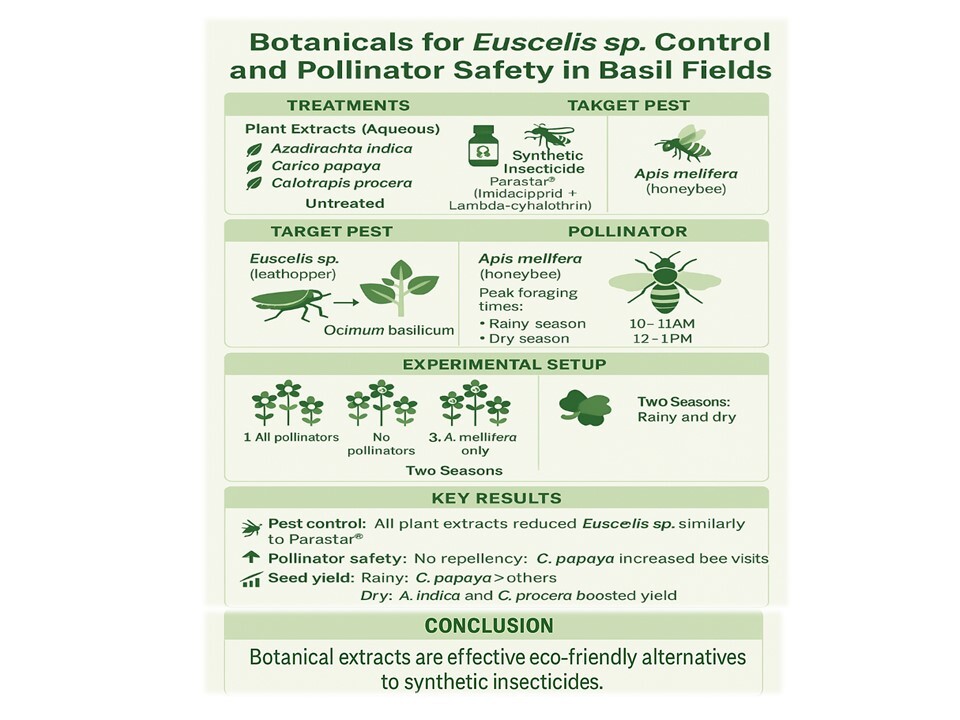
In recent years, researchers have increasingly focused on using secondary compounds from plant extracts as potential alternatives to synthetic insecticides, which can harm biodiversity, including pollinators. This study evaluated the effectiveness of aqueous leaf extracts from Azadirachta indica A. Juss., Carica papaya L. and Calotropis procera (Ait.) R.BR. on the population density of Euscelis sp. and the foraging behavior of Apis mellifera Linnaeus in a basil (Ocimum basilicum L.) field during both the rainy and dry seasons. Trials were carried out using a RCBD with four replications: three plant extracts x one positive control (parastar) x one negative control x four groups of flowers (1: exposed to all pollinators, 2: protected from insects, 3: exposed only to A. mellifera and 4: uncovered without insect visits). Results showed that all botanical extracts exhibited insecticidal effects comparable to parastar against Euscelis sp. Among the 11 pollinator species recorded, A. mellifera was the most frequent visitor, foraging throughout the day with activity peaking at 10–11 AM during the dry season and 12–1 PM during the rainy season. The highest abundance of A. mellifera per 1000 flowers was recorded in the C. papaya treatment, which significantly improved seed yield. These results suggest that the tested botanical extracts are promising eco-friendly alternatives for integrated pest management, helping to reduce the risks of synthetic insecticides to pollinators and enhance basil seed production.
References
Abang A.F., Kouame C.M., Abang M., Hannah R., Fotso A. 2013. Vegetable growers perception of pesticide use practices, cost, and health effects in the tropical region of Cameroon. International Journal of Agronomy and Plant Production 4: 873–883.
Abdullah R.R.H., El-Rokh A.R. 2023. Using the secondary metabolites of some fungi and wild plants as natural pesticides to control cotton mealybug, Phenacoccus solenopsis (Hemiptera: Pseudococcidae). Journal of Plant Protection Research 63 (3): 318–330. DOI: https://doi.org/10.24425/jppr.2023.146870
Adamou M., Kosini D., Tchoubou‑Sale A., Massah O.D., Tchocgnia T.F.C., Mohammadou M., Youssoufa O., Nukenine E.N. 2022. Impact of aqueous extracts of Cassia occidentalis, Eucalyptus camaldulensis and Hyptis suaveolens on the entomofauna and the seed yield of Gossypium hirsutum at Bokle (Garoua, Cameroon). Heliyon 8: e10937. DOI: https://doi.org/10.1016/j.heliyon.2022.e10937
Albrecht A.C. 2017. Illustrated identification guide to the Nordic aphids feeding on conifers (Pinophyta) (Insecta, Hemiptera, Sternorhyncha, Aphidomorpha). European Journal of Taxonomy 338: 1–160. DOI: https://doi.org/10.5852/ejt.2017.338
Arivuchudar R., Nazni P., Uvaraj M.G. 2022. Experimental investigation on materialistic attributes of Ocimum basilicum seed supplementation on diabetic subjects. Materials Today Proceedings 66 (3): 670–674. DOI: https://doi.org/10.1016/j.matpr.2022.03.638
Bakkali F., Averbeck S., Averbeck D., Idaomar M. 2008. Biological effects of essential oils – a review. Food and Chemical Toxicology 46 (2): 446–475. DOI: https://doi.org/10.1016/j.fct.2007.09.106
Baskar K., Sudha V., Jayakumar M. 2017. Effect of pesticides on pollinators. MOJ Ecology & Environmental Sciences 2 (8): 00052. DOI: https://doi.org/10.15406/mojes.2017.02.00052
Bigot L., Bodot P. 1973. Contribution à l’étude biocénotique de la garrigue à Quercus coccifera – composition biotique du peuplement des invertébrés. Vie et Milieu 23: 229–249.
Brailovsky H. 2014. Illustrated key for identification of the species included in the genus Leptoglossus (Hemiptera: Heteroptera: Coreidae: Coreini: Anisoscelini), and descriptions of five new species and new synonyms. Zootaxa 3794 (1): 143–178. DOI: https://doi.org/10.11646/zootaxa.3794.1.7
Chakraborti S., Sarkar P.K. 2011. Management of Leucinodes orbonalis Guenee on eggplants during the rainy season in India. Journal of Plant Protection Research 51 (4): 325–328. DOI: https://doi.org/10.2478/v10045-011-0053-5
da Silva S.G., Sant’Ana J., Jahnke S.M., dos Santos C.D.R. 2023. Effects of essential oils from the Brazilian pepper tree, eucalyptus and citronella on brassica aphids Brevicoryne brassicae and Myzus persicae (Hemiptera: Aphididae) and their parasitoid Diaeretiella rapae (Hymenoptera: Braconidae). Journal of Plant Protection Research 63 (3): 286–296. DOI: https://doi.org/10.24425/jppr.2023.146879
de Souza T.A.N., Alvarenga C.D., Soares D.P., Giustolin T.A. 2023. Insecticidal potential of organic extracts of Calotropis procera to Spodoptera frugiperda. Bioscience Journal 39 (2023): e39025. DOI: https://doi.org/10.14393/BJ-v39n0a2023-63699
Djongyang N. 2022. Climate change and some adaptation measures in the Sudano-Sahelian zone of Cameroon. E3S Web of Conferences 354. DOI: https://doi.org/10.1051/e3sconf/202235401004
El-Wakeil N.E. 2013. Botanical pesticides and their mode of action. Gesunde Pflanzen 65: 125–149. DOI: http://dx.doi.org/10.1007/s10343-013-0308-3
Geldert C., Abdo Z., Stewart J.E., Arathi H.S. 2021. Dietary supplementation with phytochemicals improves diversity and abundance of honey bee gut microbiota. Journal of Applied Microbiology 130 (5): 1705–1720. DOI: https://doi.org/10.1111/jam.14897
Gnago J.A., Danho M., Agneroh T.A., Arathi H.S. 2010. Efficacité des extraits de neem (Azadirachta indica) et de papayer (Carica papaya) dans la lutte contre les insectes ravageurs du gombo (Abelmoschus esculentus) et du chou (Brassica oleracea) en Côte d’Ivoire. International Journal of Biological and Chemical Sciences 4 (4): 953–966.
Goulson D., Nicholls E., Botías C., Rotheray E.L. 2015. Bee declines driven by combined stress from parasites, pesticides, and lack of flowers. Science 347 (6229): 1255957. DOI: https://doi.org/10.1126/science.1255957
Gourmel C. 2014. Catalogue illustré des principaux insectes ravageurs et auxiliaires des cultures de Guyane. Coopérative Bio Savane.
Gullan P.J., Cranston P.S. 2005. The insects: An outline of entomology, 3rd ed. Blackwell Publishing, Oxford, UK, 505 pp.
Gumber K. 2022. Naked eye sensors for on-site pesticide detection: a review. Journal of Plant Protection Research 63 (2): 173–184. DOI: https://doi.org/10.24425/jppr.2023.145752
Gupta G., Sharma S., Kumar N. 2020. Carica papaya aqueous leaf extracts as potential botanical insecticide against rose aphids (Macrosiphum rosaeformis D.). Journal of Entomology and Zoology Studies 8 (3): 960–964.
Hellen K.M., Mugastia H.T., Mary G., Wilbur M.L. 2018. Distance effects on diversity and abundance of the flower visitor of Ocimum kilimandscharicum in the Kakamega forest ecosystem in Kenya. International Journal of Biodiversity 2018: 1–7. DOI: https://doi.org/10.1155/2018/7635631
Ikram E.H., Netzel M.E., Fanning K., Stanley R. 2015. Phytochemicals in the tissues of Australian-grown papaya cultivars. Acta Horticulturae 1106: 175–178. DOI: https://doi.org/10.17660/ActaHortic.2015.1106.27
Jacob‑Remacle A. 1989. Comportement de butinage de l’abeille domestique et des abeilles sauvages dans des vergers de pommiers en Belgique. Apidologie 20 (4): 271–285.
Katbeh‑Bader A., Al‑Jboory I.J., Bora Kaydan M. 2019. First record of the Madeira mealybug, Phenacoccus madeirensis Green (Hemiptera: Pseudococcidae), in Jordan. EPPO Bulletin 49 (2): 401–404.
Kilani-Morakchi S., Morakchi-Goudjil H., Sifi K. 2021. Azadirachtin-based insecticide: overview, risk assessments, and future directions. Frontiers in Agronomy 3: 1–13. DOI: https://doi.org/10.3389/fagro.2021.676208
Kot I., Lisecka M., Kmieć K., Golan K., Górska‑Drabik E., Kiljanek T., Zimowska B., Skwaryło‑Bednarz B. 2023. Visitation of Apis mellifera L. in runner bean (Phaseolus coccineus L.) and its exposure to seasonal agrochemicals in agroecosystems. Agriculture 13 (11): 2138. DOI: https://doi.org/10.3390/agriculture13112138
Kovac H., Stabentheiner A. 2011. Thermoregulation of foraging honeybees on flowering plants: Seasonal variability and influence of radiative heat gain. Ecology and Entomology 36 (6): 686–699. DOI : https://doi.org/10.1111/j.1365-2311.2011.01313.x
Kumar M., Kumar N., Rai D., Rai C.P., Kumar A. 2022. Major insect pests of sweet basil (Ocimum basilicum) and their management. Vigyan Varta 3: 57–61.
Lecoq M. 2010. Taxonomie et systématique des acridiens et principales espèces d’Afrique de l’Ouest. Institut Hassan II, Maroc.
Lin Y.-C., Lu Y.-H., Tang C.-K., Yang E.-C., Wu Y.-L. 2023. Honey bee foraging ability suppressed by imidacloprid can be ameliorated by adding adenosine. Environmental Pollution 332 : 121920. DOI: https://doi.org/10.1016/j.envpol.2023.121920
Moreno E., Arenas A. 2024. Foraging task specialization in honey bees (Apis mellifera): the contribution of floral rewards to the learning performance of pollen and nectar foragers. Journal of Experimental Biology 227 (13): jeb246979. DOI: https://doi.org/10.1242/jeb.246979
Mramba R.P. 2025. The role of plant diversity and density in the availability of floral resources for effective pollination and honey production by the honey bee (Apis mellifera) in arid areas. Discover Plants 2 (65). DOI: https://doi.org/10.1007/s44372-025-00154-y
Namvong U., Chongrattanameteekul W. 2015. Insect pest abundance on sweet basil, Ocimum basilicum L. (Labiatae) under different production systems. Agriculture and Natural Resources 49 (1) : 22–31.
Ndakidemi B., Mtei K., Ndakidemi P.A. 2016. Impacts of synthetic and botanical pesticides on beneficial insects. Agricultural Sciences 7 (6): 364–372. DOI: https://doi.org/10.4236/as.2016.76038
Ngom S., Diome T., Diop B., Sembene M. 2020. Effet des extraits aqueux de Calotropis procera sur les principaux ravageurs du chou en culture au Sénégal. International Journal of Biological and Chemical Sciences 14 (5): 1600–1610.
Oberemok V.V., Laikova K.V., Gninenko Y.I., Zaitsev A.S., Nyadar P.M., Adeyemi T.A. 2015. A short history of insecticides. Journal of Plant Protection Research 55 (3): 221–226. DOI: https://doi.org/10.1515/jppr-2015-0033
Parolin P., Bresch C., Desneux N., Brun R., Bout A., Boll R., Poncet C. 2012. Secondary plants used in biological control: a review. International Journal of Pest Management 58 (2): 91–100. DOI: https://doi.org/10.1080/09670874.2012.659229
Pacini E., Nepi M. 2007. Nectar production and presentation. Annual Review of Plant Biology 58: 183–206. DOI: https://doi.org/10.1146/annurev.arplant.58.032806.103624
Pel A.V., Van Nest B.N., Hathaway S.R., Fahrbach S.E. 2023. Impact of odorants on perception of sweetness by honeybees. PLoS One 18 (12): e0290129. DOI: https://doi.org/10.1371/journal.pone.0290129
Prabha S., Yadav A., Kumar A., Yadav A., Kumar Yadav H., Kumar S., Yadav R.S., Kumar R. 2016. Biopesticides – an alternative and eco‑friendly source for the control of pests in agricultural crops. Plant Archives 16 (2): 902–906.
Ramos‑Robles M.L., Romero K.L.R., Burgos‑Solorio A., Aguilar‑Dorantes K.M. 2023. The effect of tropical dry forest seasonality on the diversity of insects associated with ferns. Rodriguésia 74 : e00362023. DOI: https://doi.org/10.1590/2175-7860202374067
Raymann K., Motta E.V.S., Girard C., Riddington I.M., Dinser J.A., Moran N.A. 2018. Imidacloprid decreases honey bee survival rates but does not affect the gut microbiome. Applied and Environmental Microbiology 84 (13): e00545–18. DOI: https://doi.org/10.1128/AEM.00545-18
Smitha G. R., Varghese T. S., Manivel P. 2014. Cultivation of Ocimum. ICAR–Directorate of Medicinal and Aromatic Plants Research.
Sonchieu J., Ngassoum M.B., Nantia Akono E., Laxman P.S. 2018. Pesticide applications on some vegetables cultivated and health implications in Santa, North‑West Cameroon. International Journal of Agriculture & Environmental Science 4 (2): 39–46. DOI: https://doi.org/10.14445/23942568/IJAES-V4I2P108
Tahiri A. 2012. Toxicité du macérât de Carica papaya L. contre Coptotermes formosanus Shiraki (Isoptera: Rhinotermitidae). Afrique Science 8 (3): 93–101.
Tronquet M. (ed.). 2014. Catalogue des Coléoptères de France, Revue de l’Association Roussillonnaise d’Entomologie, 23 (Supplément): 1052 pp.
Tudi M., Ruan H. D., Wang L., Lyu J., Sadler R., Connell D., Chu C., Phung D. T. 2021. Agriculture development, pesticide application and its impact on the environment. International Journal of Environmental Research and Public Health 18 (3): 1112. DOI: https://doi.org/10.3390/ijerph18031112
Zettler J. A., Mateer S. C., Link-Pérez M., Bailey J. B., Demars G., Ness T. 2016. To key or not to key: A new key to simplify & improve the accuracy of insect identification. The American Biology Teacher 78 (8): 626–633. DOI: https://doi.org/10.1525/abt.2016.78.8.626
Downloads
Published
How to Cite
Issue
Section
License
Copyright (c) 2025 Journal of Plant Protection Research

This work is licensed under a Creative Commons Attribution 4.0 International License.