Biocontrol: a bibliometric analysis of microbial biocontrol research for plant disease management
DOI:
https://doi.org/10.24425/jppr.2026.3256Abstract
Biocontrol has enormous potential to replace chemical pest management as a sustainable alternative, especially in tackling plant diseases with microbes. This study provides a basic outline of the research impact, trend progression, and interdisciplinary relationships in biocontrol studies via a bibliometric analysis integrated with a systematic literature review.
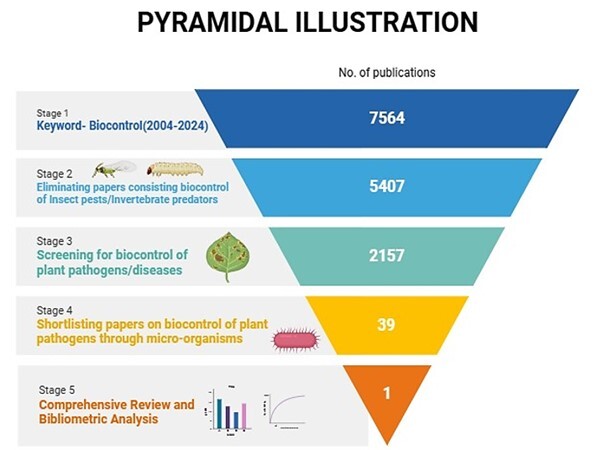
The bibliometric technique of traversing dominant themes, emerging trends, and interdisciplinary connections has piqued the interest and attention of researchers and their collaborators worldwide; however, a definitive conclusion can be drawn only after studying the methodological similarities and differences between the papers, for which more such analyses are required. This bibliometric analysis facilitates understanding of the severity and economic detriment implicated by plant pathogens in tandem with further research work on the application of biocontrol methods. Publications from Scopus (2004–2024) were analyzed using RStudio, complemented by a PRISMA-directed systematic review of methodological frameworks to determine the severity of research on combating plant pathogens. Publication output, country contributions, authorship patterns, citation metrics, and keyword occurrences were interpreted cautiously because the final subset is relatively small and reflects database and screening choices. The present study, therefore, integrates both approaches and also revealed that India contributed the highest number of papers within the final dataset of 39 papers, and that the literature is distributed across multiple journals and publishers, propounding a disjointed yet interdisciplinary field. The authors of this research do not claim any national or technological supremacy based solely on publication counts but position their findings as an exploratory overview of a screened Scopus dataset. Emphasis on the mechanisms that vary by strain, host, pathogen, and environmental context has also been laid. In summation, a network or graphical representation can be helpful in understanding a research problem and its efficacious remedial measures, here, 'plant diseases’ and ‘biological control,’ respectively.
References
Ahima J., Zhang H., Apaliya, M.T., Zhang, X., Yang Q., Zhao L. 2019. The effect of Rhodotorula mucilaginosa on degradation of citrinin production by Penicillium digitatum and its toxin in vitro. Journal of Food Measurement and Characterization 13: 2998–3004. DOI: https://doi.org/10.1007/s11694-019-00220-6
Aiello D., Restuccia C., Stefani E., Vitale A., Cirvilleri G. 2019. Postharvest biocontrol ability of Pseudomonas synxantha against Monilinia fructicola and Monilinia fructigena on stone fruit. Postharvest Biology and Technology 149: 83–89. DOI: https://doi.org/10.1016/j.postharvbio.2018.11.020
Askarov Z., Doucouliagos H., Stanley T. D., Doucouliagos A. 2022. The Significance of Data-Sharing Policy. Journal of the European Economic Association 21(3): 1191–1226. DOI: https://doi.org/10.1093/jeea/jvac053
Bastakoti S., Belbase S., Manandhar S., Arjyal C. 2019. Trichoderma species as biocontrol agent against soil borne fungal pathogens. Nepal Journal of Biotechnology 5: 39–45. DOI: https://doi.org/10.3126/njb.v5i1.18492
Błaszczyk U., Wyrzykowska S., Gastoł M. 2022. Application of Bioactive Coatings with Killer Yeasts to Control Post-Harvest Apple Decay Caused by Botrytis cinerea and Penicillium italicum. Foods 11: 1868 DOI: https://doi.org/10.3390/foods11131868
Caulier S., Nannan C., Gillis A., Licciardi F., Bragard C., and Mahillon J. 2019. Overview of the Antimicrobial Compounds Produced by Members of the Bacillus subtilis Group. Frontiers in Microbiology 10: 302 DOI: 10.3389/fmicb.2019.00302
Chen C., Zhang X., Wei X., Zhu Y., Chen W., Han Y. 2022. Postharvest biological control of Botrytis cinerea and the mechanisms underlying the induction of disease resistance in grapes by Lactobacillus plantarum CM-3. Biological Control 172: 104982. DOI: https://doi.org/10.1016/j.biocontrol.2022.104982
Chou W., Chow J. C. 2024. Analyzing collaboration and impact: A bibliometric review of four highly published authors' research profiles on collaborative maps. Medicine: 103 (28): e38686 DOI: https://doi.org/10.1097/MD.0000000000038686
Colavizza G., Hrynaszkiewicz I., Staden I., Whitaker K., & McGillivray, B. 2021. The citation advantage of linking publications to research data. Scientific Data 8: 122 DOI: https://doi.org/10.1038/s41597-021-00981-0
Donthu N., Kumar S., Mukherjee D., Pandey N., Lim W. M. 2023. Evaluating bibliometrics reviews: A practical guide for peer review and publication. Journal of Business Research 158: 113705 DOI: https://doi.org/10.1016/j.jbusres.2022.113705
El-Sayed H., Hamada M. A., Elhenawy A. A., Sonbol H., Abdelsalam A. 2023. Acetylcholine esterase inhibitory effect, antimicrobial, antioxidant, metabolomic profiling, and an in silico study of non-polar extract of the halotolerant marine fungus Penicillium chrysogenum MZ945518. Microorganisms 11(3): 769 DOI: https://doi.org/10.3390/microorganisms11030769
Farina D., Bianco A., Manzulli V., Castellana S., Parisi A., Caruso M., Fraccalvieri R., Serrecchia L., Rondinone V., Pace L., et al. 2024. Antimicrobial and Phylogenomic Characterization of Bacillus cereus Group Strains Isolated from Different Food Sources in Italy. Antibiotics 13(9): 898 DOI: https://doi.org/10.3390/antibiotics13090898
Fenta, L., Kibret M. 2021. Biocontrol potential of Lactobacillus spp. against post-harvest mango (Mangifera indica L.) anthracnose disease caused by Colletotrichum gloeosporioides. Research on Crops 22: 858–867 DOI: http://dx.doi.org/10.31830/2348-7542.2021.141
Hernandez Montiel L.G., Zulueta Rodriguez R., Angulo C., Rueda Puente E.O., Quiñonez Aguilar, E.E., Galicia, R. 2017. Marine yeasts and bacteria as biological control agents against anthracnose on mango. Journal of Phytopathology 165: 833–840. DOI: https://doi.org/10.1111/jph.12623
Hirsch J. E. (15 November 2005). "An index to quantify an individual's scientific research output". PNAS. 102 (46): 1656916572. arXiv:physics/0508025. Bibcode:.
DOI: 10.1073/pnas.0507655102. PMC 1283832. PMID 16275915
Höfte M. 2021. The use of Pseudomonas spp. as bacterial biocontrol agents to control plant disease. In J. Köhl & W. J. Ravensberg (Eds.) Microbial bioprotectants for plant disease management. DOI: https://doi.org/10.19103/AS.2021.0093.11
.Hooda R., Singh S. 2021. A Bibliometric Analysis Study of Women Entrepreneurship Literature from 1984-2021. 44: 108-112
Li S., Xu X., Zhao T., Ma J., Zhao L., Song Q. 2022. Screening of Bacillus velezensis E2 and the inhibitory effect of its antifungal substances on Aspergillus flavus. Foods 11: 140 DOI: https://doi.org/10.3390/foods11020140
Lopes MR., Klein MN., Ferraz LP., da Silva AC., Kupper KC. 2015. Saccharomyces cerevisiae: A novel and efficient biological control agent for Colletotrichum acutatum during pre-harvest. Microbiological Research. 175: 93-99. DOI: 10.1016/j.micres.2015.04.003. PMID: 25960430.
Marin V. R., Ferrarezi J. H., Vieira G., Sass D. C. 2019. Recent advances in the biocontrol of Xanthomonas spp. World Journal of Microbiology and Biotechnology, 35 (5): DOI: https://doi.org/10.1007/s11274-019-2646-5
Murariu G., Dinca L., Munteanu D. 2025. Trends and Applications of Principal Component Analysis in Forestry Research: A Literature and Bibliometric Review. Forests 16 (7): 1155. DOI: https://doi.org/10.3390/f16071155
Sudhier K.G. 2013. Lotka's Law and Pattern of Author Productivity in the Area of Physics Research. DESIDOC Journal of Library & Information Technology 33: 457-464
Ntyam Mendo S. A., Dorice N. D., Brigitte K. M. L., Severin. T. N., Lambert S. M., Anne N. N. R. 2023. Antagonistic fluorescent Pseudomonads: rhizobacteria with suppressive and plant growth promoting properties against Phytophthora colocasiae, the causal agent of taro leaf blight. Journal of Plant Protection Research 63 (3): 350–365. DOI: https://doi.org/10.24425/jppr.2023.146875
Parlina A., Ramli K., Murfi H. 2020. Theme mapping and bibliometrics analysis of one decade of big data research in the scopus database. Information (Switzerland) 11(2): 1–26. DOI: https://doi.org/10.3390/info11020069
Pereyra M.M., Garmendia G., Rossini C., Meinhardt F., Vero S., Dib J.R. 2022. Volatile organic compounds of Clavispora lusitaniae AgL21 restrain citrus postharvest pathogens. Biological Control 174: 105025. DOI: https://doi.org/10.1016/j.biocontrol.2022.105025
R Core Team. 2024. R: A language and environment for statistical computing. R Foundation for Statistical Computing. https://www.r-project.org/
Savary S., Willocquet L., Pethybridge S. J., Esker P., McRoberts N., Nelson A. 2021. The persistent threat of emerging plant disease pandemics to global food security. Proceedings of the National Academy of Sciences, 118 (21): e2022239118. DOI: https://doi.org/10.1073/pnas.2022239118
Sharma P., Pandey R., & Chauhan N. S. 2024. Biofertilizer and biocontrol properties of Stenotrophomonas maltophilia BCM emphasize its potential application for sustainable agriculture. Frontiers in Plant Science 15: 1–14. DOI: https://doi.org/10.3389/fpls.2024.1364807
Syed Ab Rahman S. F., Singh E., Pieterse C. M. J., Schenk P. M. 2018. Emerging microbial biocontrol strategies for plant pathogens. Plant Science 267: 102–111. DOI: https://doi.org/10.1016/j.plantsci.2017.11.012
Tadesse Mawcha K., Malinga L., Muir D., Ge J., Ndolo D. 2025. Recent Advances in Biopesticide Research and Development with a Focus on Microbials. F1000Research 13: 1071. DOI: https://doi.org/10.12688/f1000research.154392.5
Wijerathna-Yapa A., Pathirana R. 2022. Sustainable Agro-Food Systems for Addressing Climate Change and Food Security. Agriculture 12 (10): 1554. DOI: https://doi.org/10.3390/agriculture12101554
Zhang L., Liu Z., Wang Y., Zhang J., Wan S., Huang Y., Yun T., Xie J., Wang W. 2022. Biocontrol Potential of Endophytic Streptomyces malaysiensis 8ZJF-21 From Medicinal Plant Against Banana Fusarium Wilt Caused by Fusarium oxysporum f. sp. cubense Tropical Race 4. Frontiers in Plant Science 13: 1–16. DOI: https://doi.org/10.3389/fpls.2022.874819
Zhou D., Jing T., Chen Y., Yun T., Qi D., Zang X., Zhang M., Wei, Y., Li K., Zhao Y. 2022. Biocontrol potential of a newly isolated Streptomyces sp. HSL-9B from mangrove forest on postharvest anthracnose of mango fruit caused by Colletotrichum gloeosporioides. Food Control 135: 108836. DOI: https://doi.org/10.1016/j.foodcont.2022.108836
Zhou Q., Fu M., Xu M., Chen X., Qiu J., Wang F., Yan R., Wang J., Zhao S., Xin X. 2020. Application of antagonist Bacillus amyloliquefaciens NCPSJ7 against Botrytis cinerea in postharvest Red Globe grapes. Food Science and Nutrition 8: 1499–1508. DOI: https://doi.org/10.1002/fsn3.1434
Downloads
Published
How to Cite
Issue
Section
License
Copyright (c) 2026 Journal of Plant Protection Research

This work is licensed under a Creative Commons Attribution 4.0 International License.