
Spreading and evaporation behaviors of adjuvant-amended droplets on different wheat surfaces
DOI:
https://doi.org/10.24425/jppr.2026.7074Abstract
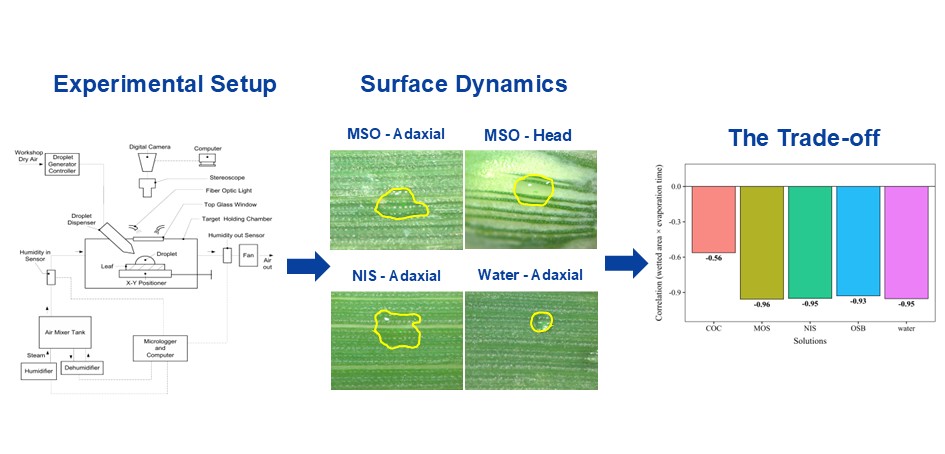
Delivering spray droplets to complex, superhydrophobic wheat (Triticum aestivum L.) structures, particularly heads and stems, remains a major challenge. Because most studies evaluate flat leaves, this research investigated droplet wetted areas and evaporation time across four wheat surfaces (adaxial/abaxial leaves, stem, head) under varying concentrations of modified seed oil (MSO), non-ionic surfactant (NIS), oil surfactant blend (OSB), and crop oil concentrate (COC). All adjuvants significantly increased spreading but reduced evaporation time compared to water. MSO and NIS maximized wetted areas but dried the fastest, whereas COC exhibited the weakest spreading and the slowest evaporation. A strong negative correlation confirmed a severe thermodynamic trade-off: extensive spreading on highly textured heads and stems created critically thin liquid films that accelerated evaporation. Consequently, maximizing spreading which then risks premature pesticide crystallization. Because interactions are strictly dose-dependent and surface-specific, no universal optimal concentration exists. Agronomists must balance target coverage with droplet longevity through precise adjuvant selection and dosing to ensure maximum biological efficacy.
References
Alisaac E, Mahlein AK. 2023. Fusarium Head Blight on Wheat: Biology, Modern Detection and Diagnosis and Integrated Disease Management. Toxins (Basel). 15(3). DOI: https://doi.org/10.3390/toxins15030192
Basu S, Luthra J, Nigam KDP. 2002. The effects of surfactants on adhesion, spreading, and retention of herbicide droplet on the surface of the leaves and seeds. Journal of Environmental Science and Health, Part B. 37(4):331–344.
Figueroa, M., Hammond-Kosack, K. E., & Solomon, P. S. (2018). A review of wheat diseases—a field perspective. In Molecular Plant Pathology (Vol. 19, Number 6, pp. 1523–1536). Blackwell Publishing Ltd. DOI: https://doi.org/10.1111/mpp.12618
Gaskin RE, Murray RJ, Krishna H, Carpenter A. 2000. Effect of adjuvants on the retention of insecticide spray on cucumber and pea foliage. New Zealand Plant Protection [Internet]. 53:355–359. http://www.nzpps.org/terms_of_use.html
Gimenes MJ, Zhu H, Raetano CG, Oliveira RB. 2013. Dispersion and evaporation of droplets amended with adjuvants on soybeans. Crop Protection. 44:84–90. DOI: https://doi.org/10.1016/j.cropro.2012.10.022
Jiang Y, Yang Z, Xu X, Ma L, Xie B, Yu J, Duan J. 2024. Regulation mechanism of droplets wetting on banana leaf surface and its dynamic contact angle wetting model. Crop Protection. 186. DOI: https://doi.org/10.1016/j.cropro.2024.106920
Jørgensen LN, Kudsk P, Ørum JE. 2019. Links between pesticide use pattern and crop production in Denmark with special reference to winter wheat. Crop Protection. 119:147–157. DOI: https://doi.org/10.1016/j.cropro.2019.01.024
Liu Z. 2004. Effects of surfactants on foliar uptake of herbicides - A complex scenario. Colloids and Surfaces B: Biointerfaces. 35(3–4):149–153. DOI: https://doi.org/10.1016/j.colsurfb.2004.02.016
Ma J, Liu K, Dong X, Chen C, Qiu B, Zhang S. 2022. Effects of Leaf Surface Roughness and Contact Angle on In Vivo Measurement of Droplet Retention. Agronomy. 12(9).DOI: https://doi.org/10.3390/agronomy12092228
Ma X, Chen Y, Song Y, Liu M, Cao L, Pengyue Z, Huang Q, Cao C. 2024. Machine learning‐based screening of pesticide adjuvants for reduction of pesticide losses on wheat leaf surfaces. New Plant Protection. 1(2). DOI: https://doi.org/10.1002/npp2.16
Makhnenko I, Hoerning C, Sawall DD, Fredericks SA, Alonzi ER, Dutcher CS. 2025. Evaporation, spreading, and possible uptake of droplets on sorghum (Sorghum bicolor) and cowpea (Vigna unguiculata) leaves using an imaging-based technology. Pest Management Science. 81(2):884–891. DOI: https://doi.org/10.1002/ps.8491
Meng Y., Liu X., Wu Q., Chen W.H., Chen W., Zhang Y., Du X., Han Y. 2025. Comprehensive Study on the Effects of Peanut Leaf Characteristics and Tank-Mix Adjuvant on Droplet-Spreading Behavior. ACS Omega. 10(12):11994–12001. DOI: https://doi.org/10.1021/acsomega.4c09553
Meng Y, Wu Q, Zhou H, Hu H. 2023. How tank-mix adjuvant type and concentration influence the contact angle on wheat leaf surface. PeerJ. 11. DOI: https://doi.org/10.7717/peerj.16464
Oliveira RB, Bonadio Precipito LM, Gandolfo MA, de Oliveira JV, Lucio FR. 2019. Effect of droplet size and leaf surface on retention of 2,4-D formulations. Crop Protection. 119:97–101. DOI: https://doi.org/10.1016/j.cropro.2019.01.015
Precipito LMB, Dario G, Oliveira J V., Oliveira RB. 2018. Evaporation and wettability of fungicide spray, with or without adjuvant, on leaves of vegetables. Horticultura Brasileira. 36(3):320–324. DOI: https://doi.org/10.1590/s0102-053620180306
R Core Team. 2022. R: A Language and Environment for Statistical Computing.
Singh J, Chhabra B, Raza A, Yang SH, Sandhu KS. 2023. Important wheat diseases in the US and their management in the 21st century. Frontiers in Plant Science. 13. DOI: https://doi.org/10.3389/fpls.2022.1010191
Song Y, Huang Q, Huang G, Liu M, Cao L, Li F, Zhao P, Cao C. 2022. The Effects of Adjuvants on the Wetting and Deposition of Insecticide Solutions on Hydrophobic Wheat Leaves. Agronomy. 12(9). DOI: https://doi.org/10.3390/agronomy12092148
Wang G, Ou M, Jia W, Zhou H, Dai S, Dong X, Wang X, Jiang L, Lu W, Wang M. 2022. The Dynamic Evaporation Characteristics of Thiophanate-Methyl Droplets and Their Enhancement under Different Wind Conditions. Horticulturae. 8(8). DOI: https://doi.org/10.3390/horticulturae8080721
Xu L, Zhu H, Ozkan HE, Bagley WE, Krause CR. 2011. Droplet evaporation and spread on waxy and hairy leaves associated with type and concentration of adjuvants. Pest Management Science. 67(7):842–851. DOI: https://doi.org/10.1002/ps.2122
Yan X, Wang M, Zhu Y, Shi X, Liu X, Chen Y, Xu J, Yang D, Yuan H. 2021. Effect of aviation spray adjuvant on improving control of fusarium head blight and reducing mycotoxin contamination in wheat. Agriculture (Switzerland). 11(12). DOI: https://doi.org/10.3390/agriculture11121284
Yu Y, Zhu H, Ozkan HE, Derksen RC, Krause CR. 2009. Evaporation and deposition coverage area of droplets containing insecticides and spray additives on hydrophilic, hydrophobic, and crabapple leaf surfaces. Transactions of the ASABE. 52(1):39–49.
Zhou Z, Cao C, Cao L, Zheng L, Xu J, Li F, Huang Q. 2018. Effect of surfactant concentration on the evaporation of droplets on cotton (Gossypium hirsutum L.) leaves. Colloids and Surfaces B: Biointerfaces. 167:206–212. DOI: https://doi.org/10.1016/j.colsurfb.2018.04.018
Zhu H., Lin, J. 2016. Coverage Area and Fading Time of Surfactant-Amended Herbicidal Droplets on Cucurbitaceous Leaves. Transactions of the ASABE. 59(3): 829-838. 10.13031/trans.59.11427
Zhu H, Yu Y, Ozkan HE, Derksen RC, Krause CR. 2008. Influence of spray additives on droplet evaporation and residual patterns on wax and wax-free surfaces Written for presentation at the 2008 ASABE Annual International Meeting Sponsored by ASABE Rhode Island Convention Center Providence, Rhode Island. 2008 ASABE Annual International Meeting (ASABE Paper No 083752).
Downloads
Published
How to Cite
Issue
Section
License
Copyright (c) 2025 Journal of Plant Protection Research

This work is licensed under a Creative Commons Attribution 4.0 International License.





