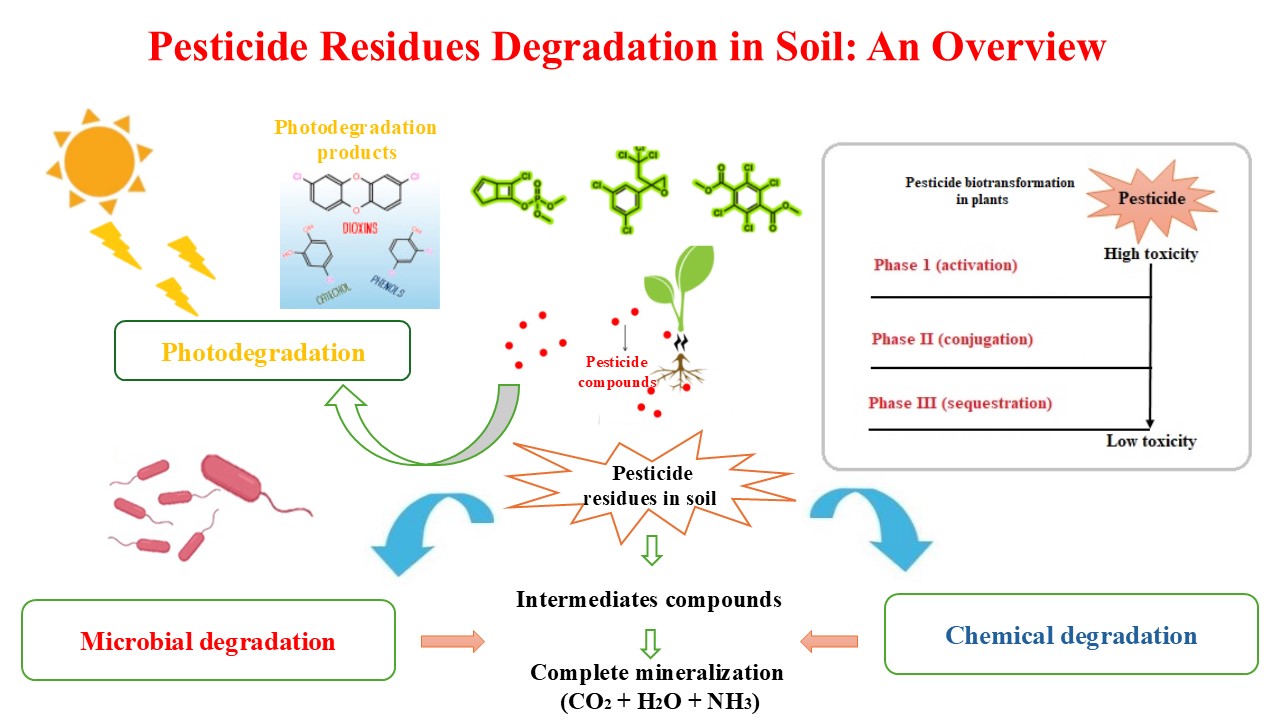
Pesticide residues degradation in soil: an overview
DOI:
https://doi.org/10.24425/jppr.2026.7609Abstract
This review summarizes the recent developments observed in the degradation of pesticide residues through biotransformation, chemical degradation, and photodegradation. The systematic review was performed in 2025 by searching for keywords like "pesticide biotransformation," "pesticide toxicity," and "pest management practices" in the PubMed, Scopus, and Web of Science scientific databases, without any time restrictions. The findings of this research indicate that the biotransformation of pesticides by microorganisms represents a pivotal process governing the fate of these chemicals in the environment, occurring mainly through three pathways: enzymatic degradation, co-metabolism, and complete mineralization. Plants generally have a much lower capacity to degrade pesticide residues than microorganisms; thus, their primary strategy is to detoxify and sequester pesticides within their cells instead of achieving full mineralization. The degradation of pesticides in the natural environment can also be accomplished through chemical degradation and photodegradation. Crucial chemical pathways involved in pesticide degradation include hydrolysis, along with oxidation and reduction reactions. In light of the escalating concerns regarding pesticide toxicity, it is important to implement sustainable management practices in the agricultural sector that focus on reducing pesticide toxicity in the soil. The first step in reducing the toxicity of pesticides in soils is to decrease their use by maximizing treatment effectiveness, minimizing the number of interventions, and lowering application rates. Applying agricultural practices like crop rotation, intercropping, organic farming, habitat management, and regular monitoring of pest populations substantially contributes to reducing pesticide toxicity in the soil. These practices not only mitigate pesticide-related soil contamination but also improve sustainable agricultural output and ecosystem resilience.
References
Abay Z., Bezabeh A., Gela A., Tassew A. 2023. Evaluating the Impact of Commonly Used Pesticides on Honeybees (Apis mellifera) in North Gonder of Amhara Region, Ethiopia. Journal of Toxicology 2023: 2634158. DOI: https://doi.org/10.1155/2023/2634158
Abu-Tahon M.A., Housseiny M.M., Aboelmagd H.I., Daifalla N., Khalili M., Isichei A.C., Ramadan A., Abu El-Saad A.M., Seddek N.H., Ebrahim D., Ali Y.H., Saeed I.K., Rikabi H.A., Eltaib L. 2025. A holistic perspective on the efficiency of microbial enzymes in bioremediation process: Mechanism and challenges: A review. International Journal of Biological Macromolecules 308 (Pt 2): 142278. DOI: https://doi.org/10.1016/j.ijbiomac.2025.142278
Acharya L.K., Paramaguru P.K., Tripathi K., Bhoi T.K., Seth P., Birah A. 2025. Pesticide contamination in groundwater: processes, risks, and mitigation strategies. Discover Agriculture 3: 152. DOI: https://doi.org/10.1007/s44279-025-00337-x
Agrawal C., Sen S., Yadav S., Rai S., Rai L.C. 2015. A Novel Aldo-Keto Reductase (AKR17A1) of Anabaena sp. PCC 7120 Degrades the Rice Field Herbicide Butachlor and Confers Tolerance to Abiotic Stresses in E. coli. PloS One 10 (9): e0137744. DOI: https://doi.org/10.1371/journal.pone.0137744
Ahmad S., Cui D., Zhong G., Liu J. 2021. Microbial Technologies Employed for Biodegradation of Neonicotinoids in the Agroecosystem. Frontiers in Microbiology 12: 759439. DOI: https://doi.org/10.3389/fmicb.2021.759439
Ahsan Z., Wu Z., Lin Z., Ji T., Wang K. 2025. The Sublethal Effects of Neonicotinoids on Honeybees. Biology 14 (8): 1076. DOI: https://doi.org/10.3390/biology14081076
Al-Ahmadi A.H. Subr A.K. 2025. Smart sprayer for weed control using an object detection algorithm (yolov5). Journal of Plant Protection Research 65 (3): 311–323. DOI: https://doi.org/10.24425/jppr.2025.155782
Alengebawy A., Abdelkhalek S.T., Qureshi S.R., Wang M.Q. 2021. Heavy Metals and Pesticides Toxicity in Agricultural Soil and Plants: Ecological Risks and Human Health Implications. Toxics 9 (3): 42. DOI: https://doi.org/10.3390/toxics9030042
Aljabri M. 2025. Recent advances in pesticide bioremediation: integrating microbial, phytoremediation, and biotechnological strategies - a comprehensive review. Environmental Pollutants and Bioavailability 37 (1): 2554173. DOI: https://doi.org/10.1080/26395940.2025.2554173
Alneyadi A.H., Shah I., AbuQamar S.F., Ashraf S.S. 2017. Differential Degradation and Detoxification of an Aromatic Pollutant by Two Different Peroxidases. Biomolecules 7 (1): 31. DOI: https://doi.org/10.3390/biom7010031
Aswathi A., Pandey A., Sukumaran R.K. 2019. Rapid degradation of the organophosphate pesticide - Chlorpyrifos by a novel strain of Pseudomonas nitroreducens AR-3. Bioresource Technology 292: 122025. DOI: https://doi.org/10.1016/j.biortech.2019.122025
Ayenew B., Getu E. 2025. Pesticide Residues, Glyphosate Adsorption and Degradation Characteristics in Ethiopian Agricultural Soils. Environmental Health Insights 19: 11786302241311679. DOI: https://doi.org/10.1177/11786302241311679
Banu M.M., Reehana N., Imran M.M. 2024. Microbial Degradation of Pesticides in Agricultural Environments: A Comprehensive review of Mechanisms, Factors and Biodiversity. Molecular Sciences and Applications 4: 65–101. DOI: https://doi.org/10.37394/232023.2024.4.8
Basapuram G., Dutta A., Duttagupta S. 2025. Biotransformation of Pesticides across Biological Systems: Molecular Mechanisms, Omics Insights, and Biotechnological Advances for Environmental Sustainability. ACS Omega 10 (43): 50709–50723. DOI: https://doi.org/10.1021/acsomega.5c06484
Benbrook C., Kegley S., Baker B. 2021. Organic Farming Lessens Reliance on Pesticides and Promotes Public Health by Lowering Dietary Risks. Agronomy 11 (7): 1266. DOI: https://doi.org/10.3390/agronomy11071266
Benner J., De Smet D., Ho A., Kerckhof F.M., Vanhaecke L., Heylen K., Boon N. 2015. Exploring methane-oxidizing communities for the co-metabolic degradation of organic micropollutants. Applied Microbiology and Biotechnology 99 (8): 3609–3618. DOI: https://doi.org/10.1007/s00253-014-6226-1
Bigley A.N., Raushel F.M. 2013. Catalytic mechanisms for phosphotriesterases. Biochimica et Biophysica Acta 1834 (1): 443–453. DOI: https://doi.org/10.1016/j.bbapap.2012.04.004
Borsuah J.F., Messer T.L., Snow D.D., Comfort S.D., Bartelt-Hunt S. 2024. The Impact of Dissolved Organic Matter on Photodegradation Rates, Byproduct Formations, and Degradation Pathways for Two Neonicotinoid Insecticides in Simulated River Waters. Sustainability 16(3): 1181. DOI: https://doi.org/10.3390/su16031181
Briceño G., Fuentes M.S., Saez J.M., Diez M.C., Benimeli C.S. 2018. Streptomyces genus as biotechnological tool for pesticide degradation in polluted systems. Critical Reviews in Environmental Science and Technology 48 (10–12): 773–805. DOI: https://doi.org/10.1080/10643389.2018.1476958
Bu L., Chen X., Tan Y., Wang P., Wu Y., Zhou S. 2021. Photolysis of nitrate by solar light in agricultural runoffs: Degradation of emerging contaminant vs. formation of unintended products. Separation and Purification Technology 269: 118751. DOI: https://doi.org/10.1016/j.seppur.2021.118751
Bütüner A.K., Susurluk İ.A. 2025. Effects of pesticides on Apis mellifera L. (Hymenoptera: Apidae) and their residues in honey. Ege Üniversitesi Ziraat Fakültesi Dergisi 62 (4): 555–566. DOI: https://doi.org/10.20289/zfdergi.1703651
Cáceres T., Megharaj M., Naidu R. 2008. Toxicity and transformation of fenamiphos and its metabolites by two micro algae Pseudokirchneriella subcapitata and Chlorococcum sp. The Science of the Total Environment 398 (1-3): 53–59. DOI: https://doi.org/10.1016/j.scitotenv.2008.03.022
Chen Q., Shi H., Liang Y., Qin L., Zeng H., Song X. 2023. Degradation Characteristics and Remediation Ability of Contaminated Soils by Using β-HCH Degrading Bacteria. International Journal of Environmental Research and Public Health 20 (4): 2767. DOI: https://doi.org/10.3390/ijerph20042767
Cheng D., Yu J., Wang T., Chen W., Guo P. 2014. Adsorption Characteristics and Mechanisms of Organochlorine Pesticide DDT on Farmland Soils. Polish Journal of Environmental Studies 23 (5): 1527–1535.
Cheng M., Chen D., Parales R.E., Jiang J. 2022. Oxygenases as Powerful Weapons in the Microbial Degradation of Pesticides. Annual Review of Microbiology 76: 325–348. DOI: https://doi.org/10.1146/annurev-micro-041320-091758
Chia X.K., Hadibarata T., Kristanti R.A., Jusoh M.N.H., Tan I.S., Foo H.C.Y. 2024. The function of microbial enzymes in breaking down soil contaminated with pesticides: a review. Bioprocess and Biosystems Engineering 47 (5): 597–620. DOI: https://doi.org/10.1007/s00449-024-02978-6
Chowdhury I.F., Doran G.S., Stodart B.J., Chen C., Wu H. 2025. Microbial Degradation of Herbicide Residues in Australian Soil: An Overview of Mechanistic Insights and Recent Advancements. Toxics 13 (11): 949. DOI: https://doi.org/10.3390/toxics13110949
Chung K-Y. 2000. Enhanced degradation of pesticides. Environmental Engineering Research 5 (1): 47–61.
Commelin M.C., Baartman J.E.M., Zomer P., Riksen M., Geissen V. 2022. Pesticides are Substantially Transported in Particulate Phase, Driven by Land use, Rainfall Event and Pesticide Characteristics—A Runoff and Erosion Study in a Small Agricultural Catchment. Frontiers in Environmental Science 10: 830589. DOI: https://doi.org/10.3389/fenvs.2022.830589
Cui G., Lartey-Young G., Chen C., Ma L. 2021. Photodegradation of pesticides using compound-specific isotope analysis (CSIA): a review. RSC Advances 11 (41): 25122–25140. DOI: https://doi.org/10.1039/d1ra01658j
Cycoń M., Piotrowska-Seget Z. 2016. Pyrethroid-Degrading Microorganisms and Their Potential for the Bioremediation of Contaminated Soils: A Review. Frontiers in Microbiology 7: 1463. DOI: https://doi.org/10.3389/fmicb.2016.01463
Dagnew M., Xue Q., Zhang J., Wang Z., Zhou A., Li M., Zhao C. 2025. A Review of Various Advanced Oxidation Techniques for Pesticide Degradation for Practical Application in Aqueous Environments. Sustainability 17 (10): 4710. DOI: https://doi.org/10.3390/su17104710
Dai Y., Li N., Zhao Q., Xie S. 2015. Bioremediation using Novosphingobium strain DY4 for 2,4-dichlorophenoxyacetic acid-contaminated soil and impact on microbial community structure. Biodegradation 26 (2): 161–170. DOI: https://doi.org/10.1007/s10532-015-9724-7
Datta A., Parkhey P., Bhatnagar T. 2024. Bioremediation Studies on Pesticides in Soil by Novel Microorganisms Isolated from Agricultural Fields. International Research Journal on Advanced Engineering and Management 2 (3): 317–325. DOI: https://doi.org/10.47392/IRJAEM.2024.0046
Doolotkeldieva T., Bobusheva S., Konurbaeva M. 2025. The bacterial species’ degradation activities at maximum threshold doses of glyphosate across different pH levels and temperature glyphosate biodegradation by soil bacteria at high doses under variable pH and temperature. Frontiers in Microbiology 16: 1668968. DOI: https://doi.org/10.3389/fmicb.2025.1668968
Doolotkeldieva T., Konurbaeva M., Bobusheva S. 2018. Microbial communities in pesticide-contaminated soils in Kyrgyzstan and bioremediation possibilities. Environmental Science and Pollution Research International 25 (32): 31848–31862. DOI: https://doi.org/10.1007/s11356-017-0048-5
Druille M., Omacini M., Golluscio R.A., Cabello M.N. 2013. Arbuscular mycorrhizal fungi are directly and indirectly affected by glyphosate application. Applied Soil Ecology 72: 143–149. DOI: https://doi.org/10.1016/j.apsoil.2013.06.011
Duc H.D. 2022. Degradation of isoproturon in vitro by a mix of bacterial strains isolated from arable soil. Canadian Journal of Microbiology 68 (9): 605–613. DOI: https://doi.org/10.1139/cjm-2022-0084
Dutta B., Panja A.S., Nigam V.K., Nanjappan S.K., Ravichandiran V., Bandopadhyay R. 2024. Computational and biochemical characterization of the immobilized esterase of Salinicoccus roseus for pesticide degradation. Scientific Reports 14 (1): 30661. DOI: https://doi.org/10.1038/s41598-024-73165-6
Dyguda-Kazimierowicz E., Roszak S., Sokalski W.A. 2014. Alkaline hydrolysis of organophosphorus pesticides: the dependence of the reaction mechanism on the incoming group conformation. The Journal of Physical Chemistry B 118 (26): 7277–7289. DOI: https://doi.org/10.1021/jp503382j
Egorova D.O., Farafonova V.V., Shestakova E.A., Andreyev D.N., Maksimov A.S., Vasyanin A.N., Buzmakov A., Plotnikova E.G. 2017. Bioremediation of soil contaminated by dichlorodiphenyltrichloroethane with the use of aerobic strain Rhodococcus wratislaviensis Ch628. Eurasian Soil Science 50: 1217–1224. DOI: https://doi.org/10.1134/S1064229317100015
Elshikh M.S., Alarjani K.M., Huessien D.S., Elnahas H.A.M., Esther A.R. 2022. Enhanced Biodegradation of Chlorpyrifos by Bacillus cereus CP6 and Klebsiella pneumoniae CP19 from municipal waste water. Environmental Research 205: 112438. DOI: https://doi.org/10.1016/j.envres.2021.112438
Ewere E.E., White S., Mauleon R., Benkendorff K. 2024. Soil microbial communities and degradation of pesticides in greenhouse effluent through a woodchip bioreactor. Environmental Pollution 359: 124561. DOI: https://doi.org/10.1016/j.envpol.2024.124561
Eyer L., Vain T., Pařízková B., Oklestkova J., Barbez E., Kozubíková H., Pospíšil T., Wierzbicka R., Kleine-Vehn J., Fránek M., Strnad M., Robert S., Novak O. 2016. 2,4-D and IAA Amino Acid Conjugates Show Distinct Metabolism in Arabidopsis. PloS One 11 (7): e0159269. DOI: https://doi.org/10.1371/journal.pone.0159269
Fan L., Zhang X., Wang J., Wang C., Li S., Zhao Y.H., Martyniuk C.J. 2023. Relationship between photolysis mechanism and photo-enhanced toxicity to Vibrio Fischeri for neonicotinoids with cyano-amidine and nitroguanidine structures. Aquatic Toxicology (Amsterdam, Netherlands) 257: 106443. DOI: https://doi.org/10.1016/j.aquatox.2023.106443
Fuentes M.S., Briceño G.E., Saez J.M., Benimeli C.S., Diez M.C., Amoroso M.J. 2013. Enhanced removal of a pesticides mixture by single cultures and consortia of free and immobilized Streptomyces strains. BioMed Research International 2013: 392573. DOI: https://doi.org/10.1155/2013/392573
Futa B., Gmitrowicz-Iwan J., Skersienė A., Šlepetienė A., Parašotas I. 2024. Innovative Soil Management Strategies for Sustainable Agriculture. Sustainability 16 (21): 9481. DOI: https://doi.org/10.3390/su16219481
Gangola S., Sharma A., Joshi S., Bhandari G., Prakash O., Govarthanan M., Kim W., Bhatt P. 2022. Novel mechanism and degradation kinetics of pesticides mixture using Bacillus sp. strain 3C in contaminated sites. Pesticide Biochemistry and Physiology 181: 104996. DOI: https://doi.org/10.1016/j.pestbp.2021.104996
Garbaly V., Krestonoshina K., Kinareikina A., Bobreshova S., Avdeeva A., Ismagilova J., Zaitsev I., Silivanova E. 2025. Glutathione S-Transferase (GST) Activities and Gene Expression Patterns of Different GST Classes in Musca domestica L. Depending on Sex and Stage of Development. International Journal of Molecular Sciences 26 (23): 11366. DOI: https://doi.org/10.3390/ijms262311366
Garud A., Pawar S., Patil M.S., Kale S.R., Patil S. 2024. A Scientific Review of Pesticides: Classification, Toxicity, Health Effects, Sustainability, and Environmental Impact. Cureus 16 (8): e67945. DOI: https://doi.org/10.7759/cureus.67945
Gautam P., Dubey S.K. 2023. Biodegradation of Neonicotinoids: Current Trends and Future Prospects. Current Pollution Reports 9: 410–432. DOI: https://doi.org/10.1007/s40726-023-00265-8
Gharabli H., Della Gala V., Welner D.H. 2023. The function of UDP-glycosyltransferases in plants and their possible use in crop protection. Biotechnology Advances 67: 108182. DOI: https://doi.org/10.1016/j.biotechadv.2023.108182
Gelfand N., Warshel A. 2025. Decoding Enzymatic Dechlorination with Multiscale Modeling: Mechanistic Insights into Native Haloalkane Dehalogenase from Xanthobacter autotrophicus and Its Designed Variants. ACS Catalysis 15 (15): 13657–13666. DOI: https://doi.org/10.1021/acscatal.5c03557
Gilani R.A., Rafique M., Rehman A., Munis M.F., Rehman S.U., Chaudhary H.J. 2016. Biodegradation of chlorpyrifos by bacterial genus Pseudomonas. Journal of Basic Microbiology 56 (2): 105–119. DOI: https://doi.org/10.1002/jobm.201500336
Gong T., Liu R., Che Y., Xu X., Zhao F., Yu H., Song C., Liu Y., Yang C. 2016. Engineering Pseudomonas putida KT2440 for simultaneous degradation of carbofuran and chlorpyrifos. Microbial Biotechnology 9 (6): 792–800. DOI: https://doi.org/10.1111/1751-7915.12381
Gong T., Liu R., Zuo Z., Che Y., Yu H., Song C., Yang C. 2016. Metabolic Engineering of Pseudomonas putida KT2440 for Complete Mineralization of Methyl Parathion and γ-Hexachlorocyclohexane. ACS Synthetic Biology 5: 434–442. DOI: https://doi.org/10.1021/acssynbio.6b00025
Gopal A., Swamidason J.T.E.Y., Mariappan P., Bojan V. 2025. Microbial degradation of flubendiamide in different types of soils at tropical region using lactic acid bacteria formulation. Scientific Reports 15: 29271. DOI: https://doi.org/10.1038/s41598-025-08917-z
Gruss I., Bączek P., Ćwieląg-Piasecka I. Jędrzejewski S., Magiera-Dulewicz J., Twardowska K. 2025. Assessing the ecotoxicological effects of pesticides on non-target plant species. Environmental Monitoring Assessment 197: 1047. DOI: https://doi.org/10.1007/s10661-025-14532-2
Gruss I., Pastuszko K., Twardowski J., Hurej M. 2018. Effects of different management practices of organic uphill grasslands on the abundance and diversity of soil mesofauna. Journal of Plant Protection Research 58 (4): 376–380. DOI: https://doi.org/10.24425/jppr.2018.124652
Gryglewicz S., Piechocki W. 2010. Conversion Pathways of DDT and Its Derivatives during Catalytic Hydrodechlorination. Polish Journal of Environmental Studies 19 (4): 715–721.
Harshitha C.P., Kumar H.N., Mohana N.C., Satish S. 2024. Biodegradation of monocrotophos by Stenotrophomonas maltophilia and its potential in vitro plant growth promoting activities. The Microbe 4: 100101. DOI: https://doi.org/10.1016/j.microb.2024.100101
Häggblom M.M. 1992. Microbial breakdown of halogenated aromatic pesticides and related compounds. FEMS Microbiology Reviews 9 (1): 29–71. DOI: https://doi.org/10.1111/j.1574-6968.1992.tb05823.x
Heo Y.J., Kwak S.Y., Sarker A., Lee S.H., Choi J.W., Oh J.E., Abdulkareem L., Kim J.E. 2023. Uptake and translocation of fungicide picarbutrazox in greenhouse cabbage: the significance of translocation factors and home processing. Environmental Science and Pollution Research International 30 (14): 40919–40930. DOI: https://doi.org/10.1007/s11356-022-25087-x
Hlihor R.M., Cozma P. 2023. Microbial bioremediation of environmental pollution. Processes 11: 1543. DOI: https://doi.org/10.3390/pr11051543
Hua Y., Yuan Y., Qin Y., Zhang C., Wang X., Feng S., Lu Y. 2022. Advances in the Agro-Environment Migration of Organic Chemical Pollutants and Their Biotransformation in Crops. Agronomy 12 (12): 3009. DOI: https://doi.org/10.3390/agronomy12123009
Huang Y., Chen S.-F., Chen W.-J., Zhu X., Mishra S., Bhatt P., Chen S. 2023. Efficient biodegradation of multiple pyrethroid pesticides by Rhodococcus pyridinivorans strain Y6 and its degradation mechanism. Chemical Engineering Journal 469: 143863. DOI: https://doi.org/10.1016/j.cej.2023.143863
Huang Y., Xiao L., Li F., Xiao M., Lin D., Long X., Wu Z. 2018. Microbial Degradation of Pesticide Residues and an Emphasis on the Degradation of Cypermethrin and 3-phenoxy Benzoic Acid: A Review. Molecules 23 (9): 2313. DOI: https://doi.org/10.3390/molecules23092313
Hugo H.J., Mouton C., Malan A.P. 2014. Accelerated microbial degradation of nematicides in vineyard and orchard soils. South African Journal of Enology and Viticulture 35 (1): 157–167.
Ito K., Kawashima F., Takagi K., Kataoka R., Kotake M., Kiyota H., Yamazaki K., Sakakibara F., Okada S. 2016. Isolation of endosulfan sulfate-degrading Rhodococcus koreensis strain S1-1 from endosulfan contaminated soil and identification of a novel metabolite, endosulfan diol monosulfate. Biochemical and Biophysical Research Communications 473 (4): 1094–1099. DOI: https://doi.org/10.1016/j.bbrc.2016.04.021
Jabłońska-Trypuć A., Wiater J. 2022. Protective effect of plant compounds in pesticides toxicity. Journal of Environmental Health Science and Engineering 20: 1035–1045. DOI: https://doi.org/10.1007/s40201-022-00823-0
Jan S., Singh R., Bhardwaj R., Ahmad P., Kapoor D. 2020. Plant growth regulators: a sustainable approach to combat pesticide toxicity. 3 Biotech 10 (11): 466. DOI: https://doi.org/10.1007/s13205-020-02454-4
Jayaraj R., Megha P., Sreedev P. 2016. Organochlorine pesticides, their toxic effects on living organisms and their fate in the environment. Interdisciplinary Toxicology 9 (3-4): 90–100. DOI: https://doi.org/10.1515/intox-2016-0012
Jayasekara U.G., Nabila B., Kristanti R.A., Rubiyatno, Hossain F.M.A., Jannat M.A.H., Ruti A.A., Twum-Ampofo D., Direstiyani L.C. 2025. Eco-Friendly Strategies for Pesticide Removal: Biotechnological and Microbial Approaches. Tropical Environment, Biology, and Technology 3 (1): 11–24. DOI: https://doi.org/10.53623/tebt.v3i1.627
Jin X., Yu X., Zhu G., Zheng Z., Feng F., Zhang Z. 2016. Conditions Optimizing and Application of Laccase-mediator System (LMS) for the Laccase-catalyzed Pesticide Degradation. Scientific Reports 6: 35787. DOI: https://doi.org/10.1038/srep35787
Katagi T. 2002. Abiotic hydrolysis of pesticides in the aquatic environment. Reviews of Environmental Contamination and Toxicology 175: 79–261.
Kaur R., Singh D., Kumari A., Sharma G., Rajput S., Arora S, Kaur R. 2023. Pesticide residues degradation strategies in soil and water: a review. International Journal of Environmental Science and Technology 20: 3537–3560. DOI: https://doi.org/10.1007/s13762-021-03696-2
Khan M.F. 2025. Microbial Remediation of Agrochemical-Contaminated Soils: Enzymatic Mechanisms, Quorum Sensing, and Emerging Opportunities. Integrated Environmental Assessment and Management 2025: vjaf167. DOI: https://doi.org/10.1093/inteam/vjaf167
Khan N., Muge E., Mulaa F.J., Wamalwa B., von Bergen M., Jehmlich N., Wick L.Y. 2023. Mycelial nutrient transfer promotes bacterial co-metabolic organochlorine pesticide degradation in nutrient-deprived environments. ISME Journal 17: 570–578. DOI: https://doi.org/10.1038/s41396-023-01371-7
Kilonzi J.M., Otieno S. 2024. Degradation kinetics and physiological studies of organophosphates degrading microorganisms for soil bioremediation. Stress Biology 4 (1): 11. DOI: https://doi.org/10.1007/s44154-023-00138-6
Kosimov D., Ergashev R., Mavjudova A., Kuziev S. 2025. Organophosphorus Pesticide Degradation by Microorganisms: A Review. Frontiers in Bioscience (Elite Edition) 17 (3): 38805. DOI: https://doi.org/10.31083/FBE38805
Książek-Trela P., Potocki L. Szpyrka E. 2025. The impact of novel bacterial strains and their consortium on diflufenican degradation in the mineral medium and soil. Scientific Reports 15: 18051. https://doi.org/10.1038/s41598-025-02696-3
Kumar A., Solanki M.K., Kumar M., Kaushik A., Arya A., Saikia M., Gaur V.K., Singh R.P., Singh S.K., Singh V.K., Dufossé L. 2025. The microbial strategies for the management of chemical pesticides: A comprehensive review. Current Research in Microbial Sciences 10: 100519. DOI: https://doi.org/10.1016/j.crmicr.2025.100519
Kumar V., Sharma N., Vangnai A. 2021. Modeling degradation kinetics of profenofos using Acinetobacter sp. 33F. Environmental Technology & Innovation 21: 101367. DOI: https://doi.org/10.1016/j.eti.2021.101367
Leskovac A., Petrović S. 2023. Pesticide Use and Degradation Strategies: Food Safety, Challenges and Perspectives. Foods 12 (14): 2709. DOI: https://doi.org/10.3390/foods12142709
Levchuk I., Iutynska G., Yamborko N. 2022. Stenotrophomonas maltophilia IMV B-7288, Pseudomonas putida IMV B-7289 and Bacillus megaterium IMV B-7287 – new selected destructors of organochlorine pesticide hexachlorocyclohexane. Archives of Microbiology 204: 611. DOI: https://doi.org/10.1007/s00203-022-03220-1
Li H., Yang Y., Hu Y., Chen C.C., Huang J.W., Min J., Dai L., Guo R.T. 2022. Structural analysis and engineering of aldo-keto reductase from glyphosate-resistant Echinochloa colona. Journal of Hazardous Materials 436: 129191. DOI: https://doi.org/10.1016/j.jhazmat.2022.129191
Li J., Peng J., Zhang Y., Ji Y., Shi H., Mao L., Gao S. 2016. Removal of triclosan via peroxidases-mediated reactions in water: Reaction kinetics, products and detoxification. Journal of Hazardous Materials 310: 152–160. DOI: https://doi.org/10.1016/j.jhazmat.2016.02.037
Li Q., Li Y., Zhu X., Cai B. 2008. Isolation and characterization of atrazine-degrading Arthrobacter sp. AD26 and use of this strain in bioremediation of contaminated soil. Journal of Environmental Sciences (China) 20 (10): 1226–1230. DOI: https://doi.org/10.1016/s1001-0742(08)62213-5
Li R., Wang S., Chang J., Pan X., Dong F., Li Z., Zheng Y., Li Y. 2022. Insight into the uptake and metabolism of a new insecticide cyetpyrafen in plants. Environment International 169: 107522. DOI: https://doi.org/10.1016/j.envint.2022.107522
Li X., He J., Li S. 2007. Isolation of a chlorpyrifos-degrading bacterium, Sphingomonas sp. strain Dsp-2, and cloning of the mpd gene. Research in Microbiology 158 (2): 143–149. DOI: https://doi.org/10.1016/j.resmic.2006.11.007
Li X., Shen X., Jiang W., Xi Y., Li S. 2024. Comprehensive review of emerging contaminants: Detection technologies, environmental impact, and management strategies. Ecotoxicology and Environmental Safety 278: 116420. DOI: https://doi.org/10.1016/j.ecoenv.2024.116420
Li Y., Mitch W.A. 2018. Capture and Reductive Transformation of Halogenated Pesticides by an Activated Carbon-Based Electrolysis System for Treatment of Runoff. Environmental Science & Technology 52 (3): 1435–1443. DOI: https://doi.org/10.1021/acs.est.7b05259
Li Z., Zhang Y., Zhao Q., Wang C., Cui Y., Li J., Chen A., Liang G., Jiao B. 2020. Occurrence, temporal variation, quality and safety assessment of pesticide residues on citrus fruits in China. Chemosphere 258: 127381. DOI: https://doi.org/10.1016/j.chemosphere.2020.127381
Liang X., Yu S., Ju Y., Wang Y., Yin D. 2025. Integrated Management Practices Foster Soil Health, Productivity, and Agroecosystem Resilience. Agronomy 15 (8): 1816. DOI: https://doi.org/10.3390/agronomy15081816
Liaqat I., Khalid A., Rubab S., Rashid F., Latif A.A., Naseem S., Bibi A., Khan B.N., Ansar W., Javed A., Afzaal M., Summer M., Majid S., Ali S., Aftab M.N. 2023. In Vitro Biofilm-Mediated Biodegradation of Pesticides and Dye-Contaminated Effluents Using Bacterial Biofilms. Microorganisms 11 (9): 2163. DOI: https://doi.org/10.3390/microorganisms11092163
Liu N., Huang J., Liu X., Wu J., Huang M. 2024. Pesticide-induced metabolic disruptions in crops: A global perspective at the molecular level. Science of The Total Environment 957: 177665. DOI: https://doi.org/10.1016/j.scitotenv.2024.177665
Liu P., Wen S., Zhu S., Hu X., Wang Y. 2025. Microbial Degradation of Soil Organic Pollutants: Mechanisms, Challenges, and Advances in Forest Ecosystem Management. Processes 13 (3): 916. DOI: https://doi.org/10.3390/pr13030916
Liu X.Y., Li C.X., Luo X.J., Lai Q.L., Xu J.H. 2014. Burkholderia jiangsuensis sp. nov., a methyl parathion degrading bacterium, isolated from methyl parathion contaminated soil. International Journal of Systematic and Evolutionary Microbiology 64 (Pt 9): 3247–3253. DOI: https://doi.org/10.1099/ijs.0.064444-0
Lopes P.R.M., Cruz V.H., de Menezes A.B., Gadanhoto B.P., Moreira B.R.A., Mendes C.R., Mazzeo D.E.C., Dilarri G., Montagnolli R.N. 2022. Microbial bioremediation of pesticides in agricultural soils: An integrative review on natural attenuation, bioaugmentation and biostimulation. Reviews in Environmental Science and Bio/Technology 21: 851–876. DOI: https://doi.org/10.1007/s11157-022-09637-w
Lushchak V.I., Matviishyn T.M., Husak V.V., Storey J.M., Storey K.B. 2018. Pesticide toxicity: a mechanistic approach. EXCLI Journal 17: 1101–1136. DOI: https://doi.org/10.17179/excli2018-1710
Mączka W., Wińska K., Grabarczyk M. 2018. Biotechnological Methods of Sulfoxidation: Yesterday, Today, Tomorrow. Catalysts 8 (12): 624. DOI: https://doi.org/10.3390/catal8120624
Mahalle S., Bhende R.S., Bokade P., Bajaj A., Dafale N.A. 2025. Emerging microbial remediation methods for rejuvenation of pesticide-contaminated sites. Total Environment Microbiology 1 (3): 100026. DOI: https://doi.org/10.1016/j.temicr.2025.100026
Malhotra H., Kaur S., Phale P.S. 2021. Conserved Metabolic and Evolutionary Themes in Microbial Degradation of Carbamate Pesticides. Frontiers in Microbiology 12: 648868. DOI: https://doi.org/10.3389/fmicb.2021.648868
Mansouri M., Rahnavard A., Ghane M. 2025. Biodegradation of the Pesticide Diazinon by Bacteria Isolated From a Contaminated Soil. CLEAN – Soil, Air, Water 53: e70012. DOI: https://doi.org/10.1002/clen.70012
Maqsood Q., Sumrin A., Waseem R., Hussain M., Imtiaz M., Hussain N. 2023. Bioengineered microbial strains for detoxification of toxic environmental pollutants. Environmental Research 227: 115665. DOI: https://doi.org/10.1016/j.envres.2023.115665
Materu S.F., Heise S., Urban B. 2021. Seasonal and Spatial Detection of Pesticide Residues Under Various Weather Conditions of Agricultural Areas of the Kilombero Valley Ramsar Site, Tanzania. Frontiers in Environmental Science 9: 599814. DOI: https://doi.org/10.3389/fenvs.2021.599814
Meftaul I.M., Venkateswarlu K., Annamalai P., Parven A., Megharaj M. 2023. Degradation of four pesticides in five urban landscape soils: human and environmental health risk assessment. Environmental Geochemistry and Health 45: 1599–1614. DOI: https://doi.org/10.1007/s10653-022-01278-w
Meng X., Guo Y., Wang Y., Fan S., Wang K., Han W. 2022. A Systematic Review of Photolysis and Hydrolysis Degradation Modes, Degradation Mechanisms, and Identification Methods of Pesticides. Journal of Chemistry 2022: 9552466. DOI: https://doi.org/10.1155/2022/9552466
Mishra S.K., Tripathi K.M. Pandey S. 2023. Effect of Chemical Pesticides on Soil Health and Its Physio-Chemical Properties. Novel Perspectives of Geography, Environment and Earth Sciences 8: 156–167. DOI: https://doi.org/10.9734/bpi/npgees/v8/6115E
Mitrović J., Radović Vučić M., Kostić M., Petrović M., Velinov N., Najdanović S., Bojić A. 2025. Comparative Evaluation of UV-C-Activated Peroxide and Peroxydisulfate for Degradation of a Selected Herbicide. Separations 12 (5): 116. DOI: https://doi.org/10.3390/separations12050116
Mqambalala A., Maleke M., Osman J.R., Hernandez J.C. 2025. Biodegradation of Emerging Contaminants Controlled by Biological and Chemical Factors. Microorganisms 13 (10): 2354. DOI: https://doi.org/10.3390/microorganisms13102354
Muñoz-Bautista J.M., Bernal-Mercado A.T., Martínez-Cruz O., Burgos-Hernández A., López-Zavala A.A., Ruiz-Cruz S., Ornelas-Paz J.d.J., Borboa-Flores J., Ramos-Enríquez J.R., Del-Toro-Sánchez C.L. 2025. Environmental and Health Impacts of Pesticides and Nanotechnology as an Alternative in Agriculture. Agronomy 15 (8): 1878. DOI: https://doi.org/10.3390/agronomy15081878
Muskus A.M., Krauss M., Miltner A., Hamer U., Nowak K.M. 2019. Effect of temperature, pH and total organic carbon variations on microbial turnover of 13C315N-glyphosate in agricultural soil. The Science of the Total Environment 658: 697–707. DOI: https://doi.org/10.1016/j.scitotenv.2018.12.195
Navarro S., Vela N., Navarro G. 2007. Review. An overview on the environmental behaviour of pesticide residues in soils. Spanish Journal of Agricultural Research 5 (3): 357–375. DOI: https://doi.org/10.5424/sjar/2007053-5344
Naveena B., Annalakshmi G., Partha N. 2013. An efficacious degradation of pesticide by salt tolerant Streptomyces venezuelae ACT 1. Bioresource Technology 132: 378–382. DOI: https://doi.org/10.1016/j.biortech.2012.11.019
Ni B., Xiao L., Lin D., Zhang T.L., Zhang Q., Liu Y., Chen Q., Zhu D., Qian H., Rillig M.C., Zhu Y.G. 2025. Increasing pesticide diversity impairs soil microbial functions. Proceedings of the National Academy of Sciences of the United States of America 122 (2): e2419917122. DOI: https://doi.org/10.1073/pnas.2419917122
Okutman Tas D., Pavlostathis S.G. 2010. Microbial transformation of pentachloronitrobenzene under nitrate reducing conditions. Biodegradation 21 (5): 691–702. DOI: https://doi.org/10.1007/s10532-010-9335-2
Onwona-Kwakye M., Plants-Paris K., Keita K., Lee J., Brink P.J.V.d., Hogarh J.N., Darkoh C. 2020. Pesticides Decrease Bacterial Diversity and Abundance of Irrigated Rice Fields. Microorganisms 8 (3): 318. DOI: https://doi.org/10.3390/microorganisms8030318
Ortiz-Hernández M.L., Quintero-Ramírez R., Nava-Ocampo A.A., Bello-Ramírez A.M. 2003. Study of the mechanism of Flavobacterium sp. for hydrolyzing organophosphate pesticides. Fundamental & Clinical Pharmacology 17 (6): 717–723. DOI: https://doi.org/10.1046/j.1472-8206.2003.00202.x
Otalvaro J.O., Brigante M. 2018. Interaction of pesticides with natural and synthetic solids. Evaluation in dynamic and equilibrium conditions. Environmental Science and Pollution Research International 25 (7): 6707–6719. DOI: https://doi.org/10.1007/s11356-017-1020-0
Pal R., Chakrabarti K., Chakraborty A., Chowdhury A. 2006. Degradation and Effects of Pesticides on Soil Microbiological Parameters-A Review. International Journal of Agricultural Research 1 (3): 240–258. DOI: https://doi.org/10.3923/ijar.2006.240.258
Pang S., Lin Z., Zhang W., Mishra S., Bhatt P., Chen S. 2020. Insights Into the Microbial Degradation and Biochemical Mechanisms of Neonicotinoids. Frontiers in Microbiology 11: 868. DOI: https://doi.org/10.3389/fmicb.2020.00868
Papade S.E., Suhail M., Bagwe O.K., Phale P.S. 2025. Degradation of 2,4-D by plant growth-promoting Cupriavidus sp. DSPFs: role in mitigating herbicide toxicity in soil and enhancing crop production. Microbiology Spectrum 13: 11. DOI: https://doi.org/10.1128/spectrum.00560-25
Parra-Arroyo L., González-González R.B., Castillo-Zacarías C., Melchor Martínez E.M., Sosa-Hernández J.E., Bilal M., Iqbal H.M.N., Barceló D., Parra-Saldívar R. 2022. Highly hazardous pesticides and related pollutants: Toxicological, regulatory, and analytical aspects. The Science of the Total Environment 807 (Pt 3): 151879. DOI: https://doi.org/10.1016/j.scitotenv.2021.151879
Parven A., Meftaul I.M., Venkateswarlu K., Megharaj M. 2025. Herbicides in modern sustainable agriculture: environmental fate, ecological implications, and human health concerns. International Journal of Environmental Science and Technology 22: 1181–1202. DOI: https://doi.org/10.1007/s13762-024-05818-y
Pashirova T., Salah-Tazdaït R., Tazdaït D., Masson P. 2024. Applications of Microbial Organophosphate-Degrading Enzymes to Detoxification of Organophosphorous Compounds for Medical Countermeasures against Poisoning and Environmental Remediation. International Journal of Molecular Sciences 25 (14): 7822. DOI: https://doi.org/10.3390/ijms25147822
Pathak V.M., Verma V.K., Rawat B.S., Kaur B., Babu N., Sharma A., Dewali S., Yadav M., Kumari R., Singh S., Mohapatra A., Pandey V., Rana N., Cunill J.M. 2022. Current status of pesticide effects on environment, human health and it's eco-friendly management as bioremediation: A comprehensive review. Frontiers in Microbiology 13: 962619. DOI: https://doi.org/10.3389/fmicb.2022.962619
Pearsons K.A., Tooker J.F. 2017. In-Field Habitat Management to Optimize Pest Control of Novel Soil Communities in Agroecosystems. Insects 8 (3): 82. DOI: https://doi.org/10.3390/insects8030082
Quandahor P., Kim L., Kim M., Lee K., Kusi F., Jeong I.-h. 2024. Effects of Agricultural Pesticides on Decline in Insect Species and Individual Numbers. Environments 11 (8): 182. DOI: https://doi.org/10.3390/environments11080182
Raffa C.M., Chiampo F. 2021. Bioremediation of Agricultural Soils Polluted with Pesticides: A Review. Bioengineering (Basel, Switzerland) 8 (7): 92. DOI: https://doi.org/10.3390/bioengineering8070092
Rasool S., Rasool T., Gani K.M. 2022. A review of interactions of pesticides within various interfaces of intrinsic and organic residue amended soil environment. Chemical Engineering Journal Advances 11: 100301. DOI: https://doi.org/10.1016/j.ceja.2022.100301
Ray S.S., Parihar K., Goyal N., Mahapatra D.M. 2024. Synergistic insights into pesticide persistence and microbial dynamics for bioremediation. Environmental Research 257: 119290. DOI: https://doi.org/10.1016/j.envres.2024.119290
Remucal C.K. 2014. The role of indirect photochemical degradation in the environmental fate of pesticides: a review. Environmental Science: Processes & Impacts 16 (4): 628–653. DOI: https://doi.org/10.1039/C3EM00549F
Ren X., Sun Y., Wu Z., Meng F., Cui Z. 2012. The OH-induced degradation mechanism of 4-chloro-2-methylphenoxyacetic acid (MCPA) with two forms in the water: a DFT comparison. Chemosphere 88 (1): 39–48. DOI: https://doi.org/10.1016/j.chemosphere.2012.02.045
Ren X., Sun Y., Zhu L., Cui Z. 2011. Theoretical studies on the OH-initiated photodegradation mechanism of dicofol. Computational and Theoretical Chemistry 963 (2-3): 365–370. DOI: https://doi.org/10.1016/j.comptc.2010.10.049
Rodríguez-Seijo A., Pérez-Rodríguez P., Arias-Estévez M., Gómez-Armesto A., Conde-Cid M., Santás-Miguel V., Campillo-Cora C., Ollio I., Lloret E., Martínez-Martínez S., Zornoza R., Waeyenberge L., Schrader S., Brandt K.K., Loit K., Põldmets M., Shanskiy M., Peltoniemi K., Hagner M., Calviño D.F. 2025. Occurrence, persistence and risk assessment of pesticide residues in European wheat fields: A continental scale approach. Journal of Hazardous Materials 494: 138291. DOI: https://doi.org/10.1016/j.jhazmat.2025.138291
Ruomeng B., Meihao O., Siru Z., Shichen G., Yixian Z., Junhong C., Ruijie M., Yuan L., Gezhi X., Xingyu C., Shiyi Z., Aihui Z., Baishan F. 2023. Degradation strategies of pesticide residue: From chemicals to synthetic biology. Synthetic and Systems Biotechnology 8 (2): 302–313. DOI: https://doi.org/10.1016/j.synbio.2023.03.005
Sandermann H. 1994. Higher plant metabolism of xenobiotics: the 'green liver' concept. Pharmacogenetics 4 (5): 225–241. DOI: https://doi.org/10.1097/00008571-199410000-00001
Sarker A., Kim D., Jeong W.-T. 2024. Environmental Fate and Sustainable Management of Pesticides in Soils: A Critical Review Focusing on Sustainable Agriculture. Sustainability 16 (23): 10741. DOI: https://doi.org/10.3390/su162310741
Senani N., Bedouhene S., Houali K. 2023. Peroxidase activity as a biochemical marker of insecticide use in vegetables. Acta Agriculturae Slovenica 119 (2): 1–9. DOI: https://doi.org/10.14720/aas.2023.119.2.2657
Shahid M., Khan, M.S. 2022. Ecotoxicological implications of residual pesticides to beneficial soil bacteria: A review. Pesticide Biochemistry and Physiology 188: 105272. DOI: https://doi.org/10.1016/j.pestbp.2022.105272
Shi X., Xie G., Zhang W., Yu A. 2023. Assessment of the Hydrolysis of Pydiflumetofen and Its Degradation Characteristics in Agricultural Soils. Molecules 28 (11): 4282. DOI: https://doi.org/10.3390/molecules28114282
Shehata E.M.S., Gehan Y.A. 2010. The influence of soil microorganisms and bio- or -organic fertilizers on dissipation of some pesticides in soil and potato tubers. Journal of Plant Protection Research 50 (1): 86–92.
Shultana R., Ali Tan K.Z., Rana M.M., Roy T.K., Naher U.A., Ibne Baki M.Z., Iqbal Khan M.A., Akter R., Chandra Paul P.L., Shupta S.A., Islam M.S., Hasan A.K. 2025. Exploring the impact of agricultural pesticides on soil microbes: A comprehensive review. Egyptian Journal of Soil Science 65 (3): 1247–1271. DOI: https://doi.org/10.21608/ejss.2025.371094.2081
Sibanda M.M., Focke W.W., Labuschagne F.J., Moyo L., Nhlapo N.S., Maity A., Muiambo H., Massinga Jr. P., Crowther N.A., Coetzee M., Brindley G.W. 2011. Degradation of insecticides used for indoor spraying in malaria control and possible solutions. Malaria journal 10: 307. DOI: https://doi.org/10.1186/1475-2875-10-307
Siddiqui J.A., Zhang Y., Luo Y., Bamisile B.S., Rehman N.U., Islam W., Qasim M., Jiang Q., Xu Y. 2022. Comprehensive Detoxification Mechanism Assessment of Red Imported Fire Ant (Solenopsis invicta) against Indoxacarb. Molecules 27 (3): 870. DOI: https://doi.org/10.3390/molecules27030870
Silva V.P., Moreira-Santos M., Mateus C., Teixeira T., Ribeiro R., Viegas C.A. 2015. Evaluation of Arthrobacter aurescens Strain TC1 as Bioaugmentation Bacterium in Soils Contaminated with the Herbicidal Substance Terbuthylazine. PloS One 10 (12): e0144978. DOI: https://doi.org/10.1371/journal.pone.0144978
Singh N., Singh B., Dureja P., Sethunathan N. 2003. Persistence of phorate in soils: role of moisture, temperature, preexposure, and microorganisms. Journal of Environmental Science and Health. Part. B, Pesticides, Food Contaminants, and Agricultural Wastes 38 (6): 723–735. DOI: https://doi.org/10.1081/PFC-120025556
Singh S., Kumar V., Gill J.P.K., Datta S., Singh S., Dhaka V., Kapoor D., Wani A.B., Dhanjal D.S., Kumar M., Harikumar S.L., Singh J. 2020. Herbicide Glyphosate: Toxicity and Microbial Degradation. International Journal of Environmental Research and Public Health 17 (20): 7519. DOI: https://doi.org/10.3390/ijerph17207519
Staiger S., Seufert P., Arand K., Burghardt M., Popp C., Riederer M. 2019. The permeation barrier of plant cuticles: uptake of active ingredients is limited by very long-chain aliphatic rather than cyclic wax compounds. Pest Management Science 75 (12): 3405–3412. DOI: https://doi.org/10.1002/ps.5589
Swaine M., Bergna A., Oyserman B., Vasileiadis S., Karas P.A., Screpanti C., Karpouzas D.G. 2025. Impact of pesticides on soil health: identification of key soil microbial indicators for ecotoxicological assessment strategies through meta-analysis. FEMS Microbiology Ecology 101 (6): fiaf052. DOI: https://doi.org/10.1093/femsec/fiaf052
Székács A., Mörtl M., Darvas B. 2015. Monitoring pesticide residues in surface and ground water in Hungary: surveys in 1990–2015. Journal of Chemistry 2015: 1–16. DOI: https://doi.org/10.1155/2015/717948
Szewczyk R., Różalska S., Mironenka J. Bernat P. 2020. Atrazine biodegradation by mycoinsecticide Metarhizium robertsii: Insights into its amino acids and lipids profile. Journal of Environmental Management 262: 110304. DOI: https://doi.org/10.1016/j.jenvman.2020.110304
Teja K.S., Kumar M. 2025. Review on degradation of pesticides through different techniques in different conditions. AIP Conference Proceedings 3185: 020025. DOI: https://doi.org/10.1063/5.0251135
Tian Y., Zhao G., Cheng M., Lu L., Zhang H., Huang X. 2023. A nitroreductase DnrA catalyzes the biotransformation of several diphenyl ether herbicides in Bacillus sp. Za. Applied Microbiology and Biotechnology 107 (16): 5269–5279. DOI: https://doi.org/10.1007/s00253-023-12647-5
Tonelli Fernandes A.F., Braz V.S., Bauermeister A., Rizzato Paschoal J.A., Lopes N.P., Stehling E.G. 2018. Degradation of atrazine by Pseudomonas sp. and Achromobacter sp. isolated from brazilian agricultural soil. International Biodeterioration & Biodegradation 130: 17–22. DOI: https://doi.org/10.1016/j.ibiod.2018.03.011
Țopa D.-C., Căpșună S., Calistru A.-E., Ailincăi C. 2025. Sustainable Practices for Enhancing Soil Health and Crop Quality in Modern Agriculture: A Review. Agriculture 15 (9): 998. DOI: https://doi.org/10.3390/agriculture15090998
Tudi M., Daniel Ruan H., Wang L., Lyu J., Sadler R., Connell D., Chu C., Phung D.T. 2021. Agriculture Development, Pesticide Application and Its Impact on the Environment. International Journal of Environmental Research and Public Health 18 (3): 1112. DOI: https://doi.org/10.3390/ijerph18031112
Vaithyanathan V.K., Vaidyanathan V.K., Cabana H. 2022. Laccase-Driven Transformation of High Priority Pesticides Without Redox Mediators: Towards Bioremediation of Contaminated Wastewaters. Frontiers in Bioengineering and Biotechnology 9: 770435. DOI: https://doi.org/10.3389/fbioe.2021.770435
Valdiviezo A., Kato Y., Baker E.S., Chiu W.A., Rusyn I. 2022. Evaluation of Metabolism of a Defined Pesticide Mixture through Multiple In Vitro Liver Models. Toxics 10 (10): 566. DOI: https://doi.org/10.3390/toxics10100566
Valentová K. 2023. Biotransformation of Natural Products and Phytochemicals: Metabolites, Their Preparation, and Properties. International Journal of Molecular Sciences 24 (9): 8030. DOI: https://doi.org/10.3390/ijms24098030
Verdadero F.X.D., Agarap A.Z., Macatingrao C.N.E., Ordonez Jr. I.A., Tavu L.E.J., Pires D., Balendres M.A.O. 2025. Pesticides in the Environment: Benefits, Harms, and Detection Methods. Sci 7 (4): 171. DOI: https://doi.org/10.3390/sci7040171
Vicidomini C., Palumbo R., Moccia M., Roviello G.N. 2024. Oxidative Processes and Xenobiotic Metabolism in Plants: Mechanisms of Defense and Potential Therapeutic Implications. Journal of Xenobiotics 14 (4): 1541–1569. DOI: https://doi.org/10.3390/jox14040084
Wang W., Zhao Z., Yan H., Zhang H., Li Q.X., Liu X. 2022. Carboxylesterases from bacterial enrichment culture degrade strobilurin fungicides. The Science of the Total Environment 814: 152751. DOI: https://doi.org/10.1016/j.scitotenv.2021.152751
Widhiastuti F., Rajendram W., Pramanik B.K. 2023. Understanding the risk of using herbicides for tree root removal into wastewater treatment plant performance. Chemosphere 337: 139345. DOI: https://doi.org/10.1016/j.chemosphere.2023.139345
Wilkes T.I., Warner D.J., Davies K.G., Edmonds-Brown V. 2020. Tillage, Glyphosate and Beneficial Arbuscular Mycorrhizal Fungi: Optimising Crop Management for Plant–Fungal Symbiosis. Agriculture 10 (11): 520. DOI: https://doi.org/10.3390/agriculture10110520
Wu X., Chen W.J., Lin Z., Huang Y., El Sebai T.N., Alansary N., El-Hefny D.E., Mishra S., Bhatt P., Lü H., Chen S. 2023. Rapid Biodegradation of the Organophosphorus Insecticide Acephate by a Novel Strain Burkholderia sp. A11 and Its Impact on the Structure of the Indigenous Microbial Community. Journal of Agricultural and Food Chemistry 71 (13): 5261–5274. DOI: https://doi.org/10.1021/acs.jafc.2c07861
Wu Z., Man Q., Niu H., Lyu H., Song H., Li R., Ren G., Zhu F., Peng C., Li B., Ma X. 2022. Recent advances and trends of trichloroethylene biodegradation: A critical review. Frontiers in Microbiology 13: 1053169. DOI: https://doi.org/10.3389/fmicb.2022.1053169
Xiao Y., Lu Q., Yi X., Zhong G., Liu J. 2020. Synergistic Degradation of Pyrethroids by the Quorum Sensing-Regulated Carboxylesterase of Bacillus subtilis BSF01. Frontiers in Bioengineering and Biotechnology 8: 889. DOI: https://doi.org/10.3389/fbioe.2020.00889
Xiong J., Liang Y., Yuan C., Chen S., Wen M., Wang W., Lin Q., Yu Y. 2025. Application of multi-dimensional isotope fractionation to characterize the biotic and abiotic transformation mechanisms of the herbicide 2,4-dichlorophenoxyacetic acid. Journal of Hazardous Materials 498: 139885. DOI: https://doi.org/10.1016/j.jhazmat.2025.139885
Xu A., Zhang X., Wu S., Xu N., Huang Y., Yan X., Zhou J., Cui Z., Dong W. 2021. Pollutant Degrading Enzyme: Catalytic Mechanisms and Their Expanded Applications. Molecules 26 (16): 4751. DOI: https://doi.org/10.3390/molecules26164751
Xu J., Wang B., Wang M.Q., Gao J.J., Li Z.J., Tian Y.S., Peng R.H., Yao Q.H. 2022. Metabolic Engineering of Escherichia coli for Methyl Parathion Degradation. Frontiers in Microbiology 13: 679126. DOI: https://doi.org/10.3389/fmicb.2022.679126
Yang C., Dong M., Yuan Y., Huang Y., Guo X., Qiao C. 2007. Reductive transformation of parathion and methyl parathion by Bacillus sp. Biotechnology Letters 29 (3): 487–493. DOI: https://doi.org/10.1007/s10529-006-9264-7
Yasir M., Hossain A., Pratap-Singh A. 2025. Pesticide Degradation: Impacts on Soil Fertility and Nutrient Cycling. Environments 12 (8): 272. DOI: https://doi.org/10.3390/environments12080272
Younus H., Khan M.A., Khan A., Alhumaydhi F.A. 2025. Eco-Friendly Biocatalysts: Laccase Applications, Innovations, and Future Directions in Environmental Remediation. Catalysts 15 (10): 921. DOI: https://doi.org/10.3390/catal15100921
Zaffar H., Sabir S.R., Pervez A., Naqvi T.A. 2018. Kinetics of Endosulfan Biodegradation by Stenotrophomonas maltophilia EN-1 Isolated from Pesticide-Contaminated Soil. Soil and Sediment Contamination: An International Journal 27 (4): 267–279. DOI: https://doi.org/10.1080/15320383.2018.1470605
Zhang B., Lv F., Yang J. 2024. Pesticides Toxicity, Removal and Detoxification in Plants: A Review. Agronomy 14 (6): 1260. DOI: https://doi.org/10.3390/agronomy14061260
Zhang J.J., Yang H. 2021. Yang Metabolism and detoxification of pesticides in plants. Science of The Total Environment 790: 148034. DOI: https://doi.org/10.1016/j.scitotenv.2021.148034
Zong W., Su W., Xie Q., Gu Q., Deng X., Ren Y., Li H. 2022. Expression, characterization, and immobilization of a novel SGNH esterase Est882 and its potential for pyrethroid degradation. Frontiers in Microbiology 13: 1069754. DOI: https://doi.org/10.3389/fmicb.2022.1069754
Zuo Z., Gong T., Che Y., Liu R., Xu P., Jiang H., Qiao C., Song C., Yang C. 2015. Engineering Pseudomonas putida KT2440 for simultaneous degradation of organophosphates and pyrethroids and its application in bioremediation of soil. Biodegradation 26 (3): 223–233. DOI: https://doi.org/10.1007/s10532-015-9729-2
Downloads
Published
How to Cite
Issue
Section
License
Copyright (c) 2025 Journal of Plant Protection Research

This work is licensed under a Creative Commons Attribution 4.0 International License.





