Nanoparticle-mediated defense and antiviral protection in roselle against Hibiscus chlorotic ringspot virus (HCRSV)
DOI:
https://doi.org/10.24425/jppr.2026.2997Abstract
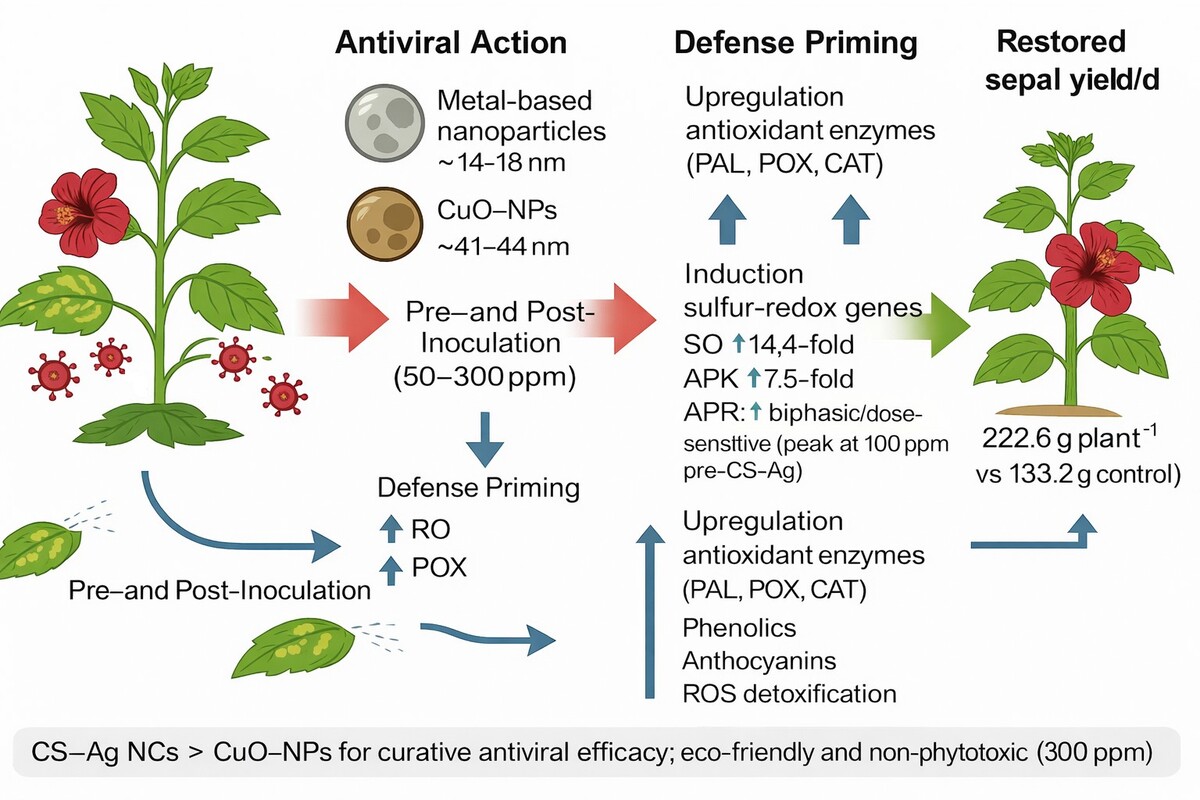
Hibiscus sabdariffa (roselle) is highly susceptible to Hibiscus chlorotic ringspot virus (HCRSV), for which effective control strategies remain limited. This study assessed the antiviral and defense-priming potential of foliar-applied chitosan–silver nanocomposites (CS-Ag NCs) and copper oxide nanoparticles (CuO-NPs) at concentrations of 50–300 ppm, applied either before or after virus inoculation. The nanomaterials were synthesized and physicochemically characterized using HR-TEM, DLS/ζ-potential, and XRD analyses. Both CS-Ag NCs and CuO-NPs significantly reduced HCRSV infection incidence in a dose-dependent manner, with the strongest curative effects observed at 300 ppm post-inoculation (CS-Ag ≈ 91.7% and CuO ≈ 85%), without visible phytotoxic effects under greenhouse conditions. CS-Ag NC treatment markedly enhanced host defense capacity, as reflected by increased activities of antioxidant and phenylpropanoid-related enzymes (PAL, POX, and CAT), elevated phenolic and anthocyanin contents, and improved sepal yield (222.6 g plant⁻¹ compared to 133.2 g plant⁻¹ in infected controls). Gene-expression profiling (2⁻ΔΔCt) revealed strong CS-Ag-mediated induction of sulfur redox–associated genes, particularly sulfite oxidase (SO) and APS kinase (APK), indicating reinforcement of redox homeostasis and reactive oxygen species detoxification pathways. In contrast, adenylylsulfate reductase (APR) exhibited a biphasic, dose-dependent transcriptional response, suggesting that sulfur assimilation is finely regulated and sensitive to both nanomaterial type and stress intensity. Collectively, these findings indicate that CS-Ag NCs predominantly act as defense-priming agents that enhance sulfur-linked antioxidant signaling, whereas CuO-NPs confer antiviral protection in a more dose- and stress-dependent manner. This study provides mechanistic insight into nano-enabled antiviral defense in roselle and identifies practical dose–timing windows for disease management, while underscoring the need for field-level validation and environmental safety assessment prior to large-scale application.
References
Abdelkader H. S., Kheder A. A.A., Amin H. A., Shafie R. M. 2025. A comparative study of the antiviral effects of biogenic silver nanoparticles and nanosilica (nSiO2) against Leek yellow stripe virus on Allium sativum L. European Journal of Plant Pathology 171(3): 509-530. DOI: https://doi.org/10.1007/s10658-024-02965-3 DOI: https://doi.org/10.1007/s10658-024-02965-3
Abdelkhalek A., Qari S. H., Abu-Saied M. A. A.-R., Khalil A. M., Younes H. A., Nehela Y., Behiry S. I. 2021. Chitosan nanoparticles inactivate Alfalfa mosaic virus replication and boost innate immunity in Nicotiana glutinosa plants. Plants 10(12): 2701. DOI: https://doi.org/10.3390/plants10122701 DOI: https://doi.org/10.3390/plants10122701
Abou-Sreea A., Roby M. H., Abdelkader H. A., Mahdy H. A., Abdou N. M., El-Tahan A. M., El-Saadony M. T., El-Tarabily H. A., El-Saadony F. M. 2022. Improvement of selected morphological, physiological and biochemical parameters of roselle (Hibiscus sabdariffa L.) grown under different salinity levels using potassium silicate and Aloe saponaria extract. The Plant Journal 11(4): 1–20. DOI: https://doi.org/10.3390/plants11040497 DOI: https://doi.org/10.3390/plants11040497
Ali B. H., Wabel N. A. I., Blunden G. 2005. Phytochemical, pharmacological and toxicological aspects of Hibiscus sabdariffa L.: A review. Phytotherapy Research 19(5): 369–375. DOI: https://doi.org/10.1002/ptr.1628 DOI: https://doi.org/10.1002/ptr.1628
Anand T., Chandrasekaran A., Kuttalam S., Raghuchander T., Prakasam V., Samiyappan R. 2007. Association of some plant defense enzyme activities with systemic resistance to early blight and leaf spot induced in tomato plants by azoxystrobin and Pseudomonas fluorescens. Journal of Plant Interactions 2(4): 233–244. DOI: https://doi.org/10.1080/17429140701799954 DOI: https://doi.org/10.1080/17429140701708985
Anusuya S., Banu K. N. 2016. Silver–chitosan nanoparticles induced biochemical variations of chickpea (Cicer arietinum L.). Biocatalysis and Agricultural Biotechnology 8: 39–44. DOI: https://doi.org/10.1016/j.bcab.2016.08.005 DOI: https://doi.org/10.1016/j.bcab.2016.08.005
Aseel D., Rabie M., El-Far A., Abdelkhalek A. 2024. Antiviral properties and molecular docking studies of eco-friendly biosynthesized copper oxide nanoparticles against Alfalfa mosaic virus. BMC Plant Biology 24(1): 1089. DOI: https://doi.org/10.1186/s12870-024-05802-1 DOI: https://doi.org/10.1186/s12870-024-05802-1
Association of Official Agricultural Chemists (A.O.A.C.) 1965. Official Methods of Analysis. 10th ed. Association of Official Agricultural Chemists, Washington, D.C., USA.
Babajide J. M., Bodunde J. G., Salami A. A. 2004. Quality and sensory evaluation of processed calyces of six varieties of roselle (Hibiscus sabdariffa L.). Nigerian Journal of Horticultural Science 9: 110–115. DOI: https://doi.org/10.4314/njhs.v9i1.3388 DOI: https://doi.org/10.4314/njhs.v9i1.3388
Babu B., Nair R. S., Angelo J. M., Mathai V., Vineet R. V. 2017. Evaluation of the efficacy of chitosan-silver nanocomposite on Candida albicans when compared to three different antifungal agents in combination with standard irrigation protocol: An ex vivo study. Saudi Endodontic Journal 7(2): 87–91. DOI: https://doi.org/10.4103/1658-5984.202949 DOI: https://doi.org/10.4103/1658-5984.205124
Bhandari G., Dhasmana A., Chaudhary P., Gupta S., Gangola S., Gupta A., Rustagi S., Shende S. S., Rajput V. D., Minkina T., Malik S. 2023. A perspective review on green nanotechnology in agro ecosystems: Opportunities for sustainable agricultural practices and environmental remediation. Agriculture 13(5): 668. DOI: https://doi.org/10.3390/agriculture13050668 DOI: https://doi.org/10.3390/agriculture13030668
Brunt A., Spence N. J. 2000. The natural occurrence of Hibiscus chlorotic ringspot virus (Carmovirus; Tombusviridae) in aibika or bele (Abelmoschus manihot) in some South Pacific Island countries. New Disease Reports 11: 20. DOI: https://doi.org/10.1046/j.1365-3059.2000.00501.x DOI: https://doi.org/10.1046/j.1365-3059.2000.00501.x
Cai L., Liu C., Fan G., Liu C., Sun X. 2019. Preventing viral disease by zinc oxide nanoparticles through directly deactivating Tobacco mosaic virus and activating plant immunity in Nicotiana benthamiana. Environmental Science: Nano 6(12): 3653–3669. DOI: https://doi.org/10.1039/C9EN00850K DOI: https://doi.org/10.1039/C9EN00850K
Chandra S., Chakraborty N., Dasgupta A., Sarkar J., Panda K., Acharya K. 2015. Chitosan nanoparticles: A positive modulator of innate immune responses in plants. Scientific Reports 5: 15195. DOI: https://doi.org/10.1038/srep15195 DOI: https://doi.org/10.1038/srep15195
Chen Z., Meng H., Xing G., Chen C., Zhao Y., Jia G., Wan L. 2006. Acute toxicological effects of copper nanoparticles in vivo. Toxicology Letters 163(2): 109–120. DOI: https://doi.org/10.1016/j.toxlet.2005.10.003 DOI: https://doi.org/10.1016/j.toxlet.2005.10.003
Davydova V. N., Nagorskaya V. P., Gorbach V. I., Kalitnik A. A., Reunov A. V., Solov’eva T. F., Ermak I. M. 2011. Chitosan antiviral activity: Dependence on structure and depolymerization method. Applied Biochemistry and Microbiology 47(2): 103–108. DOI: https://doi.org/10.1134/S0003683811020036 DOI: https://doi.org/10.1134/S0003683811010042
Derbalah A., Abdelsalam I., Behiry S. I., Abdelkhalek A., Abdelfatah M., Ismail S., Elsharkawy M. M. 2022. Copper oxide nanostructures as a potential method for control of zucchini yellow mosaic virus in squash. Pest Management Science 78(8): 3585–3595. DOI: https://doi.org/10.1002/ps.6991 DOI: https://doi.org/10.1002/ps.7001
Devi P. R., Doraiswamy S., Nakkeeran S., Rabindran R., Ganapathy T., Ramiah M. 2004. Antiviral action of Harpulia cupanioides and Mirabilis jalapa against Tomato spotted wilt virus in tomato. Archives of Phytopathology and Plant Protection 37(4): 245–259. DOI: https://doi.org/10.1080/03235400410001714939 DOI: https://doi.org/10.1080/03235400412331273313
Du C. T., Francis F. J. 1973. Anthocyanin of roselle. Journal of Food Science 38: 810–812. DOI: https://doi.org/10.1111/j.1365-2621.1973.tb02081.x
Dutta P., Kumari A., Mahanta M., Biswas K. K., Dudkiewicz A., Thakuria D., Abdelrhim A. S., Singh S. B., Muthukrishnan G., Sabarinathan K. G., Mandal M. K., Mazumdar N. 2022. Advances in nanotechnology as a potential alternative for plant viral disease management. Frontiers in Microbiology 13: 935193. DOI: https://doi.org/10.3389/fmicb.2022.935193 DOI: https://doi.org/10.3389/fmicb.2022.935193
El Gamal A. Y., Tohamy M. R., Abou-Zaid M. I., Atia M. M., El Sayed T., Farroh K. Y. 2022. Silver nanoparticles as a viricidal agent to inhibit plant-infecting viruses and disrupt their acquisition and transmission by aphid vectors. Archives of Virology 165(1): 85–97. DOI: https://doi.org/10.1007/s00705-019-04483-8 DOI: https://doi.org/10.1007/s00705-021-05280-y
El-Ganainy S. M., Soliman A. M., Ismail A. M., Sattar M. N., Farroh K. Y., Shafie R. M. 2023. Antiviral activity of chitosan nanoparticles and chitosan silver nanocomposites against Alfalfa mosaic virus. Polymers 15(13): 2961. DOI: https://doi.org/10.3390/polym15132961 DOI: https://doi.org/10.3390/polym15132961
Elsahhar S., Shahba M., Elsayed T., Mikhail M., Galal A. 2022. Effect of chitosan nanoparticles on in vitro regeneration and production of Potato virus Y-free plants of potato. Agronomy 12(11): 2901. DOI: DOI: https://doi.org/10.3390/agronomy12112901 DOI: https://doi.org/10.3390/agronomy12112901
El-Shazly M. A., Kobeasy M. I., Altalhi S. H. 2016. Biological, serological and inhibition activity of Tomato spotted wilt virus isolated from tomato plants in the Taif region, Saudi Arabia. Journal of Virological Sciences 13(1): 52–73.
Fasoyiro S. B., Ashaye O. A., Adeola A., Samuel F. O. 2005. Chemical and storability of fruit-flavoured Hibiscus sabdariffa drinks. World Journal of Agricultural Sciences 1(2): 165–168.
Fernando S. S. N., Gunasekara C., Holton J. 2018. Antimicrobial nanoparticles: Applications and mechanisms of action. Sri Lankan Journal of Infectious Diseases 8(1): 2–11. DOI: https://doi.org/10.4038/sljid.v8i1.8167 DOI: https://doi.org/10.4038/sljid.v8i1.8167
Fuleki T., Francis F. J. 1968. Quantitative methods for anthocyanins. Journal of Food Science 33(1): 78–83. https://doi.org/10.1111/j.1365-2621.1968.tb00887.x DOI: https://doi.org/10.1111/j.1365-2621.1968.tb00888.x
Galdiero S., Falanga A., Vitiello M., Cantisani M., Marra V., Galdiero M. 2011. Silver nanoparticles as potential antiviral agents. Molecules 16(10): 8894–8918. DOI: https://doi.org/10.3390/molecules16108894 DOI: https://doi.org/10.3390/molecules16108894
Galeazzi M. A., Sgarbieri V. C., Garbieri S., Constantinides M. 1981. Isolation, purification and physicochemical characterization of polyphenol oxidase from banana. Journal of Food Science 46(1): 150–155. DOI: https://doi.org/10.1111/j.1365-2621.1981.tb14556.x DOI: https://doi.org/10.1111/j.1365-2621.1981.tb14551.x
Gao R., Ng F. K. L., Liu P., Wong S. M. 2012. Hibiscus chlorotic ringspot virus coat protein upregulates sulfur metabolism genes for enhanced pathogen defense. Molecular Plant–Microbe Interactions 25(12): 1574–1583. DOI: https://doi.org/10.1094/MPMI-08-12-0203-R DOI: https://doi.org/10.1094/MPMI-08-12-0203-R
Giannopolitis C. N., Ries S. K. (1977). Superoxide dismutase: Purification and quantitative relationship with water-soluble protein in seedlings. Plant Physiology 59(2): 315–318. DOI: https://doi.org/10.1104/pp.59.2.315 DOI: https://doi.org/10.1104/pp.59.2.315
Hassan F. 2009. Response of Hibiscus sabdariffa L. to biofertilization treatments. Annals of Agricultural Science (Ain Shams University) 54(2): 437–446.
Hassan O., Chang T. 2017. Chitosan for eco-friendly control of plant disease. Asian Journal of Plant Pathology 11(2): 53–70. DOI: https://doi.org/10.3923/ajppaj.2017.53.70 DOI: https://doi.org/10.3923/ajppaj.2017.53.70
He X., Xing R., Liu S., Qin Y., Li K., Yu H., Li P. 2021. Improved antiviral activities of amino-modified chitosan derivatives against Newcastle disease virus. Drug and Chemical Toxicology 44(4): 335–340. DOI: https://doi.org/10.1080/01480545.2019.1690475 DOI: https://doi.org/10.1080/01480545.2019.1620264
Kopriva S., Rahimzadeh Karvansara P., Takahashi H. 2024. Adaptive modifications in plant sulfur metabolism over evolutionary time. Journal of Experimental Botany 75(16): 4697–4711. DOI: https://doi.org/10.1093/jxb/erae252 DOI: https://doi.org/10.1093/jxb/erae252
Liu S., Tian W., Liu Z., Wei X., Yuan K., Du W., Cai L. 2024. Biosynthesis of cupric oxide nanoparticles and their antiviral activities against Tobacco mosaic virus by direct virion destruction and induction of plant resistance. Phytopathology Research 6(1): 30. DOI: https://doi.org/10.1186/s42483-024-00250-z DOI: https://doi.org/10.1186/s42483-024-00250-z
Loeffler H. J., Ponting J. D. 1942. Ascorbic acid. Industrial and Engineering Chemistry, Analytical Edition 14(11): 846–849. https://doi.org/10.1021/i560111a017 DOI: https://doi.org/10.1021/i560111a003
López-Velázquez J. C., García-Morales S., López-Sánchez G. P., Montero-Cortés M. I., Uc-Várguez A., Qui-Zapata J. A. 2023. High-density chitosan induces biochemical and molecular responses in Coffea arabica during infection with Hemileia vastatrix. International Journal of Molecular Sciences 24(22): 16165. DOI: https://doi.org/10.3390/ijms242216165 DOI: https://doi.org/10.3390/ijms242216165
Lu J. M., Wang X., Muller C. M., Wang H., Lin P. H., Yu Q., Chen C. 2009. Current advances in research and clinical applications of PLGA-based nanotechnology. Expert Review of Molecular Diagnostics 9(4): 325–341. DOI: https://doi.org/10.1586/erm.09.15 DOI: https://doi.org/10.1586/erm.09.15
Lu Q., Ding Y., Liu W., Liu S. 2025. Viral infections and the glutathione peroxidase family: Mechanisms of disease development. Antioxidants and Redox Signaling 42(10–12): 623–639. DOI: https://doi.org/10.1089/ars.2024.0645 DOI: https://doi.org/10.1089/ars.2024.0645
Luna I. Z., Hilary L. N., Chowdhury A. S., Gafur M. A., Khan N., Khan R. A. 2015. Preparation and characterization of copper oxide nanoparticles synthesized by chemical precipitation. Open Access Library Journal 2(3): 1–8. DOI: https://doi.org/10.4236/oalib.1101409
Maini A., Shah M. A. 2021. Physical properties of nanosized cobalt-doped copper oxide for electronic device applications. International Journal of Ceramic Engineering and Science 3(3): 192–199. DOI: https://doi.org/10.1002/ces2.10100 DOI: https://doi.org/10.1002/ces2.10097
Malik C. P., Singh M. B. 1980. Estimation of Total Phenols in Plant Enzymology and Histoenzymology. Kalyani Publishers, New Delhi, India.
Masood H. A., Qi Y., Zahid M. K., Li Z., Ahmad S., Lv J. M., Shahid M. S., Ali H. E., Ondrasek G., Qi X. 2024. Nano-enabled immunomodulation for enhancing plant resilience against phytopathogens. Frontiers in Plant Science 15: 1445786. DOI: https://doi.org/10.3389/fpls.2024.1445786 DOI: https://doi.org/10.3389/fpls.2024.1445786
Maxwell D. P., Bateman D. F. 1967. Changes in oxidase activities in Rhizoctonia-infected bean hypocotyls during lesion development. Phytopathology 57: 132–136.
Mosa M. A., El-Abeid S. E. 2023. Chitosan-loaded copper oxide nanoparticles as antifungal nanocomposites against Fusarium wilt of tomato. Sustainability 15(19): 14295. DOI: https://doi.org/10.3390/su151914295 DOI: https://doi.org/10.3390/su151914295
Nikolova M. P., Chavali M. S. 2020. Metal oxide nanoparticles as biomedical materials. Biomimetics 5(4): 27. DOI: https://doi.org/10.3390/biomimetics5040027 DOI: https://doi.org/10.3390/biomimetics5020027
Niu S., Gil-Salas F. M., Tewary S. K., Samales A. K., Johnson J., Swaminathan K., Wong S. 2014. Hibiscus chlorotic ringspot virus coat protein is essential for viral movement but not RNA replication. PLOS ONE 9(11): e113808. DOI: https://doi.org/10.1371/journal.pone.0113808 DOI: https://doi.org/10.1371/journal.pone.0113347
Przemieniecki S. W., Damszel M., Kosewska O. 2025. Impact of TiO₂ nanoparticles on wheat rhizosphere microbiome structure and function. International Journal of Molecular Sciences 26(2): 685. DOI: https://doi.org/10.3390/ijms26020685 DOI: https://doi.org/10.3390/ijms26020685
Rajeshkumar R., Moorthy P. S., Raveendran M., Karthikeyan G., Gomathi V., Djanaguiraman M., Abinaya K. 2025. Mitigating plant viruses through nanoparticles: Mechanisms, applications and future perspectives. Plant Nano Biology 100155. DOI: https://doi.org/10.1016/j.plana.2025.100155 DOI: https://doi.org/10.1016/j.plana.2025.100155
Raza M. A. S., Amin J., Valipour M., Iqbal R., Aslam M. U., Zulfiqar B., Elsalahy H. H. 2024. Copper nanoparticles enhance growth and yield of drought-stressed wheat. Scientific Reports 14(1): 14254. DOI: https://doi.org/10.1038/s41598-024-62680-1 DOI: https://doi.org/10.1038/s41598-024-62680-1
Ross I. A. 2003. Medicinal Plants of the World: Chemical Constituents, Traditional and Modern Medicinal Uses. Vol. 1. Humana Press, Totowa, New Jersey, USA.
Saito K. 2004. Sulfur assimilatory metabolism: The long and smelling road. Plant Physiology 136(1): 2443–2450. DOI: https://doi.org/10.1104/pp.104.046755 DOI: https://doi.org/10.1104/pp.104.046755
Shafie R. M. 2019. Hibiscus chlorotic ringspot virus affecting roselle in Egypt. Middle East Journal of Applied Sciences 9: 50–62.
Vasquez-Gutierrez U., Frias-Treviño G. A., Aguirre-Uribe L. A., Ramírez-Barrón S. N., Mendez-Lozano J., Hernández-Juárez A., García-Ruíz H. 2025. Nanoparticles and nanocarriers for managing plant viral diseases. Plants 14(20): 3118. DOI: https://doi.org/10.3390/plants14203118 DOI: https://doi.org/10.3390/plants14203118
Warghane A., Saini R., Shri M., Andankar I., Ghosh D. K., Chopade B. A. 2024. Application of nanoparticles for management of plant viral pathogens: Current status and future prospects. Virology 592: 109998. DOI: https://doi.org/10.1016/j.virol.2023.109998 DOI: https://doi.org/10.1016/j.virol.2024.109998
Downloads
Published
How to Cite
Issue
Section
License
Copyright (c) 2026 Journal of Plant Protection Research

This work is licensed under a Creative Commons Attribution 4.0 International License.