
Dual culture and VOC analysis reveal Trichoderma harzianum as an effective biocontrol agent against Fusarium oxysporum f.sp. ciceris on chickpea
DOI:
https://doi.org/10.24425/jppr.2026.158064Abstract
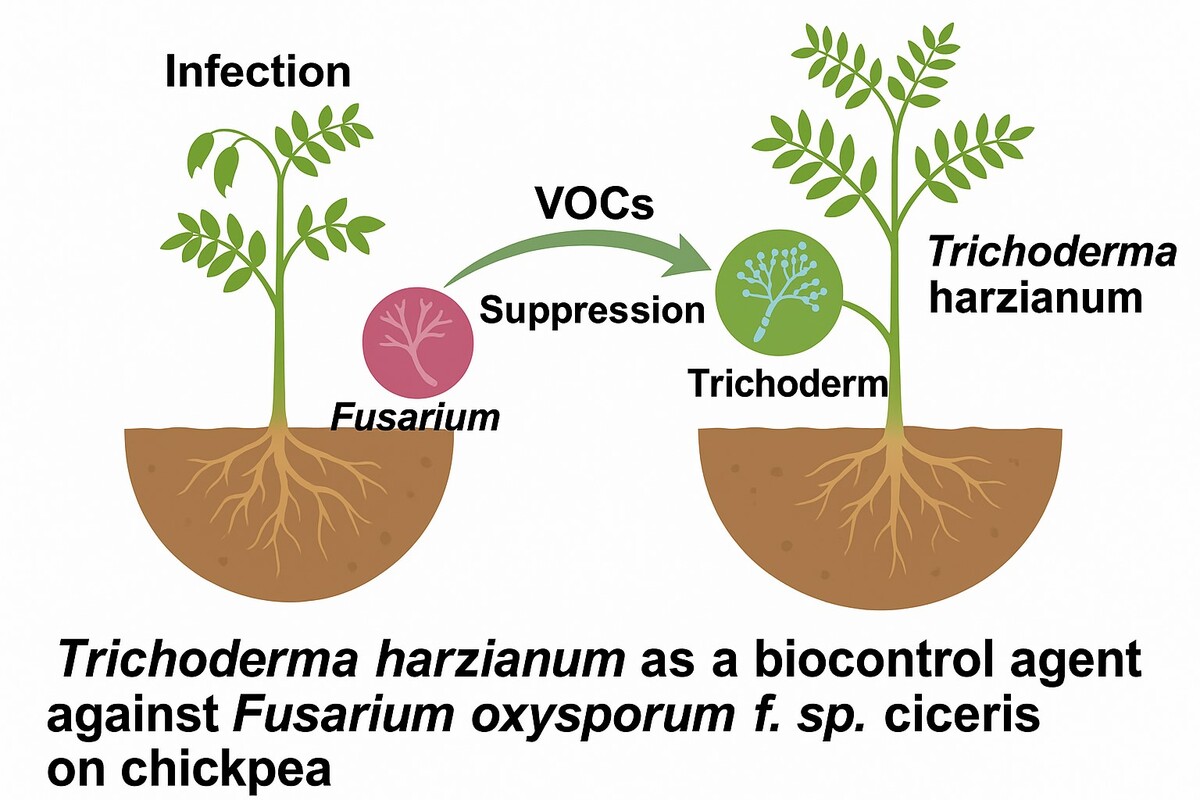
Fusarium wilt, caused by Fusarium oxysporum f. sp. ciceris (Foc), is a major constraint in chickpea production in Turkey, leading to yield losses of up to 50%. This study aimed to characterize the morphological and molecular traits of Foc isolates and evaluate the antagonistic efficacy of three Trichoderma species under in vitro and greenhouse conditions. A total of 20 Foc isolates were obtained from diseased chickpea plants in Tarsus, Mersin, of which 10 were confirmed by PCR amplification of the ITS region. The isolates showed variation in colony morphology, spore type, and pathogenicity, with Foc8, 10, 14, 15 and 20 being the most virulent. Dual culture assays demonstrated that Trichoderma harzianum (T3) had the highest antagonistic activity, inhibiting mycelial growth of Foc isolates by up to 68%. Headspace GC–MS analysis indicated that T. harzianum VOCs were rich in antifungal ketones, in contrast to the alcohol- and acid-dominated VOCs of Foc. Greenhouse experiments revealed that T. harzianum not only suppressed disease development but also significantly enhanced chickpea growth by increasing root biomass, seed weight, and relative water content. These findings highlight T. harzianum as a promising biocontrol agent for the sustainable management of Fusarium wilt in chickpeas. Further field validation and formulation development are recommended to support its use in integrated disease management programs.
References
Almourrh A., Abdul Wahab J., Alsalmo A., Hamijo T., Nawaz H., Kayim M., Arpacı B. B. 2025. Comparative Study of Biological and Chemical Control for Fusarium Wilt in Tomato. Diyala Agricultural Sciences Journal 17 (1): 209–221. DOI: https://doi.org/10.52951/dasj.25170116
Almourrh A., Alsalmo A., Mousa S., Al-Taweel K. 2024. Effect of some fungicides on Fusarium oxysporum f. sp. lycoprsici Colony growth in the laboratory. African Journal of Biological Sciences 6 (13): 1979–1995.
Altinok H.H., Erdogan O. 2015. Determination of the in vitro effect of Trichoderma harzianum on phytopathogenic strains of Fusarium oxysporum. Notulae Botanicae Horti Agrobotanici Cluj-Napoca 43 (2): 494–500.
Aydın M.H. 2019. The biological control of Fusarium oxysporum causing wilting in chickpea (Cicer arietinum L.). Türkiye Tarımsal Araștırmalar Dergisi, Siirt University. 6: 65–72. (in Turkish)
Bapela T., Shimelis H., Terefe T., Bourras S., Sánchez-Martín J., Douchkov D., Desiderio F., Tsilo T.J. 2023. Breeding wheat for powdery mildew resistance: genetic resources and methodologies – a review. Agronomy 13: 1–36. DOI: https://doi.org/10.3390/agronomy13041173
Basim H., Stall R.E., Minsavage G.V., Jones J.B. 1999. Chromosomal gene transfer by conjugation in the plant pathogen Xanthomonas axonopodis pv. vesicatoria. Phytopathology 89: 1044–1049. DOI: https://doi.org/10.1094/PHYTO.1999.89.11.1044
Bayraktar H., Dolar F.S. 2012. Pathogenic variability of Fusarium oxysporum f. sp. ciceris isolates from chickpea in Turkey. Pakistan Journal of Botany 44: 821–823.
Benítez T., Rincón A.M., Limón M.C., Codón A.C. 2004. Biocontrol mechanisms of Trichoderma strains. International Microbiology 7 (4): 249–260. DOI: https://doi.org/10.1007/s10123-004-0092-1
Bubici G., Kaushal M., Prigigallo M.I., Cabanás C.G.L., Mercado-Blanco J. 2019. Biological control agents against Fusarium wilt of banana. Frontiers in Microbiology 10: 616. DOI: https://doi.org/10.3389/fmicb.2019.00616
Daguerre Y., Siegel K., Edel-Hermann V., Steinberg C. 2014. Fungal proteins and genes associated with biocontrol mechanisms of soil-borne pathogens – a review. Fungal Biology Reviews 28: 97–125. DOI: https://doi.org/10.1016/j.fbr.2014.11.001
FAO. 2022. FAOSTAT: Food and Agriculture Data. Food and Agriculture Organization of the United Nations. https://www.fao.org/faostat/en/#data
Harman G.E., Howell C.R., Viterbo A., Chet I., Lorito M. 2004. Trichoderma species – opportunistic, avirulent plant symbionts. Nature Reviews Microbiology 2 (1): 43–56. DOI: https://doi.org/10.1038/nrmicro797
Huner N.P.A., Öquist G., Sarhan F. 1998. Energy balance and acclimation to light and cold. Trends in Plant Science 3: 224–230. DOI: https://doi.org/10.1016/S1360-1385(98)01248-5
Hung R., Lee S., Bennett J.W. 2015. Fungal volatile organic compounds and their role in ecosystems. Applied Microbiology and Biotechnology 99: 3395–3405. DOI: https://doi.org/10.1007/s00253-015-6494-4
Jalali F., Abbasi S., Salari H. 2024. The activity of Trichoderma spp. culture filtrate to control Phelipanche aegyptiaca infection in tomato. Journal of Plant Protection Research 64 (2): 189–199. DOI: https://doi.org/10.24425/jppr.2024.150252
Jamil A. 2021. Antifungal and plant growth promoting activity of Trichoderma spp. against Fusarium oxysporum f. sp. lycopersici colonizing tomato. Journal of Plant Protection Research 61 (3): 243–253. DOI: https://doi.org/10.24425/jppr.2021.137950
Jiménez-Díaz R.M., Castillo P., Jiménez-Gasco M. del M., Landa B.B., Navas-Cortés J.A. 2015. Fusarium wilt of chickpeas: biology, ecology and management. Crop Protection 73: 16–27. DOI: https://doi.org/10.1016/j.cropro.2015.02.023
Jiménez-Díaz R.M., Mercado-Blanco J., Olivares-García C., Collado-Romero M., Bejarano-Alcázar J., Rodríguez-Jurado D., Giménez-Jaime A., García-Jiménez J., Armengol J. 2006. Genetic and virulence diversity in Verticillium dahliae populations infecting artichoke in eastern-central Spain. Phytopathology 96: 288–298. DOI: https://doi.org/10.1094/PHYTO-96-0288
Kayim M., Yones A.M., Endes A. 2018. Biocontrol of Alternaria alternata causing leaf spot disease on faba bean (Vicia faba L.) using some Trichoderma harzianum isolates under in vitro condition. Harran Tarım ve Gıda Bilimleri Dergisi 22: 169–178. DOI: https://doi.org/10.29050/harranziraat.329976
Kocalar A.O., Bilgili M. 2020. Opinions of geography teacher candidates about energy resources: a critical phenomenological approach. Review of International Geographical Education Online 10: 159–170. DOI: https://doi.org/10.33403/rigeo.641546
Lochmann F., Flatschacher D., Speckbacher V., Zeilinger S., Heuschneider V., Bereiter S., Ruzsanyi V. 2024. Demonstrating the applicability of proton transfer reaction mass spectrometry to quantify volatiles emitted by the mycoparasitic fungus Trichoderma atroviride in real time: Monitoring of Trichoderma-based biopesticides. Journal of the American Society for Mass Spectrometry 35 (6): 1168–1177.
Lee S., Yap M., Behringer G., Hung R., Bennett J.W. 2016. Volatile organic compounds emitted by Trichoderma species mediate plant growth. Fungal Biology and Biotechnology 3: 1–14. DOI: https://doi.org/10.1186/s40694-016-0025-7
Li N., Alfiky A., Vaughan M.M., Kang S. 2014. Volatile compound-mediated antifungal activity of Trichoderma species: a comparative study. Biological Control 76: 9–16. DOI: https://doi.org/10.1016/j.biocontrol.2014.05.003
Li N., Alfiky A., Vaughan M.M., Kao-Kniffin J. 2016. Effect of fungal volatile organic compounds on plant health and development. Plant, Cell & Environment 39 (4): 667–677. DOI: https://doi.org/10.1111/pce.12656
Li N., Alfiky A., Wang W., Islam M., Nourollahi K., Liu X., Kang S. 2018. Volatile compound-mediated recognition and inhibition between Trichoderma biocontrol agents and Fusarium oxysporum. Frontiers in Microbiology 9: 1–15. DOI: https://doi.org/10.3389/fmicb.2018.02614
Mossa M.I., El-Sharkawy E.E., ElSharawy A.A. 2023. Antifungal activity of silver nanoparticles green biosynthesis from the extract of Zygophyllum album (L.f.) on Fusarium wilt. Journal of Plant Protection Research 63 (3): 340–349. DOI: https://doi.org/10.24425/jppr.2023.146874
Mohammed A., Kayim M. 2021. Molecular characterization of Trichoderma spp. with biocontrol ability against faba bean chocolate spot (Botrytis cinerea). International Journal of Agriculture and Environmental Research 22: 52–63. [Online] Available: https://www.researchgate.net/publication/325818888
Nguyen K.Q., Cao T.T.T., Do X.T., Le Q.T., Tran H.N., Ly T.X.N., Le T.V. 2023. Evaluation of the antagonistic potential of Trichoderma spp. against Fusarium oxysporum F.28.1A. Journal of Plant Protection Research 63 (1): 13–26. DOI: https://doi.org/10.24425/jppr.2023.144502
Navas-Cortés J.A., Hau B., Jiménez-Díaz R.M. 2000. Yield loss in chickpeas in relation to development of Fusarium wilt epidemics. Phytopathology 90: 1269–1278. DOI: https://doi.org/10.1094/PHYTO.2000.90.11.1269
Nawrot-Chorabik K., Marcol-Rumak N., Latowski D. 2021. Investigation of the biocontrol potential of two ash endophytes against Hymenoscyphus fraxineus using in vitro plant–fungus dual cultures. Forests 12: 1750. DOI: https://doi.org/10.3390/f12121750
Pelias R., Samia G., Karkachi N., Kihal M. 2022. Antifungal activity of Bacillus spp. against Fusarium oxysporum f. sp. lycopersici and Ascochyta sp. Journal of Plant Protection Research 62 (3): 247–257. DOI: https://doi.org/10.24425/jppr.2022.142131
Rajani P., Rajasekaran C., Vasanthakumari M.M., Olsson S.B., Ravikanth G., Uma Shaanker R. 2021. Inhibition of plant pathogenic fungi by endophytic Trichoderma spp. through mycoparasitism and volatile organic compounds. Microbiological Research 242: 126595. DOI: https://doi.org/10.1016/j.micres.2020.126595
Skidmore A.M., Dickinson C.H. 1976. Colony interactions and hyphal interference between Septoria nodorum and phylloplane fungi. Transactions of the British Mycological Society 66 (1): 57–64. DOI: https://doi.org/10.1016/S0007-1536(76)80009-9
Singh B.P., Saikia R., Yadav M., Singh R., Chauhan V.S., Arora D.K. 2006. Molecular characterization of Fusarium oxysporum f. sp. ciceris causing wilt of chickpea. African Journal of Biotechnology 5 (6): 497–502.
Yuan J., Raza W., Shen Q., Huang Q. 2012. Antifungal activity of Bacillus amyloliquefaciens NJN-6 volatile compounds against Fusarium oxysporum f. sp. cubense. Applied and Environmental Microbiology 78 (16): 5942–5944. DOI: https://doi.org/10.1128/AEM.01357-12
Zou X., Wei Y., Zhu J., Sun J., Shao X. 2023. Volatile organic compounds of Scheffersomyces spartinae W9 have antifungal effect against Botrytis cinerea on strawberry fruit. Foods 12: 3619. DOI: https://doi.org/10.3390/foods12193619
Downloads
Published
How to Cite
Issue
Section
License
Copyright (c) 2026 Journal of Plant Protection Research

This work is licensed under a Creative Commons Attribution 4.0 International License.