
Fusarium fruit rot of banana in Iran
DOI:
https://doi.org/10.24425/jppr.2026.3394Abstract
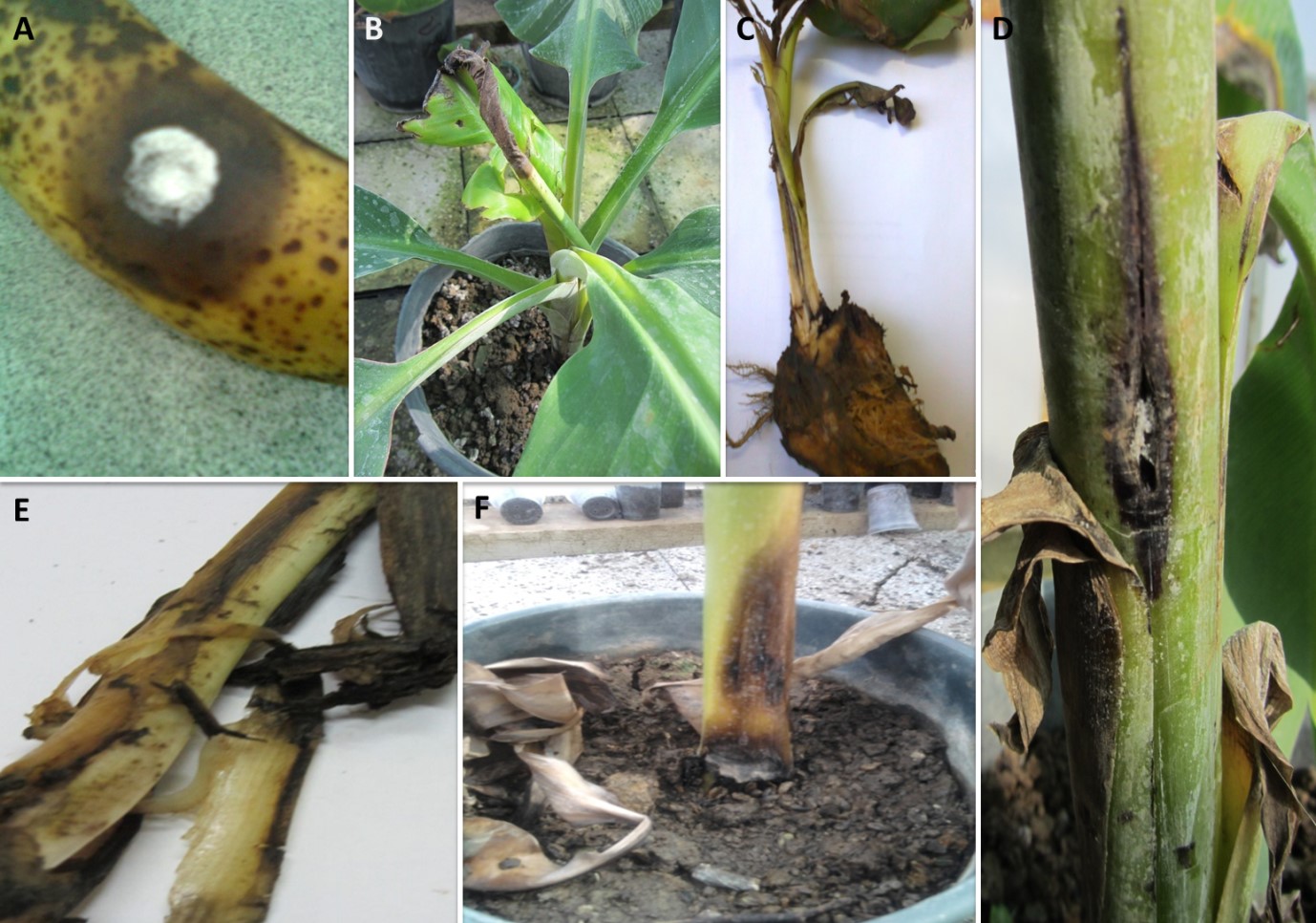
Banana fruit rot by Fusariumverticillioides is one of the most important diseases of banana in Iran. In 2021-2022 this species was identified by both morphological and molecular methods in Iran, also its phylogenetic relationship with the reference species in the GenBank was investigated. Pathogenicity tests revealed that all isolates induced symptoms of banana fruit rot disease that were consistent with those observed in the field. In the second step of this study, control of F. verticillioides was evaluated in vitro and in vivo. Nowadays, the current trend is shifting from chemical pesticides toward safer methods. Antagonist microorganisms as biocontrol agents are useful substitutes. Some bacteria and fungi have been found to have inhibitory effects on F. verticillioides. In this research we examined bacterial and yeast antagonist isolates, Neem extract and finally a chemical fungicide (Thiabendazole) on mycelial growth of F. verticillioides. Our results showed that two bacterial isolates and two isolates of yeasts inhibited the pathogen growth. The methanol leaf extract of Neem at 4000 ppm concentration, showed the most antifungal activity. Integration of bacterial and yeast antagonists with Thiabendazole showed the best activity at 600 ppm concentration of Thiabendazole.
References
1. Acharya S. 2021.Dual Culture Approach for the Evaluation of Antagonistic Activity of Native Trichoderma Isolates against Bipolaris sorokiniana. International Journal of Advanced Research 9 (12): 1002-1008.
2. Attia M.S., El-Wakil D.A., Hashem A.H., Al-Askar A.A., Abdelgawad H., Alotaibi R.S., Abdel-Kader S.A., Abdelaziz A.M. 2025. Investigating the activity of Bacillus subtilis and Trichoderma harzianum to mitigate Fusarium wilt disease of diverse cultivars of Vicia faba. Scientific Reports 15: 16093. 10.1038/s41598-025-99381-2
3. Bahraminejad S., Asenntorfer R.E., Riley I.T., Zwer P., Schultz C.J. and Schmidt O. 2008. genetic variation of flavonoid defense compound concentration in oat (avena sativaL.) entries and testing of their biological activity. 1127-1132. In: Proceedings of Australasian plant breeding conference.18-21 Jan 2008, Christchurch, New Zealand.
4. Denham T.P., Haberle S.G.,Fullagar C.R.,Field J.,TherinM.,PorchM. Winsborough B. 2003. Origins of agriculture at Kuk swamp in the Highlands of New Guinea. Science 301:189-193.
5. Dionio B.T., Bacoba C.J.M., Puig C.G., Ramos F.R.A. 2020. Fusarium Heart Rot:First Report on Pineapplein South Cotabato and Davao City, Philippines.Southeastern Philippines Journal of Research and Development 25 (1): 183-196. dx.doi.org/10.53899/spjrd.v25i1.65
6. Elbouazaoui A., Sijilmassi B., Maafa I., Allal D., Ahmed S. 2022.Biocontrol activity of Bacillus, Paenibacillus and Pseudomonas against Fusarium wilt of chickpea in Morocco.Acta Agriculturae Scandinavica, Section B- Soil & Plant Science 72 (1): 847-859, 10.1080/09064710.2022.2100819
7. Fandohan P., Gbenou J.D., Gnonlonfin B., Hell K., Marasas W.F., Wingfield M.J. 2004. Effect of essential oils on the growth of Fusarium verticillioides and fumonisin contamination in corn. Journal of Agricultural and Food Chemistry52(22):6824-6829. 10.1021/jf040043p.
8. Hadian Sh., Rahnama K., Jamali S., Eskandari A.2011. Comparing Neem Extract with Chemical Control on Fusarium oxysporum and Meloidogyne incognita Complex of Tomato. Advances in Environmental Biology. 5(8): 2052-2057.
9. Hagen E.N., Dunwiddie P.W. 2008. Does stem injection of glyphosate control invasive knotweeds (Polygonum spp.)? A comparison of four methods. Invasive Plant Science and Management 1(1):31-35.
10. Hu H., Xu Y., Lu H-P., Xiao R., Zheng X., Yu T. 2015. Evaluation of yeasts from Tibetan fermented products as agents for biocontrol of blue mold of Nashi pear fruits. Journal of Zhejiang University-Science B16 (4): 275-285.
11. Ismaila A.A., Ahmad Kh., Siddique Y., AbdulWahab M.A., Bashir Kutawa A., Abdullahi A., Mohd Zobir S.A., Abdu A., Akmar Abdullah S.N.2023. Fusarium wilt of banana: current update andsustainable disease control using classical and essential oils approaches. Horticultural Plant Journal. 10.1016/j.hpj.2022.02.004
12. Kahawattage A., Hansini N., Daranagama D.A., Ranasinghe Ch. 2023. Effect of pre-treatments with natural compounds for controllinganthracnose in papaya variety Red Lady.Journal of Horticulture and Postharvest Research 6(2): 169-180, 10.22077/jhpr.2023.5762.1292
13. Kara M., Soylu S. 2022. Isolation of endophytic bacterial isolates from healthy banana trees and determination of their in vitro antagonistic activities against crown rot disease agent Fusarium verticillioides. Journal of Agricultural Sciences 27 (1): 36-46.
14. Kiran B.L., Nayana K.N., Raveesha K.A. 2023. Evaluation of antifungal effect of medicinal plants against Panama wilt of Banana caused by Fusarium oxysporum f. sp. cubense. Journal of Applied Biology and Biotechnology 11(1): 73-79, 10.7324/JABB.2023.110110
15. Leslie J.F., Summerell A. 2006. The Fusarium Laboratory Manual.Blackwell Publishing, United States. 387 pp. 10.1002/9780470278376
16. Matic S., Spadaro D., Garibaldi A., Lodovica Gullino M. 2014. Antagonistic yeasts and thermotherapy as seed treatments to control Fusarium fujikuroi on rice.Biological Control (73): 59-67, 10.1016/j.biocontrol.2014.03.008.
17. Moore N.Y., Pegg K.G., Allen R.N., Irwin A.G. 1993. Vegetative compatibility and distribution of Fusarium oxysporum f.sp. cubense in Australia. Australian Journal of Experimental Agriculture 33: 797-802.
18. Murad N.B., Mustafa M., Shaari Kh., Zainudin N.A. 2021. Antifungal Activity of Aqueous Plant Extracts and Effects on Morphological and Germination of Fusarium Fruit Rot Pathogens.Sains Malaysiana 50 (6): 1589-1598. 10.17576/jsm-2021-5006-07
19. Nelson P.E., Toussoun T.A., Marasas W.F.O. 1983. Fusarium species: an illustrated manual for identification. Pennsylvania State University Press. Pennsylvania. 206 pp.
20. Payan-Arzapalo M.A., Lopez-Avendano J.E., CazarezFlores L.L., Lopez-Inzunza H.d.J., Molina-Cardenas L., Vega-Gutierrez T.A., Tirado-Ramirez M.A. 2024. Effectiveness of Chemical Fungicides for the in vitro Control of Fusarium spp. Causing Basal Rot in Onion in Sinaloa, Mexico. Agro Productividad, 10.32854/agrop.v17i11.3115
21. Rai Sh. 2024. Exploring the properties and extraction of neem leaves. International Journal of Toxins and Toxics 01 (02):32-39.
22. Roy M., Langthasa S., Hazarika J., Hazarika D.N. 2023. Effects of various indigenous ripening methods on phonological and physical characteristics of banana. The pharma Innovation Journal 12 (9): 871-876.
23. Salem N.M., AlMomany A.M., Tahat M.M., Aldakil H. 2020. First Report of Fusarium verticillioides causing Banana Fruit Rot in Jordan.Plant Disease.10.1094/PDIS-05-20-1116-PDN
24. Sipiczki M. 2023. Identification of antagonistic yeasts as potential biocontrol agents: Diverse criteria and strategies. International Journal of Food Microbiology 406: 110360. 10.1016/j.ijfoodmicro.2023.110360
25. Sneh B., Burpee L.L., Ogoshi A. 1991. Identification of Rhizoctonia species. The American Phytopathological Society Press, SaintPaul, Minnesota. 133 pp.
26. Sobowale A.A., Odebode A.C., Cardwell K.F., Bandyopadhyay R. 2009. Suppression of growth of Fusarium verticillioides(Niren.) using strains of Trichoderma harzianum from maize (Zea mays) plant parts and its rhizosphere. Journal of Plant Protection Research49(4):452-459. 10.2478/v10045-009-0072-7.
27. Solorzano R., Maguina H.A.R., Johnson L., Sierra C.U., Cruz J. 2025. Current Progress in Microbial Biocontrol of Banana Fusarium Wilt: A Systematic Review. Agronomy 15: 619. 10.3390/agronomy15030619
28. Stracquadanio C., Quiles J.M., Meca G., Cacciola S. 2020. Antifungal activity of bioactive metabolites produced by Trichoderma asperellum and Trichoderma atroviride in liquid medium. Journal of Fungi 6:263. 10.3390/ jof6040263.
29. Tava V., Prigitano A., Cortesi P., Esposto M.C., Pasquali M. 2021.Fusarium musae from Diseased Bananas and Human Patients: Susceptibility to Fungicides Used in Clinical and Agricultural Settings. Journal of Fungi 7(9): 784. 10.3390/jof7090784
30. Wang J., Cai B., Li K., Zhao Y., Li Ch., Xiang D., Zhang L., Xie J., Wang W. 2022. Biological Control of Fusarium oxysporum f.sp.cubense Tropical Race 4 in Banana Plantlets Using Newly Isolated Streptomyces sp. WHL7 from Marine Soft Coral. Plant Disease 106 (1):254-259.
31. Weller D.M. 1988. Biological control of soil-borne plant pathogens in the rhizosphere with bacteria. Annual Review of Phytopathology 26: 379-407.
32. Zakaria L. 2023. Fusarium Species Associated with Diseases of Major Tropical Fruit Crops. Horticulture 9 (3): 322. 10.3390/horticulturae9030322
33. Zhang M., SunX., Cui L., Yin Y., Zhao X., Pant S., Wang W. 2018. The Plant Infection Test: Spray and Wound-Mediated Inoculation with the Plant Pathogen Magnaporthe grisea. Journal of Visualized Experiments 4(138): 57675. 10.3791/57675
34. Zhong S., Steffenson B.J. 2001. Virulence and molecular diversity in Cochliobolus sativus. Phytopathology 91: 469-476.
Downloads
Published
How to Cite
Issue
Section
License
Copyright (c) 2025 Journal of Plant Protection Research

This work is licensed under a Creative Commons Attribution 4.0 International License.