
First report of Quinisulcius capitatus (Allen, 1955) Siddiqi, 1971 infesting pepper (Capsicum annuum L.) crops in Poland
DOI:
https://doi.org/10.24425/jppr.2026.6420Abstract
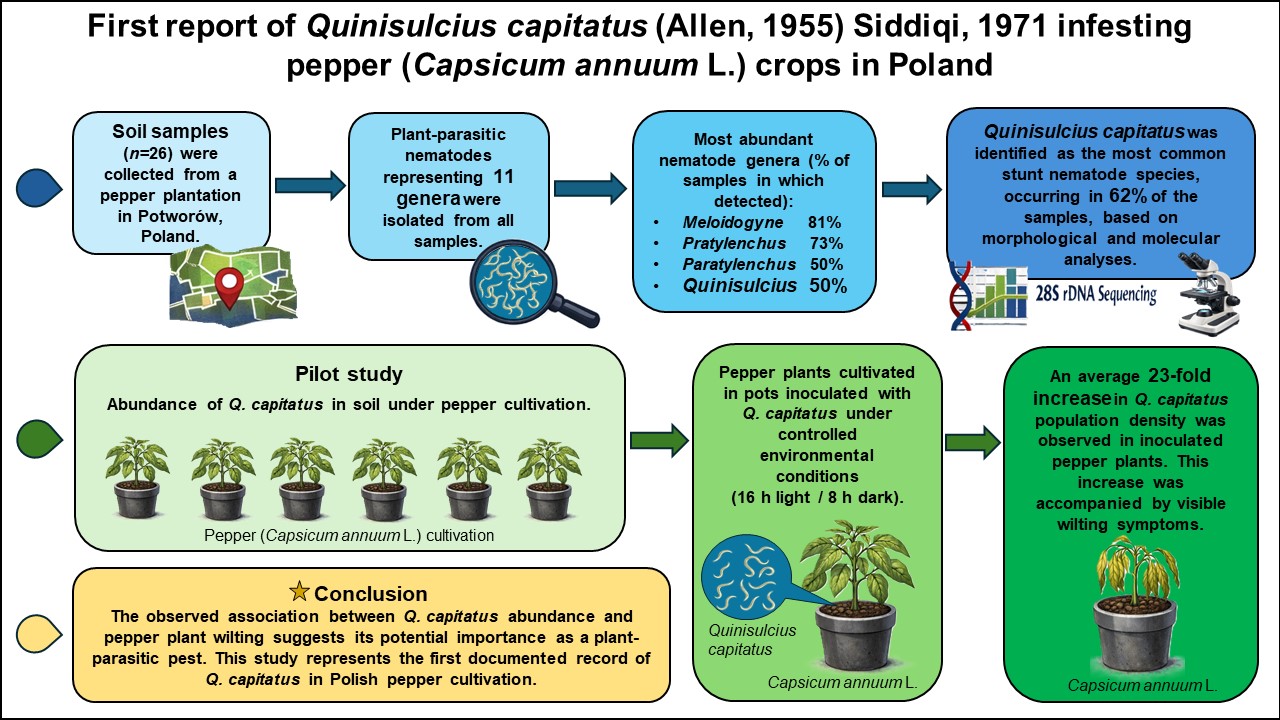
Among the plant-parasitic nematodes feeding on peppers (Capsicum annuum L.), the most frequently mentioned genera are root-knot nematodes (Meloidogyne), root-lesion nematodes (Pratylenchus), spiral nematodes (Helicotylenchus), and pearl nematodes (Naccobbus aberrans). These nematodes negatively impact pepper plant growth, manifesting as root damage and wilting of the above-ground parts. A study conducted in the intensive pepper cultivation area of Potworów, Poland identified the plant-parasitic nematode genera and species associated with wilting. Soil samples were collected from 26 sites, and 11 genera of plant-parasitic nematodes were found. The most prevalent were Meloidogyne (present in 81% of samples), Pratylenchus (73% of samples), along with Paratylenchus and Quinisulcius (both found in 50% of samples). An average of 55 Quinisulcius capitatus nematodes were found per 100 ml of soil, with the statistical significance of this value being 62.71 for the specific comparison being made in the study. This pilot study confirmed the species Q. capitatus through morphometric, morphological, and genetic analyses (sequencing of the 28S rDNA gene). Subsequently, the abundance of Q. capitatus in pepper crops was assessed under controlled conditions (16/8 hours day/night) by growing peppers in pots inoculated with the nematode. The study revealed an average 23-fold increase in nematode abundance. The observations of wilting symptoms in the pepper plants, concurrent with the rapid increase in Q. capitatus abundance, suggests this nematode is a potential pest for this crop. To our knowledge, this is the first report of Q. capitatus infesting peppers in Poland. These results provide a strong basis for further research into the specific impacts of Q. capitatus on pepper production in Poland.
References
Akhter S., Zarina B. 2014. Bitylenchus capsicumi sp.n. and one known species of the genus Aphelenchus from chilli plants in Sindh, Pakistan. International Journal of Biology Research 2 (2): 135–141.
Allen M.W. 1955. A review of the genus Tylenchorhynchus. University of California Publications in Zoology 61: 129–66.
Allonso-Villegas R., González-Amaro R.M., Figueroa-Hernández C.Y., Rodríguez-Buenfil I.M. 2023. The genus Capsicum: A review of bioactive properties of its polyphenolic and capsaicinoid composition. Molecules 28 (10): 4239. DOI: https://doi.org/ 10.3390/molecules28104239
Apalowo O.A., Baba H.S., Babatunde M.B., Nwoye O.H., Akinyemi D.A., Iheatru D.E. 2024. Distribution of plant parasitic nematodes on pepper in Ilorin, Kwara State, Nigeria. p. 86–89. In: Proceedings of the “Second Faculty of Agriculture International Conference”. 12–14 March 2024, Awka, Nigeria.
Bafokuzara N.D. 1996. Incidence of different nematodes on vegetable and fruit crops and preliminary assessment of yield loss due to Meloidogyne species in Uganda. Nematologia Brasileira 20 (1): 32–43.
Baimey H., Coyne D., Dagnenonbakin G., James B. 2009. Plant-parasitic nematodes associated with vegetable crops in Benin: relationship with soil physico-chemical properties. Nematologia Mediterranea 37 (2): 227–236.
Bernardo V.F., Garita S.A., Arango M.C., Ripodas J.I., Nazareno Saparrat M.C., Ruscitti M.F. 2020. Arbuscular mycorrhizal fungi against the false root-knot nematode activity in Capsicum annuum: physiological responses in plants. Biocontrol Science and Technology 31: 119–131. DOI: https://doi.org/10.1080/09583157.2020.1833304
Bridgemohan P., Mohammed M., Bridgemohan R.S.H. 2018. Fruit and vegetable phytochemicals. p. 957–968. In: ”Chemistry and Human Health” (E.M. Yahia, ed.), John Wiley & Sons, New York, 1488 pp.
Brzeski M.W. 1986. The occurrence of plant parasitic nematodes in field vegetable cultivation in Poland (in Polish). Zeszyty Problemowe Postępów Nauk Rolniczych 323: 33–49.
Brzeski M.W. 1998. Nematodes of Tylenchina in Poland and temperate Europe. Museum and Institute of Zoology Polish Academy of Sciences, Warsaw, Poland, 396 pp.
Carrillo-Fasio J.A., Angúlo-Castro A., Martinez-Gallardo J.A., Ayala-Tafoya F., Yáñez-Juárez M.G., Retes-Manjarrez J.E. 2021. Distribution and incidence of root-knot nematodes (Meloidogyne spp.) on pepper in Sinaloa, Mexico. Tropical Plant Pathology 46: 195–200. DOI: https://doi.org/10.1007/s40858-020-00400-6
Courtney W.D., Polley D., Miller V.L. 1955. TAF, an improved fixative in nematode technique. Plant Disease Reporter 39: 570–571.
Da Veiga V.F., Moreira Wiedemann L.S., Pereira de Araujo C., da Silva Antonio A. 2022. Origin and Evolution of Capsicum. p. 1–14. In: ”Chemistry and Nutritional Effects of Capsicum. Food Chemistry, Function and Analysis” (V.F. da Veiga ed.). Royal Society of Chemistry, London, 172 pp. [Avaliable from: https://doi.org/10.1039/9781839160646-00001] [Accessed 10 February 2025].
Di Vito M., Cianciotta V., Zaccheo G. 1992. Yield of susceptible and resistant pepper in microplots infested with Meloidogyne incognita. Nematropica 22: 1–6.
Ekine E.G., Ezenwaka C.O. 2024. Phyto-parasitic nematodes of bell pepper plant and farm soil in Abua, Rivers State, Nigeria. Science World Journal 19: 275–278. DOI: https://doi.org/ 10.4314/swj.v19i1.38
FAO. 2025. https://www.fao.org/faostat/en/#data/QCL [Accessed 10 February 2025].
Feyisa B., Yimer F., Kebede G. 2023. Survey and identification of plant parasitic nematodes associated with pepper in Ethiopia. Journal of Biology, Agriculture and Healthcare 13 (6): 12–18.
Garba A., Rizvi H. 2021. Soil and root nematode pests of bell pepper (Capsicum anuum). International Journal of Progressive Research in Engineering Management and Science 1: 16–21.
Gomez-Rodríguez O., Corona-Torres T., Aguilar-Rincon V. H. 2017. Differential response of pepper (Capsicum annuum L.) lines to Phytophthora capsici and root-knot nematodes. Crop Protection 92: 148e152. DOI: https://doi.org/10.1016/j.cropro.2016.10.023
Greco N., Di Vito M., Saxena M.C. 1992. Plant parasitic nematodes of cool season food legumes in Syria. Nematologia Mediterranea 20 (1): 37–46.
Gu J., Munawar M., Castillo P., Cai B. 2021. Morphological and molecular characterization of Quinisulcius curvus from China. Journal of Nematology 53: 1–11. DOI: https://doi.org/10.21307/jofnem-2021-086
Hall T.A. 1999. BioEdit: a user-friendly biological sequence alignment editor and analysis program for Windows 95/98/NT. Nucleic Acids Symposium Series 41: 95–98.
Hancock J.F. 2023. Fifty years later – the legacy of Alfred Crosby’s “The Columbian Exchange: Biological and Cultural Consequences of 1492”. Economic Botany 77: 82–102. DOI: https://doi.org/10.1007/s12231-022-09563-6
Holterman M., van der Wurff A., van den Elsen S., van Megen H., Bongers T., Holovachov O., Bakker J. Helder J. 2006. Phylum-wide analysis of SSU rDNA reveals deep phylogenetic relationships among nematodes and accelerated evolution toward crown clades. Molecular Biology and Evolution 23: 1792–800. DOI: https://doi.org/10.1093/molbe v/msl044
Hooper D.J., Evans K. 1993. Extraction, identification and control of plant parasitic nematodes. p: 1–59. In:” Plant par¬asitic nematodes in temperate agriculture” (K. Evans, D.L. Trudgill, J.M. Webster eds.). CABI, Wallingford, 648 pp.
Hopper B.E. 1959. Three new species of the genus Tylenchorhynchus (Nematoda: Tylenchida). Nematology 4: 23–30.
Hussain S., Iqbal E., Fayyaz S. 2019. Compendium of the genus Quinisulcius (Tylenchida: Telotylenchidae) and observations on occurrence of Q. capitatus. Pakistan Journal of Zoology 51: 1599–1606. DOI: https://doi.org/10.17582/journal.pjz/2019.51.5.1599.1606
Iqbal E., Shokoohi E., Hussain S., Mashela P.W., Kazi N. 2021. Morphological and molecular characterization of plant-parasitic nematode Quinisulcius capitatus (Allen, 1955) Siddiqi, 1971 from Gilgit Province, Pakistan. European Journal of Plant Pathology 159: 569–582. DOI: https://doi.org/10.1007/s10658-020-02188-2
Kasapoğlu Uludamar, E.B.R., Yildiz S., İmren M., Ocal A. Elekcioğlu H. 2018. Occurrence of plant parasitic nematode species in important crops in the Southeast Anatolia Region of Turkey. Türkiye Entomoloji Dergisi 42: 63–74. DOI: https://doi.org/10.16970/entoted.359616
Kefelegn H., Meressa B.H., Yon S., Couvreur M., Wesemael W.M.L., Teklu M.G., Bert W. 2023. First reports and morphological and molecular characterization of Pratylenchus delattrei and Quinisulcius capitatus associated with chickpea in Ethiopia. Journal of Nematology 55: 1–13. DOI: https://doi.org/10.2478/jofnem-2023-0027
Kefelegn H., Meressa B.H., Wesemael W.M.L., Teklu M.G. Sunheng Y., Couvreur M., Aseffa A.W., Bert W. 2024. Diversity of plant-parasitic nematodes associated with chickpea (Cicer arietinum L.) in the main growing areas of Ethiopia. Nematology 26: 491–518. DOI: https://doi.org/10.1163/15685411-bja10318
Knobloch N.A., Laughlin C.W. 1973. A collection of plant parasitic nematodes (Nematoda) from Mexico with description of three new species. Nematologica 19: 205–17.
Kvvs Kranti K., Patil J.A., Yadav S., Supriya P. 2023. Community analysis of plant parasitic nematodes infesting vegetable crops under polyhouse conditions. The Pharma Innovation Journal 12: 1622–1626.
Lax P., Passone M.A., Becerra A.G., Sosa A.L., Ciancio A, Finetti-Sialer M.M., Rosso L.C. 2022. Sustainable strategies for management of the “false root-knot nematode” Nacobbus spp. Frontiers in Plant Science 13: 1046315. DOI: https://doi.org/10.3389/fpls.2022.1046315
Loof P.A. 1959. Miscellaneous notes on the genus Tylenchorhynchus (Tylenchinae: Namatoda). Nematology 4 (4): 294–306.
Long H., Sun Y., Chen Y., Pei Y., Feng T., Che H. 2023. Occurrence of root-knot Nematode (Meloidogyne spp.) on peppers in Hainan, China, and M. enterolobii and M. incognita resistance of common cultivars. Plant Disease 107: 3148–3154. DOI: https://doi.org/10.1094/PDIS-02-23-0281-RE
Lugo Z., Crozzoli R., Greco N., Perichi G., Fernández A. 2010. Nematodos fitoparásitos asociados a hortalizas en el estado Falcón, Venezuela. Fitopatologia Venezolana 23: 16–21.
Mbatyoti A., Daneel M.S., Swart A., Marais M., De Waele D., Fourie H. 2020. Plant-parasitic nematode assemblages associated with glyphosate tolerant and conventional soybean cultivars in South Africa. African Zoology 55: 93–107. DOI: https://doi.org/10.1080/15627020.2019.1679040
Maqbool M.A. 1982. Description of Quinisulcius solani n. sp., (Nematoda: Tylenchorhynchidae) with a key to the species and data on Scutylenchus koreanus from Pakistan. Journal of Nematology 14 (2): 221–225.
Mekete T., Sikora R.A., Kiewnick S., Hallmann J. 2008. Description of plant parasitic nematodes associated with coffee in Ethiopia. Nematologia Mediterranea 36: 69–77.
Moosavi M.R. 2015. Damage of the root-knot Nematode Meloidogyne javanica to bell pepper, Capsicum annuum. Journal of Plant Diseases and Protection 122: 244–249.
Munawar M., Yevtushenko D.P., Castillo P. 2021. Integrative taxonomy, distribution, and host associations of Geocenamus brevidens and Quinisulcius capitatus from southern Alberta, Canada. Journal of Nematology 53: e2021-15. DOI: https://doi.org/10.21307/jofnem-2021-015
Nunn G.B. 1992. Nematode molecular evolution. An investigation of evolutionary patterns among nematodes based upon DNA sequences. Ph.D. thesis. University of Nottingham, UK, 187 pp.
Peraza-Padilla W., Artavia-Carmona R., Aráuz-Badilla J., Hilje-Rodríguez I. 2024. First report of Quinisulcius capitatus (Allen, 1955) Siddiqi, 1971 (Telotylenchidae) in Costa Rica: morphological and molecular characterization. Pesquisa Agropecuária Tropical 54: e80198. DOI: https://doi.org/10.1590/1983-40632024v5480198
Pinheiro J.B., Silva G.O., Macêdo A.G., Biscaia D., Ragassi C.F., Ribeiro C.S.C., Carvalho S.I.C., Reifschneider F.J.B. 2020. New resistance sources to root-knot nematode in Capsicum pepper. Horticultura Brasileira 38: 33–40. DOI: https://doi.org/10.1590/S0102-053620200105
Qing X. Gamliel A., Bucki P., Duvrinin S., Braun Miara S. 2020. Occurrence of the stunt nematode Neodolichorhynchus sulcatus as pathogen of Pepper (Capsicum annuum) in Israel. Disease Notes 104: 595–595. DOI: https://doi.org/10.1094/PDIS-07-19-1427-PDN
Qing X., Bert W., Gamliel A., Bucki P., Duvrinin S., Alon T., Miyara S.B. 2019. Phylogeography and molecular species delimitation of Pratylenchus capsici n. sp., a new root-lesion nematode in Israel on pepper (Capsicum annuum). Phytopathology 109: 847–858. DOI: https://doi.org/10.1094/PHYTO-09-18-0324-R
Roberts P., Sanogo S., Ochoa Corona F. 2024. Compendium of pepper diseases, disorders, and pests. Second Edition. Eagan, APS Press. [Avaliable from: https://doi.org/10.1094/9780890547168] [Accessed 10 February 2025].
Sandrine Y.A., Gnenakan Y., Jacob N., Eric-Olivier T., Martial K.K.F.J., Gilchrist K.E.Y., Urbain K.K.U, Junior K.D., Théodore K.K., Kouabenan A. 2024. Plant parasitic nematodes associated with vegetable crops in the main agroecological zones of Côte d’Ivoire. Asian Journal of Agriculture and Biology 2: 2023128. DOI: https://doi.org/10.35495/ajab.2023.128
Seinhorst J.W. 1959. A rapid method for the transfer of nematodes from fixative to anhydrous glycerine. Nematologica 4: 67–69. DOI: https://doi.org/10.1163/18752 9259X 00381
Siddiqi M.R. 1971. Structure of the oesophagus in the classification of the superfamily Tylenchoidea (Nematoda). Indian Journal of Nematology 1: 25–43.
Silvar C., Rocha F., Barata A.M. 2022. Tracing back the history of pepper (Capsicum annuum) in the Iberian Peninsula from a phenomics point of view. Plants 11: 3075. DOI: https://doi.org/10.3390/plants11223075
Silva-Soares R., Costa Silva E.H., Vidal R.L., dos Santos Candido W., Andrade Franco C., Becker Reifschneider F.H., Trevisan Braz L. 2018. Response of Capsicum annuum L. var. annuum genotypes to root-knot nematode infection. Chilean Journal of Agricultural Research 78: 78–85. DOI: https://doi.org/10.4067/S0718-58392018000100078
Singh S.K., Hodda M., Ash G.J. 2013. Plant-parasitic nematodes of potential phytosanitary importance, their main hosts and reported yield losses. Bulletin OEPP/ EPPO 43 (2): 334–374.
Todorova V., Nankar A.N., Yankova V., Tringovska I., Markova D. 2024. Assessment of Balkan pepper (Capsicum annuum L.) accessions for agronomic, fruit quality, and pest resistance traits. Horticulturae 10.389. DOI: https://doi.org/10.3390/horticulturae10040389
Tola D.D., Meressa B.H., Muleta D., Assefa F. 2022. Biodiversity of parasitic nematodes associated with hot pepper (Capsicum spp.) in Jimma area, Ethiopia. Russian Journal of Nematology 30: 161–173. DOI: https://doi.org/10.24412/0869-6918-2022-2-161-173
Van Bezooijen J. 2006. Methods and techniques for nematology. Wageningen University, Wageningen, 118 pp.
Vovlas N. 1983. Observations on the morphology and histopathology of Quinisulcius acti on corn. Revue de Nematology 6 (1): 79–83.
Yoder M., De Ley I.T., King I., Mundo- Ocampo M., Mann J., Blaxter M., Poiras L., De Ley P. 2006. DESS: a versatile solution for preserving morphology and extractable DNA of nematodes. Nematology 8: 367–376.
Downloads
Published
How to Cite
Issue
Section
License
Copyright (c) 2025 Journal of Plant Protection Research

This work is licensed under a Creative Commons Attribution 4.0 International License.





