
Epidemiological patterns of black pod (Phytophthora spp.) and frosty pod rot (Moniliophthora roreri) in cocoa plantations of Tequendama, Colombia
DOI:
https://doi.org/10.24425/jppr.2026.8031Abstract
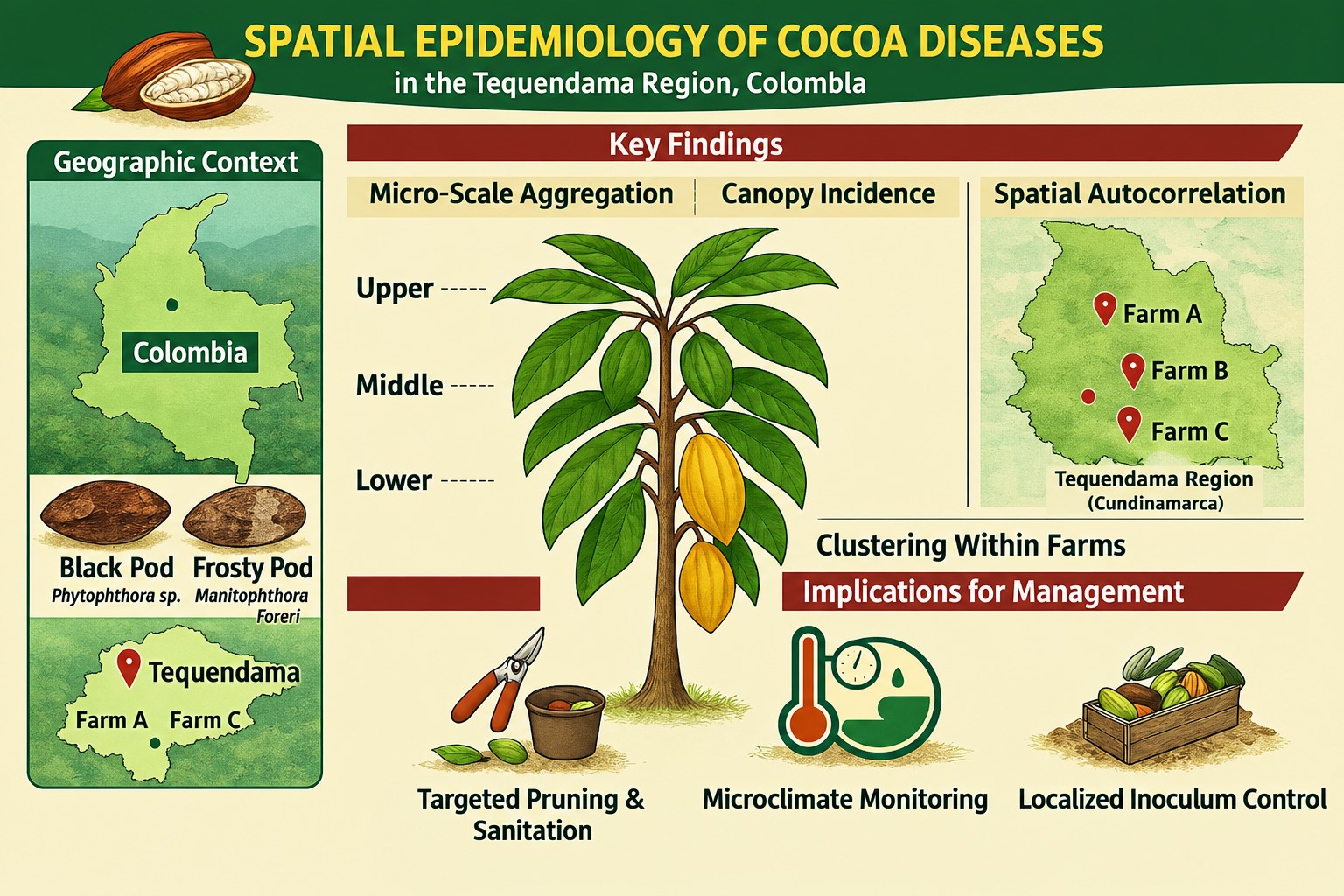
Cocoa is an important crop in Colombia and a key productive alternative in post-conflict rural areas. Similar to other tropical production systems, yields are constrained by diseases such as black pod disease and frosty pod rot. This study evaluated the temporal and spatial epidemiological patterns of both diseases on three cocoa farms located in the Tequendama region of Colombia through analyses of disease incidence, severity, disease progress, and spatial distribution. Pod assessments were conducted over a six-month period, recording disease incidence, severity, pod developmental stage, and canopy stratum. Temporal analyses evaluated the effects of temperature and relative humidity on disease incidence, whereas spatial analyses examined disease distribution among farms and canopy strata and assessed horizontal spatial autocorrelation using Moran’s I. The results revealed contrasting epidemiological patterns. Black pod incidence was not significantly associated with temperature or relative humidity and remained low throughout the study period. Incidence increased from the lower to the upper canopy layer, and most variability occurred among trees rather than among farms. In contrast, frosty pod rot showed significant negative associations with temperature and relative humidity and consistently there was a higher incidence in the upper canopy layer. Severity and AUDPC values were also greater for frosty pod rot than for black pod disease. Moran’s I analyses did not detect significant spatial autocorrelation at the farm scale. These findings demonstrated that black pod disease and frosty pod rot differed in their temporal dynamics and canopy distribution patterns despite affecting the same host organ. The results highlighted the importance of disease-specific epidemiological approaches and provided information relevant for improving disease monitoring and management in cocoa production systems.
References
Abad Z.G., Burgess T.I., Redford A.J., Bienapfl J.C., Srivastava S., Mathew R., Jennings K. 2023. IDphy: An international online resource for molecular and morphological identification of Phytophthora based on type specimens. Plant Disease 107(4): 987–998. DOI: https://doi.org/10.1094/PDIS-02-22-0448-FE
Adeniran A.O., Onanaye A.S., Adeleke O.J. 2024. Optimal control of cocoa black pod disease: a multi-pronged approach. Franklin Open 7: 100100. DOI: https://doi.org/10.1016/j.fraope.2024.100100
Almestar-Montenegro J., Leiva-Espinoza S., Borjas-Ventura R., Valderrama-Palacios D., León-Rojas F., Castro-Cepero V., Alvarado-Huamán L., Julca-Otiniano A. 2024. Efecto de la poda y la remoción de frutos sobre las enfermedades de la mazorca de cacao en Copallín, Amazonas, Perú. Idesia (Arica) 42 (4): 69–77. DOI: https://doi.org/10.4067/S0718-34292024000400069
Alsultan W., Yun W.M., Ahmad Z.A.M., Vadamalai G., Khairulmazmi A., Al-Sadi A.M., Rashed O., Nasehi A., Al-Tawaha A.R. 2022. Morphological, pathogenic, and molecular characterization of Phytophthora palmivora isolates causing black pod disease on cocoa in Peninsular Malaysia. International Journal of Food Science and Agriculture 6(2): 135–148. DOI: https://doi.org/10.26855/ijfsa.2022.06.002
Alves da Silva N.J., Menezes Reis S.P., Diorato V.S., Rocha J.S.A., Barbosa C.S., Ciampi-Guillardi M., Patrocínio N.G.R.B., Niella G.R., Solis K., Peñaherrera S., Manco M.J.S., Teixeira G.A., Arévalo-Gardini E., Gramacho K.P. 2022. A molecular diagnostic for Moniliophthora perniciosa, the causal agent of witches' broom disease of cacao, that differentiates it from its sister taxon Moniliophthora roreri. Crop Protection 158: 106003. https://doi.org/10.1016/j.cropro.2022.106003
Anzules-Toala V., Pazmiño-Bonilla E., Alvarado-Huamán L., Borjas-Ventura R., Castro-Cepero V., Julca-Otiniano A. 2021. Control of cacao (Theobroma cacao) diseases in Santo Domingo de los Tsachilas, Ecuador. Agronomía Mesoamericana 33(1): 45939. DOI: https://doi.org/10.15517/am.v33i1.45939
Bailey B.A., Evans H.C., Phillips-Mora W., Ali S.S., Meinhardt L.W. 2018. Moniliophthora roreri, causal agent of cacao frosty pod rot. Molecular Plant Pathology 19 (7): 1580–1594. DOI: https://doi.org/10.1111/mpp.12648
Bailey B.A., Meinhardt L.W. (eds.). 2016. Cacao Diseases: A History of Old Enemies and New Encounters. Springer, Cham, Switzerland, 633 pp. DOI: https://doi.org/10.1007/978-3-319-24789-2
Barro M., Kassankogno A.I., Wonni I., Séréme D., Somda I., Kabore H.K., Bena G., Brugidou C., Tharreau D., Tollenaar C. 2021. Spatiotemporal survey of multiple rice diseases in irrigated areas compared to rainfed lowlands in the Western Burkina Faso. Plant Disease 105: 3889–3899. https://doi.org/10.1094/PDIS-03-21-0579-RE
Bates D., Mächler M., Bolker B., Walker S. 2015. Fitting linear mixed-effects models using lme4. Journal of Statistical Software 67(1): 1–48. DOI: https://doi.org/10.18637/jss.v067.i01
Charry A., Perea C., Ramírez K., Zambrano G., Yovera F., Santos A., Pulleman M. 2025. The bittersweet economics of different cacao production systems in Colombia, Ecuador and Peru. Agricultural Systems 224: 104235. DOI: https://doi.org/10.1016/j.agsy.2024.104235
Chen Y. 2021. An analytical process of spatial autocorrelation functions based on Moran’s index. PLoS ONE 16 (4): e0249589. DOI: https://doi.org/10.1371/journal.pone.0249589
Chiang K.S., Bock C.H. 2022. Understanding the ramifications of quantitative ordinal scales on accuracy of estimates of disease severity and data analysis in plant pathology. Tropical Plant Pathology 47(1): 58–73. DOI: https://doi.org/10.1007/s40858-021-00446-0
Christensen R.H.B. 2018. Cumulative Link Models for Ordinal Regression with the R Package ordinal. Technical report, R package ordinal. Available at: https://cran.r-project.org/web/packages/ordinal/vignettes/clm_article.pdf
Correa A.J., Castro M.S., Coy J. 2014. Estado de la moniliasis del cacao causada por Moniliophthora roreri en Colombia. Acta Agronómica 63 (4): 388–399. DOI: https://doi.org/10.15446/acag.v63n4.42747
Delgado-Ospina J., Molina-Hernández J.B., Chaves-López C., Romanazzi G., Paparella A. 2021. The role of fungi in the cocoa production chain and the challenge of climate change. Journal of Fungi 7 (3): 202. DOI: https://doi.org/10.3390/jof7030202
Federación Nacional de Cacaoteros (FEDECACAO). 2025. Colombia reportó en 2024 producción histórica de cacao. [Online]. Available from: https://www.fedecacao.com.co/post/colombia-reportó-en-2024-producción-histórica-de-cacao [accessed 14 June 2026].
Fofana B., Patrick D.J., Miyasi B.W., Zouzou M., Daouda K. 2025. Influence of climatic parameters on the incidence of black pod rot of cocoa trees in Côte d’Ivoire. Journal of Experimental Agriculture International 47 (1): 161–170. DOI: https://doi.org/10.9734/JEAI/2025/v47i13214
Gobernación de Cundinamarca. 2025. Cundinamarca siembra futuro con cacao: más de 100000 nuevas plántulas y proyectos para 3500 familias rurales. [Online]. Available from: https://www.cundinamarca.gov.co/dependencias/secagrocampesinado/noticias/cundinamarca-siembra-futuro-con-cacao-mas-de-100000-nuevas-plantulas-y-proyectos-para-3500-familias-rurales [accessed 14 June 2026].
Gramacho K.P., Albuquerque P., Novais C.B., Lopes U.V., Sobrinho C.M. 2018. Moniliophthora roreri (Cif & Par.) (Agaricales: Marasmiaceae). pp. 257–269. In: "Priorização de pragas quarentenárias ausentes no Brasil" (E.G. Fidelis, T.R. Lohmann, M.L. da Silva, P. Parizzi, F.F.L. Barbosa, eds.). Embrapa, Brasília, DF, Brazil.
Hampf A.C., Nendel C., Strey S., Strey R. 2021. Biotic yield losses in the Southern Amazon, Brazil: making use of smartphone-assisted plant disease diagnosis data. Frontiers in Plant Science 12: 621168. DOI: https://doi.org/10.3389/fpls.2021.621168
Hernández-Núñez H.E., Suárez J.C., Andrade H.J., Bernal Núñez A.P., Gutiérrez D.R., Gutiérrez G.A., Gutiérrez-Montes I., Méndez V.E., Casanoves F. 2025. Agronomic performance of cocoa production type systems in Colombia. PLOS One 20 (12): e0337624. DOI: https://doi.org/10.1371/journal.pone.0337624
Hipólito-Romero E., Cocoletzi-Vásquez E., Ramos-Prado J.M., Espinoza C., Torres-de la Cruz M., Ricaño-Rodríguez J. 2020. Breve aproximación a la naturaleza genómica de Moniliophthora roreri CPMRT01 aislado de cacao en Tabasco, México. Biotecnia 22 (2): 39–49. DOI: https://doi.org/10.18633/biotecnia.v22i2.1244
Jaimes-Suárez Y.Y., Carvajal-Rivera A.S., Galvis-Neira D.A., Carvalho F.E., Rojas-Molina J. 2022. Cacao agroforestry systems beyond the stigmas: biotic and abiotic stress incidence impact. Frontiers in Plant Science 13: 921469. DOI: https://doi.org/10.3389/fpls.2022.921469
Jaimes Y.Y., Ribeyre F., Gonzalez C., Rojas J., Furtado E.L., Cilas C. 2019. Factors affecting the dynamics of frosty pod rot in the main cocoa areas of Santander state, Colombia. Plant Disease 103(7): 1665–1673. DOI: https://doi.org/10.1094/PDIS-10-18-1761-RE
Jaimes Y.Y., Gonzalez C., Rojas J., Cornejo O.E., Mideros M.F., Restrepo S., Cilas C., Furtado E.L. 2016. Geographic differentiation and population genetic structure of Moniliophthora roreri in the principal cocoa production areas in Colombia. Plant Disease 100(8): 1548–1558. DOI: https://doi.org/10.1094/PDIS-12-15-1498-RE
Jibat M., Alo S. 2023. Integrated management of black pod (Phytophthora palmivora) disease of cocoa through fungicides and cultural practices in Southwestern Ethiopia. International Journal on Food, Agriculture and Natural Resources 4 (3): 43–45. DOI: https://doi.org/10.46676/ij-fanres.v4i3.150
Jiménez D.L., Alvarez J.C., Mosquera S. 2022. Frosty pod rot: a major threat to cacao plantations on the move. Tropical Plant Pathology 47 (2): 187–200. DOI: https://doi.org/10.1007/s40858-021-00472-y
Kongor J.E., Owusu M., Oduro-Yeboah C. 2024. Cocoa production in the 2020s: challenges and solutions. CABI Agriculture and Bioscience 5: 102. DOI: https://doi.org/10.1186/s43170-024-00310-6
Lan Y.H., Shaw D.C., Lee E.H., Beedlow P.A. 2022. Distribution of a foliage disease fungus within canopies of mature Douglas-fir in Western Oregon. Frontiers in Forests and Global Change 5: 743039. DOI: https://doi.org/10.3389/ffgc.2022.743039
Leandro-Munoz M.E., Tixier P., Germon A., Rakotobe V., Phillips-Mora W., Maximova S., Avelino J. 2017. Effects of microclimatic variables on the symptoms and signs onset of Moniliophthora roreri, causal agent of Moniliophthora pod rot in cacao. PLoS ONE 12 (10): e0184638. DOI: https://doi.org/10.1371/journal.pone.0184638
Lenth R.V. 2021. emmeans: Estimated Marginal Means, aka Least-Squares Means. R package version 1.6.0. Available from: https://CRAN.R-project.org/package=emmeans
López-Torres M.E., Ramírez-Argueta O.A., Dubon Dubon A., Diaz Matute F.J. 2025. Selecting cacao clones with high productivity potential and tolerance to black pod rot (Phytophthora sp.) and frosty pod rot (Moniliophthora roreri). Journal of Plant Protection Research 65: 535–547. DOI: https://doi.org/10.24425/jppr.2025.156888
Lüdecke D., Ben-Shachar M.S., Patil I., Waggoner P., Makowski D. 2021. performance: An R package for assessment, comparison and testing of statistical models. Journal of Open Source Software 6 (60). DOI: https://doi.org/10.21105/joss.03139
Madden L.V., Hughes G., van den Bosch F. 2007. The Study of Plant Disease Epidemics. 2nd ed. APS Press, St. Paul, Minnesota, USA, 421 pp. DOI: https://doi.org/10.1094/9780890545058
Madden L.V., Ojiambo P.S. 2024. The value of generalized linear mixed models for data analysis in the plant sciences. Frontiers in Horticulture 3: 1423462. DOI: https://doi.org/10.3389/fhort.2024.1423462
Mejia-Cervantes L.E., Mendoza-Thompson J.U. 2026. Underestimation of the economic impact of moniliasis and witches' broom on Theobroma cacao L. Frontiers in Sustainable Food Systems 10: 1726828. DOI: https://doi.org/10.3389/fsufs.2026.1726828
Meraz-Pérez I.M., Carvalho M.R., Sena K.F., Soares Y.J.B., Estrela Junior A.S., Lopes U.V., dos Santos Filho L.P., Araújo S.A., Soares V.L.F., Pirovani C.P., Gramacho K.P. 2021. The Moniliophthora perniciosa–cacao pod pathosystem: Structural and activated defense strategies against disease establishment. Physiological and Molecular Plant Pathology 115: 101656. DOI: https://doi.org/10.1016/j.pmpp.2021.101656
Merga J. 2022. Epidemiology and management strategies of cocoa black pod (Phytophthora spp.). Plant Pathology & Quarantine 12 (1): 34–39. DOI: https://doi.org/10.5943/ppq/12/1/2
Mora F.D., Fiallos F.R. 2012. Moniliophthora roreri Evans et al. in the crop of cacao. Scientia Agropecuaria 3 (3): 249–258. DOI: https://doi.org/10.17268/sci.agropecu.2012.03.06
Moreno-Lopez J.P., Banda-Sánchez L.D.C., Gil-Clavijo A.I., Méndez-Pineda D.O., Márquez-Niño F.G. 2022. Aspectos de la investigación del cacao en municipios de la zona del Tequendama. Editorial Universidad de Cundinamarca. Fusagasugá, Colombia, 80 pp. DOI: https://doi.org/10.36436/9786287621190
Moura V.B., Pantoja L.P., Cavalcante Filho E.H., Haber R.A., Leandro-Silva V., Costa D.L.P., Júnior M.A., Franco T.M., Nery M.K.M., Rua M.L., de Souza P.J.O.P. 2025. Current bioclimatic suitability and climate change impacts on the risk of cacao moniliasis invasion in Pará. Ecological Modelling 505: 111106. DOI: https://doi.org/10.1016/j.ecolmodel.2025.111106
Murrieta E., Palma H. 2018. Manual de buenas prácticas de cosecha y postcosecha de cacao a nivel de productor. USAID–Alianza Cacao Perú, Lima, Perú, 43 pp. Available from: https://pdf.usaid.gov/pdf_docs/PA00XDCP.pdf [accessed 14 June 2026].
Ndoumbè-Nkeng M., Efombagn M.I.B., Nyassé S., Nyemb E., Sache I., Cilas C. 2009. Relationships between cocoa Phytophthora pod rot disease and climatic variables in Cameroon. Canadian Journal of Plant Pathology 31 (3): 309–320. DOI: https://doi.org/10.1080/07060660909507605
Ndoumbe-Nkeng M., Cilas C., Nyemb E., Nyassé S., Bieysse D., Flori A., Sache I. 2004. Impact of removing diseased pods on cocoa black pod caused by Phytophthora megakarya and on cocoa production in Cameroon. Crop Protection 23 (5): 415–424. DOI: https://doi.org/10.1016/j.cropro.2003.09.010
Nyarko B.N.E., Wu W.B., Zhou J.Z., Mohd M.M.J. 2024. Improved YOLOv5m model based on Swin Transformer, K-means++, and Efficient Intersection over Union (EIoU) loss function for cocoa tree (Theobroma cacao) disease detection. Journal of Plant Protection Research 64 (3): 265–274. DOI: https://doi.org/10.24425/jppr.2024.151253
Opoku I.Y., Akrofi A.Y., Appiah A.A. 2007. Assessment of sanitation and fungicide application directed at cocoa tree trunks for the control of Phytophthora black pod infections in pods growing in the canopy. European Journal of Plant Pathology 117 (2): 167–175. DOI: https://doi.org/10.1007/s10658-006-9082-8
Pavicic M., Mouhu K., Hautsalo J., Jacobson D., Jalli M., Himanen K. 2023. Image-based time series analysis to establish differential disease progression for two Fusarium head blight pathogens in oat spikelets with variable resistance. Frontiers in Plant Science 14: 1126717. DOI: https://doi.org/10.3389/fpls.2023.1126717
Pebesma E. 2018. Simple features for R: standardized support for spatial vector data. The R Journal 10 (1): 439–446. DOI: https://doi.org/10.32614/RJ-2018-009
Perrine-Walker F. 2020. Phytophthora palmivora–cocoa interaction. Journal of Fungi 6 (3): 167. DOI: https://doi.org/10.3390/jof6030167
Ramírez-Martínez J., Cárdenas M., Duitama J., Duarte D., Gutiérrez Rodríguez E., Restrepo S. 2026. High genetic diversity of Phytophthora palmivora in Colombian cacao: Evidence against geographic barriers. Phytopathology. Published online: 15 Apr 2026. DOI: https://doi.org/10.1094/PHYTO-10-25-0351-R
Ramírez Martínez J., Cárdenas Toquica M., Guevara-Suarez M., Duarte D., Victorino Jimenez L.D., Argüello Bernal B.K., Gutiérrez Rodríguez E., Restrepo Restrepo S. 2021. Oomycete species associated with Theobroma cacao crops in Colombia. Plant Pathology 70 (7): 1695–1707. DOI: https://doi.org/10.1111/ppa.13410
Rodriguez-Medina C., Arana A.C., Sounigo O., Argout X., Alvarado G.A., Yockteng R. 2019. Cacao breeding in Colombia, past, present and future. Breeding Science 69 (3): 373–382. DOI: https://doi.org/10.1270/jsbbs.19011
Rodríguez-Polanco E., Alferes E.B., Fuquene P.A., Amaya J.D., Polanco L.A. 2020a. Manejo de la pudrición parda de la mazorca (Phytophthora palmivora) en cacao por aplicación conjunta de prácticas culturales y químicas. Revista Facultad de Ciencias Básicas 16(1): 79–94. DOI: https://doi.org/10.18359/rfcb.4887
Rodríguez-Polanco E., Morales J.G., Muñoz-Agudelo M., Segura J.D., Carrero M.L. 2020b. Morphological, molecular and pathogenic characterization of Phytophthora palmivora isolates causing black pod rot of cacao in Colombia. Spanish Journal of Agricultural Research 18(2): e1003. DOI: https://doi.org/10.5424/sjar/2020182-15147
Rojas G. M., Benavides R.M., Mayorga G.D., Manjarres D. 2014. Línea base y componentes agroecológicos de un sistema productivo de cacao en el municipio de Medina, Cundinamarca. Inventum 9 (17): 16–22. DOI: https://doi.org/10.26620/uniminuto.inventum.9.17.2014.16-22
Romero-Vergel A.P., Camargo- Rodríguez A.V., Ramírez O.D., Arenas Velilla P.A., Gallego A.M. 2022. A crop modelling strategy to improve cacao quality and productivity. Plants 11 (2): 157. DOI: https://doi.org/10.3390/plants11020157
Tovar-León J.A., Silva-Cobos D.C., Mateus-Vargas L.N. 2023. Análisis de la cadena productiva de cacao en los contextos local y nacional de Colombia. Ciencias Agropecuarias 9 (1): 39–60. DOI: https://doi.org/10.36436/24223484.370
Vanegas J.I., Suárez J.C., Casanoves F., Phillips-Mora W. 2026. Performance of cacao clones resistant to frosty pod rot under agroforestry systems and full sun in the Colombian Amazon. Agroforestry Systems 100 (1): 13. DOI: https://doi.org/10.1007/s10457-025-01384-5
Villamizar-Gallardo R., Osma J.F., Ortíz-Rodríguez O.O. 2019. Regional evaluation of fungal pathogen incidence in Colombian cocoa crops. Agriculture 9 (3): 44. DOI: https://doi.org/10.3390/agriculture9030044
Wickham H. 2016. Data analysis. pp. 189–201. In: "ggplot2: Elegant Graphics for Data Analysis". Springer International Publishing, Cham, Switzerland. DOI: https://doi.org/10.1007/978-3-319-24277-4_9
Downloads
Published
How to Cite
Issue
Section
License
Copyright (c) 2025 Journal of Plant Protection Research

This work is licensed under a Creative Commons Attribution 4.0 International License.





