
Controlling root rot disease in colored peppers utilizing mixtures of bio-agents or antioxidants with regard to yield qualities
DOI:
https://doi.org/10.24425/jppr.2026.3253Abstract
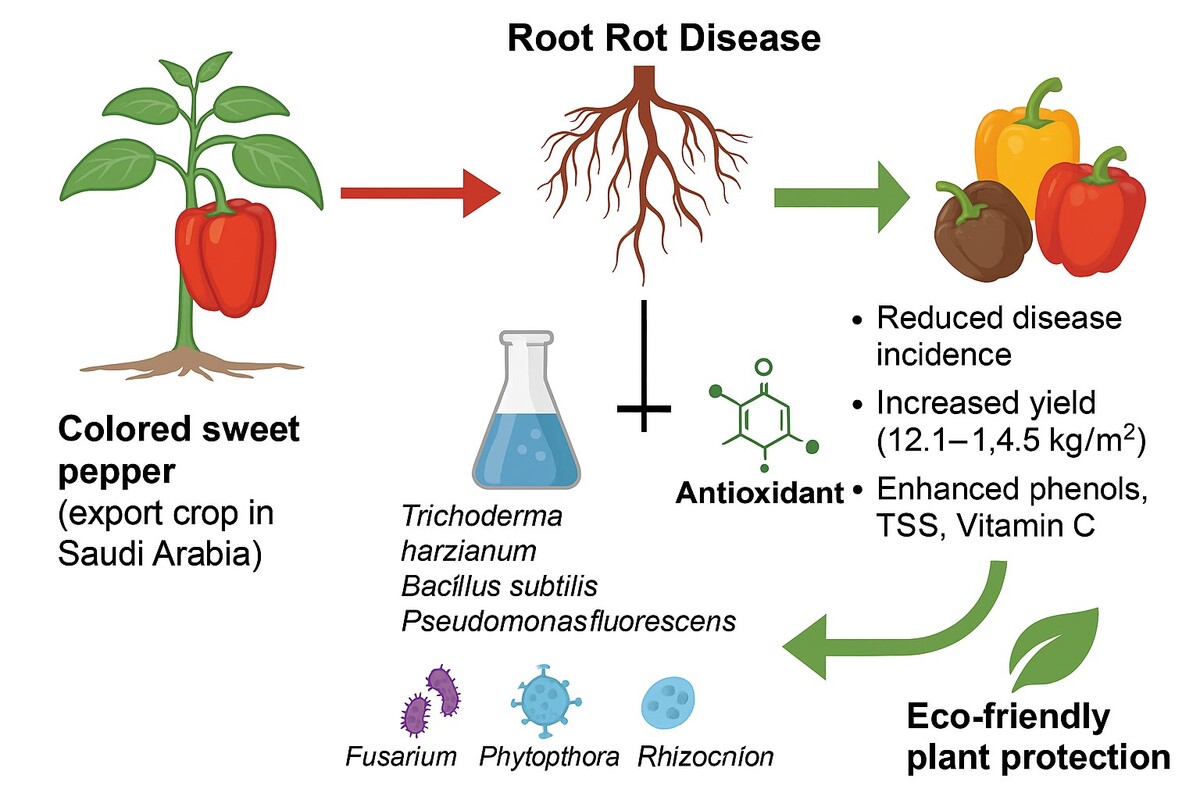
Root rot caused by soil-borne fungi severely limits the productivity of colored sweet pepper in Saudi Arabia, challenging the sustainability of intensive greenhouse systems. This study assessed whether mixtures of microbial antagonists, with or without an antioxidant formulation, provided superior suppression of root rot and improvement of fruit quality compared to single applications. Greenhouse and commercial greenhouse experiments evaluated single strains of Trichoderma harzianum, Bacillus subtilis, and Pseudomonas fluorescens, their pairwise mixtures, and their combinations with a potassium tartrate-based antioxidant over two consecutive growing seasons. All biocontrol combinations significantly reduced disease incidence relative to the untreated control and increased marketable yield. The T. harzianum + B. subtilis mixture provided the greatest disease suppression and highest fruit yield, followed by T. harzianum + P. fluorescens. When B. subtilis was combined with an antioxidant, it produced the strongest reductions in root rot incidence. Treatments most effectively suppressing disease also enhanced total phenolic content, total soluble solids (TSS), and vitamin C (V.C.) concentration in fruits, which correlated positively with improved disease resistance and yield. These findings demonstrated that integrating compatible biocontrol agents, particularly Bacillus subtilis, with antioxidants can offer a promising and environmentally sound strategy for managing pepper root rot while simultaneously improving fruit nutritional quality in greenhouse production systems in Saudi Arabia.
References
Abd El Moity T.H. 1981. Further studies on the biological control of white rot disease of onion. PhD thesis. Faculty of Agriculture, Menoufia University, Egypt.
Abd El Moity T.H. 1985. Effect of single and mixture of Trichoderma harzianum isolates on controlling three different soil-borne pathogens. Egyptian Journal of Microbiology 20(1): 111–120.
Ahmed M. 2008. Management of Fusarium wilt of tomato by soil amendment with Trichoderma koningii and a white sterile fungus. Indian Journal of Research 5(1): 35–38.
Ahmed S.S., Abd El-Aziz G.H., Abou-Zeid M.A., Fahmy A.H. 2019. Environmental impact of using some eco-friendly natural fungicides to resistant rust diseases in wheat crop. CATRINA 18(1): 87–95. DOI: https://doi.org/10.21608/cat.2019.28611
Ainsworth E.A., Gillespie K.M. 2007. Estimation of total phenolic content and other oxidation substrates in plant tissues using Folin-Ciocalteu reagent. Nature Protocols 2(4): 875–877. DOI: https://doi.org/10.1038/nprot.2007.102
Akgül D.S., Mirik M. 2008. Biocontrol of Phytophthora capsici on pepper plants by Bacillus megaterium strains. Journal of Plant Pathology 90(1): 29–34.
Akter M.K., Hossain M.D., Nahar K., Meah M.B., Hossain M.A. 2007. Isolation and identification of Phytophthora capsici and its mating type determination. Journal of Agroforestry and Environment 1(2): 89–92.
Alegbejo M., Lawal A., Chindo P., Banwo O. 2006. Outbreak of basal stem rot and wilt disease of pepper in Northern Nigeria. Journal of Plant Protection Research 46(1): 7–13.
Ali A.M. 2013. Control of fungal diseases in strawberries under organic agriculture conditions. PhD thesis. Faculty of Agriculture, Cairo University, Egypt.
Ali A.M. 2021. The competitive potential of different Trichoderma spp. to control Rhizoctonia root rot disease of pepper (Capsicum annuum L.). Egyptian Journal of Phytopathology 49(1): 136–150.
Ali S., El-Sayed H., Hassan M. 2023. Antioxidant-mediated enhancement of plant defenses: Synergies with biocontrol agents in sustainable agriculture. Frontiers in Plant Science 14: 1189. DOI: https://doi.org/10.3389/fpls.2023.01189
Andersson D.I., Hughes D. 2023. The biological cost of antibiotic resistance and its implications for multi-target management strategies. Nature Reviews Microbiology 21(1): 36–48. DOI: https://doi.org/10.1038/s41579-022-00794-7
AOAC. 2000. Official methods of analysis. 17th ed. AOAC International.
Atia A.M., El-Khateeb E.A., Abd El-Maksoud R.M., Abou-Zeid M.A., Salah A., Abdel-Hamid A.M.E. 2021. Mining of leaf rust resistance genes content in Egyptian bread wheat collection. Plants 10(7): 1378. DOI: https://doi.org/10.3390/plants10071378
Babay-Ahari A., Toloui S., Ghosta Y., Sedghi M. 2009. Identification and pathogenicity of fungi species causing root rot on pepper in West Azarbaijan Province, Iran. In: Proceedings of the International Symposium “Root Research and Applications” (RootRAP). BOKU, Vienna, Austria.
Bansal R., Pachauri S., Gururajaiah D., Sherkhane P.D., Khan Z., Gupta S. 2021. Dual role of a dedicated GAPDH in the biosynthesis of volatile and non-volatile metabolites: Novel insights into the regulation of secondary metabolism in Trichoderma virens. Microbiological Research 253: 126862. DOI: https://doi.org/10.1016/j.micres.2021.126862
Booth C. 1971. The genus Fusarium. Commonwealth Mycological Institute, Kew, Surrey, England, 235 pp.
Brain P.W., Hemming H.G. 1945. Gliotoxin: A fungistatic metabolic product of Trichoderma viride. Annals of Applied Biology 32(3): 214–220. DOI: https://doi.org/10.1111/j.1744-7348.1945.tb07356.x
Carrión V.J., Perez-Jaramillo J., Cordovez V., Tracanna V., de Hollander M., Ruiz-Buck D., Mendes L.W., van Ijcken W.F.J., Gomez-Exposito R., Elsayed S.S., Mohanraju P., Arifah A., van der Oost J., Paulson J.N., Mendes R., Medema M.H., Raaijmakers J.M. 2019. Pathogen-induced activation of disease-suppressive functions in the endophytic root microbiome. Science 366(6465): 606–612. DOI: https://doi.org/10.1126/science.aaw9285
Chilosi G., Aleandri M.P., Luccioli E., Stazi S.R., Marabottini R., Morales-Rodríguez C. 2020. Suppression of soil-borne plant pathogens in growing media amended with espresso spent coffee grounds as a carrier of Trichoderma spp. Scientia Horticulturae 259: 108666. DOI: https://doi.org/10.1016/j.scienta.2019.108666
Choudhary D.K., Johri B.N. 2009. Interaction of Bacillus spp. and plants with special reference to induced systemic resistance. Microbiological Research 164(5): 493–513. DOI: https://doi.org/10.1016/j.micres.2008.08.007
Constantinescu F., Voshol G., Bloemberg G. 2009. Mechanisms involved in biocontrol activity of Bacillus subtilis B49b against Fusarium oxysporum f. sp. radicis-lycopersici. IOBC/WPRS Bulletin 43: 113–116.
Dowson W.J. 1957. Plant diseases due to bacteria. 2nd ed. Cambridge University Press.
El-Feky N.H., Essa T.A., Elzaawely A.A., El-Zahaby H.M. 2019. Antagonistic activity of some bioagents against root rot diseases of pepper (Capsicum annuum L.). Environmental Biodiversity and Soil Security 3(1): 215–225. DOI: https://doi.org/10.21608/jenvbs.2019.12854.1032
El-Gamal N.G., Shehata A.N., Hamed E.R., Shehata H.S. 2016. Improvement of lytic enzyme production by Pseudomonas fluorescens and Bacillus subtilis isolates for enhancing their biocontrol potential against root rot disease in tomato plants. Research Journal of Pharmaceutical, Biological and Chemical Sciences 7(1): 1393–1400.
Fick S.E., Hijmans R.J. 2017. WorldClim 2: New 1-km spatial resolution climate surfaces for global land areas. International Journal of Climatology 37(12): 4302–4315. DOI: https://doi.org/10.1002/joc.5086
Food and Agriculture Organization of the United Nations. 2021. FAOCLIM: FAO Climate Database. [Online]. [Available from: https://www.fao.org] [Accessed 16 January 2026].
Gebily D.A.S., Ghanem G.A.M., Ragab M.M., Ali A.M., Soliman N.E.K., Abd El-Moity T.H. 2021. Characterization and potential antifungal activities of three Streptomyces spp. as biocontrol agents against Sclerotinia sclerotiorum infecting green beans. Egyptian Journal of Biological Pest Control 31(1): 1–15. DOI: https://doi.org/10.1186/s41938-021-00424-0
Hair J.F., Black W.C., Babin B.J., Anderson R.E. 2019. Multivariate data analysis. 8th ed. Cengage.
Huang X., Chen L., Ran W., Shen Q., Yang X. 2011. Trichoderma harzianum strain SQR-T37 and its bio-organic fertilizer could control Rhizoctonia solani damping-off disease in cucumber seedlings mainly by mycoparasitism. Applied Microbiology and Biotechnology 91(3): 741–755. DOI: https://doi.org/10.1007/s00253-011-3279-6
Jalal A.S., Ali A.M., Abou-Zeid M.A., Alrobaish S.A., Almanzalawi E.A., Alqahtani T.M., Abdelmoneim D., Thabet M. 2024. Enhancing quality characteristics and controlling gray mold disease caused by Botrytis cinerea in strawberry fruits using various edible abiotic coatings. Notulae Botanicae Horti Agrobotanici Cluj-Napoca 52(4): 13861. DOI: https://doi.org/10.15835/nbha52413861
Jash S., Sitansu P. 2007. Variability in antagonistic activity and root colonizing behavior of Trichoderma isolates. Journal of Tropical Agriculture 45(1–2): 29–35.
Karlidag H., Esitken A., Yildirim E., Donmez M.F., Turan M. 2012. Effects of plant growth-promoting bacteria on yield, growth, leaf water content, membrane permeability, and ionic composition of strawberry under saline conditions. Journal of Plant Nutrition 34(1): 34–45. DOI: https://doi.org/10.1080/01904167.2011.536880
Kashyap P.L., Xiang X., Heiden P. 2022. Role of phenolic compounds in plant defense and their integration with biological control strategies. Phytochemistry Reviews 21(4): 845–862. DOI: https://doi.org/10.1007/s11101-022-09797-6
King E.O., Ward M.K., Raney D.E. 1954. Two simple media for the demonstration of pyocyanin and fluorescein. Journal of Laboratory and Clinical Medicine 44(2): 301–307.
Köhl J., Kolnaar R., Ravensberg W.J. 2019. Mode of action of microbial biological control agents against plant diseases: relevance beyond efficacy. Frontiers in Plant Science 10: 845. DOI: https://doi.org/10.3389/fpls.2019.00845
Latha P.A., Ragupathi N.T., Samiyappan R.V. 2009. Antimicrobial activity of plant extracts and induction of systemic resistance in tomato plants by mixtures of PGPR strains and Zimmu leaf extract against Alternaria solani. Biological Control 50(2): 85–93. DOI: https://doi.org/10.1016/j.biocontrol.2009.03.002
Lenth R.V. 2020. Emmeans: Estimated marginal means, aka least-squares means. Journal of Statistical Software 89(1): 1–48. DOI: https://doi.org/10.18637/jss.v089.i01
Luecken M.D., Theis F.J. 2019. Current best practices in single-cell RNA-seq analysis: A tutorial. Molecular Systems Biology 15(6): e8746. DOI: https://doi.org/10.15252/msb.20188746
Mannai S., Jabnoun-Khiareddine H., Nasraoui B., Daami-Remadi M. 2018. Rhizoctonia root rot of pepper (Capsicum annuum): Comparative pathogenicity of causal agents and biocontrol attempts using fungal and bacterial agents. Journal of Plant Pathology and Microbiology 9(2): 1–9. DOI: https://doi.org/10.4172/2157-7471.1000435
Michelsen C.F., Stougaard P. 2011. A novel antifungal Pseudomonas fluorescens isolated from potato soils in Greenland. Current Microbiology 62(4): 1185–1192. DOI: https://doi.org/10.1007/s00284-010-9840-8
Ministry of Environment, Water and Agriculture. 2024. Annual agricultural statistical yearbook 2023. Government of Saudi Arabia.
Mitter B., Brader G., Afzal M., Compant S., Naveed M., Trognitz F., Sessitsch A. 2021. Next-generation biological control: Combining compatible microbial agents to overcome pathogen resistance. Annual Review of Phytopathology 59: 411–435. DOI: https://doi.org/10.1146/annurev-phyto-020620-095107
Mohdly B.R., Safhi F.A., Abou-Zeid M.A., Abdel-Fattah A.A., Almoshadak A.S., Almanzalawi E.A., Alqahtani T.M., AbdElMoneim D.A., Elessawy R.A.M. 2024. Understanding the influence of applying plant extracts and microorganism culture filtrates against barley leaf rust disease. Notulae Botanicae Horti Agrobotanici Cluj-Napoca 52(1): 13450. DOI: https://doi.org/10.15835/nbha52113450
Muhanna N.A.S., Essa T.A., El-Gamal M.A.H., Kamel S.M. 2016. Efficacy of free and formulated arbuscular mycorrhiza, Trichoderma viride and Pseudomonas fluorescens on controlling tomato root rot diseases. Egyptian Journal of Biological Pest Control 26(3): 477–486.
Mukesh S., Vipul K., Mohammad S., Sonika P., Anuradha S. 2016. Trichoderma: A potential and effective biofungicide and alternative source against notable phytopathogens: A review. African Journal of Agricultural Research 11(5): 310–316. DOI: https://doi.org/10.5897/AJAR2015.10512
Nakkeeran S., Krishnamoorthy A., Ramamoorthy V., Renukadevi P. 2002. Microbial inoculants in plant disease control. Journal of Ecobiology 14(2): 83–94.
Nawar L.S., Mostafa M.H. 1982. Studies on damping-off and root rot diseases of bean and their control by seed dressing fungicides. Egyptian Journal of Phytopathology 14(1–2): 115–126.
Niu B., Wang W., Yuan Z., Sederoff R.R., Sederoff H., Chiang V.L., Borriss R. 2020. Microbial interactions within multiple-strain biological control agents impact soil-borne plant disease. Frontiers in Microbiology 11: 585404. DOI: https://doi.org/10.3389/fmicb.2020.585404
Omar H.S., Al Mutery A., Osman N.H., Reyad N.E., Abou-Zeid M.A. 2021. Molecular marker analysis of stem and leaf rust resistance in Egyptian wheat genotypes and interpretation of the antifungal activity of chitosan-copper nanoparticles by molecular docking analysis. PLOS ONE 16(11): e0257959. DOI: https://doi.org/10.1371/journal.pone.0257959
Pandya U., Saraf M. 2010. Application of fungi as a biocontrol agent and their biofertilizer potential in agriculture. Journal of Advanced Development Research 1(1): 90–99.
Poveda J., Eugui D. 2022. Combined use of Trichoderma and beneficial bacteria (mainly Bacillus and Pseudomonas): Development of microbial synergistic bio-inoculants in sustainable agriculture. Biological Control 176: 105100. DOI: https://doi.org/10.1016/j.biocontrol.2022.105100
Rahman M.M., Huque K.S. 2002. Study on voluntary intake and digestibility of banana foliage as a cattle feed. Journal of Biological Sciences 2(1): 49–52. DOI: https://doi.org/10.3923/jbs.2002.49.52
Rajamanickam V., Ramsubhag A., Jayaraman J. 2025. Sweet pepper foliar diseases quantification and identification using an image analysis tool. Journal of Plant Protection Research 65(1): 89–99. DOI: https://doi.org/10.24425/jppr.2025.153821
Rini C.R., Sulochana K.K. 2007. Management of seedling rot of chilli (Capsicum annuum L.) using Trichoderma spp. and fluorescent pseudomonads (Pseudomonas fluorescens). Journal of Tropical Agriculture 44: 79–82.
SAS Institute. 1996. SAS/STAT user’s guide. Version 6.12. 12th ed. SAS Institute Inc., Cary, NC, USA.
Sid Ahmed A., Ezziyyani M., Perez Sanchez C., Candela M.E. 2003. Effect of chitin on biological control activity of Bacillus spp. and Trichoderma harzianum against root rot disease in pepper (Capsicum annuum) plants. European Journal of Plant Pathology 109(6): 633–637. DOI: https://doi.org/10.1023/A:1024220202632
Simamora A.V., Hahuly M.V., Kana Y.R., Benggu Y.I., Mudita I.W., Kasim M., Hosang E.Y., Londingkene J.A., Mahayasa I.N.W. 2024. Exploring the antagonist potential of indigenous Trichoderma spp., Bacillus, and Pseudomonas against Phytophthora palmivora of Soe mandarin in East Nusa Tenggara, Indonesia. IOP Conference Series: Earth and Environmental Science 1302(1): 012017. DOI: https://doi.org/10.1088/1755-1315/1302/1/012017
Singh N., Pandey P., Dubey R.C., Maheshwari D.K. 2008. Biological control of root rot fungus Macrophomina phaseolina and growth enhancement of Pinus roxburghii (Sarg.) by rhizosphere-competent Bacillus subtilis BN1. World Journal of Microbiology and Biotechnology 24(9): 1669–1679. DOI: https://doi.org/10.1007/s11274-008-9678-y
Sneh B., Burpee L., Ogoshi A. 1992. Identification of Rhizoctonia species. APS Press, USA, 133 pp.
Sreedevi B., Devi M.C., Saigopal D.V.R. 2011. Induction of defense enzymes in Trichoderma harzianum-treated groundnut plants against Macrophomina phaseolina. Journal of Biological Control 25(1): 33–39.
Trivedi P., Leach J.E., Tringe S.G., Sa T., Singh B.K. 2020. Plant–microbiome interactions: from community assembly to plant health. Nature Reviews Microbiology 18(11): 607–621. DOI: https://doi.org/10.1038/s41579-020-0412-1
Wasserstein R.L., Schirm A.L., Lazar N.A. 2019. Moving to a world beyond “p < 0.05”. The American Statistician 73(sup1): 1–19. DOI: https://doi.org/10.1080/00031305.2019.1583913
Yobo K.S., Laing M.D., Hunter C.H. 2011. Effects of single and combined inoculations of selected Trichoderma and Bacillus isolates on growth of dry bean and biological control of Rhizoctonia solani damping-off. African Journal of Biotechnology 10(44): 8746–8756. DOI: https://doi.org/10.5897/AJB10.2582
Yousef S.A.M., El-Metwally M.M., El-Ghareeb N.R. 2017. Impact of antioxidants and micronutrients as fungicides alternatives in improvement of antagonism of Trichoderma spp. against Sclerotinia sclerotiorum. Journal of Plant Pathology 99(1): 69–75.
Yuliar Y., Tomita S., Hishinuma H., Yokota K. 2025. Involvement of iturin and surfactin in inhibition of a post-harvest fungal pathogen on green bell pepper. Journal of Plant Protection Research 65(3): 400–410. DOI: https://doi.org/10.24425/jppr.2025.155786
Downloads
Published
How to Cite
Issue
Section
License
Copyright (c) 2026 Journal of Plant Protection Research

This work is licensed under a Creative Commons Attribution 4.0 International License.