
Seed treatment strategies combining Bacillus amyloliquefaciens and insecticides for management of the emerging soil pest Scutigerella immaculata in soybean
DOI:
https://doi.org/10.24425/jppr.2026.3358Abstract
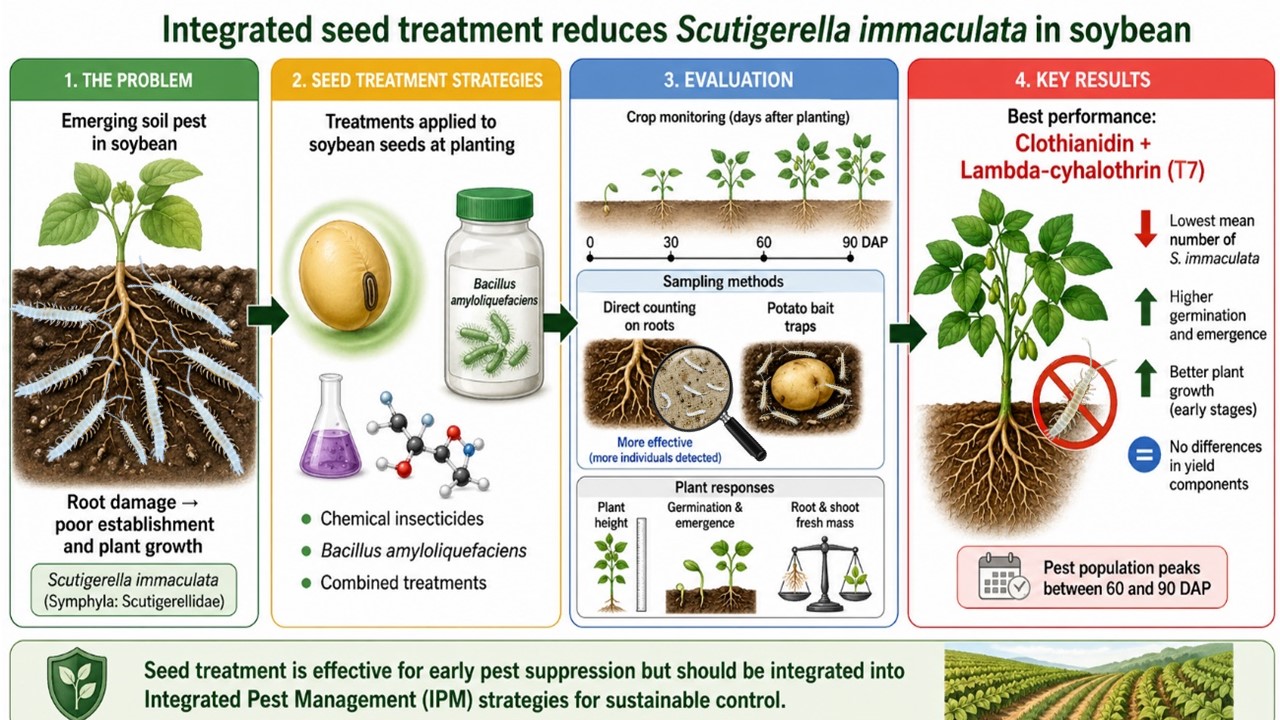
Scutigerella immaculata (Symphyla: Scutigerellidae) causes increasing problems in soybean-producing areas of Brazil, particularly in MATOPIBAPA, one of the country’s most recent agricultural frontiers. This study evaluated soybean seed treatments for the control of S. immaculata, using Bacillus amyloliquefaciens applied alone or combined with chemical insecticides, and assessed pest sampling methods and soybean responses to these treatments. Soybean seeds were treated on the day of planting in the municipality of Açailândia, Maranhão State, Brazil. The experiment was conducted under field conditions in a completely randomized design with nine treatments and four replicates. The treatments (T) were T1: untreated control, T2: fipronil, T3: bifenthrin + imidacloprid, T4: clothianidin, T5: B. amyloliquefaciens, T6: clothianidin + fipronil, T7: clothianidin + lambda-cyhalothrin, T8: clothianidin + fipronil + B. amyloliquefaciens, and T9: cyantraniliprole + lambda-cyhalothrin + thiamethoxam + abamectin. S. immaculata was sampled using potato baits placed in the soil and by direct counting on plant roots. Evaluated parameters included plant height, seedling emergence, seed germination, and fresh root and shoot mass, which showed significant differences among treatments. Direct counting on plant roots detected more individuals than bait sampling. Among the treatments, T7 resulted in the lowest mean number of S. immaculata individuals. Pest population peaks occurred between 60 and 90 days after planting. Further studies are needed to clarify the effectiveness of the evaluated biological product and to determine the contribution of soybean seed treatment to the control and integrated management of this emerging pest.
References
Araújo M.L.S., Rufino I.A.A., Silva F.B., Brito H.C., Santos J.R.N. 2024. The Relationship between Climate, Agriculture and Land Cover in Matopiba, Brazil (1985–2020). Sustainability 16 (7): 2670. Doi: https://doi.org/10.3390/su16072670
Backer R., Rokem J.S., Ilangumaran G., Lamont J., Praslickova D., Ricci E., Subramanian S., Smith D.L. 2018. Plant growth-promoting rhizobacteria: context, mechanisms of action, and roadmap to commercialization of biostimulants for sustainable agriculture.
Frontiers in Plant Science 9: 1473. https://doi.org/10.3389/fpls.2018.01473
Bateman C., Willette A., Kaur N., Dorman S.J., Buckland K., Anderson N.P. 2023. Symphylan Control in Grass Grown for Seed, 2022. Arthropod Management Tests 48 (1): e013. Doi: https://doi.org/10.1093/amt/tsad013
Benjamin J.G., Nielsen D.C. 2004. A method to separate plant roots from soil and analyze root surface area. Plant and Soil 267 (1): 225-234. Doi: https://doi.org/10.1007/s11104-005-4887-3
Bork C.R., Almeida A.S., Castellano C.S., Zimmer G., Avila T.D., Meneghello G.E., Dellaostin S.M., Rodrigues D.B., Mattos F., Rossetti C., Fonseca H.W., Tunes C., Suñé A.S., Barreto B., Tunes L.M., Suchch L.O.B. 2018. Soybean industrial seed treatment: effect on physiological quality during storage. Journal of Agricultural Science 10 (8): 468-476. Doi: https://doi.org/10.5539/jas.v10n8p468
Bortoletto W.V., Macedo W.R., Oliveira T.C., Souza D.S. 2017. Agrochemicals and storage times on soybean seed vigor. Pesquisa Agropecuária Brasileira 52 (2): 129-132. Doi: https://doi.org/10.1590/S0100-204X2017000200007
Bovi T.S., Zaluski R., Orsi R.O. 2018. Toxicity and motor changes in africanized honeybees (Apis mellifera L.) exposed to fipronil and imidacloprid. Anais da Academia Brasileira de Ciências 90 (1): 239-245. Doi: https://doi.org/10.1590/0001-3765201820150191
Brzezinski C.R., Henning A.A., Abati J., Henning F.A., França-Neto J.D.B., Krzyzanowski F.C., Zucareli C. 2015. Seeds treatment times in the establishment and yield performance of soybean crops. Journal of Seed Science 37 (2): 147-153. Doi: https://doi.org/10.1590/2317-1545v37n2148363
Caulier S., Nannan C., Gillis A., Licciardi F., Bragard C., Mahillon J. 2019. Overview of the antimicrobial compounds produced by members of the Bacillus subtilis group. Frontiers in Microbiology 10: 302. Doi: https://doi.org/10.3389/fmicb.2019.00302
Czembor E., Tratwal A., Pukacki J., Krystek M., Czembor, J.H. 2025. Managing fungal pathogens of field crops in sustainable agriculture and AgroVariety internet application as a case study. Journal of Plant Protection Research 65 (1): 1-26. Doi: https://doi.org/10.24425/jppr.2025.153820
Fabiano A.R., Schwan-Estrada K.R.F., Robinson L.C., Guilherme B.P.B., Rodrigo R., Rafael B.B., Valdenir C. 2018. Agronomic performance of soybean treated with Bacillus amyloliquefaciens. African Journal of Microbiology Research 12 (45): 1020-1027. Doi: https://doi.org/10.5897/AJMR2018.9006
Ferreira T.F., Oliveira J.A., Carvalho R.A.D., Resende L.S., Lopes C.G.M., Ferreira V.D.F. 2016. Quality of soybean seeds treated with fungicides and insecticides before and after storage. Journal of Seed Science 38 (4): 278-286. Doi: https://doi.org/10.1590/2317-1545v38n4161760
Gandini E.M.M., Costa E.S.P., Santos J.B., Soares M.A., Barroso G.M., Corrêa J.M., Carvalho A.G., Zanuncio J.C. 2020. Compatibility of pesticides and/or fertilizers in tank mixtures. Journal of Cleaner Production 268: 122152. Doi: https://doi.org/10.1016/j.jclepro.2020.122152
Gazziero D.L.P. 2015. Misturas de agrotóxicos em tanque nas propriedades agrícolas do Brasil. Planta Daninha 33 (1): 83-92. Doi: https://doi.org/10.1590/S0100-83582015000100010
Hawkins D.M. 2004. The problem of overfitting. Journal of chemical information and computer sciences 44 (1): 1-12. Doi: https://doi.org/10.1021/ci0342472
Jin Y.L., Godeiro N.N., Bu Y. 2023. Description of the first species of Scutigerella (Symphyla, Scutigerellidae) from China, with mitogenomic and genetic divergence analysis. ZooKeys 1157: 145-161. Doi: https://doi.org/10.3897/zookeys.1157.99686
Joseph S.V. 2015. Effects of direct and indirect exposure of insecticides to garden Symphylan (Symphyla: Scutigerellidae) in laboratory bioassays. Journal of economic entomology 108 (6): 2729-2736. Doi: https://doi.org/10.1093/jee/tov227
Joseph S.V., Martin T., Steinmann K., Kosina P. 2017. Outlook of pyrethroid insecticides for pest management in the Salinas Valley of California. Journal of Integrated Pest Management 8 (1): 1-11. Doi: https://doi.org/10.1093/jipm/pmx001
Lamichhane J.R., You M.P., Laudinot V., Barbetti M.J. Aubertot J. N. 2020. Revisiting sustainability of fungicide seed treatments for field crops. Plant Disease 104 (3): 610-623. Doi: https://doi.org/10.1094/PDIS-06-19-1157-FE
Laurance W.F., Lovejoy T.E., Vasconcelos H.L., Bruna E.M., Didham R.K., Stouffer P.C., Gascon C., Bierregaard R.O., Laurance S.G., Sampaio E. 2002. Ecosystem decay of Amazonian Forest Fragments: a 22‐year investigation. Conservation biology 16 (3): 605-618. Doi: https://doi.org/10.1046/j.1523-1739.2002.01025.x
Loureiro M.C., Galvão J.D. 1970. Nota sobre Hanseniella sp. (Symphyla) praga de arroz (Oryza sativa L.) em Viçosa, Minas Gerais. Revista Ceres 17 (91): 86-90. Doi: https://ojs.ceres.ufv.br/ceres/article/view/6556
Ma C.S., Wang B.X., Wang, X.J., Lin Q.C., Zhang W., Yang X.F., Baaren J.V., Bebber D.P., Eigenbrode S.D., Zalucki M.P, Zeng J., Ma G. 2025. Crop pest responses to global changes in climate and land management. Nature Reviews Earth & Environment 6: 264–283. Doi: https://doi.org/10.1038/s43017-025-00652-3
Marchesini V.A., Town J., Tenuta M., Pereira F.G, Shaw L., Sharpe S., Schoenau J., Hubbard M. 2025. Spiral nematodes, soil microbiome and micronutrients increase chickpea drought susceptibility but do not induce symptoms of the emerging health issue. Scientific Reports 15: 39823. Doi: https://doi.org/10.1038/s41598-025-23475
Marek P.E., Shear W.A. 2022. Myriapods. Current Biology 32 (23): 1294-1296. Doi: https://doi.org/10.1016/j.cub.2022.09.058
Martinelli L.A., Batistella M., Silva R.F.B.D., Moran E. 2017. Soy expansion and socioeconomic development in municipalities of Brazil. Land. 6 (3): 62. Doi: https://doi.org/10.3390/land6030062
Morais J.W., Silva E.P. 2010. Occurrence of Symphyla (Myriapoda) in the region of the Upper Solimões River, Amazonas, Brazil. Pesquisa Agropecuária Brasileira 44 (8): 981–983. Doi: https://doi.org/10.1590/S1678-3921.pab2009.v44.1461
Oliveira Aparecido L.E., Dutra A.F., Lorençone P.A., Alcântara Neto F., Lorençone J.A., Leite M.R.L. 2023. Climate change in MATOPIBA region of Brazil: a study on climate extremes in agriculture: Climate change in MATOPIBA region of Brazil: a study on climate extremes in agriculture. Theoretical and Applied Climatology 153 (1): 87-100. Doi: https://doi.org/10.1007/s00704-023-04509-x
Pereira R.C., Pelloso M.F., Correia L.V., Matera T.C., Dos Santos R.F., Braccini A.L., Bastiani G.G., Coppo C., Silva B.G. 2020. Physiological quality of soybean seeds treated with imidacloprid before and after storage. Plant, Soil and Environment 66: 513-518. Doi: https://doi.org/10.17221/364/2020-PSE
Rabbee M.F., Ali M.S., Choi J., Hwang B.S., Jeong S.C., Baek K.H. 2019. Bacillus velezensis: a valuable member of bioactive molecules within plant microbiomes. Molecules 24 (6):1046. Doi: https://doi.org/10.3390/molecules24061046
Rakes M., Grützmacher A.D., Pazini J.B., Pasini R.A., Schaedler C.E. 2017. Physicochemical compatibility of agrochemical mixtures in spray tanks for paddy field rice crops. Planta Daninha. 35: e017165185. Doi: https://doi.org/10.1590/S0100-83582017350100090
Reed G.F., Lynn F., Meade B.D. 2002. Use of coefficient of variation in assessing variability of quantitative assays. Clinical and Vaccine Immunology 9 (6): 1235-1239. Doi: https://doi.org/10.1128/CDLI.9.6.1235-1239.2002
Ribeiro Junior J.I., Melo A.L.P. 2009. Guia prático para utilização do SAEG. Folha Artes Graficas Ltd.a. Viçosa (UFV), Brazil. 287 p.
Ribeiro W.R.M., Pacheco L.P., Monteiro F.P., Petter F.A.E., Carvalho W.L., Oliveira Sousa T., Gualberto A.V.S., Alcântara Neto F. 2014. Fungicides phytotonic action on the development of soybean. African Journal of Agricultural Research 9 (44): 3283-3290. Doi: https://doi.org/10.5897/AJAR2014.8906
Santos R.S., Zhang Y., Cotrufo M.F., Hong M., Oliveira D.M.S., Damian J.M., Cerri C.E.P. 2023. Simulating soil C dynamics under intensive agricultural systems and climate change scenarios in the Matopiba region, Brazil. Journal of Environmental Management 347: 119149. Doi: https://doi.org/10.1016/j.jenvman.2023.119149
Sentelhas P.C., Battist R., Câmara G.M.D.S., Farias J.R.B., Hampf A.C., Nendel C. 2015. The soybean yield gap in Brazil – magnitude, causes and possible solutions for sustainable production. The journal of agricultural science 153 (8): 1394-1411. Doi: https://doi.org/10.1017/S0021859615000313
Siqueira M.S., Silva M.T., Brito J.I.B., Braga C.C., Souza A.C., Sousa W.G. 2024. Índices climáticos extremos de precipitação pluvial e temperatura do ar na região do MATOPIBA-Brasil. Revista Brasileira de Geografia Física 17 (1): 446–464. Doi: https://doi.org/10.26848/rbgf.v17.1.p446-464
Souza R., Teixeira I., Reis E., Silva A. 2016. Soybean morphophysiology and yield response to seeding systems and plant populations. Chilean journal of agricultural research 76 (1): 3-8. Doi: http://dx.doi.org/10.4067/S0718-58392016000100001
Swenson K.G. 1966. Infection of the garden symphylan, Scutigerella immaculata, with the DD-136 nematode. Journal of Invertebrate Pathology 8 (1): 133-134. Doi: http://dx.doi.org/10.1016/0022-2011(66)90118-2
Umble J.R., Fisher J.R. 2003. Influence of below-ground feeding by garden symphylans (Scutigerella immaculata Newport) on plant health. Environmental Entomology 32 (5): 1251–1261. Doi: https://doi.org/10.1603/0046-225X-32.5.1251
Vanolli B.S., Andrade N., Canisares L.P., Franco A.L.C., Pereira A.P.A., Cherubin M. R. 2024. Edaphic mesofauna responses to land use change for sugarcane cultivation: insights from contrasting soil textures. Frontiers in Ecology and Evolution 11. Doi: https://doi.org/10.3389/fevo.2023.1305115
Vasques, N.C., Nogueira M. A., Hungria M. 2024. Increasing Application of Multifunctional Bacillus for Biocontrol of Pests and Diseases and Plant Growth Promotion: Lessons from Brazil. Agronomy 14 (8):1654. Doi: https://doi.org/10.3390/agronomy14081654
Waterhouse, J.S. 1968. Studies on the garden symphylan, Scutigerella immaculata (Symphyla: Scutigerellidae). The Canadian Entomologist 100 (2): 172-178. Doi: https://doi.org/10.4039/Ent100172-2
Zalila-Kolsi, I., Ben-Mahmoud, A., & Al-Barazie, R. 2023. Bacillus amyloliquefaciens: Harnessing Its Potential for Industrial, Medical, and Agricultural Applications—A Comprehensive Review. Microorganisms 11 (9): 2215. Doi: https://doi.org/10.3390/microorganisms11092215
Zandona R.R., Pazdiora P.C., Pazini J.D.B., Seidel E.J., Ethur L.Z. 2019. Chemical and biological seed treatment and their effect on soybean development and yield. Revista Caatinga 32 (2): 559-565. Doi: https://doi.org/10.1590/1983-21252019v32n229rc
Downloads
Published
How to Cite
Issue
Section
License
Copyright (c) 2026 Journal of Plant Protection Research

This work is licensed under a Creative Commons Attribution 4.0 International License.