Metabolomics, a step towards understanding environmental stress tolerance of major African cereals
DOI:
https://doi.org/10.24425/jppr.2026.1580Abstract
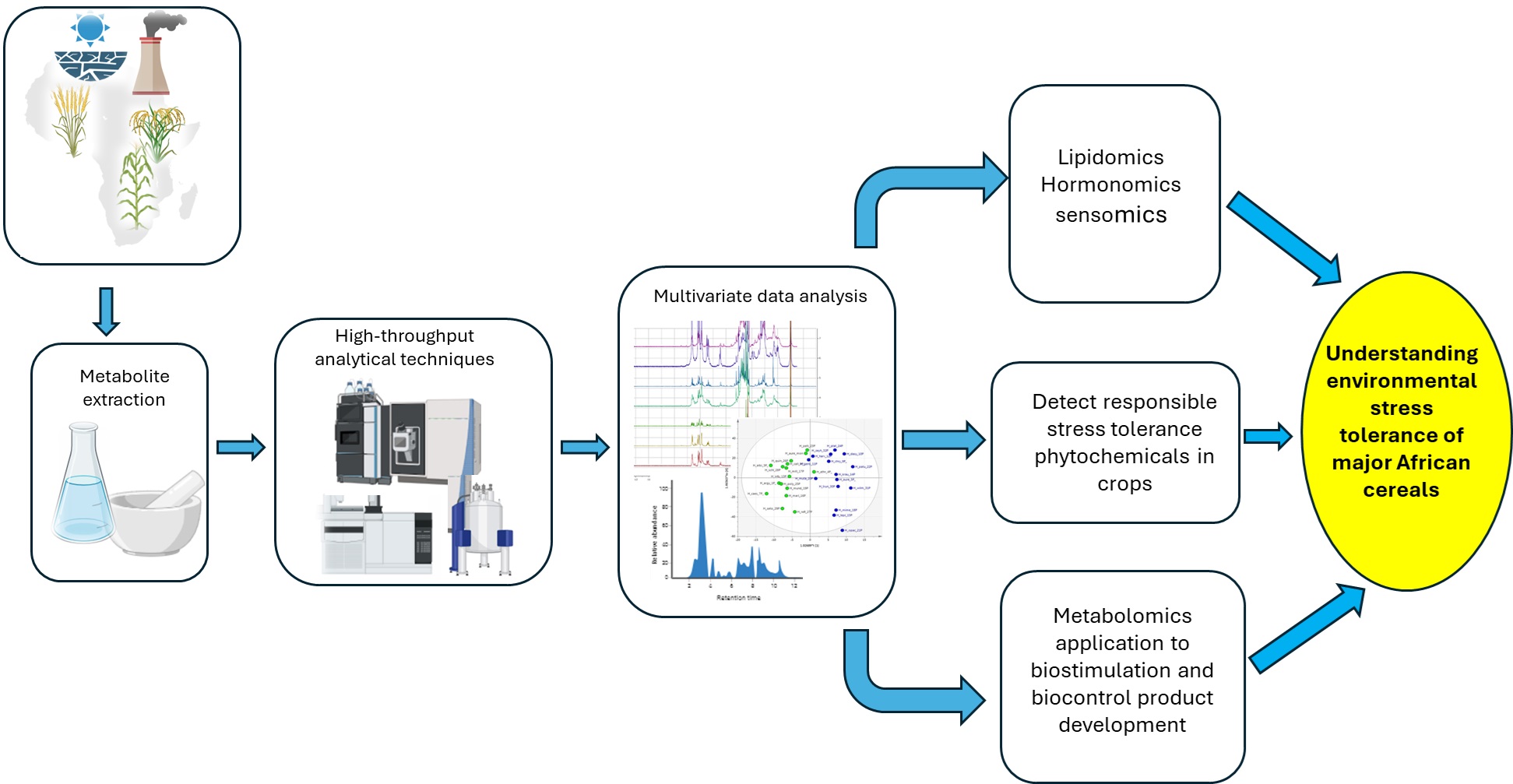
Secondary metabolites isolated from plants are usually complex mixtures consisting of varieties of active ingredients which need to be characterized. Environmental stresses, including but not limited to drought and salinity, cause significant challenges to crop growth and development. These stresses can disrupt various physiological and biochemical processes within plants, leading to reduced yields and compromised quality of agricultural products and producing different secondary metabolites. Scientific agronomists can utilize environmental stresses to optimize crop traits and improve the quality of resilient crop products. Metabolomics investigations play an important role in identifying the chemical composition of natural products. This technique is a useful tool in agrochemistry and biocontrol for crop protection via biostimulation. Metabolomics plays an essential role in decoding mechanisms of action employed by biostimulants under environmental stresses. It can also assist in understanding the plant-microorganism interaction and lead to exploring the biocontrol products under biotic and abiotic stresses in the crop industry. Lipidomics, sensomics, hormonomics and some other functional metabolomic-based techniques can assist in improving the quality of stressed crops. This review discusses a metabolomics analysis of three vital African cereals (maize, rice and wheat) to demonstrate the potential value of metabolomic investigation in enhancing the nutritional quality and quantity of these cereals under environmental stresses.
References
Abdelraheem A., Esmaeili N., O’Connell M., Zhang J. 2019. Progress and perspective on drought and salt stress tolerance in cotton. Industrial Crops and Products 130: 118–129. DOI: https://doi.org/10.1016/j.indcrop.2018.12.070
Alvarez S., Marsh E.L., Schroeder S.G., Schachtman D.P. 2008. Metabolomic and proteomic changes in the xylem sap of maize under drought. Plant, Cell & Environment 31 (3): 325–340. DOI: https://doi.org/10.1111/j.1365-3040.2007.01770.x
Badu-Apraku B., Fakorede M.A.B., Badu-Apraku B., Fakorede M.A.B. 2017. Maize in Sub-Saharan Africa: importance and production constraints. In: “Advances in genetic enhancement of early and extra-early maize for Sub-Saharan Africa”. Springer Link, 452 pp. DOI: https://doi.org/10.1007/978-3-319-64852-1_1
Belgis M., Witono Y., Giyarto G., Sadek N.F., Masruroh E.L, Herlina H. 2023. Metabolomic and sensomic approach to characterize key aroma of aromatic mangoes from Indonesia. Biodiversitas Journal of Biological Diversity 24 (4): 2242–2250. DOI: https://doi.rog/10.13057/biodiv/d240437
Bernardo L., Carletti P., Badeck F.W., Rizza F., Morcia C., Ghizzoni R., Rouphael Y., Colla G., Terzi V., Lucini L. 2019. Metabolomic responses triggered by arbuscular mycorrhiza enhance tolerance to water stress in wheat cultivars. Plant Physiology and Biochemistry 137: 203–212. DOI: https://doi.org/10.1016/j.plaphy.2019.02.007
Bertrand C., Gonzalez-Coloma A., Prigent-Combaret C. 2021. Plant metabolomics to the benefit of crop protection and growth stimulation. Advances in Botanical Research 98: 107–132. DOI: https://doi.org/10.1016/bs.abr.2020.11.002
Bueno P.C., Lopes N.P. 2020. Metabolomics to characterize adaptive and signalling responses in legume crops under abiotic stresses. ACS omega 5 (4): 1752–1763. DOI: https://doi.org/10.1021/acsomega.9b03668
Castro-Alves V., Kalbina I., Öström Å., Hyötyläinen T., Strid Å. 2020. The taste of UV light: Using sensomics to improve horticultural quality. UV4Plants Bulletin 2020 (1): 39–43. DOI: http://doi.org/10.19232/uv4pb.2020.1.11
Chaudhry S., Sidhu G.P.S. 2022. Climate change regulated abiotic stress mechanisms in plants: A comprehensive review. Plant Cell Reports 41 (1): 1–31. DOI: https://doi.org/ 10.1007/s00299-021-02759-5
Chen J.F., Liu Y., Zhang T.Y., Zhou Z.F., Huang J.Y., Zhou T., Hua Y.P. 2022. Integrated physiological and transcriptional dissection reveals the core genes involving nutrient transport and osmoregulatory substance biosynthesis in allohexaploid wheat seedlings under salt stress. BMC Plant Biology 22 (1): 502. DOI: http://doi.org/ 10.1186/s12870-022-03887-0
Cramer G.R., Urano K., Delrot S., Pezzotti M., Shinozaki K. 2011. Effects of abiotic stress on plants: a systems biology perspective. BMC Plant Biology 11 (1): 1–14. DOI: http://www.biomedcentral.com/1471-2229/11/163
Dawid C., Hille K. 2018. Functional metabolomics—a useful tool to characterize stress-induced metabolome alterations opening new avenues towards tailoring food crop quality. Agronomy 8 (8): 138. DOI: https://doi.org/10.3390/agronomy8080138
Diagne A., Alia D.Y., Wopereis M., Saito K. 2012. Impact of rice research on income and poverty in Africa: an ex-ante analysis. In: “Realizing Africa’s Rice Promise”. CAB International, Wallingford, UK, 451 pp.
Dixon R.A., Gang D.R., Charlton A.J., Fiehn O., Kuiper H.A., Reynolds T.L., Tjeerdema R.S., Jeffery E.H., German J.B., Ridley W.P., Seiber J.N. 2006. Applications of metabolomics in agriculture. Journal of Agricultural and Food Chemistry 54 (24): 8984–8994. DOI: https://doi.org/10.1021/jf061218t
Duggan T., Gilch J., Stark T.D., Dawid C., Hofmann T. 2022. Identification, Quantitation and Sensory Elucidation of off-taste compounds in wheat bran. Journal of Food Bioactives 20: 29–39. DOI: https://doi.org/10.31665/JFB.2022.18326
FAO. 2023a. Production: Crops and livestock products. In: FAOSTAT. Rome. [Online] [Available from: https://www.fao.org/3/cc9205en/cc9205en.pdf] [Accessed December 2023]
FAO. 2023b. Statistical Year Book, 2023. In: FAOSTAT. [Online] [Available from: https://reliefweb.int/report/world/fao-statistical-yearbook-2023-world-food-and-agriculture]. [Accessed December 2023]
Franzoni G., Cocetta G., Prinsi B., Ferrante A., Espen L. 2022. Biostimulants on crops: Their impact under abiotic stress conditions. Horticulturae 8 (3): 189. DOI: https://doi.org/10.3390/horticulturae8030189
Fumagalli E., Baldoni E., Abbruscato P., Piffanelli P., Genga A., Lamanna R., Consonni R. 2009. NMR techniques coupled with multivariate statistical analysis: tools to analyse Oryza sativa metabolic content under stress conditions. Journal of Agronomy and Crop Science 195 (2): 77–88. DOI: https://doi.org/10.1111/j.1439-037X.2008.00344.x
Gavaghan C.L., Li J.V., Hadfield S.T., Hole S., Nicholson J.K., Wilson I.D., Howe P.W., Stanley P.D., Holmes E. 2011. Application of NMR‐based metabolomics to the investigation of salt stress in maize (Zea mays). Phytochemical Analysis 22 (3): 214–224. DOI: https://doi.org/10.1002/pca.1268
Guo R., Yang Z., Li F., Yan C., Zhong X., Liu Q., Xia X., Li H., Zhao L. 2015. Comparative metabolic responses and adaptive strategies of wheat (Triticum aestivum) to salt and alkali stress. BMC Plant Biology 15: 1–13. DOI: http://doi.org/ 10.1186/s12870-015-0546-x
Gupta P., De B. 2017. Metabolomics analysis of rice responses to salinity stress revealed elevation of serotonin, and gentisic acid levels in leaves of tolerant varieties. Plant Signaling & Behavior 12 (7): e1335845. DOI: https://doi.org/10.1080/15592324.2017.1335845
Haggag W.M., Abouziena H.F., Abd-El-Kreem F., El Habbasha S. 2015. Agriculture biotechnology for management of multiple biotic and abiotic environmental stress in crops. Journal of Chemical and Pharmaceutical Research 7 (10): 882–889.
Hickey L.T., Hafeez A., Robinson H., Jackson S.A., Leal-Bertioli S.C., Tester M., Gao C., Godwin I.D., Hayes B.J., Wulff B.B. 2019. Breeding crops to feed 10 billion. Nature Biotechnology 37 (7): 744–754. DOI: https://doi.org/10.1038/s41587-019-0152-9
Hirayama T., Mochida K. 2022. Plant hormonomics: a key tool for deep physiological phenotyping to improve crop productivity. Plant and Cell Physiology 63 (12): 1826–1839. DOI: https://doi.org/10.1093/pcp/pcac067
Jeandet P., Hébrard C., Deville M.A., Cordelier S., Dorey S., Aziz A., Crouzet J. 2014. Deciphering the role of phytoalexins in plant-microorganism interactions and human health. Molecules 19 (11): 18033–18056. DOI: https://doi.org/10.3390/molecules191118033
Jiang J.L., Tian Y., Li L., Yu M., Hou R.P., Ren X.M. 2019. H2S alleviates salinity stress in cucumber by maintaining the Na+/K+ balance and regulating H2S metabolism and oxidative stress response. Frontiers in Plant Science 10: 678. DOI: https://doi.org/10.3389/fpls.2019.00678
Joshi J., Hasnain G., Logue T., Lynch M., Wu S., Guan J.C., Alseekh S., Fernie, A.R., Hanson A.D. and McCarty D.R. 2021. A core metabolome response of maize leaves subjected to long-duration abiotic stresses. Metabolites 11 (11): 797.DOI: http://doi.org/10.3390/metabo11110797
Kopecká R., Kameniarová M., Černý M., Brzobohatý B., Novák J. 2023. Abiotic stress in crop production. International Journal of Molecular Sciences 24 (7): 6603. DOI: https://doi.org/10.3390/ijms24076603
Kusano M., Tohge T., Fukushima A., Kobayashi M., Hayashi N., Otsuki H., Kondou Y., Goto H., Kawashima M., Matsuda F., Niida R. 2011. Metabolomics reveals comprehensive reprogramming involving two independent metabolic responses of Arabidopsis to UV‐B light. The Plant Journal 67 (2): 354–369. DOI: http://doi.org/ 10.1111/j.1365-313X.2011.04599.x
Li P.C., Yang X.Y., Wang H.M., Ting P.A.N., Yang J.Y., Wang Y.Y., Yang X.U., Yang Z.F., Xu C.W. 2021. Metabolic responses to combined water deficit and salt stress in maize primary roots. Journal of Integrative Agriculture 20 (1): 109–119. DOI: http://doi.org/ 10.1016/S2095-3119(20)63242-7
Liang X., Liu S., Wang T., Li F., Cheng J., Lai J., Qin F., Li Z., Wang X., Jiang C. 2021. Metabolomics‐driven gene mining and genetic improvement of tolerance to salt‐induced osmotic stress in maize. New Phytologist 230 (6): 2355–2370. DOI: http://doi.org/10.1111/nph.17323
Lynch M., Walsh B. 1998. Genetics and Analysis of Quantitative Traits. Sinauer Associates, Oxford University Press, 980 pp.
Ma Y., Dias M.C., Freitas H. 2020. Drought and salinity stress responses and microbe-induced tolerance in plants. Frontiers in Plant Science 11: 591911. DOI: https://doi.org/10.3389/fpls.2020.591911
Martínez-Lorente S.E., Martí-Guillén J.M., Pedreño M.Á., Almagro L., Sabater-Jara A.B. 2024. Higher plant-derived biostimulants: mechanisms of action and their role in mitigating plant abiotic stress. Antioxidants 13 (3): 318. DOI: https://doi.org/10.3390/antiox13030318
Mashabela M.D., Tugizimana F., Steenkamp P.A., Piater L.A., Dubery I.A., Mhlongo M.I. 2022. Untargeted metabolite profiling to elucidate rhizosphere and leaf metabolome changes of wheat cultivars (Triticum aestivum L.) treated with the plant growth-promoting rhizobacteria Paenibacillus alvei (T22) and Bacillus subtilis. Frontiers in Microbiology 13: 971836. DOI: http://doi.org/ 10.3389/fmicb.2022.971836
Mehta D., Vyas S. 2023. Comparative bio-accumulation of osmoprotectants in saline stress tolerating plants: A review. Plant Stress 9: 100177. DOI: https://doi.org/10.1016/j.stress.2023.100177
Mekonnen T.W., Gerrano A.S., Mbuma N.W., Labuschagne M.T. 2022. Breeding of vegetable cowpea for nutrition and climate resilience in Sub-Saharan Africa: progress, opportunities, and challenges. Plants 11 (12): 1583. DOI: http://doi.org/ 10.3390/plants11121583
Mishra A., Singh B.B., Shakil N.A., Shamim M.D., Homa F., Chaudhary R., Yadav P., Srivastava D., Fatima P., Sharma V., Yadav M.K. 2024. Effect of high temperature stress on metabolome and aroma in rice grains. Plant Gene 38: 100450. DOI: https://doi.org/10.1016/j.plgene.2024.100450
Nakabayashi R., Saito K. 2015. Integrated metabolomics for abiotic stress responses in plants. Current Opinion in Plant Biology 24: 10–16. DOI: https://doi.org/10.1016/j.pbi.2015.01.003
Nephali L., Moodley V., Piater L., Steenkamp P., Buthelezi N., Dubery I., Burgess K., Huyser J., Tugizimana F. 2021. A metabolomic landscape of maize plants treated with a microbial biostimulant under well-watered and drought conditions. Frontiers in Plant Science 12: 676632. DOI: https://doi.org/10.3389/fpls.2021.676632
Novák O., Napier R., Ljung K. 2017. Zooming in on plant hormone analysis: tissue-and cell-specific approaches. Annual Review of Plant Biology 68: 323–348. DOI: http://doi.org/ 10.1146/annurev-arplant-042916-040812
Okazaki Y., Saito K. 2016. Integrated metabolomics and phytochemical genomics approaches for studies on rice. GigaScience 5 (1): s13742–016. DOI: https://doi.org/10.1186/s13742-016-0116-7
Pelleschi S., Leonardi A., Rocher J.P., Cornic G., De Vienne D., Thevenot C., Prioul J.L. 2006. Analysis of the relationships between growth, photosynthesis and carbohydrate metabolism using quantitative trait loci (QTLs) in young maize plants subjected to water deprivation. Molecular Breeding 17: 21–39. DOI: http://doi.org/10.1007/s11032-005-1031-2
Piasecka A., Kachlicki P., Stobiecki M. 2019. Analytical methods for detection of plant metabolomes changes in response to biotic and abiotic stresses. International journal of molecular sciences 20 (2): 379. DOI: http:// doi.org/10.3390/ijms20020379
Ranilla L. 2020. The application of metabolomics for the study of cereal corn (Zea mays L.). Metabolites 10 (8): 300. DOI: http://doi.org/10.3390/metabo10080300
Rodrigues Neto J.C., Salgado F.F., Braga Í.D.O., Carvalho da Silva T.L., Belo Silva V.N., Leão A.P., Ribeiro J.A.D.A., Abdelnur P.V., Valadares L.F., De Sousa C.A.F., Souza Júnior M.T. 2023. Osmoprotectants play a major role in the Portulaca oleracea resistance to high levels of salinity stress—insights from a metabolomics and proteomics integrated approach. Frontiers in Plant Science 14: 1187803. DOI: http://doi.org/10.3389/fpls.2023.1187803
Ritchie H., Rosado P., Roser M. 2023. Agricultural Production. Published online at OurWorldInData.org. [Online] [Available from: https://ourworldindata.org/agricultural-production] [Accessed 24 May 2023]
Rouphael Y., Lucini L., Miras-Moreno B., Colla G., Bonini P., Cardarelli M. 2020. Metabolomic responses of maize shoots and roots elicited by combinatorial seed treatments with microbial and non-microbial biostimulants. Frontiers in Microbiology 11: 664. DOI: http://doi.org/10.3389/fmicb.2020.00664
Saia S., Fragasso M., De Vita P., Beleggia R. 2019. Metabolomics provides valuable insight for the study of durum wheat: a review. Journal of Agricultural and Food Chemistry 67 (11): 3069–3085. DOI: http://doi.org/10.1021/acs.jafc.8b07097
Salvi P., Manna M., Kaur H., Thakur T., Gandass N., Bhatt D., Muthamilarasan M. 2021. Phytohormone signaling and crosstalk in regulating drought stress response in plants. Plant Cell Reports 40: 1305–1329. DOI: http://doi.org/ 10.1007/s00299-021-02683-8
Sgherri C., Navari-Izzo F., Pardossi A., Soressi G.P., Izzo R. 2007. The influence of diluted seawater and ripening stage on the content of antioxidants in fruits of different tomato genotypes. Journal of Agricultural and Food Chemistry 55 (6): 2452–2458. DOI: https://doi.org/10.1021/jf0634451
Shafique A., Rehman S., Khan A., Kazi A.G. 2014. Improvement of legume crop production under environmental stresses through biotechnological intervention. p. 1–22 pp. In: “Emerging technologies and management of crop stress tolerance”. Academic Press.
Silva J.V., Jaleta M., Tesfaye K., Abeyo B., Devkota M., Frija A., Habarurema I., Tembo B., Bahri H., Mosad A., Blasch G. 2023. Pathways to wheat self-sufficiency in Africa. Global Food Security 37: 100684. DOI: https://doi.org/10.1016/j.gfs.2023.100684
Šimura J., Antoniadi I., Široká J., Tarkowská D.E., Strnad M., Ljung K., Novák O. 2018. Plant hormonomics: multiple phytohormone profiling by targeted metabolomics. Plant Physiology 177 (2): 476–489. DOI: https://doi.org/10.1104/pp.18.00293
Sun C., Gao X., Fu J., Zhou J., Wu X. 2015. Metabolic response of maize (Zea mays L.) plants to combined drought and salt stress. Plant and Soil 388: 99–117. DOI: http://doi.org. 10.1007/s11104-014-2309-0
Tenenboim H., Burgos A., Willmitzer L., Brotman Y. 2016. Using lipidomics for expanding the knowledge on lipid metabolism in plants. Biochimie 130: 91–96. DOI: https://doi.org/10.1016/j.biochi.2016.06.004
Tugizimana F., Piater L., Dubery I. 2013. Plant metabolomics: A new frontier in phytochemical analysis. South African Journal of Science 109 (5–6): 1–11. DOI: http://dx.doi.org/10.1590/sajs.2013/20120005
Umair M., Sun N., Du H., Yuan J., Abbasi A.M., Wen J., Yu W., Zhou J., Liu C. 2019. Differential metabolic responses of shrubs and grasses to water additions in arid karst region, southwestern China. Scientific Reports 9 (1): 9613. DOI: https://doi.org/10.1038/s41598-019-46083-1
Vrobel O., Tarkowski P. 2023. Can plant hormonomics be built on simple analysis? A review. Plant Methods 19 (1): 107. DOI: https://doi.org/10.1186/s13007-023-01090-2
Vrzal T., Olšovská J. 2019. Sensomics-basic principles and practice. Kvasny Prumysl 65 (5): 166–173. DOI: https://doi.org/10.18832/kp2019.65.166
Wang Y., Frei M. 2011. Stressed food–The impact of abiotic environmental stresses on crop quality. Agriculture, Ecosystems & Environment 141 (3–4): 271–286. DOI: https://doi.org/10.1016/j.agee.2011.03.017
Wani S.H., Kumar V., Shriram V., Sah S.K. 2016. Phytohormones and their metabolic engineering for abiotic stress tolerance in crop plants. The Crop Journal 4 (3): 162–176. DOI: https://doi.org/10.1016/j.cj.2016.01.010
Witt S., Galicia L., Lisec J., Cairns J., Tiessen A., Araus J.L., Palacios-Rojas N., Fernie A.R. 2012. Metabolic and phenotypic responses of greenhouse-grown maize hybrids to experimentally controlled drought stress. Molecular Plant 5 (2): 401–417. DOI: http://doi.org. 10.1093/mp/ssr102
Wüst M. 2018. Smell of stress: Identification of induced biochemical pathways affecting the volatile composition and flavor quality of crops. Journal of Agricultural and Food Chemistry 66 (14): 3616–3618. DOI: https://doi.org/10.1021/acs.jafc.8b00522
Xie Z., Wang C., Zhu S., Wang W., Xu J., Zhao X. 2020. Characterizing the metabolites related to rice salt tolerance with introgression lines exhibiting contrasting performances in response to saline conditions. Plant Growth Regulation 92: 157–167. DOI: https://doi.org/10.1007/s10725-020-00627-y
Yakhin O.I., Lubyanov A.A., Yakhin I.A., Brown P.H. 2017. Biostimulants in plant science: A global perspective. Frontiers in Plant Science 7: 2049. DOI: http://doi.org/10.3389/fpls.2016.02049
Yang K., Han X. 2016. Lipidomics: techniques, applications, and outcomes related to biomedical sciences. Trends in Biochemical Sciences 41 (11): 954–969. DOI: http://doi.org/10.1016/j.tibs.2016.08.010
Yang M., Yang J., Su L., Sun K., Li D., Liu Y., Wang H., Chen Z., Guo T. 2019. Metabolic profile analysis and identification of key metabolites during rice seed germination under low-temperature stress. Plant Science 289: 110282. https://doi.org/10.1016/j.plantsci.2019.110282
Yue J.Y., Wang L.H., Dou X.T., Wang Y.J., Wang H.Z. 2020. Comparative metabolomic profiling in the roots of salt-tolerant and salt-intolerant maize cultivars treated with NaCl stress. Biologia Plantarum 64: 569–577. DOI: http:// doi.org.10.32615/bp.2020.082
Zeng T., Fang B., Huang F., Dai L., Tang Z., Tian J., Cao G., Meng X., Liu Y., Lei B., Lu M. 2021. Mass spectrometry-based metabolomics investigation on two different indica rice grains (Oryza sativa L.) under cadmium stress. Food Chemistry 343: 128472. DOI: https://doi.org/10.1016/j.foodchem.2020.128472
Zezulka Š., Kummerová M., Babula P., Hájková M., Oravec M. 2019. Sensitivity of physiological and biochemical endpoints in early ontogenetic stages of crops under diclofenac and paracetamol treatments. Environmental Science and Pollution Research 26: 3965–3979. DOI: http://doi.org.10.1007/s11356-018-3930-x
Zhang A., Sun H., Yan G., Wang P., Wang X. 2015. Metabolomics for biomarker discovery: moving to the clinic. Biomed Research International 2015: 1–7. DOI: http://doi.org/ 10.1155/2015/354671
Zhang J., Luo W., Zhao Y., Xu Y., Song S., Chong K. 2016. Comparative metabolomic analysis reveals a reactive oxygen species‐dominated dynamic model underlying chilling environment adaptation and tolerance in rice. New Phytologist 211 (4): 1295–1310. DOI: https://doi.org/10.1111/nph.14011
Downloads
Published
How to Cite
Issue
Section
License
Copyright (c) 2026 Journal of Plant Protection Research

This work is licensed under a Creative Commons Attribution 4.0 International License.





