
Harnessing the power of Sacha inchi leaf extract against fruit anthracnose disease
DOI:
https://doi.org/10.24425/jppr.2026.158067Abstract
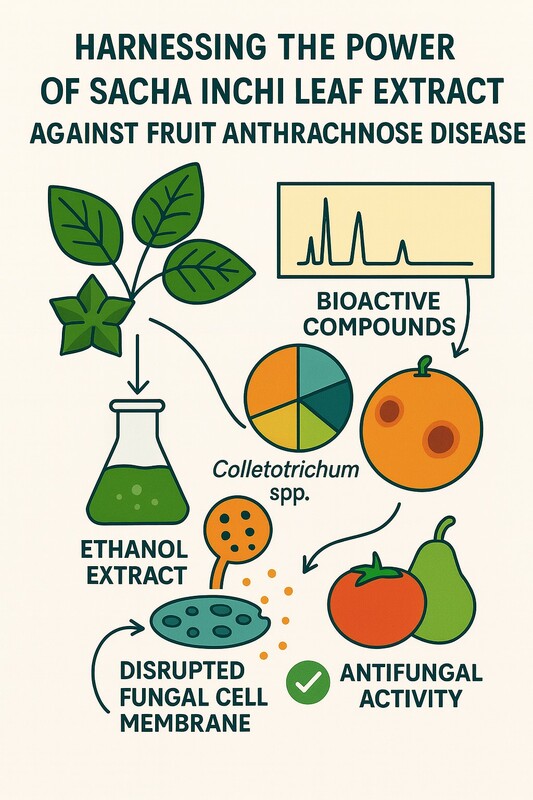
Anthracnose disease, primarily caused by Colletotrichum species, poses significant challenges to fruit production, resulting in serious global economic losses. While chemical fungicides are effective, their environmental and health risks underscore the need for sustainable alternatives. This study evaluated the antifungal potential of Sacha inchi (Plukenetia volubilis) leaf ethanol extract against Colletotrichum gloeosporioides, C. scovillei, and C. acutatum. Gas Chromatography-Mass Spectrometry (GCMS) analysis identified 20 chemical constituents, including bioactive compounds such as unsaturated fatty acids and saturated fatty acids known for their antimicrobial properties. In vitro assays demonstrated a dosedependent inhibition of mycelial growth, with complete suppression of C. gloeosporioides at 500 mg · l–1. The antifungal activity is likely attributed to the extract’s ability to disrupt fungal cell membranes and interfere with metabolic pathways. These findings support the potential of Sacha inchi leaf extract as a promising, eco-friendly alternative to synthetic fungicides in the management of anthracnose disease in fruit crops. Further research into its field application, synergistic effects, and mechanisms of action is warranted to enhance its integration into sustainable crop protection strategies.
References
Abbey J.A., Percival D., Abbey L., Asiedu S.K., Prithiviraj B., Schilder A. 2018. Biofungicides as alternative to synthetic fungicide control of grey mould (Botrytis cinerea) – Prospects and challenges. Biocontrol Science and Technology 29 (3): 207–228. DOI: https://doi.org/10.1080/09583157.2018.1548574
Bhattacharyya A., Sinha M., Singh H., Patel R.S., Ghosh S., Sardana K., Sengupta S. 2020. Mechanistic insight into the antifungal effects of a fatty acid derivative against drug-resistant fungal infections. Frontiers in Microbiology 11: 2116. DOI: https://doi.org/10.3389/fmicb.2020.02116
Cárdenas D.M., Gómez Rave L.J., Soto J.A. 2021. Biological activity of Sacha inchi (Plukenetia volubilis Linneo) and potential uses in human health: A review. Food Technology and Biotechnology 59 (3): 253–266. DOI: https://doi.org/10.17113/ftb.59.03.21.6683
Charlet R., Le Danvic C., Sendid B., Nagnan-Le Meillour P., Jawhara S. 2022. Oleic acid and palmitic acid from Bacteroides thetaiotaomicron and Lactobacillus johnsonii exhibit anti-inflammatory and antifungal properties. Microorganisms 10(9): 1803. DOI: https://doi.org/10.3390/microorganisms10091803
Ciofini A., Negrini F., Baroncelli R., Baraldi E. 2022. Management of Post-Harvest Anthracnose: Current Approaches and Future Perspectives. Plants 11 (14): 1856, DOI: https://doi.org/10.3390/plants11141856
da Silva L.L., Moreno H.L.A., Correia H.L.N., Santana M.F., de Queiroz M.V. 2020. Colletotrichum: species complexes, lifestyle, and peculiarities of some sources of genetic variability. Applied Microbiology and Biotechnology 104: 1891–1904. DOI: https://doi.org/10.1007/s00253-020-10363-y
Darlis D., Jalloh M.B., Chin C.F.S., Basri N.K.M., Besar N.A., Ahmad K., Rakib M.R.M. 2023. Exploring the potential of Bornean polypore fungi as biological control agents against pathogenic Ganoderma boninense causing basal stem rot in oil palm. Scientific Reports 1 3(1): 10316. DOI: https://doi.org/10.1038/s41598-023-37507-0
De Silva D.D., Crous P.W., Ades P.K., Hyde K.D., Taylor P.W. 2017. Life styles of Colletotrichum species and implications for plant biosecurity. Fungal Biology Reviews 31 (3): 155–168. DOI: https://doi.org/10.1016/j.fbr.2017.05.001
Desbois A.P., Smith V.J. 2010. Antibacterial free fatty acids: activities, mechanisms of action and biotechnological potential. Applied microbiology and Biotechnology 85: 1629–1642. DOI: https://doi.org/10.1007/s00253-009-2355-3
Dofuor A.K., Quartey N.K.A., Osabutey A.F., Antwi-Agyakwa A.K., Asante K., Boateng B.O., Ninsin K.D. 202). Mango anthracnose disease: the current situation and direction for future research. Frontiers in Microbiology 14. DOI: https://doi.org/10.3389/fmicb.2023.1168203
Gao G., Fu T., Song Y.W., Kim K.S. 2024. MAPKK CsSTE7 is critical for appressorium formation and pathogenicity in pepper anthracnose fungus, Colletotrichum scovillei. Journal of General Plant Pathology 90 (2): 108–119. DOI: https://doi.org/10.1007/s10327-024-01167-3
Garrido C., Carbú M., Fernández-Acero F.J., Vallejo I., Cantoral J.M. 2009. Phylogenetic relationships and genome organisation of Colletotrichum acutatum causing anthracnose in strawberry. European Journal of Plant Pathology 125: 397–411. DOI: https://doi.org/10.1007/s10658-009-9489-0
Gouvinhas I., Martins-Lopes P., Carvalho T., Barros A., Gomes S. 2019. Impact of Colletotrichum acutatum Pathogen on Olive Phenylpropanoid Metabolism. Agriculture 9 (8): 173. DOI: https://doi.org/10.3390/agriculture9080173
Grice K.R.E., Bally I.S.E., Wright C.L., Maddox C., Ali A., Dillon N.L. 2023. Mango germplasm screening for the identification of sources of tolerance to anthracnose. Australasian Plant Pathology 52 (1): 27–41. DOI: https://doi.org/10.1007/s13313-022-00899-0
Guimarães A., Venâncio A. 2022. The potential of fatty acids and their derivatives as antifungal agents: A review. Toxins 14 (3): 188. DOI: https://doi.org/10.3390/toxins14030188
Gutierrez-Perez C., Puerner C., Jones J.T., Vellanki S., Vesely E.M., Xatse M.A., Cramer R.A. 2024. Unsaturated fatty acid perturbation combats emerging triazole antifungal resistance in the human fungal pathogen Aspergillus fumigatus. Mbio 15 (7): e01166–24. DOI: https://doi.org/10.1128/mbio.01166-24
Hua L., Yong C., Zhanquan Z., Boqiang L., Guozheng Q., Shiping T. 2018. Pathogenic mechanisms andcontrol strategies of Botrytis cinerea causing post-harvest decay in fruits and vegetables. Food Quality and Safety 2 (3): 111–119. DOI: https://doi.org/10.1093/fqsafe/fyy016
Ismail M.N., Ismail N.I., Fauzi B. 2022. Antioxidant activities of Malaysian Plukenetia volubilis. Multidisciplinary Applied Research and Innovation 3 (2): 18–24. DOI: https://publisher.uthm.edu.my/periodicals/index.php/mari/article/view/3602
Joujou F.M., Darra N.E., Rajha H.N., Sokhn E.S., Alwan N. 2024. Evaluation of synergistic/antagonistic antibacterial activities of fatty oils from apricot, date, grape, and black seeds. Scientific Reports 14 (1): 6532. DOI: https://doi.org/10.1038/s41598-024-54850-y
Kamaruzaman N.A., Leong Y.H., Jaafar M.H., Khan H.R.M., Rani N.A.A., Razali M.F., Majid M.I.A. 2020. Epidemiology and risk factors of pesticide poisoning in Malaysia: a retrospective analysis by the National Poison Centre (NPC) from 2006 to 2015. BMJ Open 10 (6): e036048. DOI: https://doi.org/10.1136/bmjopen-2019-036048
Kamle M., Kumar P. 2016. Colletotrichum gloeosporioides: Pathogen of Anthracnose Disease in Mango (Mangifera indica L.). p. 207–219. In: “Current Trends in Plant Disease Diagnostics and Management Practices. Fungal Biology” (P. Kumar, V. Gupta, A. Tiwari, M. Kamle, eds.). Springer International Publishing, Switzerland, 469 pp. DOI: https://doi.org/10.1007/978-3-319-27312-9_9
Kankam F., Larbi-Koranteng S., Adomako J., Kwowura Kwodaga J., Boatey Akpatsu I., Danso Y., Nortaa Kunedeb Sowley E. 2023. Anthracnose Disease of Mango: Epidemiology, Impact and Management Options. Intech Open. DOI: https://www.intechopen.com/chapters/82782
Kodahl N., Sørensen M. 2021. Sacha inchi (Plukenetia volubilis L.) is an underutilized crop with a great potential. Agronomy 11 (6): 1066. DOI: https://doi.org/10.3390/agronomy11061066
Koul O. 2011. Microbial biopesticides: Opportunities and challenges. CAB Reviews Perspectives in Agriculture Veterinary Science Nutrition and Natural Resources 6 (56): 1–26. DOI: https://doi.org/10.1079/PAVSNNR20116056
Lima N.B., Lima W.G., Tovar-Pedraza J.M., Michereff S.J., Câmara M.P. 2015. Comparative epidemiology of Colletotrichum species from mango in northeastern Brazil. European Journal of Plant Pathology 141: 679–688. DOI: https://doi.org/10.1007/s10658-014-0570-y
Liu S., Ruan W., Li J. Xu H., Wang J., Gao Y. Wang J. 2008. Biological Control of Phytopathogenic Fungi by Fatty Acids. Mycopathologia 166: 93–102. DOI: https://doi.org/10.1007/s11046-008-9124-1
Martin F.L., Martinez E.Z., Stopper H., Garcia S.B., Uyemura S.A., Kannen V. 2018. Increased exposure to pesticides and colon cancer: Early evidence in Brazil. Chemosphere 209: 623–631. DOI: https://doi.org/10.1016/j.chemosphere.2018.06.118
Mohideen M, Abidin N.S.I.Z, Idris M.I.H, Kamaruzaman N.A. 2022. An Overview of Antibacterial and Antifungal effects of Azadirachta indica Crude Extract: A Narrative Review. Biomedical and Pharmacology Journal 15 (1). DOI: https://dx.doi.org/10.13005/bpj/2391
Muthamil S., Prasath K.G., Priya A., Precilla P., Pandian S.K. 2020. Global proteomic analysis deciphers the mechanism of action of plant derived oleic acid against Candida albicans virulence and biofilm formation. Scientific Reports 10 (1): 5113. DOI: https://doi.org/10.1038/s41598-020-61918-y
Narayan S., Liew Z., Bronstein J.M., Ritz B. 2017. Occupational pesticide use and Parkinson's disease in the Parkinson Environment Gene (PEG) study. Environment International 107: 266–273. DOI: https://doi.org/10.1016/j.envint.2017.04.010
Noor N.M., Zakaria L. 2018. Identification and characterization of Colletotrichum spp. associated with chili anthracnose in peninsular Malaysia. European Journal of Plant Pathology 151: 961–973. DOI: https://doi.org/10.1007/s10658-018-1431-x
Parthasarathy A., Borrego E. J., Savka M.A., Dobson R.C., Hudson A.O. 2021. Amino acid–derived defense metabolites from plants: A potential source to facilitate novel antimicrobial development. Journal of Biological Chemistry 296: 100438. DOI: https://pubmed.ncbi.nlm.nih.gov/33610552/
Paudel A., Poudel P., Yogi M. 2022. Insights on the Mango Anthracnose and its Management. Journal of Plant Pathology Research 4 (1): 81–90. DOI: https://scholars.direct/Articles/plant-pathology/jppr-4-012.php?jid=plant-pathology
Pedras M.S.C., Yaya E.E. 2015. Plant chemical defenses: are all constitutive antimicrobial metabolites phytoanticipins? Natural Product Communications 10 (1): 209–218. DOI: https://doi.org/10.1177/1934578X1501000142.
Puangpronpitag D., Tankitjanon P., Sumalee A., Konsue A. 2021. Phytochemical screening and antioxidantactivities of the seedling extracts from Inca Peanut Plukenetia volubilis. Pharmacognosy Journal 13 (1): 52–58. DOI: https://doi.org/10.5530/pj.2021.13.8
Rashid M.H.U., Yi E.K.J., Amin N.D.M., Ismail M.N. 2024. An Empirical Analysis of Sacha Inchi (Plantae: Plukenetia volubilis L.) Seed Proteins and Their Applications in the Food and Biopharmaceutical Industries. Applied Biochemistry and Biotechnology 196 (8): 4823–4836. DOI: https://doi.org/10.1007/s12010-023-04783-5
Ren L.S.F., Wang X. J., Shi J., Cao Y., Zhou J.B., Zhao X.J. 2020. Characterisation of sensitivity of Colletotrichum gloeosporioides and Colletotrichum capsici, causing pepper anthracnose, to picoxystrobin. Journal of Plant Diseases and Protection 127: 657–666. DOI: https://doi.org/10.1007/s41348-020-00316-y
Semwal P., Painuli S., Badoni H., Bacheti R.K. 2018. Screening of phytoconstituents and antibacterial activity of leaves and bark of Quercus leucotrichophora A. Camus from Uttarakhand Himalaya. Clinical Phytoscience 4: 1–6. DOI: https://doi.org/10.1186/s40816-018-0090-y
Sharma M. Kulshrestha S. 2015. Colletotrichum gloeosporioides: An anthracnose causing pathogen of fruits and vegetables. Biosciences Biotechnology Research Asia 12 (2). DOI: https://www.biotech-asia.org/vol12no2/colletotrichum-gloeosporioides-an-anthracnose-causing-pathogen-of-fruits-and-vegetables/
Uda M.N.A., Gopinath S.C.B., Hashim U., Hakimi A., Anuar A., Bakar M., Sulaiman M.K.A Parmin N. 2020. Harumanis Mango: Perspectives in Disease Management and Advancement using Interdigitated Electrodes (IDE) Nano-Biosensor. IOP Conference Series: Materials Science and Engineering 864: 012180. DOI: https://doi.org/10.1088/1757-899X/864/1/012180
Usman H.M., Tan Q., Karim M.M., Adnan M., Yin W.X., Zhu F.X., Luo C.X. 2021. Sensitivity of Colletotrichum fructicola and Colletotrichum siamense of peach in China to multiple classes of fungicides and characterization of pyraclostrobin-resistant isolates. Plant Disease 105 (11): 3459–3465. DOI: https://doi.org/10.1094/PDIS-04-21-0693-RE
Xue R., Du G., Chen C., Chen B., Peng Y. 2023. Oleic acid improves the conidial production and quality of Metarhizium rileyi as a biocontrol agent. Biocontrol Science and Technology 33 (8): 758–771. DOI: https://doi.org/10.1080/09583157.2023.2229972
Yang X., Bai S., Wu J., Fan Y., Zou Y., Xia Z., Ao J., Chen T., Zhang M., Yang R. 2023. Antifungal Activity and Potential Action Mechanism of Allicin against Trichosporon asahii. Microbiology Spectrum 11(3): e0090723. DOI: https://doi.org/10.1128/spectrum.00907-23
Downloads
Published
How to Cite
Issue
Section
License
Copyright (c) 2026 Journal of Plant Protection Research

This work is licensed under a Creative Commons Attribution 4.0 International License.