
Evaluation of Beauveria bassiana isolates from Hypsipyla robusta and Zeuzera coffeae for biological control of borer pests in Chukrasia tabularis
DOI:
https://doi.org/10.24425/jppr.2026.2986Abstract
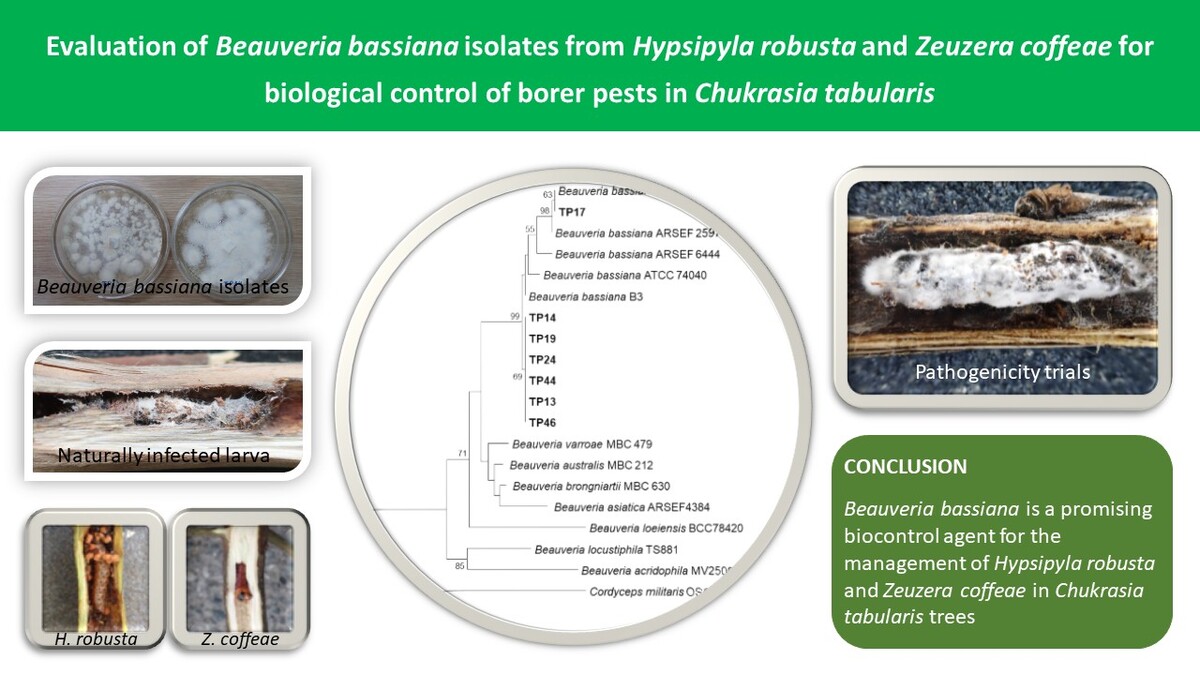
Indian mahogany (Chukrasia tabularis) is vulnerable to attack by insect borers. In Vietnam, serious damage is caused by the mahogany shoot borer (Hypsipyla robusta) and the coffee borer (Zeuzera coffeae). Biological control options are desirable for the future management of these pest species. This study aimed to evaluate the pathogenicity of seven wild indigenous Beauveria bassiana (Bals.-Criv.) Vuill, 1912 (Hypocreales: Cordycipitaceae) isolates obtained from mahogany and coffee borer larvae against the target pests. The fungi were identified by phylogenetic analysis of the Internal Transcribed Spacer, Large Subunit, and Translation Elongation Factor 1-alpha gene regions using sequence comparison. In laboratory tests, suspensions of B. bassiana conidia induced 71–89% mortality of H. robusta and Z. coffeae larvae after nine days. In nursery experiments, conidia were sprayed onto one-year-old C. tabularis seedlings infested with 1st instar larvae of H. robusta or Z. coffeae to confirm the pathogenicity of seven isolates. Isolates TP13, TP17, TP24, and TP46 reduced damage from H. robusta by 72–76% (P <0.001); and TP14, TP19, and TP44 reduced damage from Z. coffeae by 74–77% (P <0.001). In experiments in C. tabularis plantations, these B. bassiana isolates significantly (P <0.001) reduced the incidence of borer damage from H. robusta and Z. coffeae by 71–73% and 72–75%, respectively. These results suggest that locally adapted isolates of B. bassiana can be developed as a biocontrol tool for future integrated pest management of C. tabularis borer pests. Further research is required to identify field protocols for commercial application.
References
Abbott WS (1925) A method of computing the effectiveness of an insecticide. Journal of Economic Entomology 18(2): 265-267
Abdo C, Nemer N, Nemer G, Abou Jawdah Y, Atamian H, Kawar NS (2008) Isolation of Beauveria species from Lebanon and evaluation of its efficacy against the cedar web-spinning sawfly, Cephalcia tannourinensis. BioControl 53(2): 341-352. DOI: https://doi.org/10.1007/s10526-006-9062-0
Barta M, Kautmanová I, Čičková H, Ferenčík J, Florián Š, Novotný J, Kozánek M (2018) The potential of Beauveria bassiana inoculum formulated into a polymeric matrix for a microbial control of spruce bark beetle. Biocontrol Science and Technology 28(7): 718-735. DOI: https://doi.org/10.1080/09583157.2018.1487027
Biryol S, Araz Sayın N, Aktürk R, Bilgin L, İşık S, Soydinç A, Topkara EF, Yanar O, Ayvaz S, Turna H, Demir I (2025) Target and non-target impact of oil-based Beauveria bassiana formulation in controlling forest insect pests. Journal of Pest Science. DOI: https://doi.org/10.1007/s10340-025-01929-8
Boggione MJ, Sala A, Tubio G, Barrena R, Gea T, Artola A (2025) Effective biocontrol on Nezara viridula (L.) using a biopesticide produced from Beauveria bassiana. Biocatalysis and Agricultural Biotechnology 66: 103614. DOI: https://doi.org/10.1016/j.bcab.2025.103614
Boomsma JJ, Jensen AB, Meyling NV, Eilenberg J (2014) Evolutionary interaction networks of insect pathogenic fungi. Annual Review of Entomology 59: 467-485. DOI: https://doi.org/10.1146/annurev-ento-011613-162054
Bustamante DE, Oliva M, Leiva S, Mendoza JE, Bobadilla L, Angulo G, Calderon MS (2019) Phylogeny and species delimitations in the entomopathogenic genus Beauveria (Hypocreales, Ascomycota), including the description of B. peruviensis sp. nov. MycoKeys 58: 47-68. DOI: https://doi.org/10.3897/mycokeys.58.35764
Cai Y, Nie Y, Gao Y, Huang B (2022) Natural populations of the entomopathogenic fungus Beauveria bassiana in Chinese forest ecosystems are diverse and reveal equal frequencies of mating types within phylogenetic species. Fungal Ecology 56: 101139. DOI: https://doi.org/10.1016/j.funeco.2021.101139
Chen MJ, Huang B, Li ZZ, Spatafora JW (2013) Morphological and genetic characterisation of Beauveria sinensis sp. nov. from China. Mycotaxon 124: 301-308. DOI: https://doi.org/10.5248/124.301
Chen ZH, Chen K, Dai YD, Zheng Y, Wang YB, Yang XN, Yu H, Yang YM, Xu L (2019) Beauveria species diversity in the Gaoligong Mountains of China. Mycological Progress 18(7): 933-943. DOI: https://doi.org/10.1007/s11557-019-01497-z
Chi NM (2022) Influence of silvicultural practices on management of Hypsipyla robusta damage in Chukrasia tabularis in Hoa Binh and Nghe An provinces, Vietnam. Journal of Forestry Science and Technology 2: 41-47. DOI: https://doi.org/10.55250/jo.vnuf.2022.2.041-047
Chi NM (2024) The manual report of the project "Investigation of screening and planting methods for high value and shoot tip borer tolerance of Chukrasia tabularis in Vietnam - Phase 2". Vietnamese Academy of Forest Sciences
Chi NM, Anh DTK (2025) First record of Beauveria bassiana, a potential biocontrol agent for management of stem borers. Vietnam Journal of Forest Science 2: 121-128. DOI: https://doi.org/10.70169/VJFS.1043
Chi NM, Huong VD, Pham DL, Binh LV, Luu NV, Ha KM, Loi VV, Yakovlev RV (2022) Neurozerra conferta (Lepidoptera: Cossidae) damaging Melaleuca plantations in Vietnam and its biological control. Ecologica Montenegrina 60: 13-24. DOI: https://doi.org/10.37828/em.2022.60.3
Chi NM, Nhung NP, Loi VV, Thuy PTT, Dell B (2025) Bacillus bombysepticus, an entomopathogen in yellow‑spined bamboo locust with biocontrol potential. Neotropical Entomology 54(1): 12. DOI: https://doi.org/10.1007/s13744-024-01223-9
Chi NM, Pham DL, Nhung NP, Hoa NTHH, Do TT, Tra TTL, Loi VV, Thuy PTT, Hai ND, Tuan DX, Thu PQ, Dell B (2023) Integrated pest management of Hypsipyla robusta shoottip borer (Lepidoptera: Pyralidae) in Chukrasia tabularis (Sapindales: Meliaceae). Journal of Economic Entomology 116(2): 486-495. DOI: https://doi.org/10.1093/jee/toad033
Chi NM, Quang DN, Hien BD, Dzung PN, Nhung NP, Nam NV, Thuy PTT, Tuong DV, Dell B (2021) Management of Hypsipyla robusta Moore (Pyralidae) damage in Chukrasia tabularis A. Juss (Meliaceae). International Journal of Tropical Insect Science 41(4): 2341-2350. DOI: https://doi.org/10.1007/s42690-020-00405-3
Chuang WY, Lin YC, Shrestha B, Luangsa-Ard JJ, Stadler M, Tzean SS, Wu S, Ko CC, Hsieh SY, Wu ML (2024) Phylogenetic diversity and morphological characterization of cordycipitaceous species in Taiwan. Studies in Mycology 109(1): 6-61. DOI: https://doi.org/10.3114/sim.2024.109.01
Do NV (2003) Study on biology, ecology and management of Hypsipyla robusta (Moore), feeding on Chukrasia tabularis in Northern regions of Vietnam. PhD Thesis. Vietnamese Academy of Forest Sciences, Hanoi, Vietnam
Farrokhzadeh H, Jaronski ST, Rashed A (2025) Reduced survivorship, host preference, and feeding damage by Helicoverpa zea (Lepidoptera: Noctuidae) on cotton plants colonized by the endophyte Beauveria bassiana (Ascomycota: Hypocreales). Journal of Economic Entomology 118(2): 523-530. DOI: https://doi.org/10.1093/jee/toae302
Felsenstein J (1985) Confidence limits on phylogenies: a justification. Evolution 39: 783-791
Goble TA, Dames JF, Hill MP, Moore SD (2011) Investigation of native isolates of entomopathogenic fungi for the biological control of three citrus pests. Biocontrol Science and Technology 21(10): 1193-1211. DOI: https://doi.org/10.1080/09583157.2011.608907
Goundar P, Slippers B, Hurley BP, Lawson SA (2025) Classical biological control of bark and wood borers in Pinus plantations. In: Hurley BP, Lawson SA, Slippers B (eds) Biological control of insect pests in plantation forests. Springer Nature Switzerland, Cham, pp 321-337. DOI: https://doi.org/10.1007/978-3-031-76495-0_13
Henderson CF, Tilton EW (1955) Tests with acaricides against the brown wheat mite. Journal of Economic Entomology 48(3): 157-161. DOI: https://doi.org/10.1093/jee/48.2.157
Ho KS, Noshiro S (1995) Chukrasia AHL Juss. In: Lemmens RHMJ, Soerianegara I, Wong WC (eds) Timber trees: minor commercial timbers. Plant resources of South-East Asia, vol 5. Backhuys Publishers, Leiden, pp 127-130
Hurley BP, Lawson SA, Slippers B (2025) Biological control of insect pests in plantation forests. Springer Cham, Switzerland. DOI: https://doi.org/10.1007/978-3-031-76495-0
Hussein KA, Abdel-Rahman MAA, Abdel-Mallek AY, El-Maraghy SS, Joo JH (2012) Pathogenicity of Beauveria bassiana and Metarhizium anisopliae against Galleria mellonella. Phytoparasitica 40(2): 117-126. DOI: https://doi.org/10.1007/s12600-011-0204-2
Imoulan A, Hussain M, Kirk PM, El Meziane A, Yao YJ (2017) Entomopathogenic fungus Beauveria: Host specificity, ecology and significance of morpho-molecular characterization in accurate taxonomic classification. Journal of Asia-Pacific Entomology 20(4): 1204-1212. DOI: https://doi.org/10.1016/j.aspen.2017.08.015
Imoulan A, Wu HJ, Lu WL, Li Y, Li BB, Yang RH, Wang WJ, Wang XL, Kirk PM, Yao YJ (2016) Beauveria medogensis sp. nov., a new fungus of the entomopathogenic genus from China. Journal of Invertebrate Pathology 139: 74-81. DOI: https://doi.org/10.1016/j.jip.2016.07.006
Islam SMN, Chowdhury MZH, Mim MF, Momtaz MB, Islam T (2023) Biocontrol potential of native isolates of Beauveria bassiana against cotton leafworm Spodoptera litura (Fabricius). Scientific Reports 13(1): 8331. DOI: https://doi.org/10.1038/s41598-023-35415-x
Islam W, Adnan M, Shabbir A, Naveed H, Abubakar YS, Qasim M, Tayyab M, Noman A, Nisar MS, Khan KA, Ali H (2021) Insect-fungal-interactions: A detailed review on entomopathogenic fungi pathogenicity to combat insect pests. Microbial Pathogenesis 159: 105122. DOI: https://doi.org/10.1016/j.micpath.2021.105122
Jaronski ST (2010) Ecological factors in the inundative use of fungal entomopathogens. BioControl 55(1): 159-185. DOI: https://doi.org/10.1007/s10526-009-9248-3
Kepler RM, Sung GH, Ban S, Nakagiri A, Chen MJ, Huang B, Li Z, Spatafora JW (2012) New teleomorph combinations in the entomopathogenic genus Metacordyceps. Mycologia 104(1): 182-197. DOI: https://doi.org/10.3852/11-070
Kien ND, Harwood C (2017) Timber demand and supply in northwest Vietnam: the roles of natural forests and planted trees. Small-scale Forestry 16(1): 65-82. DOI: https://doi.org/10.1007/s11842-016-9343-0
Kumar S, Stecher G, Tamura K (2016) MEGA7: molecular evolutionary genetics analysis version 7.0 for bigger datasets. Molecular Biology and Evolution 33(7): 1870-1874. DOI: https://doi.org/10.1093/molbev/msw054
Lee JH, Kim NK, Shin K, Lee JK, Lee DH (2025) Preliminary report of three entomopathogenic fungi as potential biocontrol agents against the oak wilt vector, Platypus koryoensis. Forests 16(6): 1009. DOI: https://doi.org/10.3390/f16061009
Li JX, Fernandez KX, Ritland C, Jancsik S, Engelhardt DB, Coombe L, Warren RL, van Belkum MJ, Carroll AL, Vederas JC, Bohlmann J, Birol I (2023) Genomic virulence features of Beauveria bassiana as a biocontrol agent for the mountain pine beetle population. BMC Genomics 24(1): 390. DOI: https://doi.org/10.1186/s12864-023-09473-4
Lopes RB, Vargas G, Colmenárez YC, Faria M (2023) Biological control in Latin America. Neotropical Entomology 52(2): 119-121. DOI: https://doi.org/10.1007/s13744-023-01036-2
Ma M, Luo J, Li C, Eleftherianos I, Zhang W, Xu L (2024) A life-and-death struggle: interaction of insects with entomopathogenic fungi across various infection stages. Frontiers in Immunology 14: 1329843. DOI: https://doi.org/10.3389/fimmu.2023.1329843
Madhavi M, Kumari CA, Reddy VR, Prasanna BL, Manohar K, Navatha A (2020) Biopesticides for Sustainable Crop Protection and Improvement. In: Sustainable Bioresource Management. Apple Academic Press, pp 255-274. DOI: https://doi.org/10.1201/9780429284229
Mahanta DK, Krishnappa C, Bhoi TK (2025) Microbial control of forest insect pests over 60 years (1964–2024): Network analysis and bibliometric mapping. Journal of Natural Pesticide Research 12: 100132. DOI: https://doi.org/10.1016/j.napere.2025.100132
Mann AJ, Davis TS (2020) Plant secondary metabolites and low temperature are the major limiting factors for Beauveria bassiana (Bals.-Criv.) Vuill. (Ascomycota: Hypocreales) growth and virulence in a bark beetle system. Biological Control 141: 104130. DOI: https://doi.org/10.1016/j.biocontrol.2019.104130
Mannino MC, Huarte-Bonnet C, Davyt-Colo B, Pedrini N (2019) Is the insect cuticle the only entry gate for fungal infection? Insights into alternative modes of action of entomopathogenic fungi. Journal of Fungi 5(2): 33. DOI: https://doi.org/10.3390/jof5020033
Mascarin GM, Jaronski ST (2016) The production and uses of Beauveria bassiana as a microbial insecticide. World Journal of Microbiology and Biotechnology 32(11): 177. DOI: https://doi.org/10.1007/s11274-016-2131-3
McKinnon AC, Saari S, Moran-Diez ME, Meyling NV, Raad M, Glare TR (2017) Beauveria bassiana as an endophyte: a critical review on associated methodology and biocontrol potential. BioControl 62(1): 1-17. DOI: https://doi.org/10.1007/s10526-016-9769-5
Moro G, Atzeni R, Al-Subhi A, Marche MG (2025) CompàreGenome: a command-line tool for genomic diversity estimation in prokaryotes and eukaryotes. BMC Bioinformatics 26(1): 14. DOI: https://doi.org/10.1186/s12859-025-06036-0
Niu F, Jia N, Xie D, Yang Y, Yu J, Chen H, Chi D (2025) Effectiveness of the entomopathogenic fungal strain Beauveria bassiana against male and female poplar/willow weevil (Cryptorhynchus lapathi) adults. Journal of Forestry Research 36(1): 106. DOI: https://doi.org/10.1007/s11676-025-01900-4
Phuong TT, Hien PH, Chi NM (2025) Damaging of Zeuzera coffeae on Chukrasia tabularis in Central Vietnam. Vietnam Journal of Forest Science 2: 107-114. DOI: https://doi.org/10.70169/VJFS.1033
Pinyopusarerk K, Kalinganire A (2003) Domestication of Chukrasia. ACIAR Monograph 98, Aciar Publishing, Canberra, Australia.
Poidatz J, Plantey RJL, Thiéry D (2019) A Beauveria bassiana strain naturally parasitizing the bee predator Vespa velutina in France. Entomologia Generalis 39(2): 73-79. DOI: https://doi.org/10.1127/entomologia/2019/0690
Qasim M, Lin Y, Dash CK, Bamisile BS, Ravindran K, Islam SU, Ali H, Wang F, Wang L (2018) Temperature-dependent development of Asian citrus psyllid on various hosts, and mortality by two strains of Isaria. Microbial Pathogenesis 119: 109-118. DOI: https://doi.org/10.1016/j.micpath.2018.04.019
Quang DN, Chi NM, Thao DV, Thanh LB, Son LT, Chung DH, Minh LN, Dell B (2022) Damage caused by Batocera lineolata Chevrolat (Coleoptera: Cerambycidae) in Eucalyptus and its management in Vietnam. International Journal of Tropical Insect Science 42(2): 1389-1399. DOI: https://doi.org/10.1007/s42690-021-00659-5
Quang DN, Thu PQ, Chi NM, Binh LV, Thong NQ, Thu NH, Nguyen VD, Dell B (2021) Management of needle-eating caterpillars associated with Pinus massoniana and P. merkusii in Vietnam. Forests 12(11): 1610. DOI: https://doi.org/10.3390/f12111610
Ramzan M, Hanif M, Younas M, Bukhari SMF, Basari N (2024) Effective treatment of the leaf eating caterpillar, Trilocha varians (Lepidoptera: Bombycidae) with Beauveria bassiana in combination with an insecticide under laboratory conditions. Serangga 29(1): 173-182. DOI: https://doi.org/10.17576/serangga-2024-2901-12
Reay SD, Hachet C, Nelson TL, Brownbridge M, Glare TR (2007) Persistence of conidia and potential efficacy of Beauveria bassiana against pinhole borers in New Zealand southern beech forests. Forest Ecology and Management 246(2): 232-239. DOI: https://doi.org/10.1016/j.foreco.2007.04.005
Resquín-Romero G, Garrido-Jurado I, Quesada-Moraga E (2016) Combined use of entomopathogenic fungi and their extracts for the control of Spodoptera littoralis (Boisduval) (Lepidoptera: Noctuidae). Biological Control 92: 101-110. DOI: https://doi.org/10.1016/j.biocontrol.2015.10.007
Rishi RR, Pandey S, Kumar R (2016) Management of Heortia vitessoides Moore. A major insect pest of Aquilaria malaccensis Lamk, in North East India. Journal of Entomology and Zoology Studies 4(6): 335-338
Robène-Soustrade I, Jouen E, Pastou D, Payet-Hoarau M, Goble T, Linderme D, Lefeuvre P, Calmès C, Reynaud B, Nibouche S, Costet L (2015) Description and phylogenetic placement of Beauveria hoplocheli sp. nov. used in the biological control of the sugarcane white grub, Hoplochelus marginalis, on Reunion Island. Mycologia 107(6): 1221-1232. DOI: https://doi.org/10.3852/14-344
Rohrlich C, Merle I, Mze Hassani I, Verger M, Zuin M, Besse S, Robene I, Nibouche S, Costet L (2018) Variation in physiological host range in three strains of two species of the entomopathogenic fungus Beauveria. PLoS One 13(7): e0199199. DOI: https://doi.org/10.1371/journal.pone.0199199
Seethapathy P (2025) Mass production of Beauveria bassiana. In: The role of entomopathogenic fungi in agriculture. CRC Press, pp 298-320. DOI: https://doi.org/10.1201/9781003505228
Simeto S, Held BW, Showalter DN, Bushley KE, Blanchette RA (2024) Ovicidal effect of entomopathogenic fungi on emerald ash borer, Agrilus planipennis Fairmaire, eggs. Forests 15(12): 2170. DOI: https://doi.org/10.3390/f15122170
Spatafora JW, Sung GH, Sung JM, Hywel-Jones NL, White JR JF (2007) Phylogenetic evidence for an animal pathogen origin of ergot and the grass endophytes. Molecular Ecology 16(8): 1701-1711. DOI: https://doi.org/10.1111/j.1365-294X.2007.03225.x
Sutanto KD, Husain M, Rasool KG, Malik AF, Al-Qahtani WH, Aldawood AS (2022) Persistency of indigenous and exotic entomopathogenic fungi isolates under Ultraviolet B (UV-B) irradiation to enhance field application efficacy and obtain sustainable control of the red palm weevil. Insects 13(1): 103. DOI: https://doi.org/10.3390/insects13010103
Sutanto KD, Husain M, Rasool KG, Mankin RW, Omer AO, Aldawood AS (2023) Acoustic comparisons of red palm weevil (Rhynchophorus ferrugineus) mortality in naturally infested date palms after injection with entomopathogenic fungi or nematodes, aluminum phosphide fumigation, or insecticidal spray treatments. Insects 14(4): 339. DOI: https://doi.org/10.3390/ insects14040339
Thanakitpipattana D, Tasanathai K, Mongkolsamrit S, Khonsanit A, Lamlertthon S, Luangsa-Ard JJ (2020) Fungal pathogens occurring on Orthopterida in Thailand. Persoonia 44(1): 140-160. DOI: https://doi.org/10.3767/persoonia.2020.44.06
Thanh GT, Trung LT, Cam NV, Kien ND, Chi NM (2024) Zeuzera multistrigata Moore (Lepidoptera: Cossidae) damaging three new host plants in Vietnam. Ecologica Montenegrina 77: 200-210. DOI: https://doi.org/10.37828/em.2024.77.20
Thu PQ, Quang DN, Chi NM, Hung TX, Binh LV, Dell B (2021) New and emerging insect pest and disease threats to forest plantations in Vietnam. Forests 12(10): 1301. DOI: https://doi.org/10.3390/f12101301
Toan PV, Khanh TN, Ha NT, Hanh H, Hien DH (2024) Biological control of parasitic nematodes and pathogenic fungi damaging black pepper in Vietnam: A case study. In: Chaudhary KK, Meghvansi MK, Siddiqui S (eds) Sustainable management of nematodes in agriculture, Vol.2: Role of microbes-assisted strategies. Springer International Publishing, Cham, pp 409-421. DOI: https://doi.org/10.1007/978-3-031-52557-5_16
Topkara EF, Yanar O, Tuncer C, Ozdemir IO, Yildirim E (2022) Efficacy of Beauveria bassiana and Beauveria pseudobassiana isolates against the pine processionary moth, Thaumetopoea wilkinsoni Tams, 1926 (Lepidoptera/Notodontidae). Egyptian Journal of Biological Pest Control 32(1): 3. DOI: https://doi.org/10.1186/s41938-021-00501-7
Tra TTL, Chi NM, Anh DTK, Thu PQ, Nhung NP, Dell B (2022) Bacterial endophytes from Chukrasia tabularis can antagonize Hypsipyla robusta larvae. Phytoparasitica 50(3): 655-668. DOI: https://doi.org/10.1007/s12600-022-01001-6
Valero-Jiménez CA, Faino L, Spring in’t Veld D, Smit S, Zwaan BJ, van Kan JAL (2016) Comparative genomics of Beauveria bassiana: uncovering signatures of virulence against mosquitoes. BMC Genomics 17(1): 986. DOI: https://doi.org/10.1186/s12864-016-3339-1
Wang H, Peng H, Li W, Cheng P, Gong M (2021) The toxins of Beauveria bassiana and the strategies to improve their virulence to insects. Frontiers in Microbiology 12: 705343. DOI: https://doi.org/10.3389/fmicb.2021.705343
Wang X, Yang Z (2025) Augmentative biological control in plantation forests in China. In: Hurley BP, Lawson SA, Slippers B (eds) Biological control of insect pests in plantation forests. Springer Nature Switzerland, Cham, pp 379-400. DOI: https://doi.org/10.1007/978-3-031-76495-0_16
Wang Y, Tang DX, Duan DE, Wang YB, Yu H (2020) Morphology, molecular characterization, and virulence of Beauveria pseudobassiana isolated from different hosts. Journal of Invertebrate Pathology 172: 107333. DOI: https://doi.org/10.1016/j.jip.2020.107333
Waterhouse DF (1998) Biological control of insect pests: Southeast Asian prospects. ACIAR, Canberra, Australia
Zimmermann G (2007) Review on safety of the entomopathogenic fungi Beauveria bassiana and Beauveria brongniartii. Biocontrol Science and Technology 17(6): 553-596. DOI: https://doi.org/10.1080/09583150701309006
Downloads
Published
How to Cite
Issue
Section
License
Copyright (c) 2026 Journal of Plant Protection Research

This work is licensed under a Creative Commons Attribution 4.0 International License.