
Spatial dynamics of ambrosia beetle infestations in avocado orchards: a geostatistical approach from Indonesia
DOI:
https://doi.org/10.24425/jppr.2026.3234Abstract
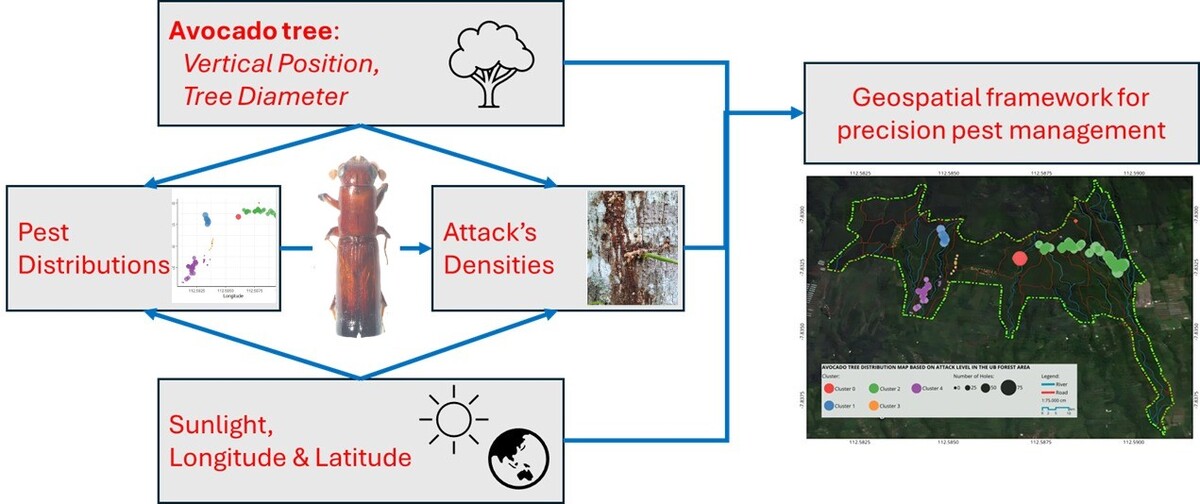
Ambrosia beetles (Coleoptera: Scolytinae and Platypodinae) represent a significant threat to tropical agroecosystems, yet their spatial ecology in Indonesian avocado orchards remains poorly understood. This study presents the first spatially explicit assessment of ambrosia beetle infestation patterns in East Java, integrating field surveys with geostatistical analyses. Using RStudio and spatial tools including kernel density estimation (KDE), density-based spatial clustering of applications with noise (DBSCAN) clustering, and Getis-Ord Gi* statistics, this research was aimed to distinguish spatial clusters, evaluate environmental correlates such as sunlight exposure, infestation holes vertical level position based on tree trunk, and recognize tree trunk diameter-related preferences in colonization of the ambrosia beetles. Results revealed strong spatial aggregation of beetle attacks, with significantly higher infestation intensity observed in trees exposed to prolonged sunlight, infestation holes located in upper trunk positions, and possessing larger tree trunk diameters. Global Moran’s I and LISA statistics confirmed significant clustering, validating the influence of orchard microheterogeneity on beetle colonization. These findings underscore the importance of integrating spatial analysis into pest management strategies and offer a replicable framework for monitoring cryptic pests in other tropical cropping systems.
References
Baddeley A., Rubak E., Turner R. 2015. Spatial point patterns: methodology and applications with R. Chapman and Hall/CRC Press, London. URL: https://www.routledge.com/Spatial-Point-Patterns-Methodology-and-Applications-with-R/Baddeley-Rubak-Turner/p/book/97814822 10200/.
Beaver R.A. 2013. The invasive neotropical ambrosia betle Euplatypus parallelus (Fabricus, 1801) in the Oriental region and its pest status (Coleoptera: Curculionidae, Platypodinae). Entomologist’s Monthly Magazine 149 (9): 143–154.
Bivand R.S., Wong D.W.S. 2018. Comparing implementations of global and local indicators of spatial association. TEST 27(3): 716–748. DOI: https://doi.org/10.1007/s11749-018-0599-x.
Bumrungsri S., Beaver R., Phongpaichit S., Sittichaya W. 2008. The infestation by an exotic ambrosia beetle, Euplatypus parallelus (F.) (Coleoptera: Curculionidae: Platypodinae) of angsana trees (Pterocarpus indicus Willd.) in southern Thailand. Songklanakarin Journal of Science and Technology 30 (5): 579–582.
Byers J.A. 1996. An encounter rate model of bark beetle populations searching at random for susceptible host trees. Ecological Modelling 91 (13): 57–66. DOI: https://doi.org/10.1016/0304-3800(95)00166-2.
Cambronero-Heinrichs J.C., Ranger C.M., Santoiemma G., Cavaletto G., Carloni F., Battisti A., Meggio F., Rassati D. 2025. Host plant selection and performance of ambrosia beetles in flood-stressed versus ethanol-injected trees provide implications for management strategies. Journal of Economic Entomology 118 (1): 253–261. DOI: https://doi.org/10.1093/jee/toae
301.
Castrillo L.A., Griggs M.H., Vandenberg J.D. 2016. Competition between biological control fungi and fungal symbionts of ambrosia beetles Xylosandrus crassiusculus and X. germanus (Coleoptera: Curculionidae): mycelial interactions and impact on beetle brood production. Biological Control 103: 138–146. DOI: https://doi.org/10.1016/j.biocontrol.2016.09.
005.
Crane, J.H., Peña J.E., Osborne J.L. 2008. Redbay ambrosia beetle-laurel wilt pathogen: a potential major problem for the florida avocado industry. EDIS 2008(2): 11-9. DOI: https://doi.org/ 10.32473/edis-hs379-2008.
Damos P., Soulopoulou P., Thomidis T. 2020. First record and current status of the brown marmorated sting bug Halyomorpha halys damaging peaches and olives in northern Greece. Journal of Plant Protection Research 60 (3): 323–326. DOI: https://doi.org/ 10.24425/jppr.2020.133317.
Dunnington D. 2025. ggspatial: spatial data framework for ggplot2. R package version 1.1.10. URL: https://paleolimbot.github.io/ggspatial/.
Garnier S., Ross N., Rudis B., Camargo P.A., Sciaini M., Scherer C. 2024. viridis(lite) - colorblind-friendly color maps for R. viridis package version 0.6.5. URL: https://sjmgarnier. github.io/viridis/.
Gómez D., Martinez G., Beaver R.A. 2012. First record of Cyrtogenius luteus (blandford) (coleoptera: curculionidae:scolytinae) in the americas and its distribution in uruguay. The Coleopterists Bulletin 66 (4): 362-364. DOI: https://doi.org/10.1649/072.066.0414.
Gomez D.F., Hulcr J. 2019. The southern pine beetle Dendroctonus frontalis (Coleoptera: Curculionidae: Scolytinae). EDIS 1: 1-8. DOI: https://doi.org/10.32473/edis-in333-2019.
Gugliuzzo A., Biedermann P.H.W., Carrillo D., Castrillo L.A., Egonyu J.P., Gallego D., Haddi K., Hulcr J., Jactel H., Kajimura H., Kamata N., Meurisse N., Li Y., Oliver J.B., Ranger C.M., Rassati D., Stelinski L.L., Sutherland R., Garzia G.T., Wright M.G., Biondi A. 2021. Recent advances toward the sustainable management of invasive Xylosandrus ambrosia beetles. Journal of Pest Science 94 (3): 615–637. DOI: https://doi.org/10.1007/s10340-021-01382-3.
Hahsler M., Piekenbrock M., Doran D. 2019. dbscan: fast density-based clustering with R. Journal of Statistical Software 91(1): 1–30. DOI: https://doi.org/10.18637/jss.v091.i01.
Harrington, T.C. 2005. Ecology and evolution of mycophagous bark beetles and their fungal partners. p 257-291 In: “Ecological and Evolutionary Advances in Insect-Fungal Associations” (F. E. Vega, M.Blackwell, eds.). Oxford University Press, Oxford, UK, 352 pp.
Henriques J., Inácio M.L., Sousa E. 2006. Ambrosia fungi in the insect-fungi symbiosis in relation to cork oak decline. Revista Iberoamericana de Micologia 14 (23): 185–188. DOI: https://doi.org/10.1016//S1130-1406(06)70041-9.
Hofstetter R.W., Dinkins-Bookwalter J., Davis T.S, Klepzig K.D. 2015. Symbiotic associations of bark beetles. In: “Bark Beetles: Biology and Ecology of Native and Invasive Species” (F.E. Vega, R.W. Hofstetter, eds.). Academic Press, Cambridge, UK, 620 pp. DOI: https://doi.org/10.1016/C2013-0-04752-4.
Irjayanti A.D., Stiyaningsih H., Putri I.M., Sumartini N.P., Areka S.K. 2025. Statistics of Horticulture 2024 Vol. 6. BPS-Statistics Indonesia, Jakarta, Indonesia, 132 pp.
Kahle D., Wickham H. 2013. ggmap: spatial visualization with ggplot2. The R Journal 5 (1): 144–161.
Kassambara A. 2025. ggpubr: ‘ggplot2’ based publication ready plots. R package version 0.6.1. URL: https://rpkgs.datanovia.com/ggpubr/.
Kitajima H., Goto H. 2004. Rearing technique for the oak platypodid beetle, Platypus quercivorus (Murayama) (Coleoptera: Platypodidae), on soaked logs of deciduous oak tree, Quercus serrata Thunb. ex Murray. Applied Entomology and Zoology 39 (1): 7–13. DOI: https://doi.org/10.1303/aez.2004.7.
Lettenmaier L., Seibold S., Bässler C, Brandl R., Gruppe A., Müller J., Hagge J. 2022. Beetle diversity is higher in sunny forests due to higher microclimatic heterogeneity in deadwood. Oecologia 198 (3), 825–834. DOI: https://doi.org/10.1007/s00442-022-05141-8.
Lira‐Noriega A., Soberón J., Equihua J. 2018. Potential invasion of exotic ambrosia beetles Xyleborus glabratus and Euwallacea sp. in Mexico: a major threat for native and cultivated forest ecosystems. Scientific Reports 8 (1): 1-13. DOI: https://doi.org/10.1038/s41598-018-28517-4.
MacEdo-Reis L.E., de Novais S.M.A., Monteiro G.F., Flechtmann C.A.H., de Faria M.L., Neves F.S. 2016. Spatio-temporal distribution of bark and ambrosia beetles in a brazilian tropical dry forest. Journal of Insect Science 16 (1): 1-9. DOI: https://doi.org/10.1093/jisesa/iew027.
Mann R., Hulcr J., Peña J.E., Stelinski L. 2011. Redbay ambrosia beetle Xyleborus glabratus Eichhoff (Insecta: Coleoptera: Curculionidae: Scolytinae)1. EDIS (5/6): 1-7. DOI: https://doi.org/10.32473/edis-in886-2011.
Marchioro M., Rassati D., Faccoli M., Rooyen K.V., Kostanowicz C., Webster V., Mayo P., Sweeny J. 2020. Maximizing bark and ambrosia beetle (Coleoptera: Curculionidae) catches in trapping surveys for longhorn and jewel beetles. Journal of Economic Entomology 113 (6): 2745-2757. DOI: https://doi.org/10.1093/jee/toaa181.
Mayfield A.E., Brownie C. 2013. The redbay ambrosia beetle (Coleoptera: Curculionidae: Scolytinae) uses stem silhouette diameter as a visual host-finding cue. Environmental Entomology 42 (4): 743–750. DOI: https://doi.org/10.1603/EN12341.
Menocal O., Cruz L.F., Kendra P.E., Berto M., Carrillo D. 2023. Flexibility in the ambrosia symbiosis of Xyleborus bispinatus. Frontiers in Microbiology 14: 1–10. DOI: https://doi.org/10.3389/fmcib.2023.1110474.
Menocal O., Kendra P.E., Padilla A.T., Chagas P.C., Chagas E.A., Crane J.H., Carrillo, D. 2022. Influence of canopy cover and meteorological factors on the abundance of bark and ambrosia beetles (Coleoptera: Curculionidae) in avocado orchards affected by laurel wilt. Agronomy 12 (3): 547-562 . DOI: https://doi.org/10.3390/agronomy12030547
Nuriadi, Sjam S., Gassa A., Dewi V.S. 2023. Incidence and damage of the ambrosia beetle on cocoa plants in East Luwu District, South Sulawesi, Indonesia. Biodiversitas 24 (6): 3592-3600. DOI: https://doi.org/10.13057/biodiv/d240659.
Oksanen J., Simpson G.L., Blanchet F.G., Kindt R., Legendre P., Minchin P.R., O'Hara R.B., Solymos P., Stevens M.H.H., Szoecs E., Wagner H., Barbour M., Bedward M., Bolker B., Borcard D., Borman T., Carvalho G., Chirico M., De Caceres M., Durand S., Evangelista H.B.A., FitzJohn R., Friendly M., Furneaux B., Hannigan G., Hill M.O., Lahti L., Martino C., McGlinn D., Ouellette M.H., Ribeiro C.E., Smith T., Stier A., Ter Braak C.J.F., Weedon J. 2025. Vegan: community ecology package. R package version 2.8-0. URL: https://vegandevs.github.io/vegan/.
Pebesma E. 2018. Simple features for R: standardized support for spatial vector data. The R Journal 10 (1): 439–446. DOI: https://doi.org/10.32614/RJ-2018-009.
Posit Team. 2025. RStudio: integrated development environment for R. Posit Software, PBC, Boston, MA. URL: http://www.posit.co/.
Ranger C.M., Parajuli M., Gresham S., Barnett J., Villani S., Walgenbach J., Baysal-Gurel F., Owen J.S. Jr., Reding M.E. 2023. Type and duration of water stress influence host selection and colonization by exotic ambrosia beetles (Coleoptera: Curculionidae). Frontiers in Insect Science 3: 1–11. DOI: https://doi.org/10.3389/finsc.2023.1219951.
Ranger C.M., Reding M.E., Schultz P.B., Oliver J.B.. 2013. Influence of flood‐stress on ambrosia beetle host‐selection and implications for their management in a changing climate. Agricultural and Forest Entomology 15 (1): 56-64. DOI: https://doi.org/10.1111/j.1461-9563.2012.00591.x
Rivera M.J., Martini X., Conover D., Mafra-Neto A., Carrillo D., Stelinski L.L. 2020. Evaluation of semiochemical based push-pull strategy for population suppression of ambrosia beetle vectors of laurel wilt disease in avocado. Scientific Reports 10 (1): 1–13. DOI: https://doi.org/10.1038/s41598-020-5956-0.
Seybold S.J., Fettig C.J.. 2020. Managing bark and ambrosia beetles (Coleoptera: Curculionidae: Scolytinae) with semiochemicals. The Canadian Entomologist 153 (1): 4–12. DOI: https://doi.org/10.4039/tce.2020.24.
Six D.L., Wingfield M.J. 2011. The role of phytopathogenicity in bark beetle–fungus symbioses: a challenge to the classic paradigm. Annual Review of Entomology 56: 255–272. DOI: https://doi.org/10.1146/annurev-ento-120709-144839.
Tarno H., Qi H., Endoh R., Kobayashi M., Goto H., Futai K. 2011. Types of frass produced by the ambrosia beetle Platypus quercivorus during gallery construction, and host suitability of five tree species for the beetle. Journal of Forest Research 16 (1): 68–75. DOI: https://doi.org/
10.1007/s10310-010-0211-z.
Tarno H., Septia E.D., Aini L.Q. 2016. Microbial community associated with ambrosia beetle, Euplatypus parallelus on sonokembang, Pterocarpus indicus in Malang. Agrivita 38 (3): 312–320. DOI: https://doi.org/10.17503/agrivita.v38i3.628.
Tarno H., Setiawan Y., Mentari D.A., Hata K., Wang J. 2025. Investigating bark and ambrosia beetle communities in apple orchards of East Java, Indonesia. Zoological Studies 64 (33): 1-8. DOI: https://doi.org/10.6620/ZS.2025.64-33.
Tarno H., Setiawan Y., Saragih L., Ramadhanti K.N.K, Kurnia U.I.P, Yafiina F.A, Zulfa I., Aditya T.P., Rohmah W.A., Mentari D.A., Wang J., Hata K. 2025. Investigating bark beetles, ambrosia beetles, and longhorn beetles communities in fruit tree orchards of Java region, Indonesia. Biologia 80 (8): 2077-2086. DOI: https://doi.org/10.1007/s11756-025-01975-8.
Tarno H., Suprapto H., Himawan T. 2014. First record of ambrosia beetle (Euplatypus paralellus Fabricius) infestation on sonokembang (Pterocarpus indicus Willd.) from Malang Indonesia. Agrivita 36 (2): 189-194. DOI: https://doi.org/10.17503/Agrivita-2014-36-2-p189-200.
Tran N.T, Tran T.T.H., Do N.D., Mai V.C. 2017. The accumulation of SA- and JA-signaling pathways in the response of Glycine max cv. “Nam Dan” to infestation by Aphis craccivora. Journal of Plant Protection Research 57 (4): 321–330. DOI: https://doi.org/10.1515/jppr-2017-0043.
Trzciński P., Piekarska-Boniecka H. 2013. Dynamics of predatory syrphidae in the apple orchard and neighbouring shrubberies. Journal of Plant Protection Research 53 (2): 119–123. DOI: https://doi.org/10.2478/jppr-2013-0017.
UPT PKH UB Forest (UB Forest Area Management Task Force Unit). 2016. History of the area. [Online] [Available from: https://ubforest.ub.ac.id/sejarah-kawasan/] [Accessed 21 Agustus 2025].
Wains M.S., Ali M.A., Hussain M., Anwar J., Zulkiffal M., Sabir W. 2010. Aphid dynamics in relation to meteorological factors and various management practices in bread wheat. Journal of Plant Protection Research 50 (3): 385–392. DOI: https://doi.org/10.2478/v10045-010-0065-6.
Wardhaugh C.W. 2014. The spatial and temporal distributions of arthropods in forest canopies: uniting disparate patterns with hypotheses for specialisation. Biological Reviews 89 (4): 1021–1041. DOI: https://doi.org/10.1111/brv.12094.
Werle C.T., Bray A.M., Oliver J.B., Blythe E.K., Sampson B.J. 2014. Ambrosia beetle (Coleoptera: Curculionidae: Scolytinae) captures using colored traps in Southeast Tennessee and South Mississippi. Journal of Entomological Science 49 (4): 373–382. DOI: https://doi.org/ 10.18474/0749-8004-49.4.373.
Wickham H. 2016. ggplot2: elegant graphics for data analysis. Springer-Verlag, New York. URL: https://ggplot2.tidyverse.org
Wickham H., François R., Henry L., Müller K., Vaughan D. 2025. dplyr: a grammar of data manipulation. R package version 1.1.4. URL: https://github.com/tidyverse/dplyr.
Wickham H., Vaughan D., Girlich M. 2025. tidyr: tidy messy data. R package version 1.3.2. URL: https://github.com/tidyverse/tidyr.
Zanuncio J.C., Sossai M.F., Flechtmann C.A.H, Zanuncio T.V., Guimarães E.M., Espindula M.C. 2005. Plants of an eucalyptus clone damaged by Scolytidae and Platypodidae (Coleoptera). Pesquisa Agropecuaria Brasileira 40 (5), 513–515. DOI: https://doi.org/10.1590/S0100-204X2005000500013.
Downloads
Published
How to Cite
Issue
Section
License
Copyright (c) 2026 Journal of Plant Protection Research

This work is licensed under a Creative Commons Attribution 4.0 International License.