Copper-allicin hybrid: a microbiota-safe organic fertilizer-pesticide for sustainable management of horticultural phytopathogens
DOI:
https://doi.org/10.24425/jppr.2026.6381Abstract
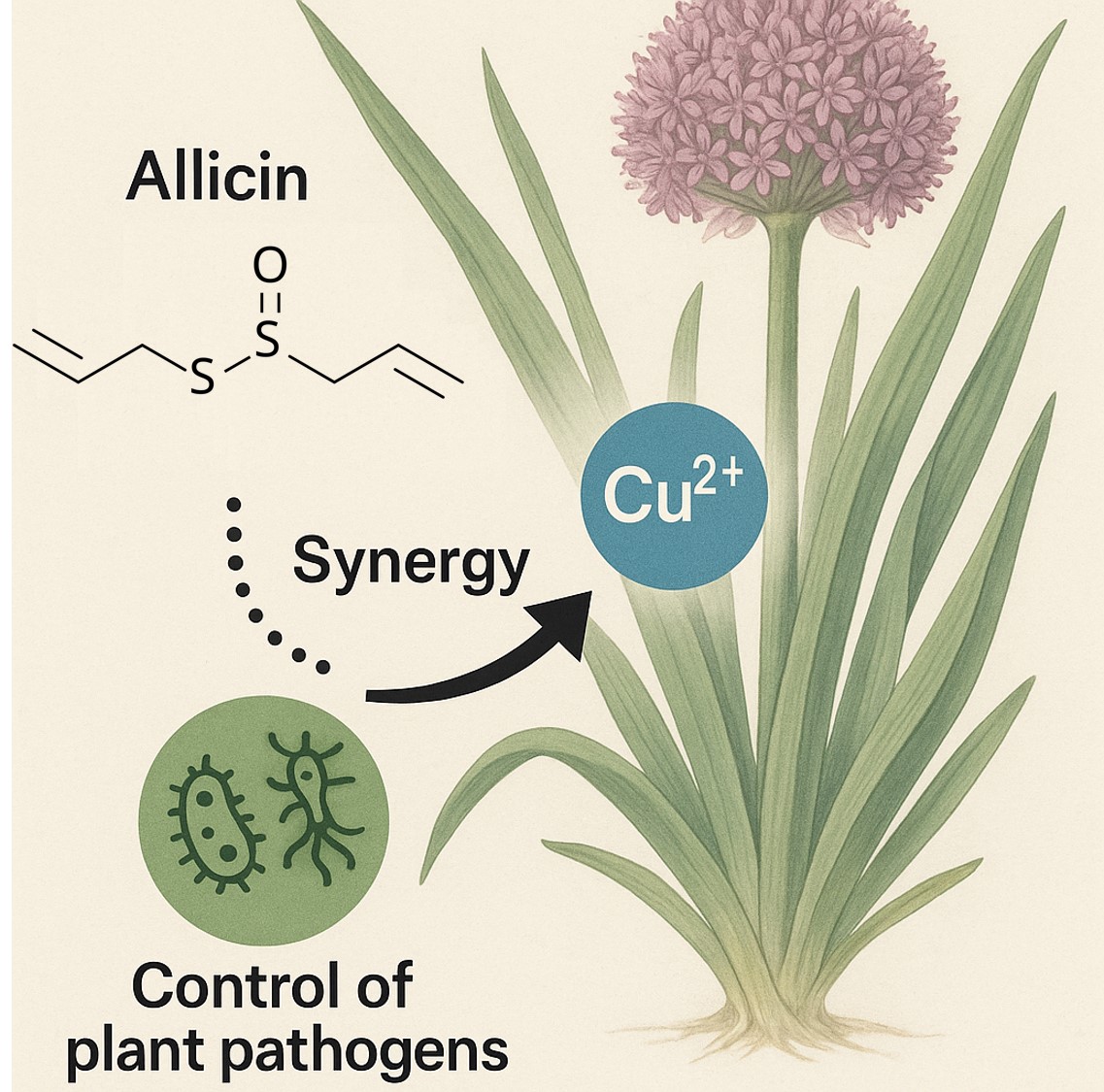
The extensive use of synthetic agrochemicals has raised environmental and resistance concerns, underscoring the need for sustainable plant protection. Combining copper with plant-derived antimicrobials offers a promising alternative. Allicin (from garlic) and copper each possess broad-spectrum activity, and their combination may enhance efficacy while reducing toxicity. This study developed and evaluated a novel copper–allicin hybrid organic fertilizer–pesticide, assessing antimicrobial efficacy against major horticultural pathogens, effects on plant growth, yield, soil fertility, and impacts on soil microbial communities compared with conventional inputs. A pH-responsive copper–allicin complex was incorporated into a nutrient-rich compost matrix. In vitro activity against bacterial and fungal pathogens was evaluated using disk diffusion and minimum inhibitory concentration (MIC) assays. Field trials on citrus affected by citrus canker compared foliar application of the hybrid with copper oxychloride and untreated controls. Leaf micronutrients, yield components, soil copper, microbial diversity, and phytotoxicity (lettuce and radish) were measured. The hybrid exhibited broad-spectrum antimicrobial activity and strong synergy. In vitro, it inhibited 94.7% of Xanthomonas isolates and all 23 fungal strains, with MICs of 50–250 mg·l⁻¹, enabling an 80–90% reduction in copper relative to conventional rates. In field trials, it reduced citrus canker lesions by 97.4% (p < 0.01), outperforming copper oxychloride (82.1%). Treated trees showed increased leaf Cu and other micronutrients, resulting in 18.7% more fruit and 12.3% higher Brix (p < 0.01). Soil copper remained very low (≤0.08 ppm), while microbial diversity and plant growth were unaffected. Overall, the compost-based copper–allicin hybrid effectively suppressed phytopathogens, enhanced nutrition and yield, and maintained soil health. Its pH-responsive, slow-release design delivered potent antimicrobial action at substantially reduced copper levels, minimizing environmental toxicity. Superior field performance, improved fruit quality, minimal soil copper accumulation, and preserved soil microbiota confirm its potential as a sustainable, integrated fertilizer–pesticide for horticulture.
References
Abdel-Razek A.S., Abd El-Ghany N.M., Djelouah K., Moussa A. 2017. An evaluation of some eco-friendly biopesticides against Bemisia tabaci on two greenhouse tomato varieties in Egypt. Journal of Plant Protection Research 57 (1): 9–17. DOI: 10.1515/jppr-2017-0002
Ai S., Yang Y., Gao K., Yu W. 2025. Synergy between copper and silver nanoparticles for the removal of thiophenic compounds in fuel oil. Chemical Engineering & Technology 48 (4): e70010. DOI: 10.1002/ceat.70010
Alfei S., Schito G.C., Schito A.M., Zuccari G. 2024. Reactive oxygen species (ROS)-mediated antibacterial oxidative therapies: available methods to generate ROS and a novel option proposal. International Journal of Molecular Sciences 25: 7182. DOI: 10.3390/ijms25137182
Ali A., AlHussaini K.I. 2024. Pesticides: unintended impact on the hidden world of gut microbiota. Metabolites 14: 155. DOI: 10.3390/metabo14030155
Bijay-Singh, Craswell E. 2021. Fertilizers and nitrate pollution of surface and ground water: an increasingly pervasive global problem. SN Applied Sciences 3: 518. DOI: 10.1007/s42452-021-04521-8
Borlinghaus J., Albrecht F., Gruhlke M.C., Chi B.K., Huyen N.T.T., Loi V.V., da Silva R.M., Canellas N.A., Olivares F.L. 2014. Allicin: chemistry and biological properties. Molecules 19: 12591–12618. DOI: 10.3390/molecules190812591
Božić Cvijan B., Korać Jačić J., Bajčetić M. 2023. The impact of copper ions on the activity of antibiotic drugs. Molecules 28: 5133. DOI: 10.3390/molecules28135133
Chi B.K., Huyen N.T.T., Loi V.V., da Silva R.M., Canellas N.A., Olivares F.L., Fagnano M., Agrelli D., Pascale A. 2019. The disulfide stress response and protein S-thioallylation caused by allicin and diallyl polysulfanes in Bacillus subtilis as revealed by transcriptomics and proteomics. Antioxidants 8: 605. DOI: 10.3390/antiox8120605
Chiarini A. 2017. Setting strategies outside a typical environmental perspective using ISO 14001 certification. Business Strategy and the Environment 26 (6): 844–854. DOI: 10.1002/bse.1969
da Silva R.M., Canellas N.A., Olivares F.L., Fagnano M., Agrelli D., Pascale A., Hassan W., Zahra Q.A., Attia K.A. 2023. Humic substances trigger plant immune responses. Chemical and Biological Technologies in Agriculture 10: 123. DOI: 10.1186/s40538-023-00468-7
Đukić M., Vasiljević S., Sovrlić Z., Adamović D. 2023. Verification and validation of analytical methods in accordance with the ISO/IEC 17025 standard. Bakar 48 (2): 25–34. DOI: 10.5937/bakar2302025D
El-Metwally I., Shalaby S. 2019. Herbicidal efficacy of some natural products and mulching compared to herbicides for weed control in onion fields. Journal of Plant Protection Research 59 (4): 479–486. DOI: 10.24425/jppr.2019.131266
Ermini M.L., Voliani V. 2021. Antimicrobial nano-agents: the copper age. ACS Nano 15: 6008–6029. DOI: 10.1021/acsnano.0c10756
Fagnano M., Agrelli D., Pascale A., Hassan W., Zahra Q.A., Attia K.A., Humphries R.M., Ambler J., Mitchell S.L. 2020. Copper accumulation in agricultural soils: risks for the food chain and soil microbial populations. Science of the Total Environment 734: 139434. DOI: 10.1016/j.scitotenv.2020.139434
Fajfer D., Łochyńska M. 2022. Impact of ecological plant protection products on mortality and cocoon shell ratio of mulberry silkworms (Bombyx mori L.) – pilot studies. Journal of Plant Protection Research 62 (3): 283–290. DOI: 10.24425/jppr.2022.142135
Gai Y., Wang H. 2024. Plant disease: a growing threat to global food security. Agronomy 14: 1615. DOI: 10.3390/agronomy14081615
González-Macedo M., Cabirol N., Rojas-Oropeza M. 2021. Assessment of the ancestral use of garlic (Allium sativum) and nettle (Urtica dioica) as botanical insecticides in the protection of mesquite (Prosopis laevigata) seeds against bruchins. Journal of Plant Protection Research 61 (2): 170–175. DOI: 10.24425/jppr.2021.137023
Grzanka M., Sobiech Ł., Radzikowska-Kujawska D., Sawińska Z., Kowalczewski P.Ł., Świtek S., Skrzypczak G., Kardasz P. 2024. The influence of Hermetia illucens L. frass on the health, stress and development of barley. Journal of Plant Protection Research 64 (4): 394–401. DOI: 10.24425/jppr.2024.151818
Hassan W., Zahra Q.A., Attia K.A., Humphries R.M., Ambler J., Mitchell S.L., Lamichhane J.R., Osdaghi E., Behlau F. 2025. Assessing the impact of copper toxicity on soil ecosystems and barley growth: identification of robust indicators. Environmental Monitoring and Assessment 197: 563. DOI: 10.1007/s10661-025-13974-y
Hayat S., Ahmad A., Ahmad H., Hayat K., Khan M.A., Runan T. 2022. Garlic, from medicinal herb to possible plant bioprotectant: a review. Scientia Horticulturae 304: 111296. DOI: 10.1016/j.scienta.2022.111296
Humphries R.M., Ambler J., Mitchell S.L., Lamichhane J.R., Osdaghi E., Behlau F., Meena R.S., Kumar S., Datta R. 2018. CLSI methods development and standardization working group best practices for evaluation of antimicrobial susceptibility tests. Journal of Clinical Microbiology 56: e01934-17. DOI: 10.1128/JCM.01934-17
Imfeld G., Duplay J., Payraudeau S. 2021. Comment on ‘Ecotoxicity of copper input and accumulation for soil biodiversity in vineyards. Environmental Chemistry Letters 19: 3525–3527. DOI: 10.1007/s10311-021-01259-y
Jasman A.K., Slomy A.K., Khaleel A.I. 2025. Biocontrol potential of selected botanicals and Beauveria bassiana spore suspension against Bemisia tabaci (Genn.). Journal of Plant Protection Research 65 (3): 283–292.
Jeon D. 2024. Evaluating the impact of copper concentrations on apple variety performance: insights from a callus media system. Sustainability 16: 9741. DOI: 10.3390/su16229741
Jung K. 2004. Combined use of insect pathogenic fungi and nematodes against the onion thrips, Thrips tabaci, in the field. p. 141–143. In: Proceedings of the Meeting “Management of Plant Diseases and Arthropod Pests by BCAs and Their Integration in Agricultural Systems”. IOBC/WPRS Bulletin 27 (8).
Kah M., Navarro D., Schenkeveld W., Kookana R.S., Kirby J.K., Santra S., Ozcan A. 2022. Fate of copper in soil: effect of agrochemical (nano) formulations and soil properties. Environmental Science: Nano 9 (2): 653–662. DOI: 10.1039/D1EN00213A
Karnwal A. 2022. A comparative study of native growth-promoting rhizobacteria and commercial biofertilizer on maize (Zea mays L.) and wheat (Triticum aestivum L.) development in a saline environment. Journal of Plant Protection Research 62 (1): 49–57. DOI: 10.24425/jppr.2022.140296
Lamichhane J.R., Osdaghi E., Behlau F., Meena R.S., Kumar S., Datta R., Moreno-Ramirez M.C., Arias-Bravo A.S., Aragón-Muriel A. 2018. Thirteen decades of antimicrobial copper compounds applied in agriculture: a review. Agronomy for Sustainable Development 38: 28. DOI: 10.1007/s13593-018-0503-9
Laurent C., Bravin M.N., Crouzet O., Pelosi C., Lamy I. 2019. Do long-term applications of organic residues promote copper ecotoxicity in soil? p. 1. In: Proceedings of the International Conference on the Biogeochemistry of Trace Elements (ICOBTE 2019).
Liu Y., Zhao W., Yin Y., Adeel M., Shakoor N., Li Y., Xing B. 2022. Agricultural applications and potential risks of copper-based nanoagrochemicals in crop cultivation. Reviews of Environmental Contamination and Toxicology 260 (1): 20. DOI: 10.1007/s44169-022-00022-w
Mahdizadehnaraghi R., Heydari A., Zamanizadehnaraghi H.R., Rezaee S., Nikan J. 2015. Biological control of garlic (Allium) white rot disease using antagonistic fungi-based bioformulations. Journal of Plant Protection Research 55 (2): 136–141. DOI: 10.1515/jppr-2015-0017
Martínez-Dalmau J., Berbel J., Ordóñez-Fernández R. 2021. Nitrogen fertilization: a review of the risks associated with the inefficiency of its use and policy responses. Sustainability 13: 5625. DOI: 10.3390/su13105625
Meena R.S., Kumar S., Datta R., Moreno-Ramirez M.C., Arias-Bravo A.S., Aragón-Muriel A., Müller A., Eller J., Neaman A. 2020. Impact of agrochemicals on soil microbiota and management: a review. Land 9: 34. DOI: 10.3390/land9020034
Mikiciński A., Sobiczewski P., Berczyński S. 2012. Efficacy of fungicides and essential oils against bacterial diseases of fruit trees. Journal of Plant Protection Research. DOI: 10.2478/v10045-012-0075-7
Moreno-Ramirez M.C., Arias-Bravo A.S., Aragón-Muriel A., Müller A., Eller J., Neaman A., Schoffer J.T., Villarroel C.N., Orta-Rivera A.M. 2024. Design, synthesis and antimicrobial potential of conjugated metallopeptides targeting DNA. Scientia Pharmaceutica 92 (2): 21. DOI: 10.3390/scipharm92020021
Müller A., Eller J., Albrecht F., Neaman A., Schoffer J.T., Villarroel C.N., Orta-Rivera A.M., Meléndez-Contés Y., Medina-Berríos N. 2016. Allicin induces thiol stress in bacteria through S-allylmercapto modification of protein cysteines. Journal of Biological Chemistry 291: 11477–11490. DOI: 10.1074/jbc.M115.702308
Neaman A., Schoffer J.T., Villarroel C.N., Orta-Rivera A.M., Meléndez-Contés Y., Medina-Berríos N., Oussou-Azo A.F., Nakama T., Nakamura M. 2024. Copper contamination in agricultural soils: a review of the effects of climate, soil properties, and prolonged copper pesticide application in vineyards and orchards. Plant, Soil and Environment 70: 407–417. DOI: 10.17221/501/2023-PSE
Ngece K., Khwaza V., Paca A.M., Aderibigbe B.A. 2025. The antimicrobial efficacy of copper complexes: a review. Antibiotics 14: 516. DOI: 10.3390/antibiotics14050516
Nikolova I. 2022. Controlling Acyrthosiphon pisum L. infestation using products of natural origin in forage pea. Journal of Plant Protection Research 62 (1): 22–32. DOI: 10.24425/jppr.2022.140293
Nwachukwu I.D., Asawalam E.F. 2014. Evaluation of freshly prepared juice from garlic (Allium sativum L.) as a biopesticide against the maize weevil, Sitophilus zeamais. Journal of Plant Protection Research. DOI: 10.2478/jppr-2014-0021
Ogita A., Hirooka K., Yamamoto Y., Tsutsui N. 2005. Synergistic fungicidal activity of Cu²⁺ and allicin and its relation to alkyl hydroperoxide reductase 1 in Saccharomyces cerevisiae. Toxicology 215: 205–213. DOI: 10.1016/j.tox.2005.07.006
Orta-Rivera A.M., Meléndez-Contés Y., Medina-Berríos N., Oussou-Azo A.F., Nakama T., Nakamura M., Panagos P., Ballabio C., Lugato E. 2023. Copper-based antibiotic strategies. Inorganics 11: 252. DOI: 10.3390/inorganics11060252
Oussou-Azo A.F., Nakama T., Nakamura M., Panagos P., Ballabio C., Lugato E., Poggere G., Gasparin A., Zimmer Barbosa J. 2020. Antifungal potential of nanostructured crystalline copper and its oxide forms. Nanomaterials 10: 1003. DOI: 10.3390/nano10051003
Panagos P., Ballabio C., Lugato E., Poggere G., Gasparin A., Zimmer Barbosa J., Rashid M.I., Shah G.A., Sadiq M. 2018. Potential sources of anthropogenic copper inputs to European agricultural soils. Sustainability 10: 2380. DOI: 10.3390/su10072380
Pfaller M.A., Flamm R.K., Jones R.N., Farrell D.J., Mendes R.E. 2016. Activities of tedizolid and linezolid against Gram-positive isolates. Antimicrobial Agents and Chemotherapy 60. DOI: 10.1128/AAC.00881-16
Poggere G., Gasparin A., Zimmer Barbosa J., Rashid M.I., Shah G.A., Sadiq M., Rein M.J., Renouf M., Cruz-Hernandez C. 2023. Soil contamination by copper: sources, ecological risks, and mitigation strategies in Brazil. Journal of Trace Elements and Minerals 4: 100059. DOI: 10.1016/j.jtemin.2023.100059
Pscheidt J.W., Ocamb C.M. 2022. Copper-based bactericides and fungicides. Pacific Northwest pest management handbooks. Oregon State University, Corvallis.
Rashid M.I., Shah G.A., Sadiq M., Rein M.J., Renouf M., Cruz-Hernandez C., Sheppard J.G., McAleer J.P., Saralkar P. 2023. Nanobiochar and copper oxide nanoparticles mixture improves wheat production. Plants 12 (6): 1312. DOI: 10.3390/plants12061312
Rein M.J., Renouf M., Cruz-Hernandez C., Sheppard J.G., McAleer J.P., Saralkar P., Song W., Shao H., Zheng A. 2013. Bioavailability of bioactive food compounds. British Journal of Clinical Pharmacology 75: 588–602. DOI: 10.1111/j.1365-2125.2012.04425.x
Sadło S., Szczepanik M., Krawiec P., Piechowicz B. 2023. Research on the certification of the apple orchard pest and disease control program as an innovative strategy for the production of apples practically free of pesticide residues, i.e., below 0.01 mg·kg⁻¹. Journal of Plant Protection Research 63 (4): 440–449. DOI: 10.24425/jppr.2023.147825
Salah I., Parkin I.P., Allan E. 2021. Copper as an antimicrobial agent: recent advances. RSC Advances 11: 18179–18186. DOI: 10.1039/D1RA02149D
Sarfraz M., Nasim M.J., Jacob C., Gruhlke M.C.H. 2020. Efficacy of allicin against plant pathogenic fungi. Applied Sciences 10: 2563. DOI: 10.3390/app10072563
Shalaby S., Abdou G. 2010. Influence of soil microorganisms on pesticide dissipation. Journal of Plant Protection Research 50 (1).
Sheppard J.G., McAleer J.P., Saralkar P., Song W., Shao H., Zheng A., Strayer-Scherer A., Timilsina S., Liao Y.Y. 2018. Allicin-inspired pyridyl disulfides as antimicrobial agents. European Journal of Medicinal Chemistry 143: 1185–1195. DOI: 10.1016/j.ejmech.2017.10.018
Song W., Shao H., Zheng A., Strayer-Scherer A., Timilsina S., Liao Y.Y., Tonnang H.E.Z., Tepa-Yotto G.T., Sokame B.M. 2023. Roles of salicylic acid in plant stress tolerance. Plants 12: 3475. DOI: 10.3390/plants12193475
Strayer-Scherer A., Timilsina S., Liao Y.Y., Tonnang H.E.Z., Tepa-Yotto G.T., Sokame B.M., Wallock-Richards D., Doherty C.J., Doherty L. 2022. Simulated leaching of foliar-applied copper bactericides. Microbiology Spectrum 10: e01481-21. DOI: 10.1128/spectrum.01481-21
Tonnang H.E.Z., Tepa-Yotto G.T., Sokame B.M., Wallock-Richards D., Doherty C.J., Doherty L., Wang Y., Deng C., Cota-Ruiz K. 2025. Roadmap for mainstreaming IPM into a climate-smart one-health framework. One Health 20: 101084. DOI: 10.1016/j.onehlt.2025.101084
Tyagi J., Ahmad S., Malik M. 2022. Nitrogenous fertilizers and environmental sustainability. International Journal of Environmental Science and Technology 19: 11649–11672. DOI: 10.1007/s13762-022-04027-9
Wallock-Richards D., Doherty C.J., Doherty L., Wang Y., Deng C., Cota-Ruiz K., Xiaolin B., Zhao N., Guo M. 2014. Antimicrobial activity of allicin-containing garlic extracts. PLoS ONE 9 (12): e112726. DOI: 10.1371/journal.pone.0112726
Wang Y., Deng C., Cota-Ruiz K., Xiaolin B., Zhao N., Guo M., Zandonadi D.B., Monda H., Gralian J. 2020. Improvement of nutrient elements and allicin content in green onion exposed to CuO nanoparticles. Science of the Total Environment 725: 138387. DOI: 10.1016/j.scitotenv.2020.138387
Xiaolin B., Zhao N., Guo M., Zandonadi D.B., Monda H., Gralian J., Zhang H., Xu Y., Jia P. 2024. Synergistic redox and adsorption for enhanced roxarsone removal. Chemical Engineering Science 287: 119713. DOI: 10.1016/j.ces.2024.119713
Zandonadi D.B., Monda H., Gralian J., Zhang H., Xu Y., Jia P., Borlinghaus J., Albrecht F., Gruhlke M.C. 2025. Humic acids as drivers of plant growth. Chemical and Biological Technologies in Agriculture 12: 71. DOI: 10.1186/s40538-025-00789-9
Zhang H., Xu Y., Jia P., Borlinghaus J., Albrecht F., Gruhlke M.C., Chi B.K., Huyen N.T.T., Loi V.V. 2020. Global trends of antimicrobial susceptibility. Antimicrobial Resistance and Infection Control 9: 166. DOI: 10.1186/s13756-020-00829-z
Ziedan E.S.H. 2022. A review of the efficacy of biofumigation agents in the control of soil-borne plant diseases. Journal of Plant Protection Research: 1–11. DOI: 10.1002/npp2.21
Downloads
Published
How to Cite
Issue
Section
License
Copyright (c) 2025 Journal of Plant Protection Research

This work is licensed under a Creative Commons Attribution 4.0 International License.





