The effect of Hortia oreadica Groppo (Rutaceae) extracts on the growth, feeding and digestive enzymes of Anticarsia gemmatalis Hübner [1818] (Erebidae)
DOI:
https://doi.org/10.24425/jppr.2026.158068%20Abstract
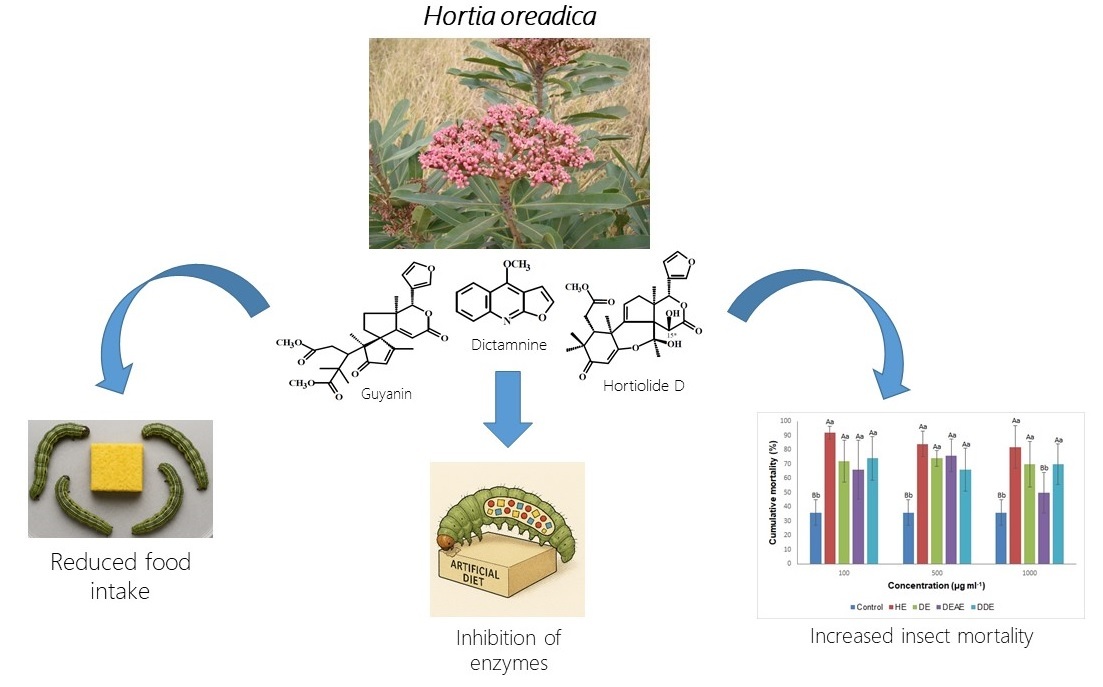
The effects of four extracts of Hortia oreadica Groppo (Rutaceae) on the biological parameters, nutritional indices, and activity of digestive enzymes of Anticarsia gemmatalis Hübner [1818] (Erebidae) were evaluated. Newly hatched caterpillars were subjected to extracts from H. oreadica extracted with hexane (HE), dichloromethane (DE), dichloromethane fractionated with ethyl acetate (DEAE) and dichloromethane fractionated with dichloromethane (DDE) at concentrations 0, 100, 500 and 1000 µg ꞏ ml–1. The results showed that treatments significantly increased the cumulative mortality rate of A. gemmatalis and that HE 100 µg ꞏ ml–1 was the most effective, causing 92% of insects’ deaths. The period of larval development was significantly shorter with treatments HE 100 and 500 µg ꞏ ml–1 and longer with DEAE (all concentrations). The pupal weight was lower in the treatments HE 1000 µg ꞏ ml–1 and in all doses tested of the DEAE treatment. The morphological integrity of pupae and adults was not affected. The lowest values of relative food consumption rate, relative metabolic rate, and relative growth rate were observed in the HE 100 µg ꞏ ml–1 treatment. In most treatments, there was a reduction in the activity of total proteases, serine and cysteine proteases, and amylase. The results suggest that the HE extract of H. oreadica is the most efficient in controlling A. gemmatalis, due to the presence of deterrent metabolites that affect the insect's digestion and nutrition and consequently promote adverse effects on its development and mortality.
References
Abdelgaleil S.A., El-Sabrout A.M. 2018. Anti-nutritional, antifeedant, growth-disrupting and insecticidal effects of four plant essential oils on Spodoptera littoralis (Lepidoptera: Noctuidae). Journal of Crop Protection 7 (2): 135–150. Available on: http://jcp.modares.ac.ir/article-3-16367-en.html [Accessed: 19 April 2025]
Abdullah R.R.H., El-Rokh A.R. 2023. Using the secondary metabolites of some fungi and wild plants as natural pesticides to control cotton mealybug, Phenacoccus solenopsis (Hemiptera: Pseudococcidae). Journal of Plant Protection Research 63 (3): 318–330. DOI: https://doi.org/10.24425/jppr.2023.146870
Berdegué M., White K.K., Trumble J.T. 1997. Feeding deterrence of Spodoptera exígua (Lepidoptera: Noctuidae) larvae by low concentrations of linear furanocoumarins. Environmental Entomology 26 (4): 912–919. DOI: https://doi.org/10.1093/ee/26.4.912
Boncan D.A.T., Tsang S.S.K., Li C., Lee I.H.T., Lam H.M., Chan T.F., Hui J.H.L. 2020. Terpenes and terpenoids in plants: Interactions with environment and insects. International Journal of Molecular Sciences 21 (19): 7382. DOI: https://doi.org/10.3390/ijms21197382
Bradford M.M. 1976. A rapid and sensitive method for the quantitation of microgram quantities of protein utilizing the principle of protein-dye binding. Analytical Biochemistry 72: 248–254. DOI: https://doi.org/10.1016/0003-2697(76)90527-3
Caraway W.T. 1959. A stable starch substrate for the determination of amylase in serum and other body fluids. American Journal of Clinical Pathology 32: 97–99. DOI: 10.1093/ajcp/32.1_ts.97
Cherry S., Crandall L.A. 1932. The specificity of pancreatic lipase: its appearance in the blood after pancreatic injury. American Journal of Physiology 100: 266–270. DOI: https://doi.org/10.1152/ajplegacy.1932.100.2.266
Couto I.F.S., Silva S.V., Valente F.I., Araújo B.S., Souza S.A., Mauad M., Scalon S.P.Q., Mussury R.M. 2019. Botanical extracts of the Brazilian Savannah affect feeding and oviposition of Plutella xylostella (Linnaeus, 1758) (Lepidoptera: Plutellidae). Journal of Agricultural Science 11 (5): 322–333. DOI: https://doi.org/10.5539/jas.v11n5p322
Cui C., Yang Y., Zhao T., Zou K., Peng C., Cai H., Wan X., Hou R. 2019. Insecticidal activity and insecticidal mechanism of total saponins from Camellia oleífera. Molecules 24: 4518. DOI: https://doi.org/10.3390/molecules24244518
Cutler G.C., Amichot M., Benelli G., Guedes R.N.C., Qu Y., Rix R.R., Ullah F., Desneux N. 2022. Hormesis and insects: Effects and interactions in agroecosystems. Science of the Total Environment 825: 153899. DOI: https://doi.org/10.1016/j.scitotenv.2022.153899
Darrag H.M., Almuhanna H.T., Hakami E.H. 2022. Secondary metabolites in basil, bio-insecticide, inhibition effect, and in silico molecular docking against proteolytic enzymes of the red palm weevil (Rhynchophorus ferrugineus). Plants 11 (1087): 2–25. DOI: https://doi.org/10.3390/plants11081087
Derbalah A., Keratum A., Darwesh M., Omar A.F., Salama A., Fatma Hegazy F. 2024. The efficacy of some synthetic monoterpenes and Yucca extract for controlling Tribolium castaneum (Herbst) in wheat grain. Journal of Plant Protection Research 64 (1): 1–10. DOI: https://doi.org/10.24425/jppr.2024.149154
Erlanger B.F., Kokowsky N., Cohen W. 1961. The preparation and properties of two new chromogenic substrates of trypsin. Archives of Biochemistry and Biophysics 95: 271–278. DOI: https://doi.org/10.1016/0003-9861(61)90145-X
Groppo M., Pirani J.R., Salatino M.L.F., Blanco S.R., Kallunki J.A. 2008. Phylogeny of Rutaceae based on two non-coding regions from cpDNA. American Journal of Botany 95: 985–1005. DOI: https://doi.org/10.3732/ajb.2007313
Kaczmarek A., Wrońska A.K., Kazek M., Boguś M.I. 2022. Octanoic acid – an insecticidal metabolite of Conidiobolus coronatus (Entomopthorales) that affects two majors antifungal protection systems in Galleria mellonella (Lepidoptera): Cuticular lipids and hemocytes. International Journal of Molecular Sciences 23 (9): 5204. DOI: https://doi.org/10.3390/ijms23095204
Li H., Zhang J., Ma T., Li C., Ma Z., Zhang X. 2020. Acting target of toosendanin locates in the midgut epithelium cells of Mythimna separate Walker larvae (Lepidoptera: Noctuidae). Ecotoxicology and Environmental Safety 201: 110828. DOI: https://doi.org/10.1016/j.ecoenv.2020.110828
Liu Y.B., Alford A.R., Rajab M.S., Bentley M.D. 1990. Effects and modes of action of citrus limonoids against Leptinotarsa decemlineata. Physiological Entomology 15 (1): 37–45. DOI: https://doi.org/10.1111/j.1365-3032.1990.tb00490.x
Liu Z.L., Xu Y.J., Wu J., Goh S.H., Ho S.H. 2002. Feeding deterrents from Dictamnus dasycarpus Turcz against two stored-product insects. Journal of Agricultural and Food Chemistry 50 (6): 1447–1450. DOI: https://doi.org/10.1021/jf010838l
Lucena D.C., Bertholdo-Vargas L.R., Silva W.C., Machado A.F., Lopes T.S., Moura S., Barros N.M. 2017. Biological activity of Piper aduncum extracts on Anticarsia gemmatalis (Hübner) (Lepidoptera: Noctuidae) and Spodoptera frugiperda (JE Smith) (Lepidoptera: Noctuidae). Anais da Academia Brasileira de Ciências 89: 1869–1879. DOI: http://dx.doi.org/10.1590/0001-3765201720170194
Ngegba P.M., Cui G., Khalid M.Z., Zhong G. 2022. Use of botanical pesticides in agriculture as an alternative to synthetic pesticides. Agriculture 12 (600): 1–24. DOI: https://doi.org/10.3390/agriculture12050600
Nhung T.T.P., Quoc L.P.T. 2024. Assessment of the insecticidal efficacy of ethanol extract of Millettia pachyloba Drake leaves against Plutella xylostella Linnaeus moth. Journal of Plant Protection Research 64 (2): 165–177. DOI: 10.24425/jppr.2024.150251
Parra J.R.P., Panizzi A.R., Haddad M.L. 2012. Nutritional indices for measuring insect food intake and utilization. p. 13–49. In: “Insect Bioecology and Nutrition for Integrate Pest Management” 2 ed. (A.R. Panizzi, J.R.P. Parra eds.). CRC Press, Brasília, DF, Brazil, 750 pp. DOI: https://doi.org/10.1201/b11713
Perobelli J.E. 2025. Pesticides and public health: discussing risks in Brazilian agroindustrial growth. Frontiers in Toxicology 7: 1442801. DOI: 10.3389/ftox.2025.1442801
Plata-Rueda A., Fiaz M., Brügger B.P., Cañas V., Coelho R.P., Zanuncio J.C., Martínez L.C., Serrão J.E. 2022. Lemongrass essential oil and its components cause effects on survival, locomotion, ingestion, and histological changes of the midgut in Anticarsia gemmatalis caterpillars. Toxin Reviews 41 (1): 208–217. DOI: https://doi.org/10.1080/15569543.2020.1861468
Praça L.B., Neto S.P.S., Monnerat R.G. 2006. Anticarsia gemmatalis Hübner, 1818 (Lepidoptera: Noctuidae). Biology, sampling and control methods. [Anticarsia gemmatalis Hübner, 1818 (Lepidoptera: Noctuidae). Biologia, amostragem e métodos de controle)]. Brasília: Embrapa Recursos Genéticos e Biotecnologia, 2006. 17 p. DOI: 10.1603/0022-0493-98.1.121 (in Portuguese)
R Core Team 2015. R: A language and environment for statistical computing. R Foundation for Statistical Computing, Vienna, Austria. URL https://www.R-project.org/
Sackett T.E., Towers G.H.T., Isman M.B. 2007. Effects of furoquinoline alkaloids on the growth and feeding of two polyphagous lepidopterans. Chemoecology 17: 97–101. DOI: https://doi.org/10.1007/s00049-007-0367-y
Sagu S.T., Landgräber E., Henkel I.M., Huschek G., Homann T., Bußler S., Schlüter O.K., Harshadrai Rawel H. 2021. Effect of cereal α-amylase/trypsin inhibitors on developmental characteristics and abundance of digestive enzymes of mealworm larvae (Tenebrio molitor L.). Insects 12 (454): 1–16. DOI: https://doi.org/10.3390/insects12050454
Severino V.G.P., Cazal C.M., Forim M.R., Silva M.F.G.F., Rodrigues-Filho E., Fernandes J.B., Vieira, P.C. 2009. Isolation of secondary metabolites from Hortia oreadica (Rutaceae) leaves through high-speed counter-current chromatography. Journal of Chromatography A 1216 (19): 4275–4281. DOI: https://doi.org/10.1016/j.chroma.2009.02.009.
Severino V.G., de Freitas S.D., Braga P.A., Forim M.R., Silva M.F.G.F., Fernandes J.B., Vieira P.C., Venâncio T. 2014. New limonoids from Hortia oreadica and unexpected coumarin from H. superba using chromatography over cleaning Sephadex with sodium hypochlorite. Molecules 19 (8): 12031–12047. DOI: https://doi.org/10.3390/molecules190812031
Shaurub E.H., EL-Sayed A.M., Ali A.M., Mohamed D.S. 2020. Some plant essential oils induce variations in the physiological aspects and midgut ultrastructure of larvae of Spodoptera littoralis (Lepidoptera: Noctuidae). African Entomology 28 (2): 349–358. DOI: https://doi.org/10.4001/003.028.0349
Sial M.U., Zhao Z., Lan Z., Yanning Z., Mao L., Hongyun, J. 2018. Evaluation of insecticides induced hormesis on the demographic parameters of Myzus persicae and expression changes of metabolic resistance detoxification genes. Scientific Reports 8 (1): 16601. DOI: https://doi.org/10.1038/S41598-018-35076-1
Solipeta D.R., Bandi S., Katragunta K., Mutheneni S.R., Katragadda S.B. 2020. UPLC-MSE guided isolation of new antifeedant limonoids from fruits of Trichilia connaroides. Journal of Agricultural and Food Chemistry 68 (25): 6826–6834. DOI: https://doi.org/10.1021/acs.jafc.0c00862
Taha H.S.E.D. 2024. Quantification of enzymes and histology changes belongings to the pinl boll worm Pectinophora gossypiella (Saunders) (Lepidopetra: Gelechiidae) exposed to some insecticide toxicities. International Journal of Agricultural and Natural Sciences 17 (1): 30–44. Available on: https://www.ijans.org/index.php/ijans/article/view/809 [Accessed: 29 April 2024]
Ukoroije R.B., Otayor R.A. 2020. Review on the bio-insecticidal properties of some plant secondary metabolites: types, formulations, modes of action, advantages and limitations. Asian Journal of Research in Zoology 3 (4): 27–60. DOI: https://doi.org/10.9734/ajriz/2020/v3i430099
Wu K., Zhang J., Zhang Q., Zhu S., Shao Q., Clark K.D., Liu Y., Ling E. 2015. Plant phenolics are detoxified by prophenoloxidase in the insect gut. Scientific Reports 5: 16823. DOI: https://doi.org/10.1038/srep16823
Downloads
Published
How to Cite
Issue
Section
License
Copyright (c) 2026 Journal of Plant Protection Research

This work is licensed under a Creative Commons Attribution 4.0 International License.