
Evaluating bacteria, fungi and viruses for controlling shoot borer (Cryptophlebia ombrodelta) damage in Erythrophleum fordii plantations in Vietnam
DOI:
https://doi.org/10.24425/jppr.2026.2966Abstract
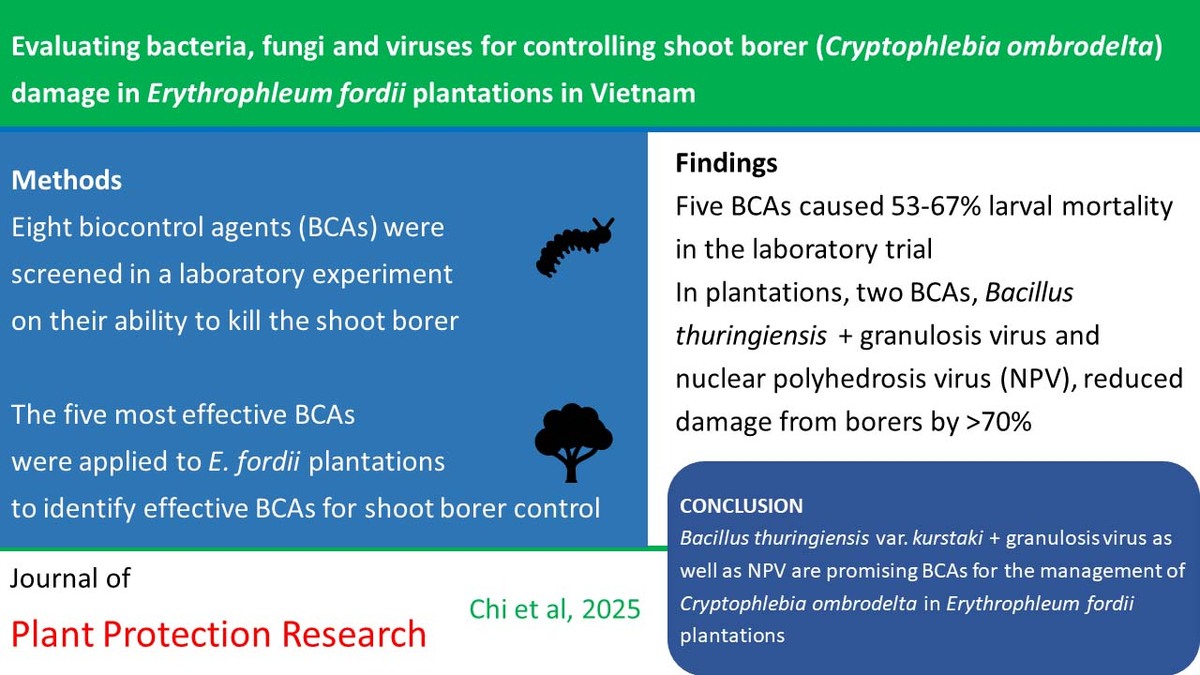
Erythrophleum fordii has been prioritized for use in sawtimber production and forest restoration programs with native tree species in Vietnam. However, the shoot borer Cryptophlebia ombrodelta (Lower, 1898) (Lepidoptera: Tortricidae) is becoming a serious pest in E. fordii plantations. This study evaluated the potency of biological agents to control C. ombrodelta in laboratory and field experiments. Eight biological control agents (BCAs) were prescreened in a laboratory trial and the five most effective BCAs were evaluated in a one-year-old plantation. Spraying foliage with Bacillus thuringiensis var. kurstaki + granulosis virus or nuclear polyhedrosis virus at concentrations of 4 g/l and 4 ml/l, respectively, reduced damage from C. ombrodelta by over 70% compared to the water control. The findings can guide further research on the timing and frequency of applications of BCAs necessary to manage the pest in young stands of E. fordii.
References
Arthurs S., Dara S.K. 2019. Microbial biopesticides for invertebrate pests and their markets in the United States. Journal of Invertebrate Pathology 165: 13–21. DOI: https://doi.org/10.1016/j.jip.2018.01.008 DOI: https://doi.org/10.1016/j.jip.2018.01.008
Ayyub M.B., Nawaz A., Arif M.J., Amrao L. 2019. Individual and combined impact of nuclear polyhedrosis virus and spinosad to control the tropical armyworm, Spodoptera litura (Fabricius) (Lepidoptera: Noctuidae), in cotton in Pakistan. Egyptian Journal of Biological Pest Control 29 (1): 67. DOI: https://doi.org/10.1186/s41938-019-0170-4 DOI: https://doi.org/10.1186/s41938-019-0170-4
Balla A., Silini A., Cherif-Silini H., Bouket A.C., Moser W.K., Nowakowska J.A., Oszako T., Benia F., Belbahri L. 2021. The threat of pests and pathogens and the potential for biological control in forest ecosystems. Forests 12 (11): 1579. DOI: https://doi.org/10.3390/f12111579 DOI: https://doi.org/10.3390/f12111579
Bell M.R., Kanavel R.F. 1977. Field tests of a nuclear polyhedrosis virus in a bait formulation for control of pink bollworms and Heliothis spp. in cotton in Arizona. Journal of Economic Entomology 70 (5): 625–629. DOI: https://doi.org/10.1093/jee/70.5.625 DOI: https://doi.org/10.1093/jee/70.5.625
Brown J.W., Basset Y., Panmeng M., Putnaul S., Miller S.E. 2019. Host records for Tortricidae (Lepidoptera) reared from seeds and fruits in a Thailand rainforest. Proceedings of the Entomological Society of Washington 121 (4): 544–556. DOI: https://doi.org/10.4289/0013-8797.121.4.544 DOI: https://doi.org/10.4289/0013-8797.121.4.544
Budziszewska M., Bereś P.K. 2024. The box tree moth Cydalima perspectalis: a review of biology, invasiveness, management practices and future perspectives of control strategy in Europe. Journal of Plant Protection Research 64 (4): 275––286. DOI: https://doi.org/10.24425/jppr.2024.152886 DOI: https://doi.org/10.24425/jppr.2024.152886
Chi N.M., Anh D.T.K. 2025. First record of Beauveria bassiana, a potential biocontrol agent for management of stem borers. Vietnam Journal of Forest Science 2: 121–128. DOI: https://doi.org/10.70169/VJFS.1043 DOI: https://doi.org/10.70169/VJFS.1043
Chi N.M., Huong V.D., Pham D.L., Binh L.V., Luu N.V., Ha K.M., Loi V.V., Yakovlev R.V. 2022. Neurozerra conferta (Lepidoptera: Cossidae) damaging Melaleuca plantations in Vietnam and its biological control. Ecologica Montenegrina 60: 13–24. DOI: https://doi.org/10.37828/em.2022.60.3 DOI: https://doi.org/10.37828/em.2022.60.3
Chi N.M., Nhung N.P., Loi V.V., Thuy P.T.T., Dell B. 2025. Bacillus bombysepticus, an entomopathogen in yellow‑spined bamboo locust with biocontrol potential. Neotropical Entomology 54 (2): 1–9. DOI: https://doi.org/10.1007/s13744-024-01223-9 DOI: https://doi.org/10.1007/s13744-024-01223-9
Chi N.M., Pham D.L., Nhung N.P., Hoa N.T.H., Do T.T., Tra T.T.L., Loi V.V., Thuy P.T.T., Hai N.D., Tuan D.X., Thu P.Q., Dell B. 2023. Integrated pest management of Hypsipyla robusta shoottip borer (Lepidoptera: Pyralidae) in Chukrasia tabularis (Sapindales: Meliaceae). Journal of Economic Entomology 116 (2): 486–495. DOI: https://doi.org/10.1093/jee/toad033 DOI: https://doi.org/10.1093/jee/toad033
Chi N.M., Quang D.N., Hien B.D., Dzung P.N., Nhung N.P., Nam N.V., Thuy P.T.T., Tuong D.V., Dell B. 2021a. Management of Hypsipyla robusta Moore (Pyralidae) damage in Chukrasia tabularis A. Juss (Meliaceae). International Journal of Tropical Insect Science 41 (4): 2341–2350. DOI: https://doi.org/10.1007/s42690-020-00405-3 DOI: https://doi.org/10.1007/s42690-020-00405-3
Chi N.M., Thanh N.V., Quang D.N., Thanh L.B., Thao D.V., Son L.T., Hinh T.X., Thu P.Q., Dell B. 2021b. First report of Tapinolachnus lacordairei (Coleoptera: Cerambycidae) damage in Chukrasia tabularis. International Journal of Tropical Insect Science 41 (1): 909–914. DOI: https://doi.org/10.1007/s42690-020-00260-2 DOI: https://doi.org/10.1007/s42690-020-00260-2
Dara S.K., Montalva C., Barta M. 2019. Microbial control of invasive forest pests with entomopathogenic fungi: A review of the current situation. Insects 10 (10): 341. DOI: https://doi.org/10.3390/insects10100341 DOI: https://doi.org/10.3390/insects10100341
de Castro M.T., Montalvão S.C.L., Monnerat R.G. 2018. Susceptibility of Hypsipyla grandella (Lepidoptera: Pyralidae) to Bacillus thuringiensis strains. Journal of Plant Protection Research 58 (1): 102–105. DOI: https://doi.org/10.24425/119121
de Castro M.T., Montalvão S.C.L., Monnerat R.G. 2019. Control of mahogany shoot borer, Hypsipyla grandella (Lepidoptera: Pyralidae), with Bacillus thuringiensis in a systemic way. Nativa: Pesquisas Agrárias e Ambientais 7 (4): 426–430. DOI: https://doi.org/10.31413/nativa.v7i4.6567 DOI: https://doi.org/10.31413/nativa.v7i4.6567
Domingues M.E.S., Pino M.D., Toledo A.V. 2022. Biological control of Frankliniella occidentalis on greenhouse bell pepper using Beauveria bassiana in combination with soil cover practices. Journal of Plant Protection Research 62 (4): 393–402. DOI: https://doi.org/10.24425/jppr.2022.144096 DOI: https://doi.org/10.24425/jppr.2022.144096
Fischbein D., Corley J.C. 2022. Population ecology and classical biological control of forest insect pests in a changing world. Forest Ecology and Management 520: 120400. DOI: https://doi.org/10.1016/j.foreco.2022.120400 DOI: https://doi.org/10.1016/j.foreco.2022.120400
Gupta A.K., Mukherjee S.C., Nag A. 2017. New record of Cryptophlebia ombrodelta (Tortricidae: Lepidoptera) on tamarind, Tamarindus indica in Bastar Plateau zone of Chhattisgarh India. International Journal of Agriculture Innovations Research 5 (5): 694–696.
Hai V.D., Hai P.H., Thu D.V., Thang H.V., Linh N.T. 2023. Science, technology and innovation in the forestry sector. Agriculture publisher, Hanoi, Vietnam, 468p.
Hamm J.J. 1993. Nuclear polyhedrosis viruses for insect control. In: "Natural and engineered pest management agents" (P.A. Hedin, J.J. Menn, R.M. Hollingworth). ACS Symposium Series. American Chemical Society, pp 324–335. DOI: https://doi.org/10.1021/bk-1994-0551.ch023 DOI: https://doi.org/10.1021/bk-1994-0551.ch023
Hatting J.L., Moore S.D., Malan A.P. 2019. Microbial control of phytophagous invertebrate pests in South Africa: current status and future prospects. Journal of Invertebrate Pathology 165: 54–66. DOI: https://doi.org/10.1016/j.jip.2018.02.004 DOI: https://doi.org/10.1016/j.jip.2018.02.004
Henderson C.F., Tilton E.W. 1955. Tests with acaricides against the brown wheat mite. Journal of Economic Entomology 48 (3): 157–161. DOI: https://doi.org/10.1093/jee/48.2.157 DOI: https://doi.org/10.1093/jee/48.2.157
Jaber L.R., Ownley B.H. 2017. Can we use entomopathogenic fungi as endophytes for dual biological control of insect pests and plant pathogens? Biological Control 116: 36–45. DOI: https://doi.org/10.1016/j.biocontrol.2017.01.018 DOI: https://doi.org/10.1016/j.biocontrol.2017.01.018
Jones V.P. 1995. Sampling plans for Cryptophlebia spp. (Lepidoptera: Tortricidae) attacking macadamia and litchi in Hawaii. Journal of Economic Entomology 88 (5): 1337–1342. DOI: https://doi.org/10.1093/jee/88.5.1337 DOI: https://doi.org/10.1093/jee/88.5.1337
Long P.D., Thanh L.B., Hung T.X., Hang H.T., Tai D.T., Phuc P.V., Chi N.M. 2023. Entomopathogenic bacterium Serratia marcescens isolated from Episparis tortuosalis causing a damage to Chukrasia tabularis in Vietnam. Journal of Forestry Science and Technology 15: 100–107. DOI: https://doi.org/10.55250/jo.vnuf.2023.15.100-107 DOI: https://doi.org/10.55250/jo.vnuf.2023.15.100-107
Marsberg T., Jukes M.D., Krejmer-Rabalska M., Rabalski L., Knox C.M., Moore S.D., Hill M.P., Szewczyk B. 2018. Morphological, genetic and biological characterisation of a novel alphabaculovirus isolated from Cryptophlebia peltastica (Lepidoptera: Tortricidae). Journal of Invertebrate Pathology 157: 90–99. DOI: https://doi.org/10.1016/j.jip.2018.08.006 DOI: https://doi.org/10.1016/j.jip.2018.08.006
Moore S.D. 2002. The development and evaluation of Cryptophlebia leucotreta granulovirus (CrleGV) as a biological control agent for the management of false codling moth, Cryptophlebia leucotreta, on citrus. Rhodes University, Grahamstown, South Africa, 355 pp.
Moore S.D., Kirkman W., Richards G.I., Stephen P.R. 2015. The Cryptophlebia leucotreta granulovirus-10 years of commercial field use. Viruses 7 (3): 1284–1312. DOI: https://doi.org/10.3390/v7031284 DOI: https://doi.org/10.3390/v7031284
Nawaz A., Ali H., Sufyan M., Gogi M.D., Arif M.J., Ranjha M.H., Arshid M., Waseem M., Mustafa T., Qasim M. 2019. Comparative bio-efficacy of nuclear polyhedrosis virus (NPV) and Spinosad against American bollwormm, Helicoverpa armigera (Hubner). Revista Brasileira de Entomologia 63 (4): 277–282. DOI: https://doi.org/10.1016/j.rbe.2019.09.001 DOI: https://doi.org/10.1016/j.rbe.2019.09.001
Nguyen M.C., Vu D.V., Do V.N., Heppner J.B. 2023. Bionomics of the shoot borer, Cryptophlebia ombrodelta, damaging Erythrophleum trees in Vietnam (Lepidoptera: Tortricidae: Olethreutinae). Lepidoptera Novae 16 (1): 61–66.
Patel R.K., Chadar V., Mandawi N.C., Nirala Y.P.S. 2023. Bionomics of Cryptophlebia ombrodelta lower - a major pest of Tamarind. Indian Journal of Entomology 85 (2): 439–440. DOI: https://doi.org/10.55446/IJE.2022.436 DOI: https://doi.org/10.55446/IJE.2022.436
Progar R., Rinella M., Fekedulegn D., Butler L. 2010. Nuclear polyhedrosis virus as a biological control agent for Malacosoma americanum (Lepidoptera: Lasiocampidae). Journal of Applied Entomology 134 (8): 641–646. DOI: https://doi.org/10.1111/j.1439-0418.2010.01508.x DOI: https://doi.org/10.1111/j.1439-0418.2010.01508.x
Quang D.N., Chi N.M., Thao D.V., Thanh L.B., Son L.T., Chung D.H., Minh L.N., Dell B. 2022. Damage caused by Batocera lineolata Chevrolat (Coleoptera: Cerambycidae) in Eucalyptus and its management in Vietnam. International Journal of Tropical Insect Science 42 (2): 1389–1399. DOI: https://doi.org/10.1007/s42690-021-00659-5 DOI: https://doi.org/10.1007/s42690-021-00659-5
Quang D.N., Thu P.Q., Chi N.M., Binh L.V., Thong N.Q., Thu N.H., Nguyen V.D., Dell B. 2021. Management of needle-eating caterpillars associated with Pinus massoniana and P. merkusii in Vietnam. Forests 12 (11): 1610. DOI: https://doi.org/10.3390/f12111610 DOI: https://doi.org/10.3390/f12111610
Rajab L., Dayoub A.M., Gazal I., Ahmad M. 2025. The fungal strain and inoculation method mediate the endophytic activity of Beauveria bassiana and its impact on the growth of cucumber plants and the population of Liriomyza sativae. Journal of Plant Protection Research 65 (1): 61–74. DOI: https://doi.org/10.24425/jppr.2025.153817 DOI: https://doi.org/10.24425/jppr.2025.153817
Sein C.C., Mitlöhner R. 2011. Erythrophleum fordii Oliver: ecology and silviculture in Vietnam. CIFOR, 18 pp. DOI: https://doi.org/10.17528/cifor/003700
Sezen K., Demir I., Demirbağ Z. 2007. Identification and pathogenicity of entomopathogenic bacteria from common cockchafer, Melolontha melolontha (Coleoptera: Scarabaeidae). New Zealand Journal of Crop and Horticultural Science 35 (1): 79–85. DOI: https://doi.org/10.1080/01140670709510171 DOI: https://doi.org/10.1080/01140670709510171
Shaalan R.S., Gerges E., Habib W., Ibrahim L. 2021. Endophytic colonization by Beauveria bassiana and Metarhizium anisopliae induces growth promotion effect and increases the resistance of cucumber plants against Aphis gossypii. Journal of Plant Protection Research 61 (4): 358–370. DOI: https://doi.org/10.24425/jppr.2021.139244 DOI: https://doi.org/10.24425/jppr.2021.139244
Toan P.V., Khanh T.N., Ha N.T., Hanh H., Hien D.H. 2024. Biological control of parasitic nematodes and pathogenic fungi damaging black pepper in Vietnam: A case study. In: "Sustainable management of nematodes in agriculture" (K.K. Chaudhary, M.K. Meghvansi, S. Siddiqui),. Springer International Publishing, Cham, pp 409–421. DOI: https://doi.org/10.1007/978-3-031-52557-5_16 DOI: https://doi.org/10.1007/978-3-031-52557-5_16
Tra T.T.L., Chi N.M., Anh D.T.K., Thu P.Q., Nhung N.P., Dell B. 2022. Bacterial endophytes from Chukrasia tabularis can antagonize Hypsipyla robusta larvae. Phytoparasitica 50 (3): 655–668. DOI: https://doi.org/10.1007/s12600-022-01001-6 DOI: https://doi.org/10.1007/s12600-022-01001-6
Tra T.T.L., Phuong T.T., Truong P.X., Khai T.Q., Chi N.M. 2025. Insect pests damaging Cassia fistula trees (Fabaceae) in Vietnam Ecologica Montenegrina 81: 108–118. DOI: https://doi.org/10.37828/em.2025.81.15 DOI: https://doi.org/10.37828/em.2025.81.15
Vail P.V., Barnett W., Cowan D.C., Sibbett S., Beede R., Tebbets J.S. 1991. Codling moth (Lepidoptera: Tortricidae) control on commercial walnuts with a granulosis virus. Journal of Economic Entomology 84 (5): 1448–1453. DOI: https://doi.org/10.1093/jee/84.5.1448 DOI: https://doi.org/10.1093/jee/84.5.1448
Vo P.H.T., Nguyen T.D.T., Tran H.T., Nguyen Y.N., Doan M.T., Nguyen P.H., Lien G.T.K., To D.C., Tran M.H. 2021. Cytotoxic components from the leaves of Erythrophleum fordii induce human acute leukemia cell apoptosis through caspase 3 activation and PARP cleavage. Bioorganic & Medicinal Chemistry Letters 31: 127673. DOI: https://doi.org/10.1016/j.bmcl.2020.127673 DOI: https://doi.org/10.1016/j.bmcl.2020.127673
Zhao Z., Shen W., Wang C., Jia H., Zeng J. 2021. Heartwood variations in mid-aged plantations of Erythrophleum fordii. Journal of Forestry Research 32 (6): 2375–2383. DOI: https://doi.org/10.1007/s11676-020-01187-7 DOI: https://doi.org/10.1007/s11676-020-01187-7
Zhao Z.G., Wang C.B., Wang H., Wang C.S., Guo J. 2019. The effectiveness of different artificial diets for rearing Cryptophlebia ombrodelta (Lower) (Lepidoptera: Tortricidae). Chinese Journal of Applied Entomology 56 (1): 163–169. DOI: https://doi.org/10.7679/j.issn.2095-1353.2019.021
Zhao Z.G., Wang M., Zeng J., Mo H.R., Guo J.J., Zeng J. 2013. Species identification and occurrence analysis for a shoot-borer of Erythrophleum fordii. Journal of Environmental Entomology 35 (4): 534–538. DOI: https://doi.org/10.3969/j.issn.1674-0858.2013.04.20
Downloads
Published
How to Cite
Issue
Section
License
Copyright (c) 2026 Journal of Plant Protection Research

This work is licensed under a Creative Commons Attribution 4.0 International License.