
Susceptibility of the Colorado potato beetle, Leptinotarsa decemlineata (Coleoptera: Chrysomelidae) to microsporidian parasites of the genus Nosema from lepidopteran hosts
DOI:
https://doi.org/10.24425/jppr.2026.7877Abstract
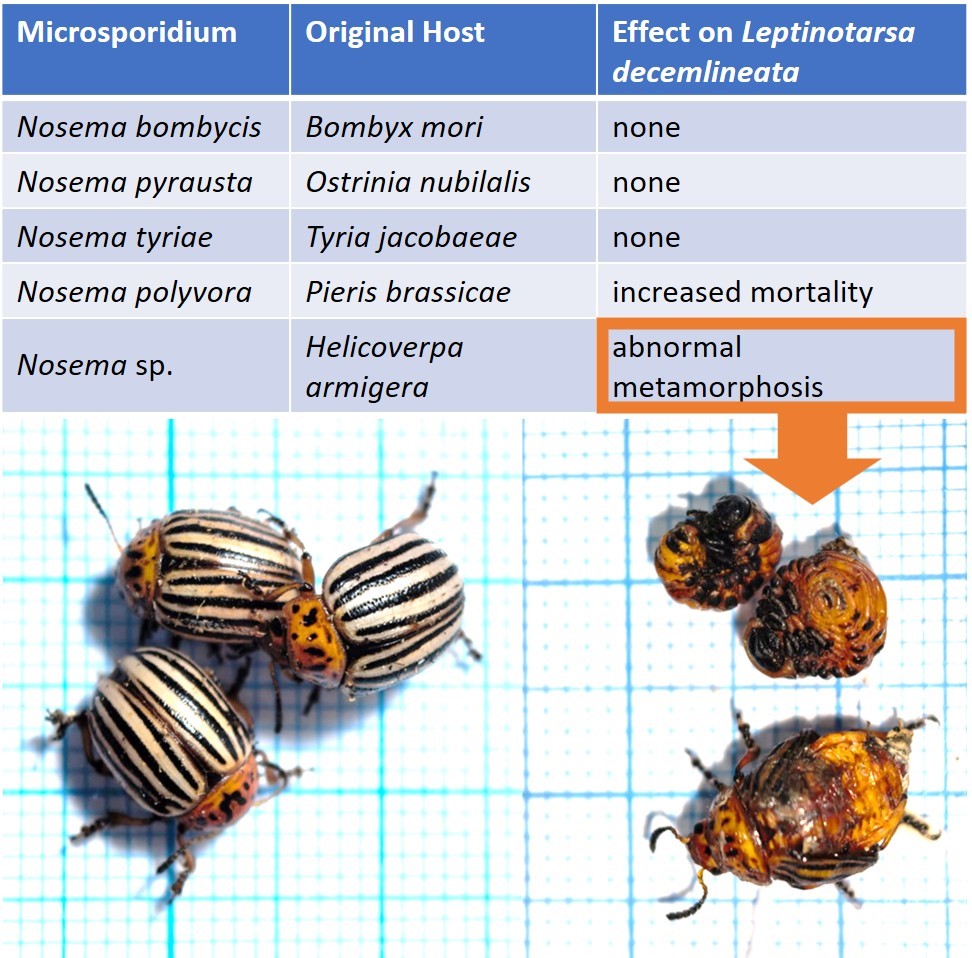
Microsporidia are intracellular parasites of animals and some protists. They are promising agents of biological protection of plants against insect pests in which they cause chronic diseases, ultimately leading to death. In this study, five species of microsporidia of the genus Nosema from different Lepidoptera (the silkworm, cotton bollworm, cinnabar moth, beet webworm, and European corn borer) were tested for their ability to infect larvae of the Colorado potato beetle Leptinotarsa decemlineata (Say). Infection was orally induced by feeding fresh potato leaves treated with microsporidian spores. Only the microsporidium Nosema sp. NspHA from the cotton bollworm Helicoverpa armigera (Hübner) had a negative impact on the growth of the Colorado potato beetle, resulting in delayed development and abnormalities during metamorphosis. Insect mortality was also increased after treatment with spores of Nosema polyvora (Blunck) from the cabbage white Pieris brassicae (Linnaeus). Further studies will include testing low doses of these isolates on beetle larvae and assessing their impact on the viability and fertility of the offspring of infected beetles.
References
Andreadis T.G., Thomas M.C., Shepard, J.J. 2018. Amblyospora khaliulini (Microsporidia: Amblyosporidae): investigations on its life cycle and ecology in Aedes communis (Diptera: Culicidae) and Acanthocyclops vernalis (Copepoda: Cyclopidae) with redescription of the species. Journal of Invertebrate Pathology 151: 113–125. DOI: https://doi.org/10.1016/j.jip.2017.11.007
Bauer L.S., Pankratz H.S. 1993. Nosema scripta n. sp. (Microsporida: Nosematidae), a microsporidian parasite of the cottonwood leaf beetle, Chrysomela scripta (Coleoptera: Chrysomelidae). Journal of Eukaryotic Microbiology 40 (2): 135–141.
Bhat I.A., Buhroo Z.I., Bhat M.A. 2017. Microsporidiosis in silkworms with particular reference to mulberry silkworm (Bombyx mori L.). International Journal of Entomology Research 2 (1): 1–9.
Bekircan Ç. 2020. Assignment of Vairimorpha leptinotarsae comb. nov. on the basis of molecular characterization of Nosema leptinotarsae Lipa, 1968 (Microsporidia: Nosematidae). Parasitology 147 (9): 1019–1025. DOI: https://doi.org/10.1017/S0031182020000669
Bojko J., Reinke A.W., Stentiford G.D., Williams B., Rogers M.S.J., Bass D. 2022. Microsporidia: a new taxonomic, evolutionary, and ecological synthesis. Trends in Parasitology 38 (8): 642–659. DOI: https://doi.org/10.1016/j.pt.2022.05.007
Boukouvala M.C., Kavallieratos N.G., Skourti A., Pons X., Alonso C.L., Eizaguirre M., Fernandez E.B., Solera E.D., Fita S., Bohinc T., Trdan S., Agrafioti P., Athanassiou C.G. 2022. Lymantria dispar (L.) (Lepidoptera: Erebidae): current status of biology, ecology, and management in Europe with notes from North America. Insects 13: 854. DOI: https://doi.org/10.3390/insects13090854
Brooks W.M., Becnel J.J., Kennedy G.G. 1988. Establishment of Endoreticulatus N. G. for Pleistophora fidelis (Hostounský & Weiser, 1975) (Microsporida: Pleistophoridae) based on the ultrastructure of a microsporidium in the Colorado potato beetle, Leptinotarsa decemlineata (Say) (Coleoptera: Chrysomelidae). The Journal of Protozoology 35 (4): 481–488. DOI: https://doi.org/10.1111/j.1550-7408.1988.tb04134.x
Bukhari T., Pevsner R., Herren J.K. 2022. Microsporidia: a promising vector control tool for residual malaria transmission. Frontiers in Tropical Diseases 3: 957109. DOI: https://doi.org/10.3389/fitd.2022.957109
Dakhel W.H., Latchininsky A.V., Jaronski S.T. 2019. Efficacy of two entomopathogenic fungi, Metarhizium brunneum, strain F52 alone and combined with Paranosema locustae against the migratory grasshopper, Melanoplus sanguinipes, under laboratory and greenhouse conditions. Insects 10 (4): 94. DOI: https://doi.org/10.3390/insects10040094
Jordan C., de Carvalho V.R., Mascarin G.M., Oliveira L.R.S., Dunlap C.A., Wilcken C.F. 2021. First record of a new microsporidium pathogenic to Gonipterus platensis in Brazil. Scientific Reports 11: 10971. DOI: https://doi.org/10.1038/s41598-021-90041-9
Haag K.L., Pombert J.F., Sun Y., de Albuquerque N.R., Batliner B., Fields P., Lopes T.F., Ebert D. 2020. Microsporidia with vertical transmission were likely shaped by nonadaptive processes. Genome Biology and Evolution 12 (1): 3599–3614. DOI: https://doi.org/10.1093/gbe/evz270
Hammer O., Harper D.A.T., Ryan P.D. 2001. PAST: Paleontological statistics software package for education and data analysis. Palaeontologia Electronica 4: 1–9.
Hinney B., Sak B., Joachim A., Kváč M. 2016. More than a rabbit’s tale – Encephalitozoon spp. in wild mammals and birds. International Journal for Parasitology: Parasites and Wildlife 5 (1): 76–87. DOI: https://doi.org/10.1016/j.ijppaw.2016.01.001
Hostounsky Z., Weiser J. 1973. Nosema gastroideae sp. n. (Nosematidae, Microsporidia) infecting Gastroidea polygoni and Leptinotarsa decemlineata (Coleoptera, Chrysomelidae). Acta Entomologica Bohemoslovaca 70 (5): 345–350.
Hostounsky Z. 1984. Production of microsporidia pathogenic to the Colorado potato beetle (Leptinotarsa decemlineata) in alternate hosts. Journal of Invertebrate Pathology 44 (2): 166-171. DOI: https://doi.org/10.1016/0022-2011(84)90008-9
Issi I.V. 2020. Development of microsporidiology in Russia. Plant Protection News 103 (3): 161–176 (in Russian with English summary). DOI: https://doi.org/10.31993/2308-6459-2020-103-3-4972
Kononchuk A.G., Malysh S.M., Rumiantseva A.S., Kireeva D.S., Gerus A.V., Zhuravlyov V.S. 2022. Molecular detection of endosymbionts in local populations of Helicoverpa armigera (Lepidoptera: Noctuidae) in European part of Russia. Plant Protection News 105 (1): 50–61. DOI: https://doi.org/10.31993/2308-6459-2022-105-1-15260
LeBrun EG, Jones M, Plowes RM, Gilbert LE. 2022. Pathogen-mediated natural and manipulated population collapse in an invasive social insect. Proceedings of the National Academy of Sciences USA 119 (14): e2114558119. DOI: https://doi.org/10.1073/pnas.2114558119
Lipa J.J., Tokarev Y.S., Issi, I.V. 2020. Ultrastructure, molecular phylogeny, and prevalence rates of Alternosema bostrichidis gen. nov. sp. nov. (Microsporidia, Terresporidia), a parasite of Prostephanus truncatus and Dinoderus spp. (Coleoptera, Bostrichidae). Parasitology Research 119: 915–923. DOI: https://doi.org/10.1007/s00436-020-06611-9
Malysh J.M., Chertkova E.A., Tokarev Yu.S. 2021. The microsporidium Nosema pyrausta as a potent microbial control agent of the beet webworm Loxostege sticticalis. Journal of Invertebrate Pathology 186: 107675. DOI: https://doi.org/10.1016/j.jip.2021.107675
Malysh J.M., Ignatieva A.N., Artokhin K.S., Frolov A.N., Tokarev Yu.S. 2018. Natural infection of the beet webworm Loxostege sticticalis L. (Lepidoptera: Crambidae) with three Microsporidia and host switching in Nosema ceranae. Parasitology Research 117: 3039–3044. DOI: https://doi.org/10.1007/s00436-018-5987-3
Malysh J.M., Kononchuk A.G., Frolov A.N. 2019. Detection of microsporidia infecting beet webworm Loxostege sticticalis (Pyraloidea: Crambidae) in European part of Russia in 2006-2008. Plant Protection News 2 (100): 45–51. DOI: https://doi.org/10.31993/2308-6459-2019-2(100)-45-51
Malysh S.М., Utkuzova A.M., Ignatieva A.N., Mirzakhodjaev B.A., Grushevaya I.V. 2023. Susceptibility of Bombyx mori larvae to the microsporidium Nosema bombycis from the silkworm and Nosema sp. from the cotton bollworm. Plant Protection News 106 (4): 210–214. DOI: https://doi.org/10.31993/2308-6459-2023-106-4-16148
Murareanu B.M., Sukhdeo R., Qu R., Jiang J., Reinke A.W. 2021. Generation of a microsporidia species attribute database and analysis of the extensive ecological and phenotypic diversity of microsporidia. MBio 12 (3). DOI: https://doi.org/10.1128/mbio.01490-21
Nattoh G., Maina T., Makhulu E.E., Mbaisi L. Mararo E., Otieno F.G., Bukhari T., Onchuru T.O., Teal E., Paredes J., Bargul J.L., Mburu D.M., Onyango E.A., Magoma G., Sinkins S.P., Herren J.K. 2021. Horizontal transmission of the symbiont Microsporidia MB in Anopheles arabiensis. Front Microbiology 12: 647183. DOI: https://doi.org/10.3389/fmicb.2021.647183
Odnosum H., Yefimenko T. 2021. Features of microsporidia Nosema apis and Nosema ceranae (Nosema species) development of winter bee (Apis mellifera L.) generation. ScienceRise: Biological Science 1 (30): 53–56. DOI: https://doi.org/10.15587/2519-8025.2022.255735
Oi D., Valles S., Porter S., Cavanaugh C., White G., Henke J. 2019. Introduction of fire ant biological control agents into the Coachella Valley of California. The Florida Entomologist 102 (1): 284–286. DOI: https://www.jstor.org/stable/48562847
Pei B., Wang C., Yu B., Xia D., Li T., Zhou Z. 2021. The first report on the transovarial transmission of microsporidian Nosema bombycis in Lepidopteran crop pests Spodoptera litura and Helicoverpa armigera. Microorganisms 9 (7): 1442. DOI: https://doi.org/10.3390/microorganisms9071442
Pan G., Bao J., Ma Z., Song Y., Han B., Ran M., Li C., Zhou Z. 2018. Invertebrate host responses to microsporidia infections. Developmental & Comparative Immunology 83: 104–113. DOI: https://doi.org/10.1016/j.dci.2018.02.004
Park E., Poulin R. 2021. Revisiting the phylogeny of microsporidia. International Journal for Parasitology 51 (10): 855–864. DOI: https://doi.org/10.1016/j.ijpara.2021.02.005
Rumiantseva A.S., Ignatieva A.N., Grushevaya I.V., Utkuzova A.M., Binitskaya N.V., Kononchuk A.G., Kozlova E.G., Khodzhash A.A., Tokarev Yu. S. 2024. Horizontal and vertical transmission of microsporidia Nosema pyrausta and Nosema bombycis in the predatory bug Podisus maculiventris (Hemiptera: Pentatomidae). Acta Biologica Sibirica 10: 1625–1645. DOI: https://doi.org/10.5281/zenodo.14356492
Sambrook J., Fritsсh E., Maniatis T. 1989. Moleсular сloning: a laboratory manual. Сold Spring Habor Laboratory Press, New York.Simakova A.V., Pankova T.F., Issi I.V., Andreeva Y.V. 2016. Ecological aspects of microsporidia parasitizing in natural populations of the Aedes (Diptera: Culicidae) blood-suking mosquitoes in Western Siberia. Bulletin of Tomsk State University. Biology 2 (34): 101–113. DOI: https://doi.org/10.17223/19988591/34/7
Sokolova Y.Y., Issi I.V., Voronin V.N. 2018. Annotated list of species of the Microsporidia described in the Former Soviet Union and Russia in 20 th century (1967-2000). Protistology 12 (1): 12–37.
Stork N.E. 2018. How many species of insects and other terrestrial arthropods are there on Earth? Annual Review of Entomology 63: 31-45. DOI: https://doi.org/10.1146/annurev-ento-020117-043348
Tokarev Yu.S., Simakova A.V., Timofeev S.A., Malysh Yu.M., Sokolova O.I., Issi I.V. 2016. Host specificity in microsporidia. Parazitologiay 50 (6): 446–459 (in Russian with English summary).
Tokarev Y.S., Kireeva D.S., Ignatieva A.N., Ageev A.A., Gerus A.V., Yaroslavtseva O.N., Kononchuk A.G., Malysh J.M. 2022. Ecological vs physiological host specificity: the case of the microsporidium Nosema pyrausta (Paillot) Weiser, 1961. Acta Biologica Sibirica 8, 297–316. DOI: https://doi.org/10.5281/zenodo.7703384
Weiss L.M., Vossbrinck C.R. 1999. Molecular biology, molecular phylogeny, and molecular diagnostic approaches to the Microsporidia. p. 129–171. In: "The microsporidia and microsporidiosis " (M. Wittner, L.M. Weiss, eds.). ASM Press, Washington, 553 pp. DOI: https://doi.org/10.1128/9781555818227.ch4
Willis A.R., Reinke A.W. 2022. Factors that determine microsporidia infection and host specificity. p. 91–114. In: "Microsporidia. Experientia Supplementum, 114" (L.M. Weiss, A.W. Reinke, eds.). Springer, Cham, 415 pp. DOI: https://doi.org/10.1007/978-3-030-93306-7_4
Yaman M., Özcan N., Radek R., Linde A., Lipa J.J. 2011. Ultrastructure, characteristic features and occurrence of Nosema leptinotarsae Lipa, 1968, a microsporidian pathogen of Leptinotarsa decemlineata (Coleoptera, Chrysomelidae). Acta Parasitologica 56 (1): 1–7. DOI: https://doi.org/10.2478/s11686-011-0009-y
Yaman M., Eroğlu M., Radek R. 2016. Occurrence of a microsporidium in the predatory beetle Calosoma sycophanta L. (Coleoptera: Carabidae). Turkish Journal of Agriculture and Forestry 40 (3): 420–424. DOI: https://doi.org/10.3906/tar-1507-42
Yaman M., Aydin Ç., Linde A., Radek R. 2022. A new microsporidian pathogen, Vairimorpha gastrophysae sp. nov., isolated from Gastrophysa viridula (Coleoptera: Chrysomelidae). European Journal of Protistology 86: 125913. DOI: https://doi.org/10.1016/j.ejop.2022.125913
Zhang L., Lecoq M. 2021. Nosema locustae (Protozoa, Microsporidia), a biological agent for locust and grasshopper control. Agronomy 11 (4): 711. DOI: https://doi.org/10.3390/agronomy11040711
Downloads
Published
How to Cite
Issue
Section
License
Copyright (c) 2025 Journal of Plant Protection Research

This work is licensed under a Creative Commons Attribution 4.0 International License.





